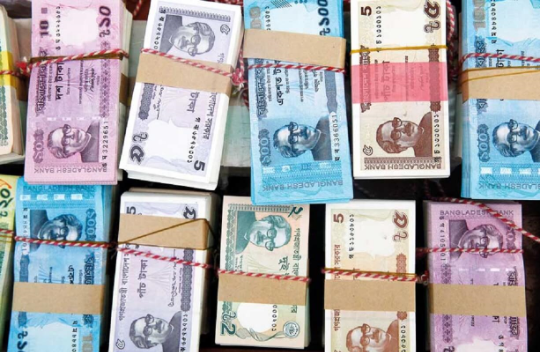
With too much cash flowing around- in the casinos or lockers, below and inside the pillow and mattress, there is a corridor discussion- like India, should Bangladesh also go for a demonetization?
It has almost been three years since the Indian government, in a surprising move, announced the removal of 500- and 1000-rupee notes from circulation. The rationale behind demonetisation was multi-layered: increasing the taxpaying population, curbing corruption, and reel in the benefits of a cashless, more digital economy.
Black money is money that has been unreported, underreported due to the desire to evade taxes, avoid regulations or conceal criminal activity. The belief is that when demonetization occurs, people with money from legitimate sources would channel their money into the banking system. While those that have hoarded cash from illegitimate sources, would have at least a portion of their money become obsolete, as they would not be able to legally account for it.
Some of the problems that prompted demonetization in India loom over Bangladesh as well, so one might ask whether this is a viable path for us. Despite our high rates of economic growth, our tax to GDP ratio has been decreasing and is one of the lowest in Asia. Several policies have been deployed in response including VAT reform. Our informal economy comprises around 80% of the labor force. Criminal activity including terrorism is much easier to finance using cash owing to its anonymous nature- counterfeit currency has been found in huge volumes in the recent casino raids.
There have been mixed responses to India’s demonetization, and there are questions whether it has succeeded. One of the driving forces behind demonetization, was to detect black money. However, according to a report from the Reserve Bank of India from 2018, 99.3% of the demonetized currency – amounting to 15.31 lakh- crore entered the banking system in the form of deposits. This implies that those who held black money either found ways to legitimize the money or they did not hold their black money in cash in the first place. Indeed, it is likely some held their money in real estate, gold and other assets. There were also reports that those affluent enough, sold their currency to money-launderers, who in turn channeled the money into the banking system through the bank accounts of low-income Indians. Finally, it was believed that the introduction of the 2000 rupee note undermined the purpose of demonetization, as the high denomination currency made it easier to conduct underground activities all the same.
Despite not attaining goals in the same manner as expected, one of the long-standing contributions of demonetization has been to catalyze a digital transformation. India- like many of its emerging contemporaries- has traditionally been a cash-dependent economy, with around 190 million Indian adults not possessing bank accounts. Following demonetization, the volume of credit card transactions increased sharply. Moreover, owing to their simplicity a market for mobile payment applications flourished. Paytm, as an example, had their user base double in a year since demonetization.
Benefits of a cashless economy, specifically for an emerging country like Bangladesh are not difficult to imagine. For merchants and consumers alike, there are the benefits of time-savings and increase in overall convenience. The scope for crime and money laundering is reduced, as there is always a paper trail left behind. Taxes are more difficult to evade when making digital transactions through formal, organized channels. This is crucial in an emerging nation like ours, where increasing our taxpaying population is of utmost importance.
In addition, there are widespread economic benefits. According to Moody’s report, as the usage of cards rises by 1 percent, it would contribute 0.02 percent to GDP growth in developing countries. When money enters the banking system- instead of sitting idly at home- it is likely to be diverted towards productive activities in the economy. Participation in the banking sector, even if this is initially just through creating deposits, might encourage individuals to explore other financial products and to possibly invest. Cash itself imposes costs to the government, as printing cash is a costly affair as is wastage from damaged currency. Finally, emerging nations often find themselves excessively reliant on primary and secondary segments of the economy, without being able to create much space for technological innovation. If digital modes of payment are accessible to majority of the population, it could boost the growth of e-commerce, thus orienting the economy to be more technologically focused.
Before a facilitating infrastructure would need to be built to enable the transition to a cashless economy. Bangladesh already seems to have a preexisting demand for a cashless economy with a burgeoning mobile financial services industry (MFS), with the leader being bKash having more than 30 million users. The mobile financial services industry has overall grown by 120 percent a year since 2011 and is likely to grow further with increasing smartphone penetration rates. To solidify growth, the public would need to be made aware of digital modes of payment, and steps would need to be taken to improve their financial literacy. Regulations should be revised periodically to keep up with the fast pace of technological innovation so that customers are protected from risks.
Mamun Rashid is an economic analyst.
The article was originally published on Daily Sun.
Views in this article are author’s own and do not necessarily reflect CGS policy.