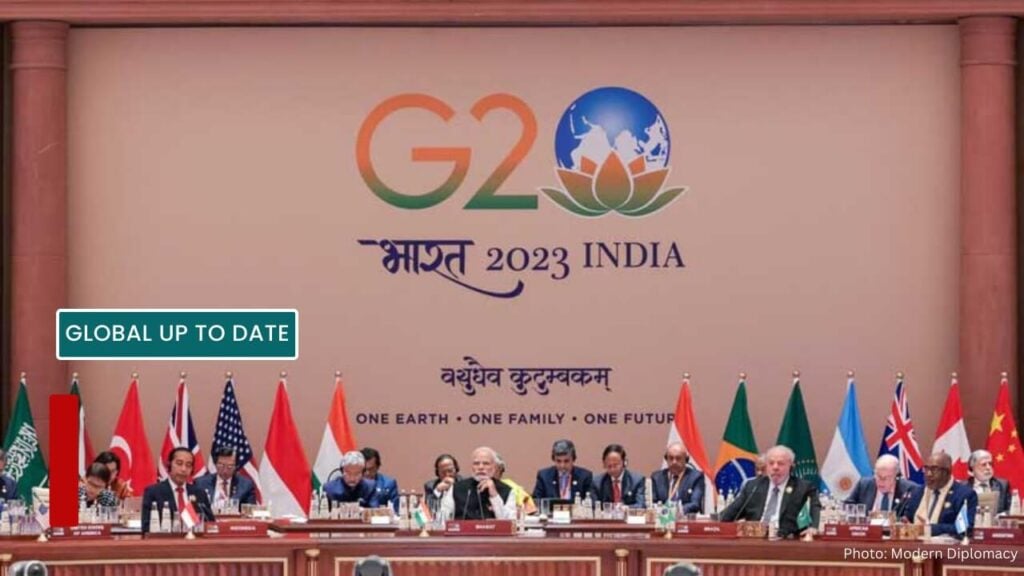
The G20 was established in 1999 after the Asian financial crisis to discuss global economic and financial issues and provide a platform for Finance Ministers and Central Bank Governors. The G20 comprises 19 countries and accounts for 85% of global GDP, over 75% of trade, and about two-thirds of the world's population. Since its inception, there have been 18 summits held by the G20. The most recent summit, the 18th, occurred in New Delhi, India, from September 9th to 10th.
In this summit, apart from the member countries, many invited states, such as Bangladesh, Comoros African Union, Egypt, Mauritius, Netherlands, Nigeria, Oman, Singapore, Spain, and the United Arab Emirates, were present.
The G20 is divided into the Finance Track and the Sherpa Track. Each track has thematically oriented working groups that include representatives from relevant ministries of the members, invited/guest countries, and various international organizations. These functional groups meet regularly throughout the term of each Presidency. During the G20 Summit, leaders discussed essential topics such as food security, climate change, energy, development, health, and digitalization. The theme of the recent summit was "One Earth, One Family, One Future."
The recently concluded G-20 summit presented India with a golden opportunity to demonstrate its prowess as a global leader, despite the intricate dynamic at play in its relationship with China. Through its participation in the summit, India was able to assert its influence on the global stage and showcase its commitment to advancing the interests of its people and the wider international community. Despite the challenges and complexities that it faces in its relationship with China, India's performance at the summit was a testament to its resilience, determination, and unwavering commitment to pursuing its strategic goals.This was the first time a Chinese president missed a leaders' summit since 2008. However, due to COVID-19, Xi Jinping attended virtually in 2020 and 2021.The G20 summit saw the absence of both the Russian and Chinese presidents. Despite this, the presence of the USA and other countries indicates India's intent to strengthen its diplomatic ties with global powers and participate in the international power game.
India is approaching the summit with great importance and holds a positive outlook on its potential to establish a new global framework. The nation effectively conveyed the message that the Global South still possesses a significant role in shaping the world order. While previous regional forums may have faced challenges, India's proactive involvement in the G20 summit indicates a promising outcome.
During the summit, the logo featured an image of the earth atop a lotus, which is the symbol of the Bharatiya Janata Party (BJP). Some speculate that this may indicate PM Narendra Modi's efforts to demonstrate that he is governing India in a manner that elevates the country's profile in global politics.
Under Prime Minister Narendra Modi's leadership, India's participation in the G20 has been a testament to the country's robustness, which has generated interest from investors. This has yielded positive results for the country, and many view it as an opportune moment for India to showcase its potential. As he seeks a third term, the Prime Minister's domestic standing has also been bolstered by the summit's success.
India is actively leveraging its potential power to foster strong relationships with fellow member states of both the BRICS and G20 summits. Although initially founded as an economic forum, the G20 also considers political considerations. It is noteworthy that Russia did not attend the most recent meeting due to ongoing conflicts with Ukraine. With the gathering of the world's most affluent nations, the G20 has the potential to impact global politics significantly.
Shrabony Akter is a Research Assistant at CGS