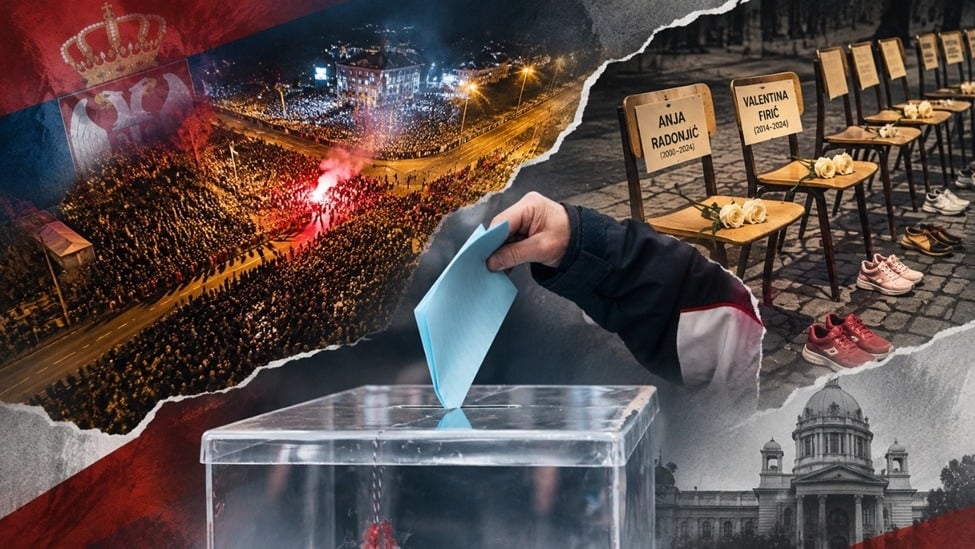
November will mark two years since the Novi Sad railway-station tragedy in Serbia, where 16 people lost their lives after a concrete canopy collapsed. For the families who lost their loved ones, the tragedy did not end with the crash. Grievance for the lost ones gradually turned into demands for answers, as students took to the streets seeking accountability for what had happened. What started as a call for justice escalated into a nationwide movement, eventually reaching beyond university campuses and entering the country’s democratic process. Today, the protests that followed the calamity have culminated in an electoral transformation that few could have anticipated at their beginning, an electoral victory that brought an end to more than a decade of political dominance by Aleksandar Vučić and the Serbian Progressive Party (SNS).[1]
On 25 October 2026, just a week before the tragedy’s second commemoration day, the student-formed electoral alliance The Students’ List defeated the SNS-led coalition in a snap parliamentary election (an election that is announced suddenly and unexpectedly). The Students’ List secured a parliamentary majority, with subsequent reporting indicating 141 seats in Serbia’s 250-member National Assembly, compared with 103 for the SNS-led alliance.[2] The result commanded one of the most consequential changes in Serbian politics since the fall of Slobodan Milošević in 2000[3]. The protests and their aftermath vocalize a remarkable journey from demands for justice over a disaster to a nationwide political force capable of challenging the settled government.
Vučić and the SNS emerged as governing forces in Serbian politics after 2012. He subsequently served as prime minister and president, consolidating political influence through successive electoral victories. The collapse of the railway station canopy spawned scrutiny of the government’s infrastructure projects. Many Serbians believed that the disaster resulted from substandard renovation work, allegedly linked to corruption and negligence in major state infrastructure projects undertaken during Vučić’s administration. Although legal responsibility remained subject to investigation, the incident increasingly came to represent broader concerns about the functioning of public institutions. For protesters, the issue was no longer confined to identifying those directly responsible for the construction failures. It extended to whether institutions responsible for supervising public projects, investigating misconduct, and ensuring accountability could function independently of political influence.
Rather than placing politicians at the center of the movement, students organized through university blockades, open assemblies, and collective decision-making. University plenums became important spaces where participants discussed demands, debated strategies, and voted on collective decisions. Working groups coordinated communication, logistics, and mobilization across different institutions. This gradually gave the movement a largely leaderless public identity, with no single prominent individual around whom its demands or organizational structure revolved.[4]It reduced dependence on individual personalities and enabled students from different universities to shape its direction. The methods of mobilization were equally significant in connecting the students with the wider population. Following the tragedy, citizens began gathering at 11:52 a.m., the time of the collapse, to observe periods of silence in memory of those who had been killed, one minute for each victim.[5]
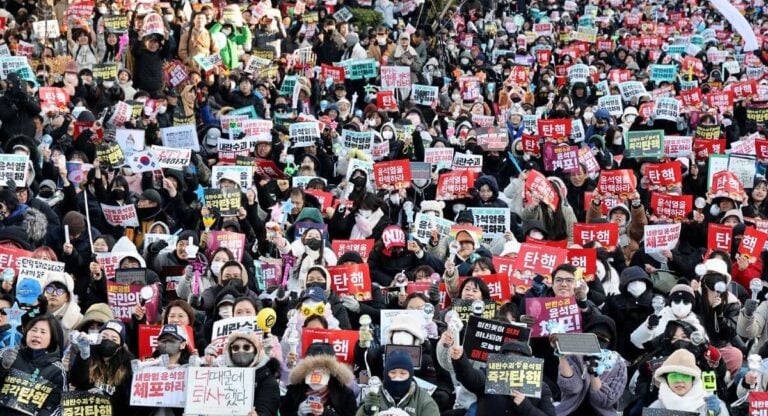
Eventually, academics, teachers, farmers, lawyers, cultural figures, and other citizens joined demonstrations or publicly expressed their support. The mass gathering in Belgrade on 15 March 2025 became an important demonstration of the movement’s growing social reach. While Serbian police estimated approximately 107,000 participants, independent crowd monitors placed attendance between 275,000 and 325,000, making it one of the largest demonstrations in the country’s recent history.[6]
Nevertheless, the campaign faced considerable counterforce. Demonstrations were accompanied at different stages by arrests, confrontations with police, and reports of intimidation and physical attacks against students and activists. Some early protests also witnessed clashes and damage to public buildings. The consequences of the movement gradually became visible. In January 2025, Prime Minister MilošVučević resigned following mounting pressure and reports of attacks on protesting students. Students continued to demand accountability, institutional transparency, and an effective response to the circumstances surrounding the disaster.[7]
As the movement continued through 2025 and into 2026, its demands expanded beyond the immediate investigation. Questions of electoral integrity, judicial independence, corruption, and political accountability became increasingly central. The decisive transition came in September 2026, when Vučić dissolved parliament and announced a snap parliamentary electionfor 25 October.Although the movement originated in universities, its parliamentary candidates were not current students.[8]Through student-led university plenums, candidates were nominated, discussed, and collectively selected for the 250-member electoral list. The list brought together academics, doctors, artists, athletes, and activists rather than relying on established political leaders. This allowed the movement to turn grassroots mobilization into an electoral alternative while retaining its decentralizedcharacter.
Voter participation was another defining feature of this election. According to the State Election Commission, voter turnout reached 64.9 percent by 6 p.m., the highest since Yugoslavia’s breakup in 1992.[9]However, a movement can bring together diverse groups through shared opposition to an incumbent administration, but governing requires agreement on policy priorities, institutional responsibilities, and the distribution of political authority. The Students’ List now faces the challenge of translating its collective decision-making principles into a functioning system of executive leadership.
For Serbia, the election represents an opportunity for political renewal. Whether it becomes a lasting democratic transition will be determined by what follows the victory. The movement has demonstrated that an entrenched government can be defeated through sustained civic participation and the ballot box. It must now demonstrate that the institutions of the state can function independently of those who govern them.
[1] Associated Press. (2026, October 25). Aleksandar Vucic, Serbia’s Putin-endorsed long-time leader, concedes election defeat in major political shift. CBS News. https://www.cbsnews.com/news/serbia-election-aleksandar-vucic-concedes-defeat/
[2]House of Commons Library. (2026, October 30).Serbia under Vučić and the 2026 parliamentary election.
[3] Bonomi, M. (2026, October 26). Serbia’s second democratic transition: The students have won, now comes the hard part. Istituto Affari Internazionali. https://www.iai.it/en/publications/c05/serbias-second-democratic-transition
[4]The depoliticization of protest: Understanding the 2024/2025 Serbian students’ uprising. (2025). Cogent Social Sciences. https://www.tandfonline.com/doi/epdf/10.1080/23311886.2025.2583748.
[5] Taha, R. (2025, November 1). Serbia: Rallies mark Novi Sad station collapse anniversary. Deutsche Welle. https://www.dw.com/en/serbia-rallies-mark-novi-sad-station-collapse-anniversary/a-74587020
[6]Associated Press. (2025, January 30).Serbia’s striking students set off on 2-day march north as their protest movement widens.
[7]Deutsche Welle. (2025, March 15).Serbia: Protesters flood Belgrade with Vučić under pressure.
[8] Reynoso, E. (2026, September 9). Serbia dissolves parliament as snap elections called. Deutsche Welle. https://www.dw.com/en/serbia-dissolves-parliament-as-snap-elections-called/a-79200868
[9] Al Jazeera Staff, & Associated Press. (2026, October 25). Serbia’s Vucic concedes election defeat to student-led movement. Al Jazeera. https://www.aljazeera.com/news/2026/10/25/serbia-voter-turnout-highest-in-decades-as-students-oppose-longtime-leader