In the era commonly referred to as the Cold War, the term "superpower" held an undeniable allure, dominating the global geopolitical landscape. However, as we find ourselves in the year 2023, a profound shift has occurred in international relations. Small nations have emerged as significant players, reshaping the geopolitical chessboard. In this contemporary landscape, even the world's great powers — the United States, the United Kingdom, France, and China — find themselves in a position where they must seek the support and goodwill of smaller nations such as Nepal, Rwanda, Bangladesh, and many others in order to achieve their strategic objectives. The interconnectedness of nations through trade, politics, and the global economy has ushered in a new era of dynamic international relations. Each day brings alterations to the intricate web of global dynamics. In this age of globalization, the pursuit of advantages extends far beyond the traditional realm of power politics. Nations now vie for strategic benefits that encompass a multitude of factors beyond mere power projection.
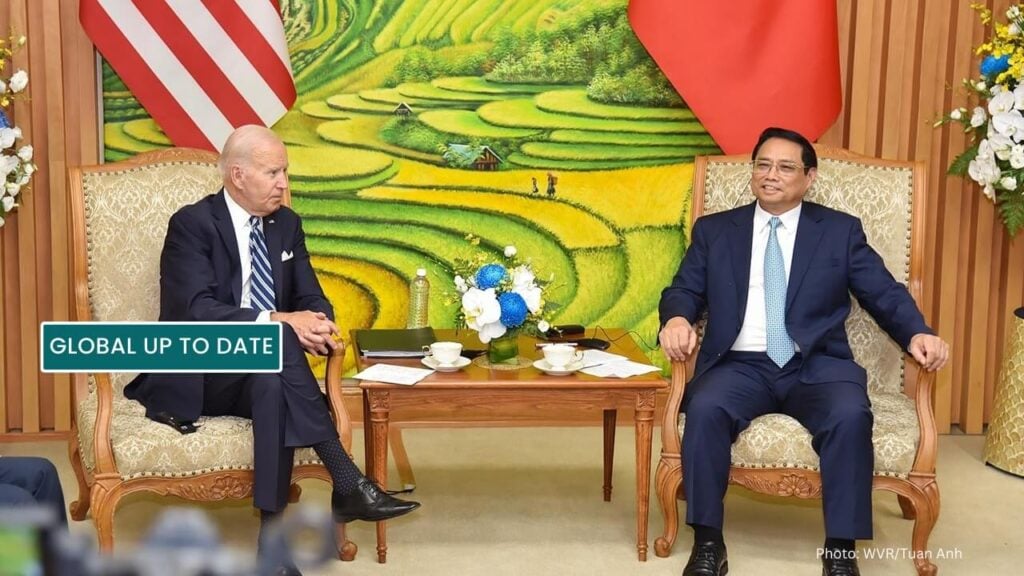
In a noteworthy development, the United States and Vietnam, whose relationship has seen limited progress since the Vietnam War in 1955, have taken a significant step forward in 2023. President Joseph R. Biden, Jr. and Vietnam's Prime Minister Pham Minh Chinh convened on September 11, 2023, in Hanoi, Vietnam, marking a potential shift towards a strategic partnership.The primary objective of this meeting is to foster economic development through increased investments and business collaborations. Both nations view this as the beginning of a "new chapter" in their relations, one that aims to mend the scars left by the Vietnam War. Notably, the U.S. seeks to establish a stronger foothold in Asia through this burgeoning relationship.During his visit, President Biden engaged with Prime Minister Pham Minh Chinh and participated in a business forum. The discussions revolved around enhancing cooperation in areas such as cloud computing, semiconductors, and artificial intelligence. Additionally, a significant $7.8 billion deal between Boeing and Vietnam Airways was announced, which is expected to create 30,000 jobs in the United States.While a 30-year-old arms embargo is currently in place against Vietnam, there are indications that it may be lifted in the near future. James Hardy, the Asia-Pacific editor at IHS Jane's Defence Weekly, suggests that U.S.-Vietnam ties have been steadily improving, making the lifting of the arms embargo a plausible prospect.
In contrast, when considering the political alignment of both China and Vietnam within the communist spectrum, it becomes evident that China is resolute in maintaining its claims over the South China Sea. The issue at hand centers around China's assertive pursuit of the "nine-dash line" in the South China Sea, encompassing approximately 90 percent of the region. This expansive claim extends over several islands that fall within the territories of neighboring Asian nations.Vietnam, in particular, has become increasingly protective of its maritime territory, which has faced encroachment by the Chinese government. China's construction of artificial islands and its aggressive maneuvers in the region, including the deployment of ships, have strained relations between Vietnam and China. Tensions escalated in 2014 when China sank a Vietnamese fishing boat within the contested area and deployed an oil rig in a different part of the South China Sea.Moreover, Vietnam has observed the presence of U.S. naval vessels patrolling the South China Sea, aimed at ensuring unimpeded access for other countries in the face of China's territorial claims. In light of China's assertive actions, Vietnam has been compelled to reassess its diplomatic priorities and seek closer ties with Western nations. Despite differing political ideologies, the pursuit of strategic and trade partnerships offers Vietnam a means to bolster its standing in the broader South Asian region.
From the perspective of the United States, there is a concerted effort to expand its influence across Southeast Asia. Notably, countries such as Japan, South Korea, and the Philippines have established amicable relations with the USA. It's crucial to emphasize that the United States has been clear about its intentions: it does not aim to disrupt the ties between China and Vietnam, nor does it seek to interfere in Vietnam's internal affairs. Instead, the USA's objective is to encourage China to act in accordance with established international norms and regulations.In this intricate geopolitical puzzle, the role of another significant player, Russia, must not be overlooked. Russia's involvement adds another layer of complexity to the dynamics at play.The primary driver behind Vietnam's pursuit of a closer relationship with the USA is its strategic positioning amid the proximity of China and Russia. Vietnam recognizes its place within this triangular relationship and is determined not to be marginalized. Consequently, Vietnam has taken proactive steps to seek partnerships beyond its traditional alliances and reduce its dependence on China's dominance.If Vietnam continues to cultivate its friendship with the United States, potentially supporting the USA in the Russia-Ukraine conflict by supplying weapons, it may need to reassess its longstanding policy of "The Noes," which was originally crafted to balance its relationships with major global powers. The evolving stance of Vietnam will undoubtedly shape the dynamics of Southeast Asia and its relations with Western countries. This emerging partnership has the potential to script new chapters in the geopolitics of Southeast Asia and beyond.
Depanjali Roy is a Research Associate at CGS