
Roundtableon Media Freedom: The Issue of Political Commitments in Manifestos
28 August 2025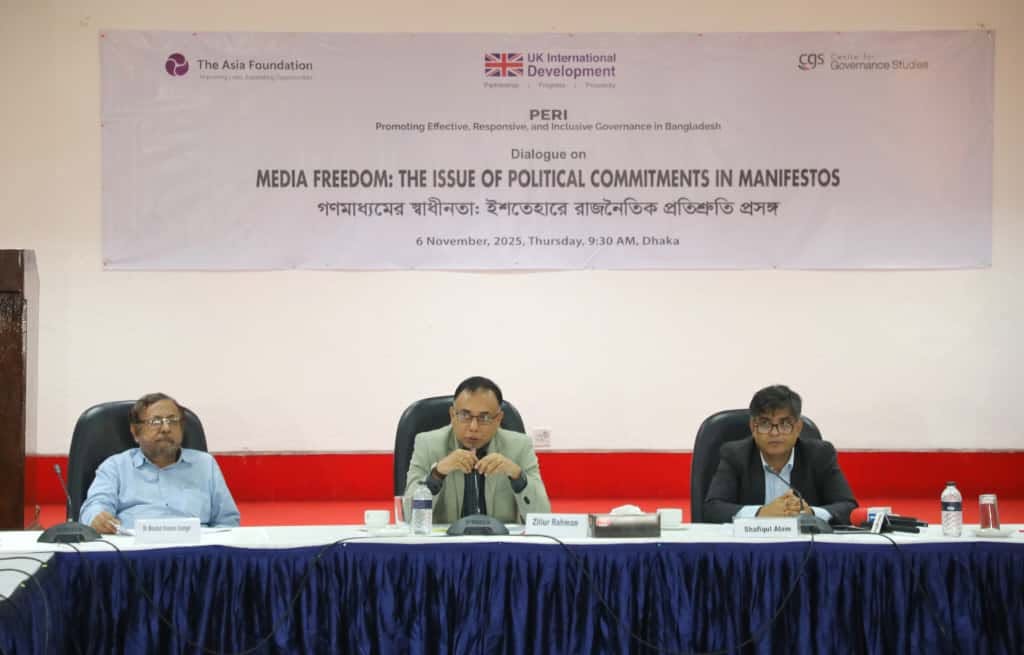
The Centre for Governance Studies (CGS) organized the roundtable dialogue on Thursday, November 6, 2025, at the CIRDAP Auditorium, Dhaka. The press release header is dated August 28, 2025, but the event description states that the dialogue was held on November 6, 2025. The name of the roundtable dialogue was “Media Freedom: The Issue of Political Commitments in Manifestos.”
Press Secretary to the Chief Adviser of Bangladesh Shafiqul Alam was present at the dialogue. The event was graced by esteemed speakers who are prominent figures in the field of media. Our distinguished speakers include Convener of BNP Media Cell Dr. Moudud Hossain Alamgir Pavel, Special Assistant to the BNP Chairperson on Foreign Affairs Committee Dr. Saimum Parvez; President of Gonoforum Advocate Subrata Chowdhury; General Secretary of Bangladesh Samajtantrik Dal Nazmul Haque Prodhan; Executive Director of CGS Parvez Karim Abbasi; Member of Central Committee of Communist Party of Bangladesh Manzur Moin; Joint Member Secretary of NCP Mushfiq Us Salehin; Joint Secretary of Rastro Songskar Andolan Didar Bhuiyan; Deputy General Secretary of Socialist Workers Front Razekuzzaman Ratan; Joint General Secretary of AB Party Nasreen Sultana Mily; General Secretary of Gono Odhikar Porishod Md Rashed Khan; Political Council Member of Ganosanhati Andolan Taslima Akhter; Former President of Bangladesh Federal Union of Journalists (BFUJ) M Abdullah; Joint Secretary General of Khelafat Majlis Dr. Mostafizur Rahman Faisal, and Executive Director, CGS Parvez Karim Abbasi; will be present as speakers in the dialogue. The session was moderated by the president of CGS, Zillur Rahman
Zillur Rahman, at the beginning of the event, said, “The people of Bangladesh have long fought for democracy and sacrificed countless lives, but even after 54 years of independence, this struggle continues.” He mentioned that media freedom was strictly suppressed in 1975, and its effects are still felt today. He further stated, “The form of the media has changed, but the culture has not. CGS’s research shows that media ownership structures have limited independent journalism. He expressed concern about the weakness and corruption in rural journalism and the inadequate salaries of journalists.”Rahman also discussed the spread of fake news due to the weakness of social media and the media's growing dependence on it. He said, “Now we hear about 'reform vs democracy', but the administration is not fully cooperating with the implementation of the media reform commission.”He appealed to political parties, urging them to include media reforms in their election manifestos, hoping for a positive change among political parties.
Shafiqul Alam said, “The relationship between the government and the media has fluctuated since 1947, sometimes good and sometimes bad. During Ayub Khan’s time, there was media freedom, but after 1990, journalists had the most freedom during the caretaker government.” He mentioned, “During the Awami League government, the state of journalism went to the lowest point. However, efforts are being made to emerge from the degeneration of journalism under Hasina's leadership.”He concluded, “Now, many are afraid of mob actions, but we will never control the news. The question is, if a political government comes in the future, will this culture remain? Currently, even those who know better, including university professors, are spreading misinformation.” He stated, “The government has faced the greatest challenges in tackling misinformation, especially regarding fake news about Saint Martin and Milestone. The amount of false news spread about Chattogram Port and North Para is unimaginable.”He further added, “In other countries, fines are imposed for spreading misinformation abroad, but here it is not. False information is being spread every day on talk shows. We have urged Meta to take action on misinformation on Facebook, but it is a long-term process. In the future, the ruling government should brainstorm about tackling misinformation. If we fail to tackle misinformation, the future of democracy will be at risk.”
Dr. Moudud Alamgir Pavel remarked, “There is a vast difference between news and photo cards. The ordinances we talk about are all for print media, but we do not discuss social media. Millions of journalists have emerged on social media, and their news goes viral quickly.”He further stated, “Now print media is following social media. We need to think about how acceptable this is to us. The people of the country are losing faith in whether the media can represent them properly.” Pavel said, “There was an opportunity to work on media ordinances, but when they said ‘it’s better that nothing happens than this’, we too felt disappointed.”He commented, “Everyone may have political ideologies, but if it is reflected in writing, it becomes problematic. Cartoonists have not been able to work for the past 17 years.” Pavel also said, “This government has no intention to control social media, and we have not seen any steps in this regard. When women speak about their rights, the bot squads attack them. Journalists may have organizations, but they should not be limited to the ideology of any party.”
The gist of the roundtable dialogue was to discuss media freedom and the role of political commitments in election manifestos. The dialogue focused on how political parties can make clearer commitments to protect media freedom, support mass media reform, and address challenges faced by journalists and media institutions in Bangladesh. Since the press release appears incomplete and does not include detailed speeches, the core theme is drawn from the title and event description.