
Round table on Media Reform: Current Progress and the Way Forward
14 January 2026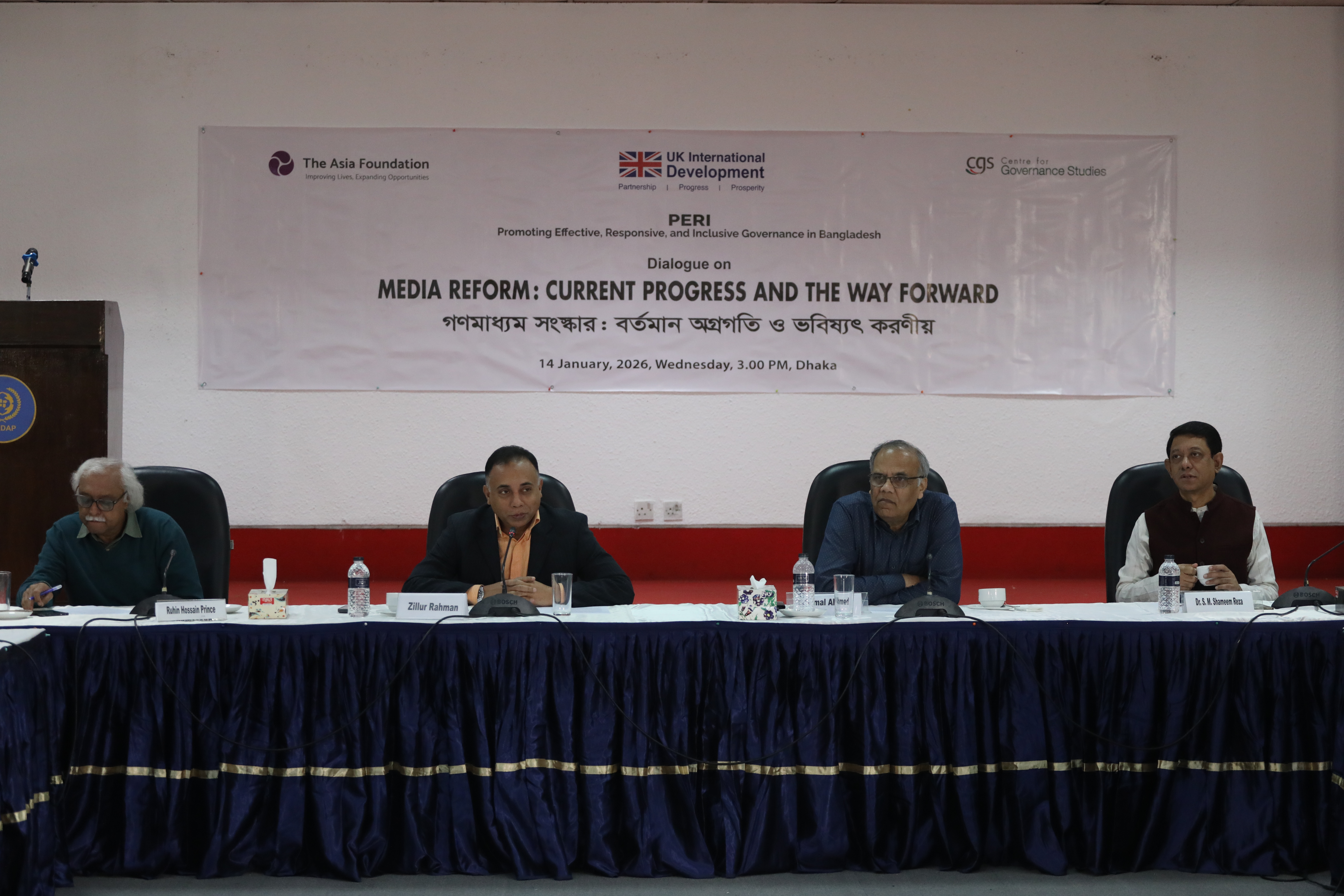
The Centre for Governance Studies (CGS) held the roundtable dialogue on Wednesday, January 14, 2026, at the CIRDAP Auditorium, Dhaka. The event discussed reforms related to Bangladesh’s mass media sector. The name of the roundtable dialogue was “Media Reform: Current Progress and the Way Forward.”
The guest of honor was Kamal Ahmed, Former Head of the Media Reform Commission. Former General Secretary of CPB Ruhin Hossain Prince, General Secretary of G-9 Shakhawat Hossain Sayantha; Professor of Department of Mass Communication and Journalism, University of Dhaka S. M. Shameem Reza; Former President of Bangladesh Federal Union of Journalists (BFUJ), M Abdullah; Bangladesh Correspondent, NHK TV Parveen F Chowdhury; Advocate of Bangladesh Supreme Court, Barrister Shihab Uddin Khan, Freelance Journalist Kazi Jesin; Bangladesh Correspondent of Irrawaddy Md Muktadir Rashid; Former Vice President Dhaka University Journalists Association (DUJA) and Member, BNP Mir Arshadul Hoque. The session was moderated by Zillur Rahman, President of CGS
Zillur Rahman said, “I do not believe the media is genuinely willing to solve its own problems. Regarding the Media Reform Commission’s report, mainstream outlets have not spoken out as much as they should have. During the previous government, I repeatedly said that our country’s media functions as puppet media or sold media. The former Information Adviser himself admitted at a CGS event that no one listened to him, that his wishes were ignored, and that he was unable to carry out his work. We saw how certain media outlets spoke in one way before August 5, and then suddenly shifted to saying the complete opposite. Our media has yet to achieve independence, nor does it show any real desire to become independent. Two newspaper offices were burned down, yet the government did nothing only offering condolences the following day. If one examines the qualifications of those who are or were in the Advisory Council, and where they stood over the past 15-16 years, many answers will become clear.”
Kamal Ahmed said, “Just a few months after we submitted the Reform Commission’s report to the government, the office where I currently work was set on fire. In that attack, there was an attempt to burn alive 28 journalists. When one journalist was rescued, he was harassed and nearly beatenraising serious doubts as to whether the remaining 27 would have survived had they tried to escape earlier.Five months ago, the Information Adviser promised to pass the Journalist Protection Act, but he failed to do so. Had it been enacted, perhaps such incidents could have been prevented. It has now been more than ten months since we submitted our report, and all the attacks and harassment of journalists during this period fall squarely on the government’s responsibility.Today, some YouTubers who once promoted obscenity and sexuality now wave the flags of patriotism, religion, and anti-India rhetoric. If they had any shame, they would not even step out of their bedrooms. While there are no formal restrictions imposed by the government on the media, restrictions are being enforced by mobsand these mobs have been patronized by the government. The responsibility lies with the government. It must be understood that journalism and freedom of expression are not the same. Political opinions may appear in newspapers, but news itself must remain objective. A television talk show cannot be equated with a newspaper report. The essence of democracy is that everyone must have freedom of expression. We anticipated bureaucratic resistance to our recommendations, which is why we submitted a draft law. First came Nahid, who became more occupied with building his own faction than with ministerial work. Later, when Mahfuz tried to act, the bureaucracy blocked him. This too reflects government failure officials could have been replaced, but no effort was made. We had also proposed exempting freelance journalists’ earnings from income tax, a measure that could have been implemented easily, but it was ignored. We did not ask for cosmetic changes; we demanded permanent reforms. The ban on journalists’ access to the courts is a grave blow to journalism.”
Ruhin Hossain Prince said, “Many people place great expectations on the media. In many cases, ordinary citizens believe that if an issue is highlighted in the media and reaches the higher authorities, it may lead to a solution. Some individuals even employ public relations officers to ensure their work or statements are presented in a particular way. At present, instead of direct censorship, a culture of fear has taken root. The government must take stronger measures to address this. If specific reforms are implemented in the future, journalism could see some improvement. Previously, there was one form of politicization in the media; now, it is taking place in another form. We must move forward together through non-partisan journalism, which is the only way to strengthen the profession and serve the public interest.”
S. M. Shameem Reza said, “Journalists must understand whose words should be highlighted when writing reports. It is not acceptable to omit the remarks of the keynote speaker and instead emphasize someone else’s. Within the next month, no meaningful implementation of the Commission’s recommendations will take place. Any rushed measures will not be effective. We should carefully observe what political parties are promising in their manifestos. Another important issue is the qualifications required to become a journalist. Without proper management skills and professional competence, one should not be allowed to enter the profession. I am not referring to academic degrees, but rather to the level of training a journalist has received. A structured training module could be introduced, followed by certification upon completion. The number of female journalists is steadily declining, and regionally their situation is dire. This government has not improved the condition of women in journalism. A proposal could be made requiring media institutions to actively engage female journalists. Additionally, there should be a review of journalists who have been harmed or targeted by lawsuits. The government could at least initiate a review of the cases and legal challenges currently faced by journalists.”
The gist of the roundtable dialogue was that media reform in Bangladesh has made little practical progress despite the submission of the Media Reform Commission’s report. Speakers discussed mob pressure on journalists, weak government action, the failure to pass the Journalist Protection Act, online misinformation, lack of self-regulation, poor working conditions, corporate influence, and the declining independence of mainstream media. The discussion emphasized the need for permanent reform, journalist protection, stronger professional standards, and serious action on online media before the upcoming elections.