
Roundtable on Media Freedom and Legal Reform: Reflections on the Two Draft Ordinances
26 June 2025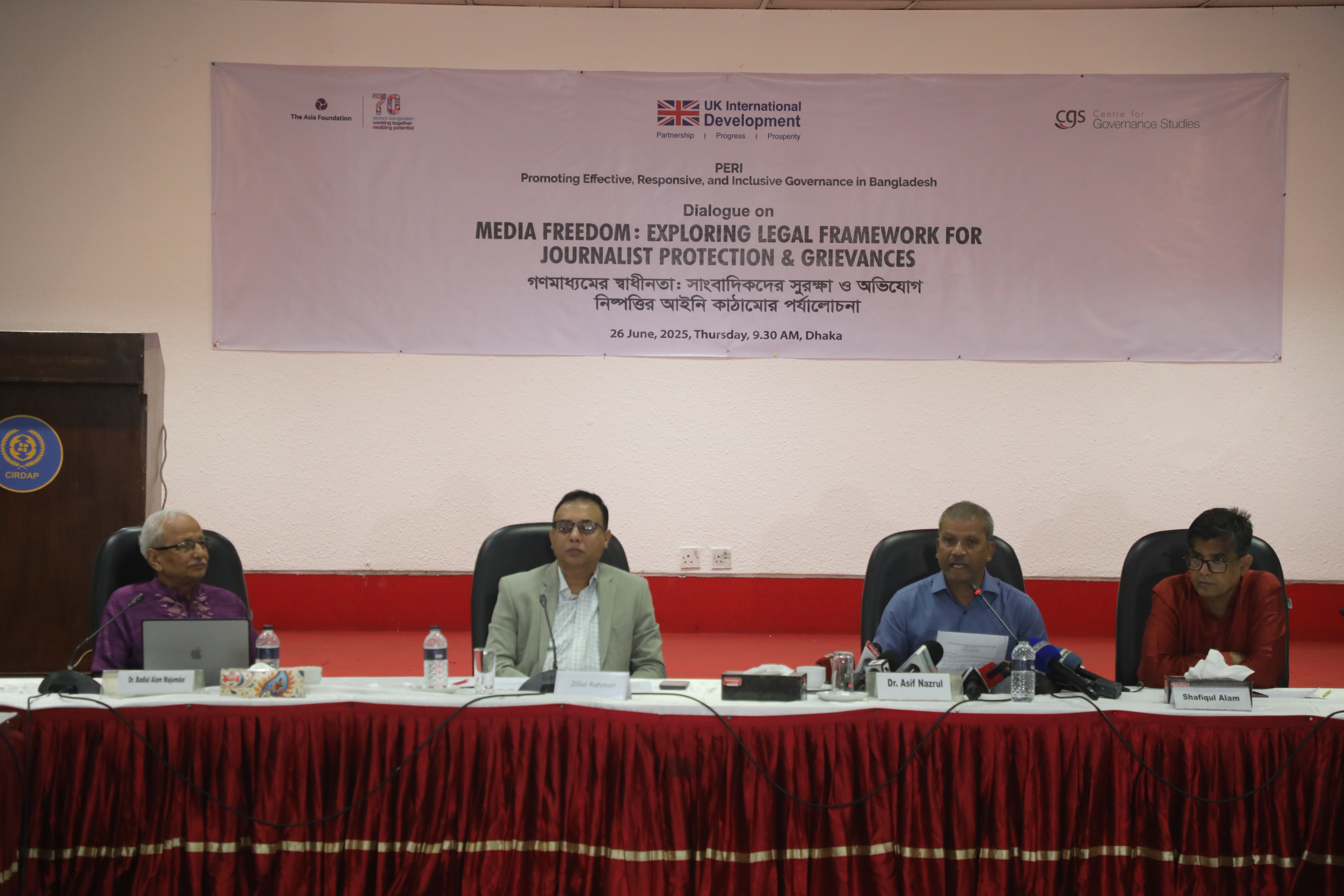
The Centre for Governance Studies (CGS) held a roundtable dialogue on Thursday, 26 June 2025, at the CIRDAP Auditorium, Dhaka. The event focused on reforms related to Bangladesh’s mass media sector. The nameof the roundtable dialogue was “Media Freedom and Legal Reform: Reflections on the Two Draft Ordinances”
The main guests and key discussants included Asif Nazrul, Adviser for Law, Justice and Parliamentary Affairs; Dr. BadiulAlam Majumdar, Chief of the Electoral Reform Commission; Shafiqul Alam, Press Secretary to the Chief Adviser; Dr Shahidul Alam, Founder, Drik Picture Library and Photojournalist; Mojibur Rahman Monju, Chairman of AB Party; Ruhin Hossain Prince, General Secretary, Communist Party of Bangladesh (CPB);Parveen F Chowdhury, Bangladesh Correspondent, NHK TV;Sohrab Hassan, Joint Editor, ProthmAlo;M A Aziz, Bangladesh Correspondent, Irrawaddy;Zahed Ur Rahman, Political Analyst; Dr.Shakhawat Hossain Sayantha, General Secretary, G-9, Bobby Hajjaj, Chairman, Nationalist Democratic Movement; Parvez Karim Abbasi, Assistant Professor, East West University, Senior Research Fellow, Centre for Governance Studies; Senior Journalist; Md Muktadir Rashid;Zyma Islam, Senior Reporter, The Daily Star; Qadaruddin Shishir, Founder and Editor of The Dissent. The session was moderated by Zillur Rahman.
Moderating the session, Zillur Rahman the media and related institutions haven’t really discussed the issue of media reform or the commission’s report. There hasn’t been much discussion on television, nor have there been writings in newspapers. There’s been no dialogue on what kind of reforms are needed, how constructive the commission’s report is, or what its weaknesses are. It’s primarily with those considerations in mind that today’s roundtable discussion has been organized.
Asif Nazrulhas said all cases under the Digital Security Act have been withdrawn. While there may not have been much in the media, there has been a lot of misinformation spread on social media. None of us have filed cases over this misinformation, nor have we protestedwe’ve left it to the people of the country. If a certain group sees an opportunity for business in filing cases, then there’s nothing we can do about it. There were 266 cases filed against journalists, but only 15 were arrested. Those who were named were charged for insider crimes or related amendments. We have no role in the casesthey were filed by ordinary citizens. However, we’ve instructed that no one should be arrested without substantial evidence
Dr. BadiulAlam Majumdar said, most television channels, in order to secure licenses, included favorable statements in their applications to please the government. Their letters of commitment contained promises that aligned with the political ideology and strategies of the Awami League. In the application forms themselves, they expressed willingness to assist in implementing the political party’s vision. Based on these applications, licenses have been granted over the past fifteen years.
Shafiqul Alam said we are going through an extraordinary time. He has claimed that the Interim Government has not created any administrative barriers for journalism. He has pointed out three main ways in which the last regime controlled journalism, through administration, repressive laws and social favors. He said that the current government is not doing any of that practices. Over the past fifteen and a half years under Hasina, a trust deficit has developedwe are trying to overcome that. We are working to ensure that the actions of that era are not repeated during our time, and we’ve been largely successful in that regard. We’re not using any administrative pressure to silence journalists or push them away from their profession. If a news report is false, we simply say it’s false and request its removal. Some comply, some don’t. We’re just letting people know it’s untrueeveryone can take their own legal steps. There are demands for a Journalist Protection Ordinance, but what about those who are harmed by unethical journalism? Shouldn’t we also think about protecting them?
The gist of the roundtable dialogue was that Bangladesh’s media sector needs serious reform to restore public trust, protect journalistic freedom, and reduce political influence over media institutions. Speakers discussed the misuse of past digital laws, self-censorship, weak professional standards, political division among journalists, ownership influence, misinformation, and the need for stronger protection for journalists. At the same time, several speakers argued that the media itself must also take responsibility for rebuilding credibility and improving ethical journalism.