
Roundtable on Self-Regulation and Grievance in Media Political and Policy Perspectives
28 September 2025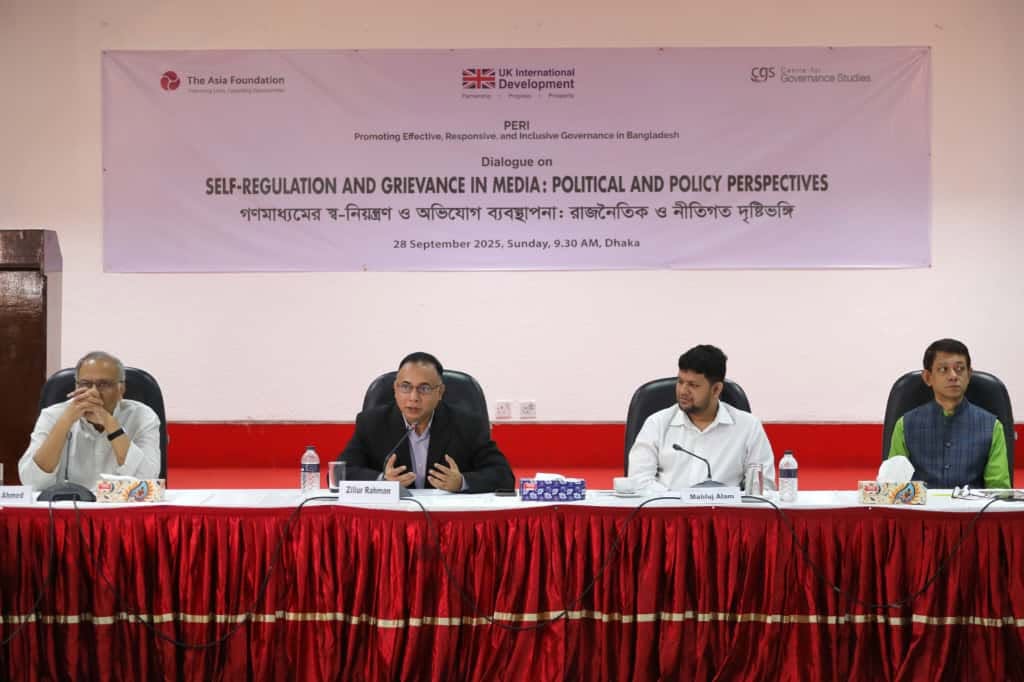
The Centre for Governance Studies (CGS) held the roundtable dialogue on Sunday, September 28, 2025, at the CIRDAP Auditorium, Dhaka. The press release header is dated August 28, 2025, but the event description states that the dialogue was held on September 28, 2025.The name of the roundtable dialogue was “Dialogue on Self-Regulation and Grievance in Media: Political and Policy Perspectives.”
The guests of honor were Mahfuz Alam, Adviser to the Ministry of Information and Broadcasting, and Kamal Ahmed, Consulting Editor of The Daily Star and former Head of the Media Reform Commission. Other guests included,S. M. Shameem Reza, Professor, Department of Mass Communication and Journalism, University of Dhaka; Dr. Moudud Hossain Alamgir Pavel, Convener, BNP Media Cell;Dr. Shakhawat Hossain Sayantha, General Secretary, G-9; Advocate Ahsanul Mahboob Zubair, Assistant Secretary General and Chief of Media and Publicity Team, Bangladesh Jamaat-e-Islami; Abdullah Kafi Ratan, General Secretary, Communist Party of Bangladesh (CPB); Nazmul Haque Prodhan, General Secretary, Bangladesh Samajtantrik Dal- Bangladesh Jasad; Advocate Subrata Chowdhury, Executive President, Gonoforum; Nasreen Sultana Mily, Joint General Secretary, AB Party; Jubairul Hasan Arif, Chief Joint Organiser of NCP, Coordinator of Chittagong region; Md. Rashed Khan, General Secretary, Gono Odhikar Parishad; Sohrab Hassan, Senior Journalist; M Abdullah, Former Secretary General, and President, Bangladesh Federal Union of Journalists (BFUJ); KaziJesin, Freelance Journalist; Zyma Islam, Senior Journalist, The Daily Star. The session was moderated by Zillur Rahman, President of CGS.
Zillur Rahman emphasized the importance of discussing reforms. He noted that although much has been said about reform, the promises made by political parties during the 2007–08 “One-Eleven” period were never implemented. He pointed out that reform narratives often remain confined to promises, with little effort made to turn the page and act on them. Previously, the government stated that reforms were essential before elections. Now, it is being claimed that most reforms have already been completed ahead of the elections. The Chief Advisor’s recent speech shed light on this in detail. It was strongly emphasized that there is no alternative to elections for democratizing the country. However, according to international organizations, the United Nations, and Article 19, the environment for freedom of expression in Bangladesh is still not safe. Progress in reform and democracy requires cooperation and active participation from all parties.
Mahfuz Alamsaid he has been worried about job insecurity for the past two months, which is hindering the implementation of initiatives like the Journalist Protection Act. “I don’t know if I’ll still have my seat tomorrow,” he remarked. He received 18 draft versions of the law and recommended presenting them to the cabinet two months ago, but the process remains stuck in its second phase. He believes the law can be enacted within a short time. As part of media reform, he proposed merging BTV and Bangladesh Betar into an autonomous entity, but complications have arisen due to staff coordination and stakeholder influence. “Visible and invisible stakeholders in the ministry influence decision-making,” he said. While media house owners have benefited from increased advertising rates, the actual benefits for journalists remain questionable. “What are journalists really getting? The owners don’t have an answer,” he stated. During his tenure, no media house was shut down, but 72–75 journalists faced harassment, and he is working with the ministry to resolve those issues. He clarified that no new media licenses have been issued. Addressing administrative challenges, he said, “You need a secretary to run the Secretariat; a ministry can’t be run by ordinary people.” He also spoke about the powerful nexus between civil-military bureaucracy and corporate society, which is difficult to dismantle.
Kamal Ahmed expressed concern over media protection, legal reform, and professionalism. He recommended gathering public opinion and publishing drafts of the “Journalist Protection Act 2025” and the “Media Commission Act” on a website. Despite submitting the report six months ago, he regretted the delay in implementing the Journalist Protection Ordinance. He proposed recognizing journalists as workers under labor law, reforming the wage board, and bringing Bangladesh Betar, BTV, and news agencies under a single board. Criticizing the inefficiency of BTV and Betar due to inadequate funding and ministerial control, he cited an example: even though 50,000 taka is needed to send a van for news collection, the funds are unavailable. He called for reform implementation by February. Highlighting the need for training in citizen journalism to ensure professionalism, he stressed the importance of verifying whether incidents involving journalists—such as being assaulted or seen with weapons—are acts of journalism or politically motivated extortion. He urged the formation of an independent Media Commission to review or revoke outdated licenses. Criticizing the Awami League government, he emphasized the importance of media license quality and demanded the release of arrested journalists. He clarified that self-regulation should not be confused with self-censorship and called for the protection of objective reporting and freedom of opinion.
Dr. S. M. Shameem Rezasaid, Public trust in the media is declining, yet there is a lack of independent and impartial research on the issue. Media houses show reluctance toward conducting research, and due to their Dhaka-centric operations, there is a shortage of monitoring and oversight at the regional level. He emphasized the need to assess the quality of good journalism, the absence of political party discussions on media reform akin to constitutional reform, and the importance of building a tradition of self-regulation and policy in a democratic society.To implement policies effectively, a supportive environment, proper training, and equal opportunities are essential. Adhering to international standards in policy implementation would help create a free and independent working environment. He recommended that political parties include provisions in their election manifestos to ensure job security, legal and financialprotection for journalists—especially the safety of female journalists and access to maternity leave.
The gist of the roundtable dialogue was that media freedom in Bangladesh remains under serious pressure despite ongoing discussions on reform. Speakers focused on self-regulation, grievance redress, journalist protection, job security, corporate ownership, political influence, and the need for an independent Media Commission. The discussion also emphasized that media reform must move beyond promises and be implemented through concrete legal and institutional changes.