
From Street to Archive: July’s Protest Art After the Uprising
Fawzia Afrin | 03 November 2026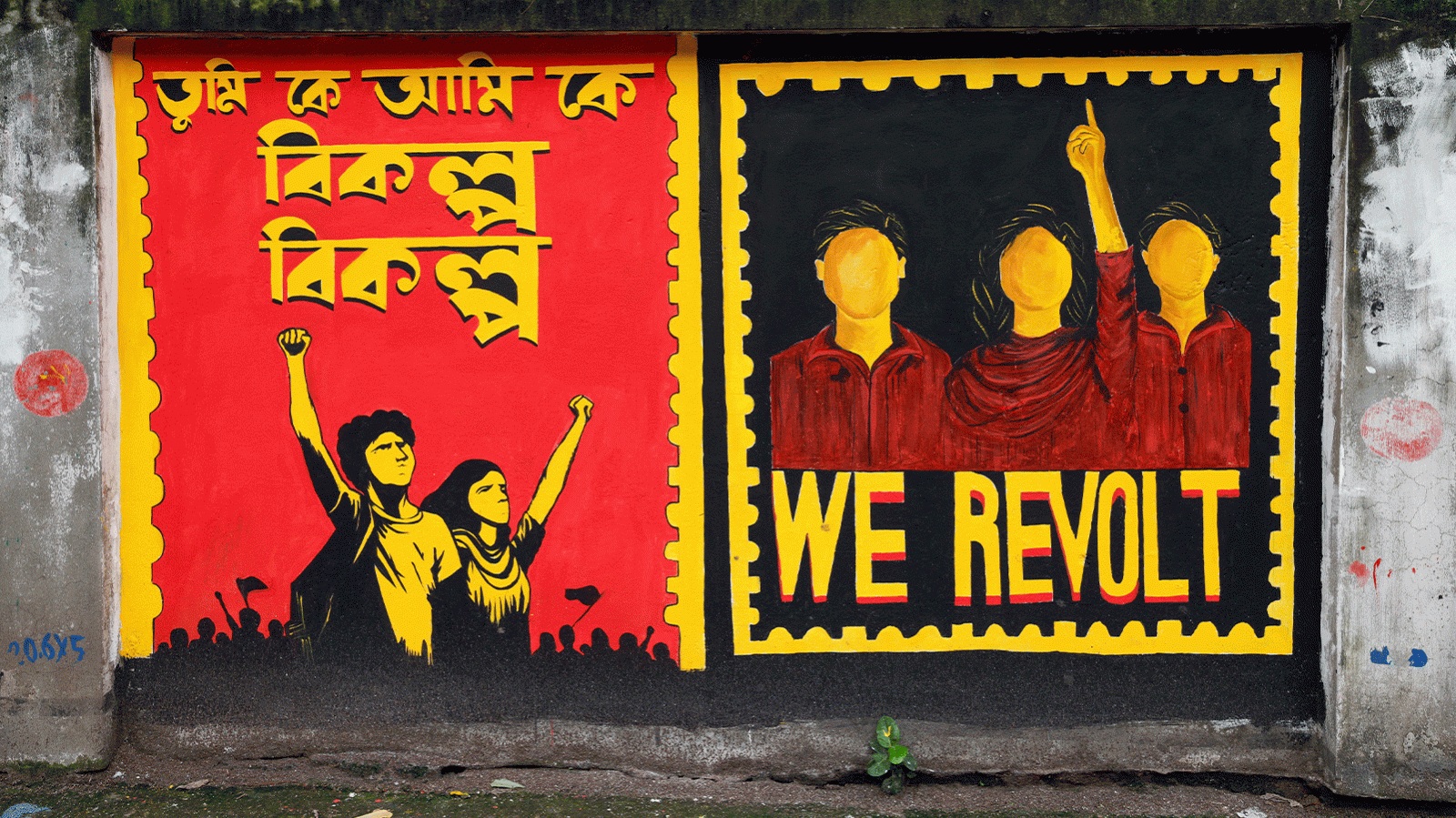
Two years after Bangladesh’s July uprising, some of the walls that once shouted in paint are being painted again. In August 2026, students and artists returned to Dhaka University to restore graffiti created during the July-August 2024 uprising. The three-day programme sought to preserve the original character, message and historical significance of works that had begun to deteriorate with time.[1]Elsewhere, however, July’s visual traces have not been treated so carefully. Murals have faded, disappeared beneath new paint or become caught in disputes over who has the right to remove them. The contrast raises a question that becomes more important as the uprising moves further into history: what happens to protest art after the protest is over?
During the uprising, graffiti was immediate. Walls and other public surfaces became spaces through which protesters expressed anger, grief, defiance and political demands. Graffiti appeared alongside cartoons, posters, songs and performances as part of a wider cultural resistance. Much of it was anonymous, reflecting the decentralised and collective character of the movement.[2][3] But protest art changes once the political emergency that produced it has passed. A slogan painted to mobilise people in 2024 may be encountered in 2026 as evidence of a historical moment. What once said “act” increasingly says “remember.” That transition from mobilization to memory - is the beginning of July art’s second life.
Street art is inherently fragile. Rain, sunlight, construction, advertisements and new layers of paint can erase an image without ceremony. Yet once an artwork becomes associated with sacrifice or political resistance, its disappearance may no longer be understood as simple urban maintenance.
That became particularly visible in Chattogram in May 2026. Allegations that July-related graffiti had been erased from pillars of the elevated expressway triggered protests and counterclaims. Students arrived with paint to recreate graffiti, police intervened, and tensions escalated. The city mayor denied ordering the removal, while allegations persisted that some pillars had been cleared for advertisements.[4] Whatever the administrative explanation, the episode revealed that these paintings had acquired a significance beyond their physical surfaces. Repainting a pillar was no longer necessarily politically neutral: it could become a dispute over who had the authority to alter a visible record of July.An empty wall, therefore, can become part of the story. Once the image is gone, its absence may tell us something about the politics of remembering.
The transformation of July’s protest art into historical material began remarkably quickly. Only months after the uprising, the 2025 Amar Ekushey Book Fair became one of the first major public spaces where the memory of July was collected, published and consumed as documented history. By February 24, more than 100 books on the uprising had appeared at the fair, according to Bangladesh Sangbad Sangstha.[5]The fair’s emphasis on July turned recent political experience into books, documents and objects that readers could carry home.
Graffiti was central to this transition. Journalist GM Rajib Hossain’s Droher Graffiti: Chobisher Gono Obhyutthan, launched in February 2025, compiled 161 selected graffiti and artworks from Dhaka and other major cities, with contextual captions.[6] An even larger visual record appeared in ৩৬শেজুলাই: গ্রাফিতিরভাষায়চব্বিশেরগণঅভ্যুত্থান, edited by Md Kawsar Hasan and published by University Press Limited. It brought together more than 1,500 photographs of graffiti from 71 locations across Bangladesh, alongside significant protest posters collected from social media.[7]
The July Shaheed Smrity Foundation also used the fair as a space of memory, displaying Art of Triumph and Satire and Ridicule at its stall.[8] Bangla Academy also scheduled a discussion titled “July Uprising: Graffiti,” with photographer Munem Wasif presenting and Taslima Akhter and Kamar Ahmad Simon as discussants.[9]Images initially created anonymously and urgently on exposed walls were now being selected, captioned, sequenced and bound into books. Yet publication also introduces selection. A book can save a disappearing mural, but deciding which graffiti deserves a page already begins to determine which visual memories of July will endure.
Restoration represents another attempt to resist disappearance. Dhaka University’s August 2026 programme formalised something that would have seemed unusual during the uprising itself: an institution assuming responsibility for protecting imagery created through spontaneous political action.[1]Photography offers another form of survival. The Art of Triumph: Graffiti of Bangladesh’s New Dawn, compiled by the July Shaheed Smrity Foundation, gathered photographs of graffiti and murals. A review in The Daily Star observed an important distinction between the hurried, raw works created during the uprising and the cleaner, more carefully executed murals that appeared later.[10] The most polished artwork is often easier to reproduce and exhibit; a hurried line written under pressure may disappear before anyone recognises its historical importance.
A more systematic effort is now underway. A 2026 Leipzig University project, developed with Heritage - Archives of Bangladesh History in Rajshahi, is documenting and indexing at least 600 politically motivated graffiti beyond Dhaka. The project explicitly addresses questions of data sovereignty, accessibility, representation, copyright and ethical archival practice.[11] Yet an archive is never simply a warehouse for the past. Someone must decide what to photograph, how to classify it, what location and date to attach to it, and how to explain its political meaning. Preserving history inevitably involves selecting history.
The institutionalization of July’s memory became even more visible on August 5, 2026, when the July Mass Uprising Memorial Museum opened at the former Ganabhaban. Its galleries preserve artefacts, photographs, official documents, video footage, personal belongings and other material connected to the uprising.[12]The transformation of a former centre of executive power into a museum commemorating the movement that ended the previous government is symbolically striking. It also represents a broader transition, material that once existed on streets and smartphones increasingly enters officially curated spaces.
The anonymity of much July protest art makes this tension more complicated. Who owns an unsigned mural? During the uprising, anonymity could be a strength. Shuddhashar notes that visual artist Debashis Chakraborty’s protest posters circulated widely online and offline and were freely printed and distributed by supporters.[2] The artwork escaped conventional notions of individual ownership and became part of a shared political vocabulary.
After an uprising, however, collective ownership becomes harder to manage. Someone eventually decides what enters a book, what receives restoration, what is archived and what becomes museum-worthy. The struggle surrounding July’s visual culture has therefore shifted. In 2024, the immediate battle concerned the right to speak, paint and occupy public space. In its aftermath, another contest has emerged over which images of July are preserved and what those images will be made to represent.
The walls themselves will not last forever. Buildings will change, paint will fade and new political generations will write over old slogans. Yet July’s visual culture has already begun migrating into photographs, books, databases, restored murals and museums. Its first life belonged to the urgency of resistance. Its second belongs to the politics of remembrance.The question is no longer only whether the walls of July will survive. It is who will decide what those walls are allowed to remember.
Views in this article are author’s own and do not necessarily reflect CGS policy.
References
[1] The Business Standard. “DU launches restoration of ‘July graffiti’ across campus.” 1 August 2026.
[2] Shuddhashar. “Protest Art of the July Uprising.” 1 February 2025.
[6] Bangladesh Sangbad Sangstha (BSS). “New book on Uprising graffiti launched at JPC.” 8 February 2025.
[8] July Shaheed Smrity Foundation. “অমরএকুশেবইমেলায়জুলাইশহীদস্মৃতিফাউন্ডেশনস্টল.” 18 February 2025.
[9] New Age. “Ekushey Book Fair: Titles on July uprising attract readers.” 24 February 2025.
[10] Emdad, Mahmuda. “Tracing an uprising in strokes.” The Daily Star, 31 July 2025.
[11] Leipzig University, ReCentGlobe. “Archiving Political Street Art from Bangladesh.” 2026.
[12] Bangladesh Sangbad Sangstha (BSS). “PM opens July Mass Uprising Memorial Museum.” 5 August 2026.