
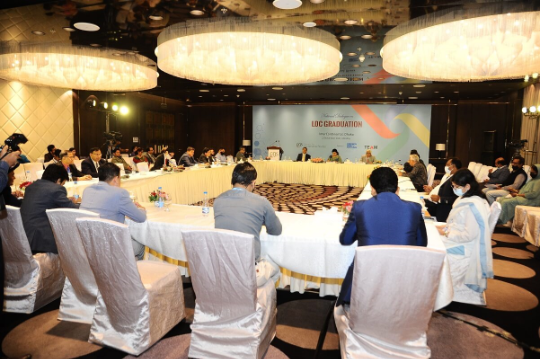
Experts at a national dialogue on LDC graduation organised by the Centre for Governance Studies said that the country should adopt favourable policy practices by maintaining transparency for a smooth graduation transition period.
They said that the United Nation Committee for Development Policy in February recommended that the country should formulate an effective transition strategy to graduate from the least development country status in 2026.
They suggested that sector-wise gaps should be identified and analysis of risk assessments conducted followed by consultations and engagement with bilateral and multilateral development partners like private sectors, non-government organisations, CSOs, and all other stakeholders.
CGS executive director Zillur Rahman gave the welcome speech at the event.
He said the aim of this event was to identify the opportunities and challenges of the country for a smooth transition period to achieve the Sustainable Development Goals.
CGS research director Abdullah-Al-Mamun presented the keynote presentation on the topic.
CGS chairman Manjur Ahmed Chowdhury said that the onslaught of the Covid-19 outbreak had brought more challenges for the government’s roadmap for its LDC graduation.
He said, ‘It would seem that the government is yet to have a comprehensive action plan to prepare an effective smooth transition strategy.’
Attending as the chief guest, planning minister MA Mannan said that though number of indicators still takes time to fill, we mostly comply with all the criteria to achieve the SDG goal.
‘Income distribution is a global crisis and we try to adopt a strategy to resolve the crisis to ensure equal distribution,’ he added.
‘We are working on ensuring equal rights for men and women at the root stage and we also try to seek out the leakages of corruption and urge for all participation to minimise the corruption,’ added the planning minister.
Bangladesh Nationalist Party standing committee member Abdul Moyeen Khan said that the human assets index of the country was still in a poor state due to the absence of democratic practices.
Leaders of the economy should ensure proper distribution of income and ensure security to attract foreign investors, he said.
He suggested that action should be taken to minimise capital flight from the country and to ensure proper distribution of assets among all.
Jatiya Party-JP secretary general Sheikh Shahidul Islam stressed on adoption of innovative ideas and proper marketing to compete with other nations globally.
Bangladesh Women Chamber of Commerce and Industry president Selima Ahmed said that the country should ensure equal facilities for all that would help to maintain a sustainable graduation status.
World Bank country director Mercy Tembon said that it was a significant moment for Bangladesh and 15 years was enough time to transform to the graduation status.
She said, ‘The country should adopt a global standard tariff policy and create a diverse export basket to enjoy the global benefits after graduation.’
PwC Bangladesh managing partner Mamun Rashid moderated the programme.
Foreign ministry standing committee member Habibe Millat, RAPID executive director and Dhaka University development studies professor M Abu Yusuf, Swadhinata Chikitshak Parishad secretary general MA Aziz and Dhaka University development studies department chairman Rashed Al Mahmud Titumir also spoke at the programme.
News Courtesy: