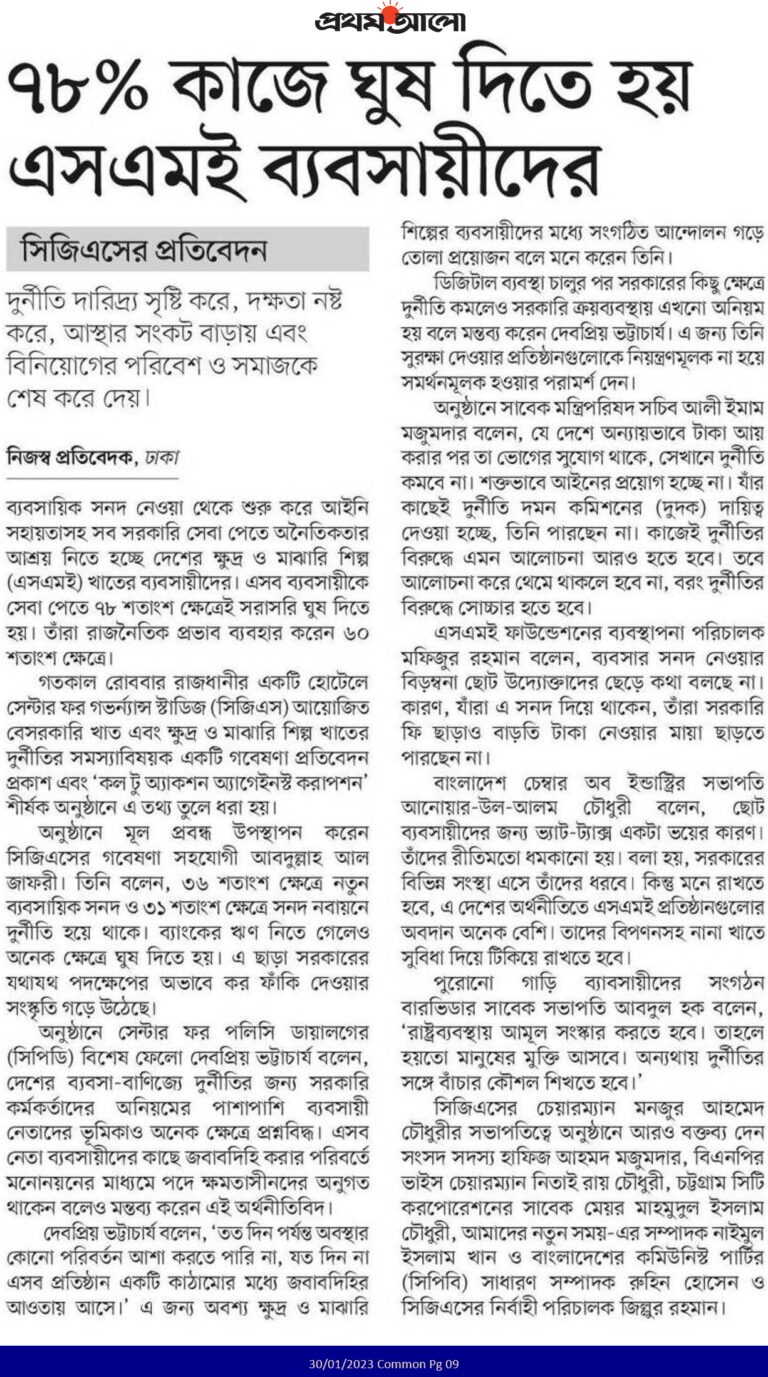
Private sector, especially small and medium entrepreneurs, is hit hard by endemic corruption at different stages including licencing processes and a lack of policy supports, according to speakers at a discussion.
They observed that complexity in initiating business and corruption undermined the SME sector contribution to entrepreneurship, national economy and employment creation.
The observation came at a round-table discussion hosted by the Centre for Governance Studies in partnership with the Center for International Private Enterprise on Sunday.
The think tank came up with the findings of a two-year-long study on the nature of corruption in the SME sector of Bangladesh.
The study found that 74 per cent of SME entrepreneurs across eight divisions of Bangladesh were directly affected by graft while doing business.
According to respondents, bribe and political influence to gain favour are the two most common forms of corruption in Bangladesh.
Addressing the discussion, Debapriya Bhattacharya, distinguished fellow at the Centre for Policy Dialogue, said that in fear of losing power delegated to them, regulatory bodies engaged in corruption.
Those who are given the responsibility of empowering the SMEs are not elected by small and medium entrepreneurs, he said, stressing democratic accountability to tackle corruption, which created prolonged poverty, widened disparities and damaged nation’s solidarity.
The noted economist observed that an increase in average income won’t necessarily reduce corruption; there was in fact a reverse causal relationship between average income level and level of corruption.
According to the public policy analyst, there should be a distinction in evaluation of corruptions taking place in allocation of public and private resources.
Former cabinet secretary of Bangladesh and secretary general of Transparency International Bangladesh Ali Imam Majumder said that that it was not possible to develop nation without developing the SME sector.
He added that despite contributing immensely to the national economy, the SME sector had always been neglected.
Managing director of the SME Foundation Md Mofizur Rahman pointed out difficulties facing the SME Foundation in providing services to the small and medium enterprises due to lack of manpower and resources.
Small traders and entrepreneurs face obstacles mostly in obtaining licences and medium-scale traders enjoy most government support and facilities whereas small traders are left in the lurch, according to Mofizur.
Anwar-ul Alam Chowdhury, president of Bangladesh Chamber of Industries and former president of the BGMEA, said that currently, no one was providing policy support to the SMEs in Bangladesh, and that was why the sector was underperforming compared to many other prosperous nations.
He mentioned a relative lack of actionable data on the SME sector and a shortage of skills and marketing expertise among the SMEs that led them to fall behind.
Ruhin Hossain Prince, general secretary of Communist Party of Bangladesh, said that there needed to be collective action against the nexus of illicit business and illicit politics that were behind destroying the SME’s potential.
Business community leaders and entrepreneurs highlighted their ordeal they face due to corruption in different stages.
The discussion was presided over by Centre for Governance Studies chairman Manjur Ahmed Chowdhury and moderated by its executive director Zillur Rahman.
News Courtesy:
https://www.newagebd.net/article/193059/corruption-hits-sme-sector-hard-discussion