
A political Commentary: The conspiracy of depoliticization of 1975 creeping in Bangladesh
Omer Sher | 11 August 2020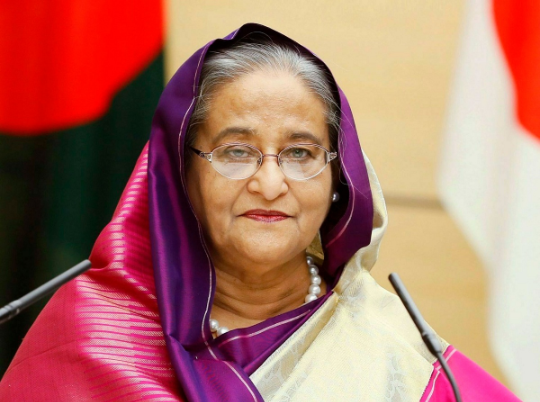
la289
Against the backdrop of a frightful pandemic the present lull in political activities in the country is understandable though not desirable. Yet the phenomenon of discernible public apathy towards politics and lack of any effective opposition is not a post pandemic trend rather had been the norm for quite some time. This has rendered the head of the government susceptible to accusation of dictatorship and one party rule.
Sheikh Hasina is quintessentially a politician. The four-time prime minister is in power for the third consecutive terms. But she is now more reliant on administration (civil service) than politicians to face the extremely challenging issues of the day. Though AL is in the government, but in absence of political programs the ruling party Awami League is practically in political coma.
The leaders and workers of the Awami League are carrying out paltry political programs like distributing relief, that too in a sporadic way limited to few places, unbefitting to a big political party like the Awami League. Activities of all the affiliated organizations of the Awami League have somehow come to a standstill.
The affiliated organizations have few or no political programmes at all. The full committees of many affiliated organizations have not been announced yet. Dhaka is considered to be the heart of Bangladeshi politics. The Awami League has two branches in the Dhaka metropolis - North and South. Although the two have a president and a general secretary, the full committee has not been announced yet. Just as the president of the Awami League is busy dealing with the country's crisis rather than party activities, so the general secretary of the party is busy giving video messages. Without this video message, none of his political activities would be visible.
Some disoriented senior political leaders of the Awami League who did not get the nominations in the last election and some who were kept out of ministerial responsibilities - they are keeping themselves confined to the Presidium office of the Awami League and the party office on Bangabandhu Avenue in the capital. Some of their speeches, statements, and limited social interactions are the only organizational activities of the Awami League politics. The leaders of the Awami League now admit that the country-wide organization is becoming disjointed. Leaders and activists are more interested in business than politics. This includes the nuisance of intruders into the party.
The situation of the main opposition BNP is worse than that of the Awami League. Except in the media BNP does not exist as political party. If there was no television or media in Bangladesh, the organization called BNP would not exist. Party workers and ordinary leaders do not even know who is running the BNP as a political organization now. Central leaders including Mirza Fakhrul Islam Alamgir have now become seasonal birds. Now they have no program except to appear in the television screen from time to time.
Needless to say, the two major political parties who were in power in the last 36 years are in a state of disarray. The third largest party, Jatiya Party is not doing any better after the death of Hussain Muhammad Ershad. Jatiya Party's new chairman GM Quader is a gentleman. But everybody agrees, he is not a dynamic leader and does not have any political acumen to inspire his party men. The leftist political parties of Bangladesh had an opportunity to prove themselves at this time but could not use that opportunity. On the contrary, they too are busy in money making schemes. People have no faith in them or their ideology.
The anti-independence Jamaat has now gone in hiding and has become an underground party. It is better not to talk about this anti-liberation party.
Under prevailing scenario, Bangladesh has become a non-political state. Businessmen and bureaucrats, including garment owners, are now more vocal than politicians. Though there is a façade of a political government, yet the show is run by the bureaucrats and businessmen. They are making all political decisions.
But without political activities it is impossible to build consensus and forge unity among the people, which is imperative to face the catastrophe the nation is facing presently. Without vigorous debate among various groups in the country, correct policies cannot be adopted and without proper accountability, corruption and misuse of power becomes the norm.
The conspiracy of de-politicization that has been going on in Bangladesh since 1975 is now becoming more and more transparent and it seems it has been quietly implemented in Bangladesh. Because when a country has zero politics, the people are disenfranchised. The void is filled by the bureaucrats or businessmen, who use the state apparatus to protect their interests. Bangladesh is moving towards such a non-political state.
Omer Sher is a retired Professor of Economics at Algonquin College, Ottawa, Canada and a researcher on politics in South Asia.
Views in this article are author’s own and do not necessarily reflect CGS policy.