
Security Cooperation in the Bay
The dynamics of geo-politics drive partnerships in security and economics. No wonder, US-Bangladesh bilateral security cooperation is driven by the perceived convergence of geopolitical interests and economic benefits. The Bay of Bengal, the largest bay in the world forms the northeastern part of the Indian Ocean. It is bordered mostly by India and Sri Lanka to the west, Bangladesh to the north and Myanmar and the Andaman and Nicobar Islands to the east. The principal trade routes for large tankers en route from the Persian Gulf to the Strait of Malacca pass south of the Bay of Bengal.
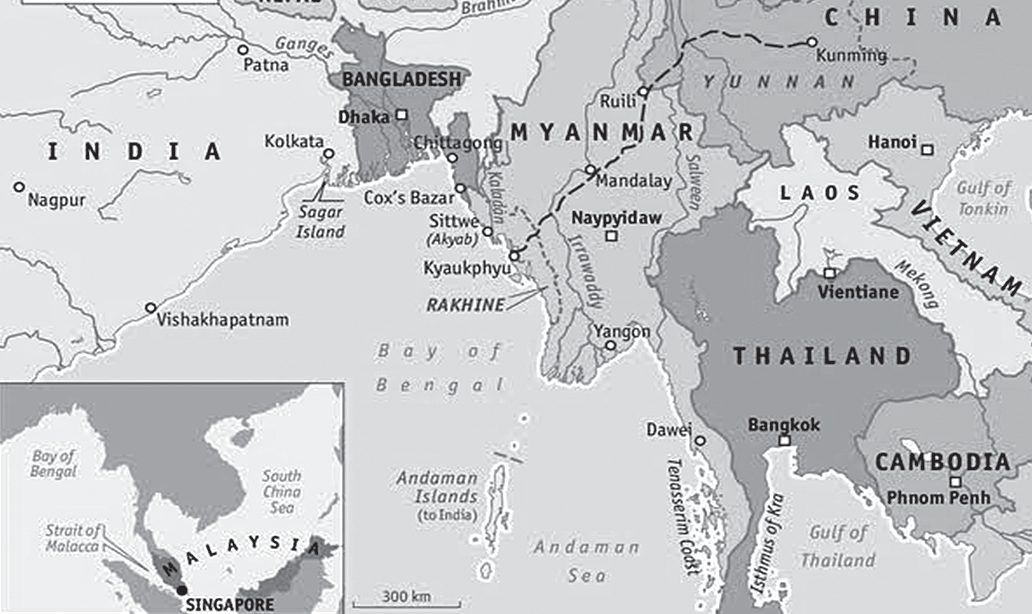
Bangladesh has a coastline of 220 nautical miles. Bangladesh shares maritime boundary with India and Myanmar in the Bay of Bengal. The maritime boundary disputes with Myanmar has been resolved by the International Tribunal for Law of the Sea (ITLOS) judgment on March 14, 2012 in which Bangladesh and Myanmar were awarded 111,631 and 171,832 square kilometers respectively. It is also noteworthy that the Arbitration Tribunal on the India-Bangladesh Maritime Delimitation delivered its ruling on 7th July 2014 resolving the dispute between the two countries. The Tribunal was set up under the Permanent Court of Arbitration in The Hague, in the matter of the Bay of Bengal Maritime Boundary Delimitation between India and Bangladesh. In 838,600 square mile area of the Bay, security threats of the littoral states including Bangladesh range from disputes over exclusive economic zones to terrorism, piracy, poaching, over-fishing, and trafficking of humans, arms, and narcotics. U.S. security ties with Bangladesh get salience in this context. U.S. realized that Bangladesh adjoined by the Bay in the Indian Ocean should not be totally under either the Indian sphere of influence or that of China. In fact, Washington also wants a stable Bangladesh, as any power vacuum in this ‘fragile’ 13 state created by political and economic chaos resulting in upsetting the status quo is not in US interest. Therefore, US security assistance program can have tremendous impact in supporting states like Bangladesh trying to build their security capacity. No doubt, in an interconnected world, terrorists, pirates, traffickers, and other transnational actors can exploit the weakness of states to cause mayhem and instability. Andrew J. Shapiro, US Assistant Secretary of State said this in very clear terms, “Our assistance is helping states like Bangladesh better control their borders and their coastlines…and better deal with natural disasters and transnational threats …through our training initiatives and exchanges we are helping professionalize national military forces to ensure they can better protect their public, while respecting human rights”. 14
In fact, US maintain a positive perception of Bangladesh to become a key player in maintaining security in Bay of Bengal. As one strategic analyst points out, “While US relations with India “may not progress as quickly as desired and those with Pakistan and Afghanistan are “in tatters,” the United States needs to forge deeper strategic relationship with the “marginal states, like Bangladesh, Sri Lanka and Myanmar.15 “Such states,” according to Doug Lieb in the Harvard International Review, “are often overlooked in a structural realist world view that privileges the study of larger countries.”16 In broader perspective, therefore, three clear interests bind Bangladesh and the United States in the Bay: First, the Indian Ocean is the central highway for international commerce particularly between the oil-rich Gulf States and an economically dynamic East Asia, and it in this context, Bangladesh shares interest with the US and other littoral states for the safety and security of the sea-route. In fact Bangladesh’s 90 percent goods pass through this route from its two ports: Chittagong and Mongla; Second, Bangladesh’s urgency to have access, explore and harness hydro-carbon resources and marine fisheries within its rightful zone for national development; and Third, China-India strategic competition that has significant implications for Bangladesh’s security and continued development.
Notes
- Chevron Bangladesh, Highlights of Operation 6
- Bangladesh is in the list of ‘fragile’ states that “lack the ability to develop mutually constructive relations with society and often have a weak capacity to carry out basic governance functions”, OECD, Fragile States: 2013 7 ↩