
Historical Context of LDC Graduation in Bangladesh and Its Socioeconomic Growth
Bangladesh’s trajectory toward LDC graduation, set for 2026, is evidence of the country’s gradual progress from the difficulties of its early years. The commencement of the journey may be traced back to the year 1975, during when Bangladesh was initially classified as a Least Developed Country (LDC) by the United Nations (Rahman, 2021). This categorization was primarily based on the nation’s significant socio-economic difficulties. Nevertheless, in the subsequent decades, the nation made deliberate and coordinated endeavors to surmount these challenges, therefore establishing a path toward progress.
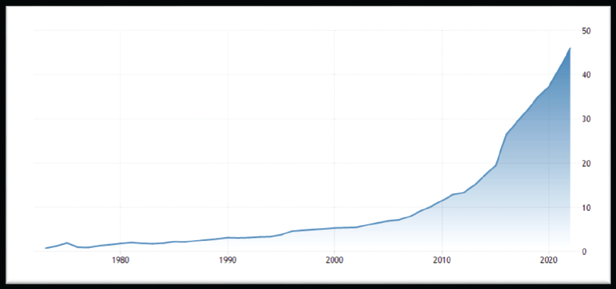
During the 1990s, Bangladesh made significant progress in its developmental trajectory with the implementation of extensive economic reforms and liberalization policies. The aforementioned measures were crucial in establishing the foundation for long-term economic expansion. The encompassment of several sectors, such as trade, investment, and governance, facilitated the creation of an environment that was beneficial to the advancement of society. The GDP increased to 460 billion in 2022 from 8.75 billion in 19713, which shows a significant economic advancement in the last 51 years.
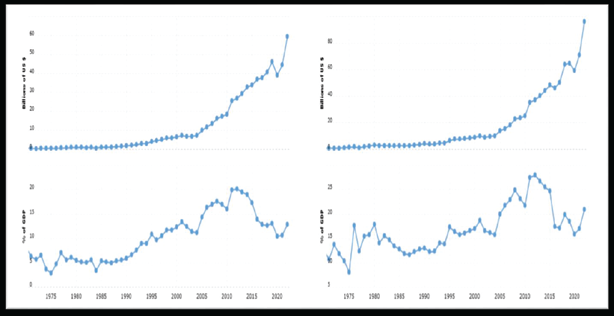
The textile and garment industry in Bangladesh is one of the primary engines that have been fueling the country’s economic growth. The aforementioned industry has witnessed significant advancements, exhibiting a quick expansion that has propelled it to the forefront of global apparel exporting (Swazan & Das, 2022). The significant impact of the industry on economic change cannot be understated, as it has resulted in the creation of jobs, the expansion of exports, and the injection of dynamism into the country’s economic environment. Also, import markets increased exponentially in a couple of years. Bangladesh exports were $59.28B4 and imports were $96.17B for 20225. Which indicates a big percentage of the total GDP leading to the country’s example of progress.
The inflow of remittances from the Bangladeshi diaspora has played a pivotal role in driving the country’s economic expansion. The remittance inflow reached a pick of 26 billion dollars in 2021 and currently, it’s nearly 20 billion dollars in 20226. The remittances, which are paid by Bangladeshi expatriates employed outside, have bestowed financial security upon numerous families. In addition to enhancing the nation’s balance of payments, these efforts have also had a positive impact on the quality of life for several households, thereby contributing to socio-economic welfare.
The allocation of resources towards infrastructure development, encompassing sectors such as transportation, electricity, and telecommunications, has significantly bolstered interconnectivity inside the nation of Bangladesh, hence facilitating expanded market accessibility. Furthermore, the country has successfully adopted a diverse range of social safety net initiatives aimed at offering support to marginalized groups, thereby guaranteeing that economic development is equitable and that the advantages of advancement are distributed across all sectors of the population.
With the approaching graduation of Bangladesh from the Least Developed Country (LDC) category in 2026, the aforementioned socio-economic accomplishments lay the foundation for a forthcoming era of progress and advancement. The process of transitioning into a developing nation entails a multitude of prospects and obstacles. The current situation necessitates the preservation of the advancements achieved thus far and the efficient resolution of emerging obstacles. The experience of Bangladesh provides useful insights and serves as an inspiring case study for other nations seeking to improve their socio-economic conditions in comparable contexts.
Notes
- World Bank Data sources[ Website and excel file: GDP (current US$) – Bangladesh | Data (worldbank.org)] ↩
- Macrotrends data on exports [ Source: Bangladesh Exports 1960-2023 | MacroTrends] ↩
- Macrotrends data on imports [ Source: Bangladesh Imports 1960-2023 | MacroTrends ] 06 ↩
- Remiitance inflow [Source: Bangladesh Remittances (tradingeconomics.com)] 07 ↩