
Research & Publications Web edition
What Do We Know?
This section of the report provides detail data regarding various aspects of the use of the DSA between October 2018 and August 2022.
Who is being accused, who is being detained?
Between October 2018 and August 2022, at least 2889 individuals have been accused under the law in 1109 cases. We have been able to gather information about the occupations of 1029 people. The breakdown of their professions is as follows (Table 10).
Table 10: Professions of the accused, Oct 2018 – Aug 2022
| Professions | No |
|---|---|
| Journalist | 280 |
| Educator | 51 |
| NGO & Activist | 10 |
| Politician | 301 |
| Student | 106 |
| Govt. Employee | 36 |
| Private Employee | 68 |
| Businessman | 87 |
| Legal Practitioners | 29 |
| Religious Leaders | 15 |
| Other Profession | 46 |
| Profession Not Found | 1860 |
According to this information, of those whose professions that are known, 29.25 percent are politicians, and 27.21% are journalists. Of the total accused, they constitute 10.42 percent and 9.69 percent, respectively (Figure 9).
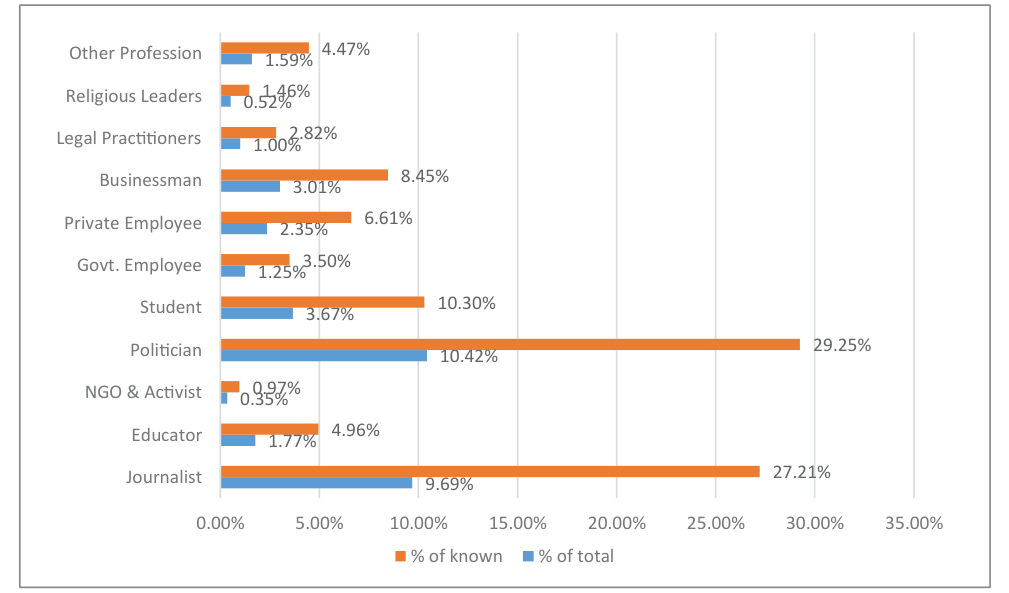
Note: ‘Other profession’ refers to the professions that are not listed under the specified professions above; ‘profession not found’ consists of the people that were unnamed, and their professions are not available.
In our previous report in April 2022, the data showed that the shares of politicians and journalists were on top of the list, with 30.98 percent and 25.24 percent of the accused whose professions were known, respectively. The pattern has held, but the share of individuals in both professions has increased significantly.
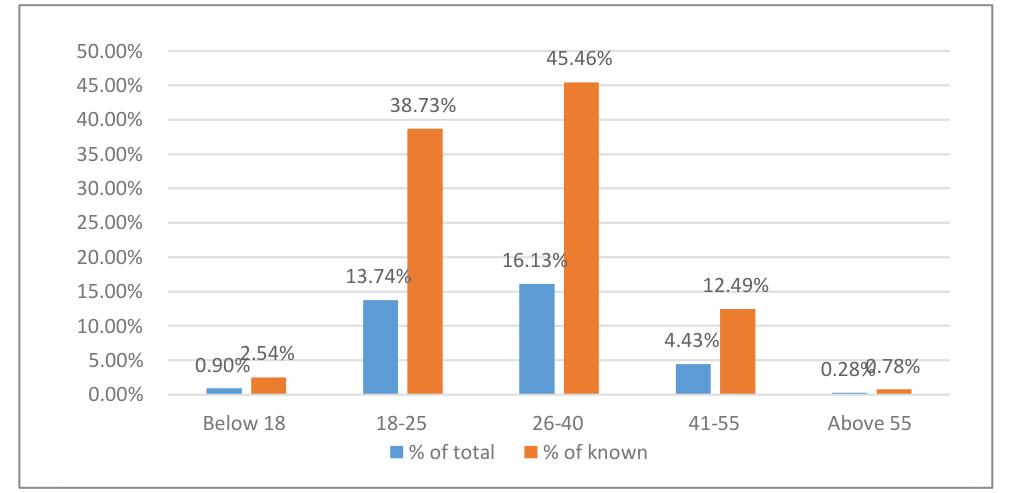
We have been able to gather information about the age of 1025 accused. Of these, 26 are below the age of 18. This is a disturbing development because it clearly shows that children have continued to remain vulnerable to the unrestrained use of the law. Overall, almost 84.2 percent of the accused belonged to the age group of 18-40. In terms of the number, accused within the age group 18-25 and 26-40 are close, 397 and 466, respectively (Table 11). Their shares are respectively 38.73 percent and 45.46 percent (Figure 10).
| Age group | No |
|---|---|
| Below 18 | 26 |
| 18-25 | 397 |
| 26-40 | 466 |
| 41-55 | 128 |
| Above 55 | 8 |
| Age Not Found | 1864 |
Table 11: Age of the accused, Oct 2018 – Aug 2022
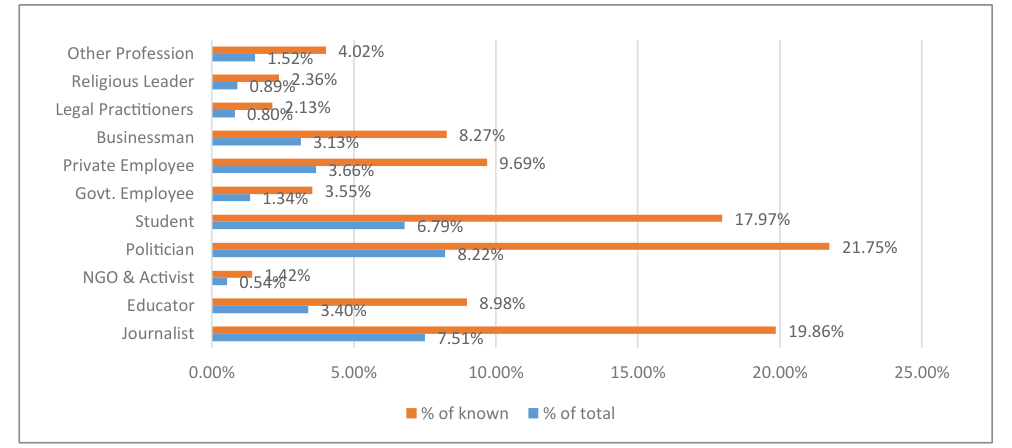
Our database has the record of 1119 individuals who have been arrested under the law over the period between October 2018 and August 2022. From various sources, we gathered occupational information of 423 people. Of them, 92 were politicians, 84 were journalists and 76 were students (Table 12), that is 21.75 percent, 19.86 percent, and 17.97 percent, respectively (Figure 11). The share of journalists among the arrestees has increased compared to our previous study period (January 2020 – February 2022), when it was 18.73 percent.
Table 12: Professions of the arrestees, Oct 2018 – Aug 2022
| Professions | No |
|---|---|
| Journalist | 84 |
| Educator | 38 |
| NGO & Activist | 6 |
| Politician | 92 |
| Student | 76 |
| Govt. Employee | 15 |
| Private Employee | 41 |
| Businessman | 35 |
| Legal Practitioners | 9 |
| Religious Leader | 10 |
| Other Profession | 17 |
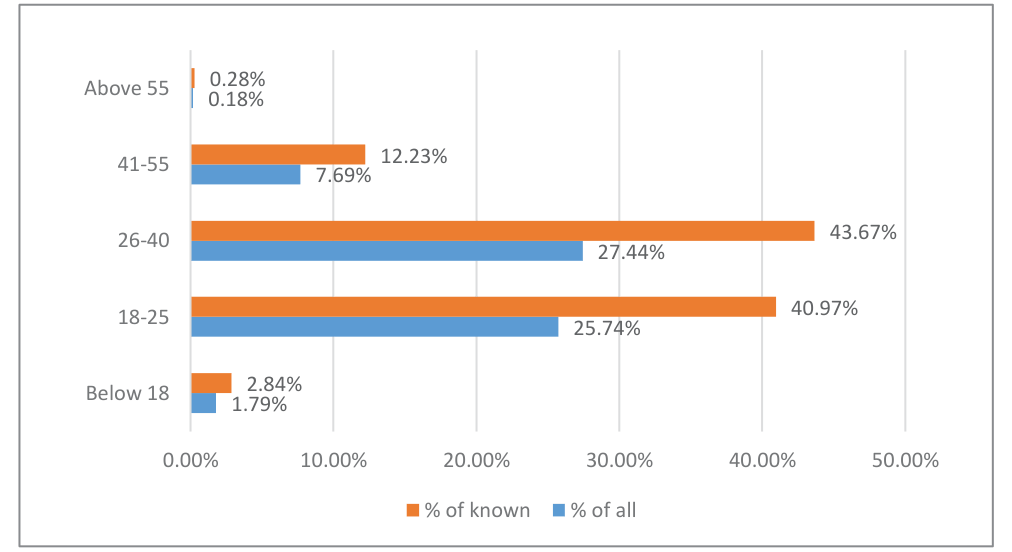
Among those who have been arrested (1119 individuals), we succeeded in confirming the age of 703 persons. Among them, 20 were underaged. The number was twelve when we analyzed the data in April 2022, covering information gathered between January 2020 and February 2022. As we mentioned regarding the underaged being accused, it is deeply disconcerting. The largest number of people arrested belonged to the 26-40 age group (307), followed by the 18-25 (288) age group. The third largest age group is 41-55 (86). Percentage-wise, 43.67% of the known arrestees are within the 26-40 group, and 40.97% are in the 18-25 age group (Figure 12).
Journalists as victims
In a 47-months period, 280 journalists have been accused. Among them, we have details about 253 journalists’ media affiliations – 109 are associated with national level media, and 144 are local journalists. Of the 280 journalists, a majority are associated with the print media – a total of 132, almost half of the journalists whose workplace has been identified. The second highest number of journalists are associated with online media – a total of 88. Online media journalists from outside Dhaka have been the largest number of victims – 82 individuals. It is not only that the journalists working outside the capital are being accused of violating the law, but they are also the victims of being detained. Of the 84 journalists who have been detained, 42 were local journalists. It is the print media journalists who were detained the most – 43, this is more than half of the total arrested journalists (Table 13).
Table 13: Workplace and medium of accused and detained journalists, Oct 2018 – Aug 2022
| Accused | Detained | ||
|---|---|---|---|
| Electronic Media | 31 | 9 | |
| National Journalists | Print Media | 72 | 19 |
| Online Media | 6 | 2 | |
| Electronic Media | 2 | 1 | |
| Local Journalists | Print Media | 60 | 24 |
| Online Media | 82 | 17 | |
| Not Specified | 27 | 12 | |
| Total | 280 | 84 |
These 280 journalists have been accused in 138 cases, filed by 138 people. Among these 138 accusers, 76 are aggrieved parties, while 44 individuals who haven’t been directly affected by the news or any other actions of these journalists filed cases. We have explored the political identities of these accusers and found that 27 of them belong to the ruling party and its affiliates. Of them, 13 belong to the Bangladesh Awami League, six of them belong to the Student League, six of them are members of the youth front, and two are members of the Swechasebak (Volunteer) League. In many instances, these journalists are alleged to have violated more than one section of the DSA. However, 54 journalists are accused of a breach of Section 25, and 61 are alleged to have violated Section 29. Section 25 deals with publishing, sending of offensive, false or fear inducing data-information, etc. It says 25(1), “If any person in any website or through any digital medium – a) intentionally or knowingly sends such information which is offensive or fear inducing, or which despite knowing it as false is sent, published or propagated with the intention to annoy, insult, humiliate or denigrate a person or b) publishes or propagates or assists in publishing or propagating any information with the intention of tarnishing the image of the nation or spread confusion or despite knowing it as false, publishes or propagates or assists in publishing or propagates information in its full or in a distorted form for the same intentions, then, the activity of that person will be an offense under the Act. (2) If any person commits any offense mentioned within subsection (1), the person will be penalized with imprisonment for a term not exceeding 3 (three) years of or fines not exceeding 3 (three) lacs taka or with both. (3) If any person commits the offense mentioned in subsection (1) for the second time or recurrently commits it, then he will be punished with imprisonment for a term not exceeding 5 (five) years or with a fine not exceeding 10 (ten) lacs taka or with both.” Section 29 deals with publishing, broadcasting and disseminating defamatory information. It says 29(1), “If a person commits an offence of publication or broadcast defamatory information as described in section 499 of the Penal Code (Act XLV of 1860) in any website or in any other electronic format then he will be sentenced to a term of imprisonment not exceeding 3 (three) years or fine not exceeding Tk.
5 (five) lac or both.” 29(2) says, “If any person commits the offence mentioned in sub-section (1) second time or repeatedly, he will be sentenced to a term of imprisonment not exceeding 5 (five) years or fine not exceeding Tk.10 (ten) lac or both.” Two other sections of the law have been used against the journalists – section 31 (18 cases, 27 accused); and section 26 (10 cases, 27 accused).
Educators as victims
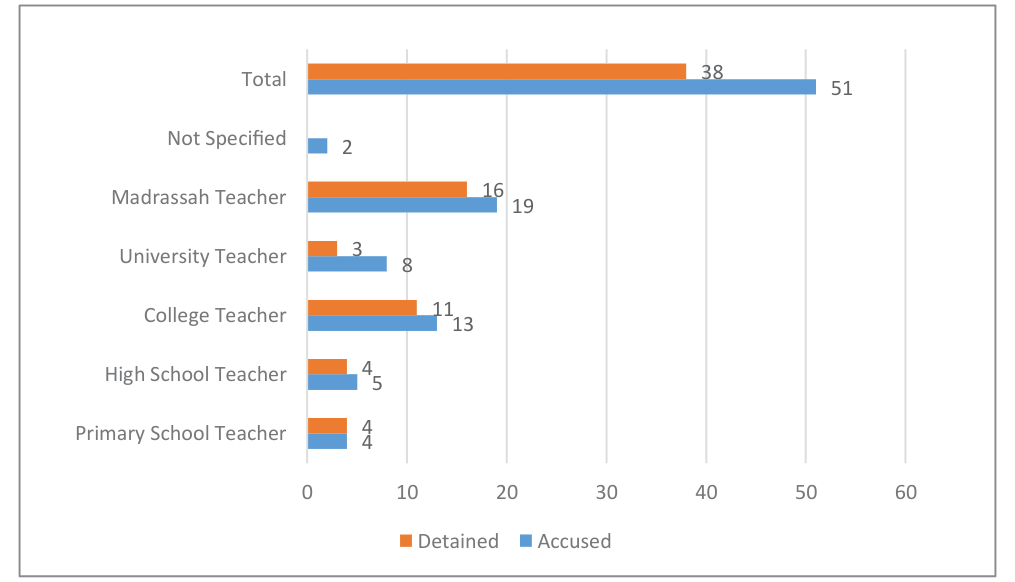
Our overall data showed that 51 educators have been accused; we gathered that 38 of them were arrested. Among the accused, madrassah teachers constitute the largest number, 19 and they, along with the 13 college teachers – have the highest number being detained. Altogether eight university teachers have been accused while three of them have been arrested (Figure 13). It is notable that of the accused, 37.25 percent were madrassah teachers; in the previous report we mentioned that the share was 41.46 percent. In the case of detention, the share of the madrassah teachers is 42.10 percent and college teachers is 28.95 percent. Our data show that the rate of arrests of educators is far greater than in any other profession – 74.51 percent of accused educators have been arrested during this period; in the case of primary school teachers, the rate is 100 percent.
Who are the accusers?
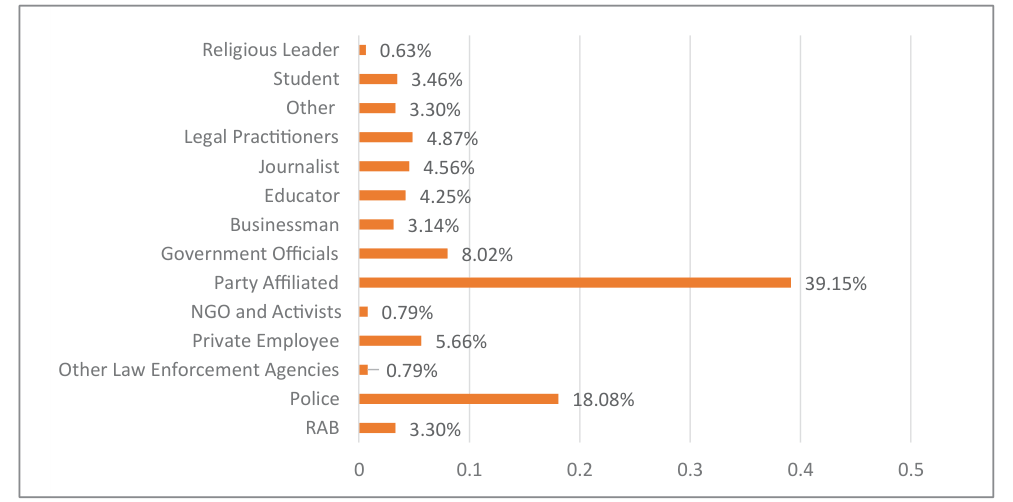
Of the 1109 cases in our database, the identities of accusers of 636 cases have been revealed. The breakdown shows that 141 cases have been filed by law enforcement agencies, and 51 cases have been filed by government officials. Considering that all of these have the government’s explicit and implicit approval, a total of 192 cases have the blessing of the authorities. After excluding the five cases filed by NGOs, the number of cases filed by individuals stands at 439. While there are instances of victims of wrongdoing, including sexual harassment, bullying, invasion of privacy, a significant number of complaints have been filed by individuals alleging defamation of other individuals (Table 14). The share of law enforcement agencies filing cases is 22.17 percent; this has increased from 21.85 percent of cases reported in April 2022. Altogether, the share of cases filed between October 2018 and August 2022 with the blessing of authorities is 30.19 percent. Among the cases filed by individuals, 249 cases have been filed by individuals with affiliations with political parties – a staggering 39.15 percent.
Table 14: Identities of accusers, Oct 2018 – Aug 2022
| Accuser | No |
|---|---|
| RAB | 21 |
| Police | 115 |
| Other Law Enforcement Agencies | 5 |
| Private employee | 36 |
| NGO and activists | 5 |
| Party Affiliated | 249 |
| Government Officials | 51 |
| Businessman | 20 |
| Educator | 27 |
| Journalist | 29 |
| Legal Practitioners | 31 |
| Other | 21 |
| Student | 22 |
| Religious Leader | 4 |
| Identity could not be ascertained | 473 |
| Total | 1109 |
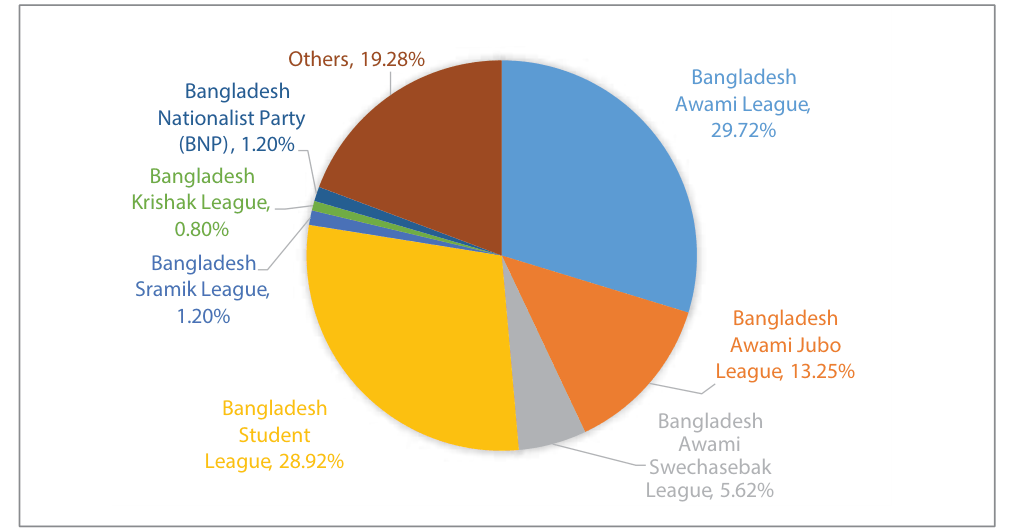
Of those who are affiliated with political parties, 198 of them or 79.51 percent are directly involved with the ruling Bangladesh Awami League (BAL); this is almost the same share from April 2022. As such, the ruling party activists have not been deterred by public criticisms that have been in the press about this phenomenon.
Table 15: Political identities of individual accusers, Oct 2018 – Aug 2022
| Political Identities of individual accusers | No |
|---|---|
| Bangladesh Awami League | 74 |
| Bangladesh Awami Jubo League (Youth front) | 33 |
| Bangladesh Awami Swechasebak League (Volunteers front) | 14 |
| Bangladesh Student League | 72 |
| Bangladesh Sramik League (Worker’s front) | 3 |
| Bangladesh Krishak League (Farmer’s front) | 2 |
| Bangladesh Nationalist Party (BNP) | 3 |
| Others | 48 |
| Total | 249 |
Among the accusers, we have been able to identify 42 individuals who hold elected positions at various national and local levels, which include seven members of the parliament (Table 16).
Table 16: Elected representatives as accusers, Oct 2018 – Aug 2022
| Categories of Elected Representatives | Number |
|---|---|
| MP | 7 |
| City Mayor | 6 |
| Municipality Panel Mayor | 1 |
| Ward Councilor | 11 |
| Chairman of Union Parisahd | 11 |
| Chairman of Upazila Parishad | 4 |
| Vice Chairman of Upazila Parishad | 2 |
| Total | 42 |
What are the Accusations, Who are the Accused, Who are the Accusers?
There are 22 sections in the Digital Security Act 2018 which deal with offenses and penalties; but the details of the cases show that primarily 16 sections have been used. In some instances, cases have been filed against the same person under multiple sections (Figure 16).
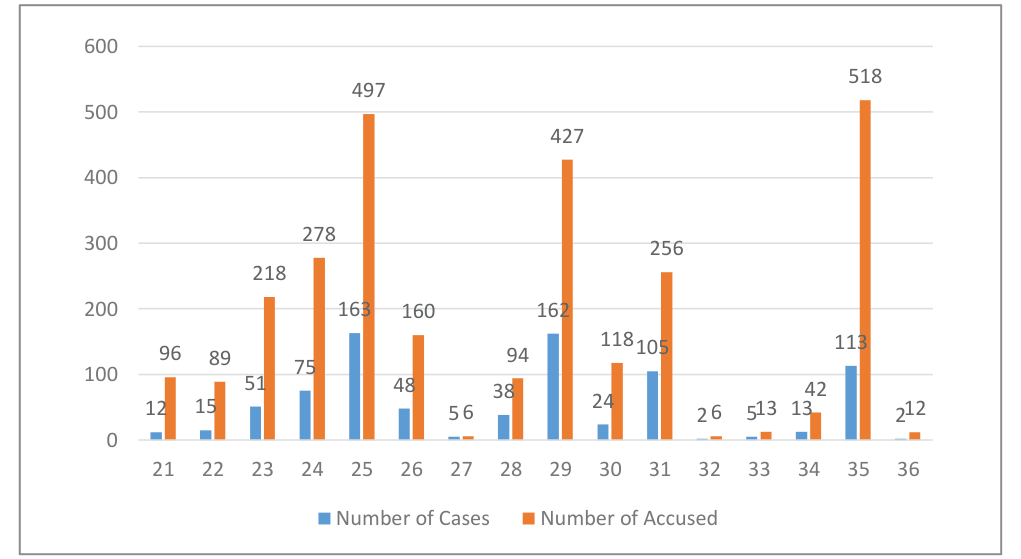
Section 25 has been used in the most instances (163), followed by Section 29 (162). However, more people have been accused under Section 35 (518). As mentioned before, Section 25 deals with publishing, sending of offensive, false or fear inducing data-information, etc. and Section 29 deals with publishing, broadcasting and disseminating defamatory information.
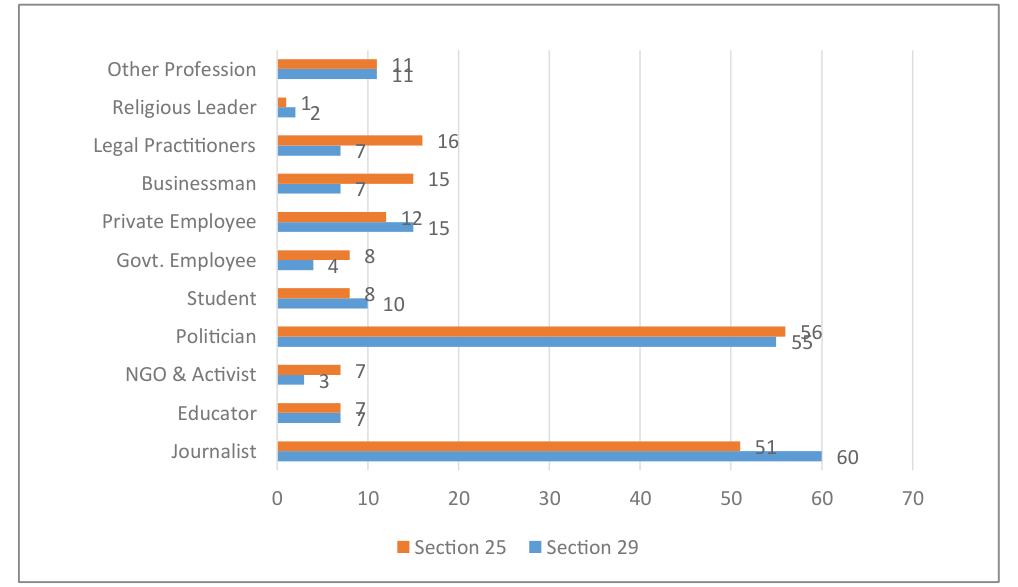
We have explored the professional identities of the accused under these two sections. Of the 427 accused in 162 cases under Section 29, 181 individuals have been identified by their professions. Most of them are journalists – 60; followed by politicians – 55. Regarding Section 25, of the 497 accused in 163 cases, 192 have been identified; most of them are politicians (56), followed by journalists (51). (Figure 17).
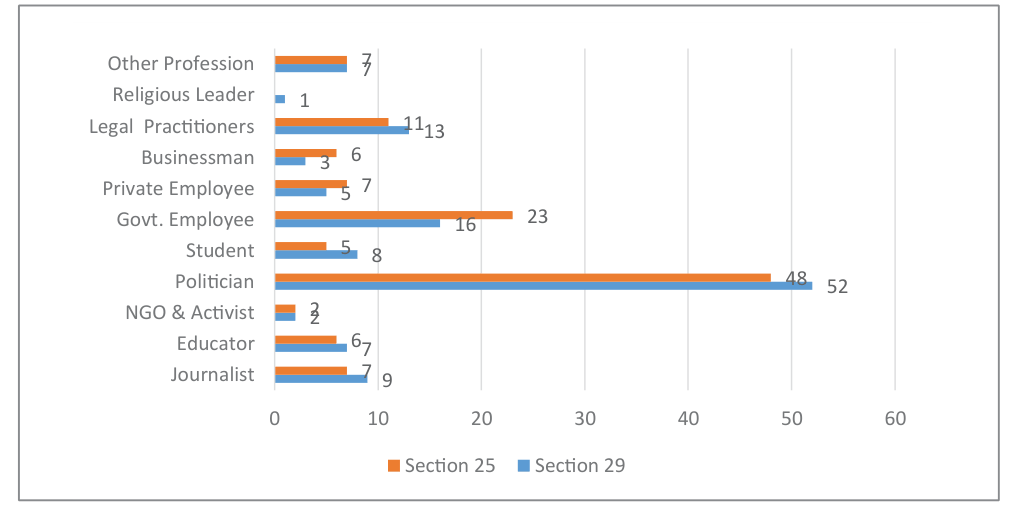
As for the accusers under these two sections, we identified the professional identities of 123 and 122, for Section 29 and Section 25, respectively. The accusers are overwhelmingly politicians in both instances. (See Figure 18).
Allegations of defaming the Prime Minister, Ministers, and Politicians
Since the introduction of the law in October 2018, hundreds of cases have been filed by law enforcement agencies and individuals. There have been instances of being accused, charged and convicted for allegedly defaming Prime Minister Sheikh Hasina under the ICT Act, the precursor of the DSA. For example, in 2013, a lecturer at the Bangladesh University of Engineering and Technology (BUET), Hafizur Rahman Rana, was tried in absentia and sentenced to seven years of imprisonment under the Information and Communication Technology Act (Hindustan Times 2013). In 2021, a cyber-tribunal in Rajshahi sentenced Bangladesh Nationalist Party leader of Natore to seven-years imprisonment on charges of sharing distorted pictures of Prime Minister Sheikh Hasina and former Indian Prime Minister Manmohan Singh on social media. The case was filed under Section 57 of the ICT Act in 2015. In March 2021, a 17-year-old boy was arrested for making comments in a video posted online against Prime Minister Sheikh Hasina, Indian Prime Minister Narendra Modi and Bangladeshi Foreign Minister M A Momen (Sakib 2021). In 2022, a student of Jahangirnagar University, named Shamsul Alam Babu, has been sentenced to seven years imprisonment under Section 57 of the ICT Act for allegedly “defaming Prime Minister Sheikh Hasina and Bangabandhu Sheikh Mujibur Rahman.” The case was filed in 2015 (Bangla Tribune 2022). These were far from exceptions, instead, similar instances have been reported in the press over the past nine years. Punitive actions have been taken against individuals by their employers, including universities on several occasions.
We examined the allegations filed under the DSA between October 2018 and August 2022. We found that 140 cases have been filed during this period alleging that the accused have defamed Prime Minister Sheikh Hasina. 21 of these cases were filed by law enforcing agencies, while 119 were filed by individuals. Sixty-four of these individuals belong to the ruling BAL and its affiliates. Among these organizations, the student wing of the party has filed 28 cases, Youth League members have filed eleven, Farmers’ League has filed two, the Volunteer wing has filed two and the Sramik League has filed one. Our database records that 115 accused were arrested.
We found that 64 cases have been filed for allegedly defaming ministers. Law enforcing agencies filed four cases, and the aggrieved minister or his/her family members filed six cases; the remaining 54 cases were filed by other individuals. Thirty-two of these individuals have direct affiliations with the ruling party and its various wings. The members and leaders of the student wing of the party filed 17 cases. The BAL activists filed eight cases, while the youth league filed four and the volunteer wing filed three cases. These cases resulted in the arrests of 51 individuals.
At least 168 cases have been filed alleging defamation of political leaders, primarily of the ruling party. In 69 instances, it was the aggrieved parties who went to the police and/or court while five were filed by law enforcement agencies. His/her supporters filed 94 cases. All but three cases of these were filed by supporters of the Bangladesh Awami League (BAL); two cases were filed by Jatiya Party supporters, and one was filed by the BNP. 120 individuals were arrested because of these cases.