
The Background
The disappearance of citizens, particularly with the direct knowledge and involvement of state agencies, which qualifies these disappearances as ‘enforced disappearances’, is not entirely a new phenomenon in Bangladesh. Between 1972 and 1975, during the Awami League regime, there were cases of disappearances and deaths of activists of the opposition parties, especially the Jatiya Samatantrik Dal (JSD). During the reign of the army, especially during the rule of General Ziaur Rahman (1975-1981), many became allegedly untraceable after various failed coups. Many people have gone missing since the start of the army operation in the Chattogram Hill Tracts in 1977 and the intensification of the activities of the insurgent group called the Shanti Bahini. In some instances, dead bodies of those who ‘disappeared’ were found, but no one has taken responsibility for their killing. Many have remained missing to date. The abduction and disappearance of Kalpana Chakma took place in 1996. It has remained a mystery. Despite these incidents, occasionally in large scale in particular periods, enforced disappearance didn’t become systematic, regular, and widespread until 2010. The number has increased over time, the scope of incidents has expanded and citizens of various walks of life have become victims.
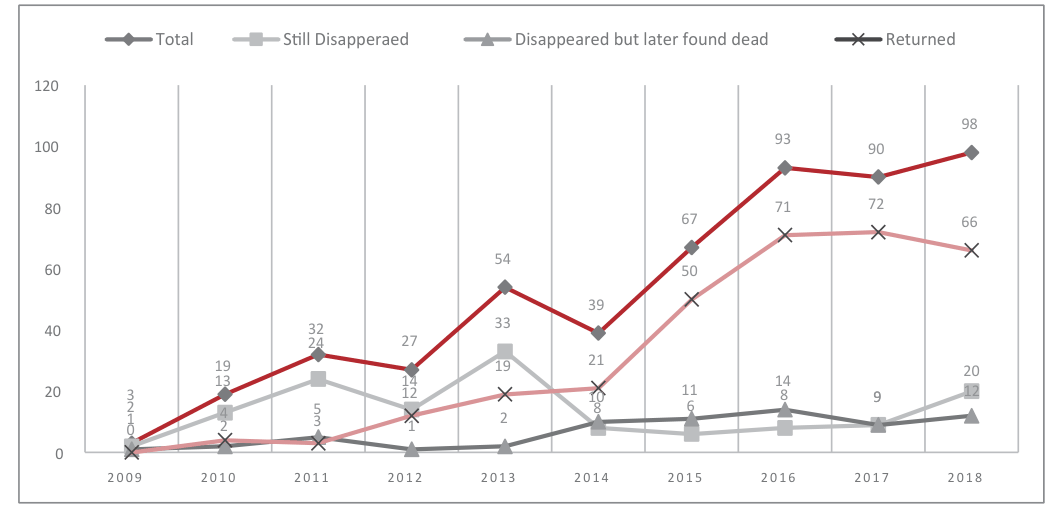
Data gathered by two human rights organizations between 2009 and 2018 reveal the trend of the incidents of enforced disappearances. According to Odhikar a total of 522 persons became victims of enforced disappearances; among them 137 remained missing, 67 were found dead after being reported to be missing, and 318 returned (Figure 1).
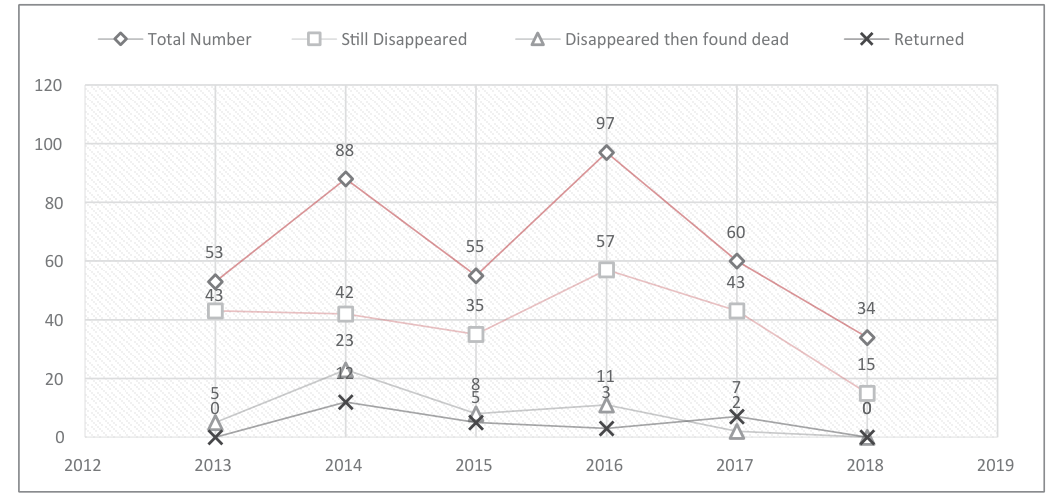
Source: Odhikar Ain O Salish Kendra (ASK)’s documentation provides data from 2013 and shows the pattern of fluctuations of the incidents (Figure 2). There have been 387 cases of enforced disappearances, of which 235 persons remained missing, while 49 individuals were found dead after being reported missing.
Source: Ain o Salish Kendra (ASK)
Most of the descriptions of alleged enforced disappearances gathered from family members, friends and bystanders have been similar. They have alleged that these individuals have been picked up by plainclothed individuals identifying themselves as members of law enforcement agencies, especially RAB. In some instances, they wore jackets bearing the name. In each instance, when the family members contacted the local police stations, office of the Detective Branch or the local station of the RAB, they were told, ‘he is not here’. Not only did the law enforcement agencies deny their involvement but often the families faced harassment for making such allegations. In most cases, local police stations declined to register even a general diary of a missing person until it had been reported in the press. In many instances, families were afraid to inform the media because they thought this would only jeopardize any possibility of having their loved ones back.
The extent of the incidents of enforced disappearances is reflected in two occurrences. On December 4, 2013, six youths were picked up by plainclothed people on a microbus from the street of Dhaka, Witnesses alleged that the abductors were apparently members of law enforcement agencies. Dead bodies of the five of them were found a few days later. One is still missing. On April 27, 2014, in Narayanganj, seven people were abducted from two different cars. These include Nazrul Islam, a panel Mayor of the Narayanganj City Corporation, his lawyer, his four associates and chauffeurs of two cars who were abducted in broad daylight. Four days later their dead bodies were found in the river. Years later a local court sentenced 27 members of RAB, including three officials for their involvement, which was upheld by the High Court (Rita 2020). During this period, the number of incidents increased so precipitously that in 2017 the head of the country’s National Human Rights Commission (NHRC) acknowledged that people are living in fear of being a victim at any time (Uddin 2017).
Documentations of incidents between 2013 and 2018 by the ASK also showed that 53 people, who were reported to be missing or picked up by law enforcing agencies were shown arrested. But most of them were shown arrested days after they were reportedly picked up by the police or RAB.