
The New Prime Minister Faces Tough Tests Ahead
Zillur Rahman | 19 February 2026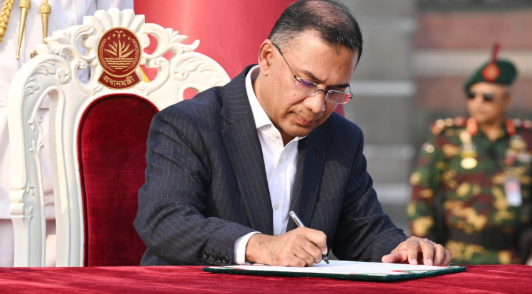
A landslide victory often feels like a coronation. Streets erupt, social media lights up, and the mandate seems unassailable. For the Bangladesh Nationalist Party (BNP) and the newly sworn-in Prime Minister Tarique Rahman, this was no ordinary victory. Winning 212 out of the 297 parliamentary seats with confirmed results, the BNP has secured a mandate that few could have imagined a decade ago. Analysts and observers alike attribute this overwhelming success to Tarique Rahman’s strategic vision, disciplined organisational leadership, and ability to connect with voters across urban and rural divides. His stewardship transformed fragmented opposition energy into coordinated campaigns while mobilising the party’s grassroots network with remarkable efficiency.
Yet, even as celebrations sweep the country, the scale of triumph brings both opportunity and burden. Electoral dominance provides unmatched authority, but it also raises expectations, heightens scrutiny, and draws the attention of both domestic and international adversaries. As the BNP returns to power after two decades, Tarique Rahman’s challenge now is to translate electoral success into stable governance and institutional credibility, and to sustain public trust.
Over the years, the state machinery—civil bureaucracy, law enforcement, and regulatory bodies—has been shaped by partisan politics. As a new political figure, as prime minister for the first time in 30 years, Tarique Rahman’s leadership will be tested in asserting authority while avoiding institutional paralysis. Sweeping purges may satisfy loyalists, but risk alienating essential civil servants, while excessive restraint could frustrate grassroots supporters eager for rapid “correction” of past grievances. Restoring faith in public institutions will require visible commitment to the rule of law, judicial independence, and merit-based appointments. Here, Tarique needs to balance assertiveness with prudence, signalling change while preserving continuity, and demonstrate that a landslide mandate can be exercised responsibly.
The opposition remains a formidable challenge. While the Awami League remains weakened, it can still mobilise public demonstrations in the future. Meanwhile, Jamaat-e-Islami—which secured 68 seats, while its allies got nine—is poised to be a vocal and organised adversary with its strong parliamentary representation and enduring street-level influence. Tarique Rahman’s ability to manage these dynamics—containing parliamentary obstruction, preempting street mobilisations, and countering political narratives—will define the durability of his administration. The challenge, again, lies in striking the right balance: projecting strength without provoking instability and demonstrating responsiveness without appearing indecisive.
Even with 212 seats, electoral victory does not eliminate the need for diplomacy, both at home and abroad. International observers, particularly in Western capitals, remain attentive to policies that might empower radical elements at the expense of women’s rights, minority protections, or counterterrorism commitments. Every major domestic decision may carry international implications. Tarique will need to reassure both foreign partners and domestic constituencies that Bangladesh will be governed responsibly henceforth.
Foreign relations will test the government’s strategic capacity. Relations with India, Bangladesh’s key partner, must be carefully managed. Past tensions over trade, border management, and regional cooperation make New Delhi cautious. Any misstep could spill into economic consequences, particularly in sectors dependent on regional stability. Moreover, over-accommodation risks domestic criticism from nationalist supporters. At the same time, China remains a vital partner, particularly in infrastructure and investment through the Belt and Road Initiative. Western governments continue to emphasise democratic governance, labour standards, and trade credibility. Tarique Rahman’s ability to navigate these complex diplomatic currents by asserting Bangladesh’s interests without alienating key partners will be central to his legacy.
Economic realities amplify the stakes. Inflationary pressures, foreign exchange constraints, and global supply chain volatility limit fiscal manoeuvring. Public expectations are soaring—job creation, energy stability, and price moderation are anticipated immediately. Structural reforms, including banking transparency, revenue mobilisation, and subsidy rationalisation, are essential and politically sensitive. The newly sworn-in PM’s leadership will be judged on whether the BNP can convert electoral euphoria into tangible economic outcomes. Managing competition within the party—senior leaders seeking influence over young reformists advocating modernisation—will require both political savvy and managerial skill.
Tarique Rahman’s decades-long political career has been marked by exile, controversy, and polarising rhetoric. Now, as prime minister, his personal transition from opposition figure to head of government will be closely scrutinised. He must demonstrate inclusive leadership, institutional respect, and governance competence. Concentrating power too tightly risks internal resentment; delegating too widely risks incoherence. Navigating this balance, while the nation watches, will test not only his political instincts but also his capacity to inspire confidence across Bangladesh’s divided society. Leadership in this context is less about electoral rhetoric and more about discipline, pragmatic governance, and the ability to deliver results under pressure.
If Tarique Rahman can leverage his electoral triumph into inclusive governance, pragmatic foreign policy, and meaningful economic reform, this victory could mark a significant turning point for Bangladesh. If not, the landslide may become the opening chapter in yet another cycle of political confrontation—proving, once again, that in politics, the bigger the victory, the lonelier and more complex the road ahead.
Zillur Rahman is a political analyst and president of the Centre for Governance Studies (CGS). He is the host of Tritiyo Matra on Channel i. His X handle is @zillur.
Views expressed in this article are the author's own.