
The Green Planet We Must Not Lose
Roman Uddin | 12 April 2026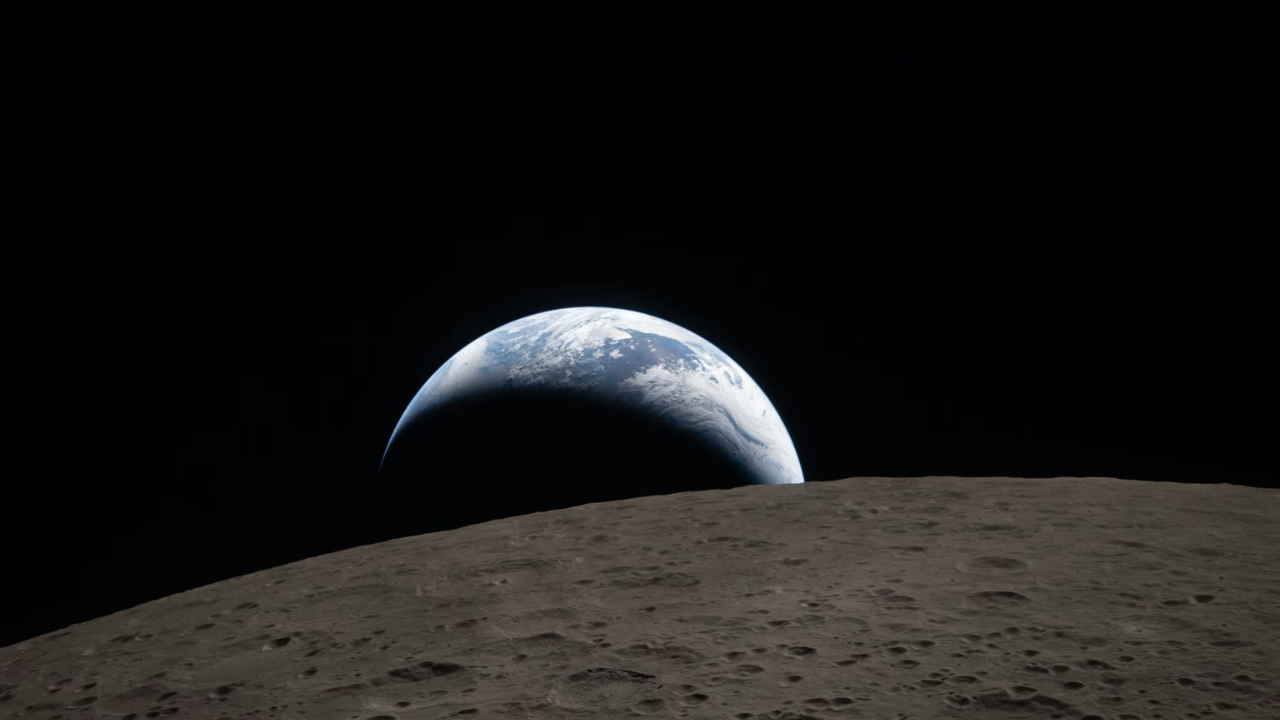
From time immemorial, humans have gazed at the heavens with awe and a sense of wonder. We stand on a small planet, under a sky that seems silent, and yet we keep asking questions of it. The stars do not speak in our language, but they have shaped our language of curiosity. From the first myth of the heavens to the telescope, from mathematics to rockets, the human mind has refused to accept ignorance as its final home. Space reminds us of our smallness, but it also reveals the dignity of our desire to know. Artemis II, which launched on April 1, 2026, and splashed down on April 10 after 9 days, 1 hour and 32 minutes, belongs to this long human story of asking, risking, learning and returning.
The road to Artemis II began long before this mission. It began with the early race to understand flight, with Sputnik, with Yuri Gagarin, with Apollo, and with the astonishing moment when humans first walked on the Moon in 1969. After Apollo, humanity did not abandon space, but it turned toward orbital laboratories, satellites, robotic probes and the International Space Station. Artemis is the next great chapter. Artemis I tested the Space Launch System and Orion without crew. Artemis II carried four astronauts, Reid Wiseman, Victor Glover, Christina Koch and Jeremy Hansen, around the Moon, becoming the first crewed lunar flight in more than half a century.
The astronauts’ journey was not a simple sightseeing flight. It was a carefully designed test of human life in deep space. In the first hours after launch, the crew entered a high Earth orbit and began checking Orion’s systems. They tested life support, communications, navigation and the spacecraft’s behavior with people aboard. They also performed a proximity operations demonstration, using the spent upper stage as a target, an important rehearsal for future missions that will need complex maneuvers near the Moon. These tasks may sound technical, but they are the hidden grammar of exploration. Before a human being can walk safely on another world, the spacecraft must be trusted in silence, distance and danger.
As Orion moved outward, Earth changed before their eyes. What had been ground, city, border and road became a shining sphere. The astronauts crossed into a region that no human had visited for more than half a century. NASA reported that the crew traveled about 695,081 miles and reached more than 252,000 miles from Earth, farther than any humans had gone before. At its closest approach, Orion passed within thousands of miles of the lunar surface before looping around the far side and beginning the return home. The Moon, so familiar in poetry and childhood, became once again a place of human presence, not by landing, but by witness.
Their experience was both scientific and deeply human. They worked through checklists, monitored systems, wore and tested equipment, spoke with mission control and shared images and reflections with the world. The crew’s words and photographs allowed people on Earth to travel with them in imagination. Through NASA briefings, live coverage, mission updates and post-flight reports, we came to know their journey not as an abstract achievement, but as a lived passage: launch pressure, weightlessness, the strange rhythm of days inside Orion, the sight of the Moon, and finally the violence and relief of re-entry. The charred Orion capsule after splashdown became a visible reminder that return is also part of exploration. To come home from the Moon requires courage, calculation and a heat shield strong enough to protect life.
The achievement of Artemis II is therefore not only that it went around the Moon. It proved that human deep-space flight can begin again. It gave engineers real data from a crewed Orion mission. It gave future missions confidence in systems that cannot be fully understood in theory alone. It strengthened cooperation between NASA and international partners. It restored to public imagination the possibility that the Moon is not merely a museum of Apollo, but a frontier for science, discipline and shared human purpose.
Yet the deepest lesson of Artemis II may not be about the Moon. It may be about Earth. From space, Earth is not seen as a battlefield of borders. It is seen as one bright, fragile, green-blue home. The atmosphere that protects us is thin. The oceans that feed clouds are finite. The forests that breathe with us are vulnerable. The planet looks peaceful from far away, and that view should shame our violence.
If human intelligence can send a spacecraft around the Moon, it should also be wise enough to protect rivers, soil, air and life. If nations can cooperate to guide astronauts through danger, they should cooperate to reduce hunger, disease, hatred and environmental destruction. The same mind that calculates a lunar trajectory must not be used only to build guns, atom bombs and missiles. Technology without wisdom becomes a threat to its maker.
Artemis II therefore asks a moral question: what kind of species do we want to become? A species that reaches the Moon while poisoning its own home? A species that maps the stars while failing to protect children from war? Or a species that uses knowledge to enlarge compassion?
The Moon does not need us. Mars does not need us. The universe can continue without human applause. But Earth needs human responsibility, because human power has become large enough to wound it. Artemis II should not make us arrogant. It should make us humble. We have crossed a little distance in a vast cosmos, and that little distance should teach us how precious home is.
The astronauts returned from space, but the real return must happen inside human civilization. We must return to care, to reason, to restraint, to the old wisdom that life is sacred because it is rare. Artemis II is a triumph of science. Its greater meaning will depend on whether we allow that triumph to change our conduct on Earth.
• Roman Uddin is a Senior Research Associate and Youth Outreach Program Coordinator at Centre for Governance Studies (CGS)
Disclaimer: Views in this article are author’s own and do not necessarily reflect CGS policy