
What India’s Youth Victory Means for South Asia
Zillur Rahman | 04 August 2026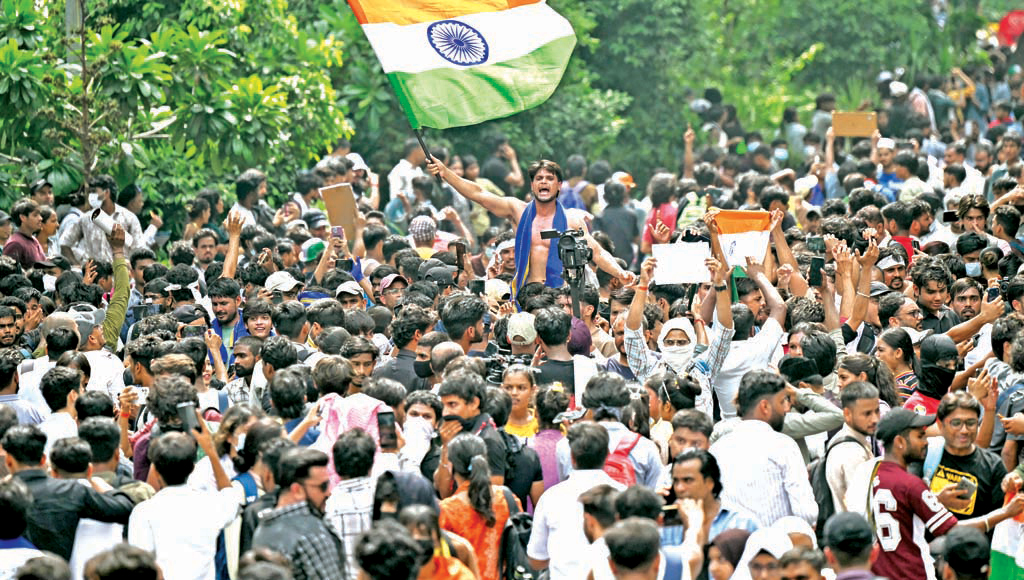
A political movement referring to itself as the ‘Cockroach Janta Party’ might have easily been laughed off. The group was unorganised, without a renowned political dynasty backing it, and even lacked a proper name. The movement started with memes, humour and the appropriation of an alleged derogatory name used for unemployed young Indians. However, within weeks, this seemingly nonsensical movement turned into a youth-led protest campaign across India, forcing hundreds into the streets and causing Indian education minister Dharmendra Pradhan to resign.
The protesters’ initial demand was urgent. Repeated exam paper leaks and irregularities had plunged the future of millions of Indian students into a state of unpredictability. Indian families spend extraordinary amounts of time and money on their children’s education in preparation for competitive examinations. Students often spend several years in coaching classes preparing for a relatively small number of places in universities and government services. Thus, when an examination paper gets leaked, it not only ruins the examination process but destroys the whole notion that hard work and merit should be rewarded.
However, protesters soon widened their initial demands from merely correcting one examination paper to the need for accountability, compensation for affected families, protection of protesters and further educational reforms. Underneath the stated demands of protesters lies their frustration with unemployment, increasing cost of living, inequalities and a political system which talks endlessly about India’s rising economy yet fails to provide its educated youth with a secure future.
That is exactly the contradiction in India’s success story. India is one of the fastest-growing major economies of the world, a technological leader and an ever-increasing global player. However, impressive economic figures cannot automatically produce enough stable, dignified and well-paid job opportunities. Researchers keep revealing especially high levels of unemployment among educated young Indians. For that generation, the economy is felt through entrance examinations, long recruitment delays and unstable job conditions.
The Cockroach movement knows how to transform that frustration into political rhetoric. Protesting supporters turned mockery into an identity. The cockroach became a sign of those whom the establishment considered irritating, insignificant and dispensable, yet refusing to disappear. Protesters used humour, videos, parodies and memes to confront a highly communicative government and party.
This was not just ‘online activism.’ The protesters gathered in front of Jantar Mantar in Delhi, organised hunger strikes and tried to march towards parliament. Roses and copies of the Indian constitution were used as a symbol of the non-violent and democratic character of the movement. Supporters used food delivery apps to send food to protesting sites. Police used force and imposed restrictions, and images immediately spread, inspiring others to join the movement.
The government promised to deal with examination leaks; however, protesters demanded not just assurances but political responsibility. Pradhan’s resignation after 36 days of protests therefore became not just the resignation of a government minister. It showed that the government of Narendra Modi could be waited out.
Compared to similar youth movements of other South Asian countries, one can’t help but compare the situation in India to that. In 2022, Sri Lanka witnessed the Aragalaya protests initiated due to an economic crisis, shortages, and public outrage against the Rajapaksa family. Protesters occupied government buildings, and President Gotabaya Rajapaksa had to flee and resign.
In 2024, in Bangladesh, the protests emerged as a reaction against public sector employment quotas. A violent response from the government turned a relatively limited student protest into a nationwide protest against authoritarianism and denial of political rights. Eventually, Sheikh Hasina had to resign and leave the country.
In 2025, Nepal saw the ‘Gen Z’ protests that were initiated by limitations of social media. However, frustrations with corruption, political stagnation, unemployment and the luxurious lifestyle of political families took the protest movement much farther and forced the resignation of prime minister KP Sharma Oli.
The pattern is obvious. Some specific demand serves as a trigger for accumulated frustrations. Young people start using a new political language outside of traditional parties. Social media disrupts the government’s monopoly on information. An insensitive or violent response makes people angrier. A government which initially did not wish to listen to the protesters eventually finds itself in the position of having to retreat.
However, India is not another country which should be included in that list. Since India gained independence, there have been no military coups in the country. National governments were never overthrown by means of mass protests. Governments change by elections, parliamentary process and constitutional procedures.
India has certainly seen transformative protest movements before. The movement of Jayaprakash Narayan helped pave the way to Indira Gandhi’s downfall after the Emergency, but she was overthrown during the 1977 election. The movement led by Anna Hazare on anti-corruption protests significantly changed the political landscape of the country and helped to give rise to the Aam Aadmi Party. The farmers’ protests forced the Modi government to withdraw the three controversial agricultural laws. These movements influence the power balance but do not replace the constitutional process.
India’s size, federal structure, regional diversity and deeply embedded electoral system also act as shock absorbers. Dissatisfaction can be expressed through state elections, regional parties, courts, legislatures and civil society. While some movements can be very influential in Delhi, it may have quite a different effect in Tamil Nadu, West Bengal or Uttar Pradesh. Also, a tradition of the Indian army being under civilian command greatly separates India from other countries where political crisis leads to military involvement.
The significance of the Cockroach movement is thus not showing that the Modi government is going to fall. It rather shows how even a government which is usually perceived as strong can be held accountable if the movement stays peaceful, uses creative communications and organises around demands that are clear for ordinary citizens.
There is also a lesson for Bangladesh here. Removing the government and governing effectively afterward are completely two different things. Usually, protest movements unite people by their common enemy but find it hard to find common positions regarding institutions, economic policies and power distribution. The experience of Bangladesh, Sri Lanka and Nepal proves that moral legitimacy gained on the street can very quickly become obsolete because of failure to fulfil expectations.
The protesters of India managed to avoid that trap. They asked for a measurable concession, received it and left without claiming any mandate to rebuild the political system. Whether the movement will become a lasting democratic force depends on its ability to evolve from viral symbolism without turning into another political party or an opposition tool.
But the governments of South Asia should take note of that. The region’s youth is unwilling to accept unemployment, corruption, hereditary privileges and government arrogance as eternal realities anymore. They may not overthrow the governments, and not every protest should aim to do that. However, the generation considered to be distracted, apolitical and chronically online is learning that organised citizenship can have real political consequences.
The cockroach may seem to be an odd symbol of democratic renewal. But its message is clear.
Zillur Rahman is a political analyst and president of the Centre for Governance Studies. He hosts Tritiyo Matra on Channel i and writes on geopolitics, strategic affairs, and governance.
This article was originally published onThe Wire.
Views in this article are author’s own and do not necessarily reflect CGS policy.