
Tightrope Walk
Sushant Singh | 27 August 2026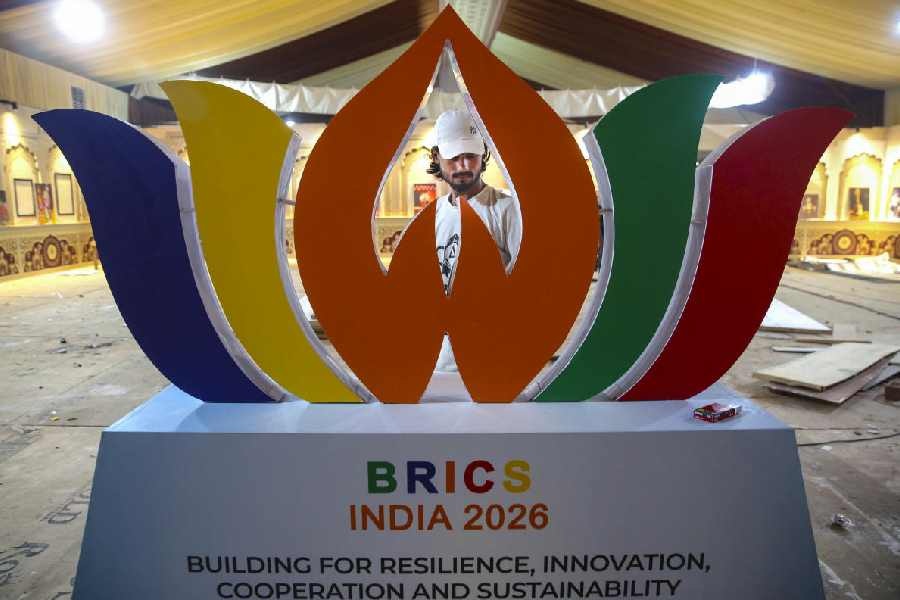
India must avoid signing on to West-driven agendas that would alienate Russia, China or Iran, while simultaneously resisting Sino-Russian attempts to turn BRICS into an explicit anti-West platform
The term, BRIC, was coined 25 years ago by the Goldman Sachs economist, Jim O’Neill, to describe Brazil, Russia, India and China as emerging economies that would gain weight in global GDP. It was a research label, not a blueprint for an institution or a common geopolitical strategy. Political leaders of these countries subsequently appropriated the acronym and held the first BRIC summit in 2009, adding South Africa the next year and turning BRIC into BRICS. The group went on to create the New Development Bank in 2015, but beyond that single institution, it has not articulated a mandate that binds members in clear, measurable forms of cooperation. In the last two years, Egypt, Ethiopia, Iran, Indonesia, Saudi Arabia and the United Arab Emirates have joined BRICS which has left the expanded bloc functioning mostly as a loose consultative forum.
As the current chair of BRICS, India is scheduled to host a summit in New Delhi next month. For India, BRICS has never been an anti-West project, and it has consistently resisted attempts to cast it as a counter-G7 platform. New Delhi frames BRICS as one plank in its policy of multi-alignment that seeks simultaneous engagement with the United States of America, Europe, Russia, China and the Gulf without accepting bloc commitment. India sees BRICS instrumentally — as a forum for selective cooperation on some issues like development finance while avoiding any binding commitments on geopolitical issues. This approach has become sharper since the US president, Donald Trump, took visible offence at some BRICS narratives such as de-dollarisation, prompting Narendra Modi to walk back from his rhetoric of using domestic currency for trade.
In practice, BRICS functions for India as a geopolitical balancing mechanism that allows it to hedge between Western partners and major non-Western actors such as China, Russia and Iran. Within the grouping, India projects itself as a bridge between the West and the rest and uses summit communiqués and working groups to keep channels open with countries that have strained ties with Washington. This posture is presented by Modi as evidence of a doctrine of multi-alignment, but the record shows a narrow transactionalism that rarely converts into substantive outcomes beyond symbolic participation. This approach requires constant swings to ensure that relations with one bloc do not damage partnerships with other partners. The Modi government has struggled to explain how this balancing act yields tangible benefits for India. Even though the strategic outcomes remain consistently underwhelming, foreign policy elites in New Delhi celebrate this ambiguity as a sophisticated diplomatic achievement. A rigorous empirical evaluation demonstrates that refusing to take definitive stands has rendered India irrelevant during critical moments of international crisis.
India’s long-standing argument is that a multipolar Asia is necessary for a multipolar world. BRICS is seen as a vehicle to advance that claim. It would want other member states to remember that Chinese hegemony cannot replace Western dominance, but China’s relative weight within BRICS and Beijing’s parallel efforts through the Belt and Road Initiative have made that proposition unpalatable. The economic disparities between India and China since 2014 have sharpened the asymmetry inside BRICS and exposed India’s limited ability to shape group outcomes. The Modi government would like to use BRICS to constrain Chinese dominance, but in negotiations it ends up reacting to Chinese and Russian proposals rather than setting the agenda.
Managing internal cohesion inside an enlarged BRICS has become a central challenge for India’s presidency, particularly after visible friction between the UAE and Iranian representatives in recent meetings. The group now includes states with directly conflicting regional interests, which makes consensus on issues from energy security to Middle East crises difficult. For New Delhi, the tightrope is twofold. It must avoid signing on to West-driven agendas that would alienate Russia, China or Iran, while simultaneously resisting Sino-Russian attempts to turn BRICS into an explicit anti-West platform.
Leadership optics around summit attendance reinforce this pressure. The Russian president, Vladimir Putin, has confirmed his attendance but participation by Xi Jinping remains crucial to the credibility of the BRICS summit. China’s domestic discourse has increasingly featured online mockery of India, reflecting strained ties, but the Modi government’s persistent efforts to placate Beijing are likely to result in the Chinese leader being present at the summit. The presence of Iran’s president will affect both public perception and the likelihood of negotiating an unanimous declaration. Even if there is a joint declaration, India’s presidency faces a real possibility of only the lowest common denominator language on current global challenges, undercutting Modi’s self-styled image of great diplomatic prowess as a Vishwaguru.
BRICS will ultimately be judged on deliverables rather than on communiqués, and this is where India’s presidency is badly struggling. The New Development Bank exists but has not yet transformed infrastructure financing in the Global South in ways that match the rhetoric around alternative institutions. Expanded BRICS membership has not translated into robust trade, investment or technology frameworks with clear benefits for Indian citizens. Environmental cooperation on climate change, biodiversity, land degradation and water scarcity remains the least controversial entry point for practical work, but the issue seems to have fallen off the agenda. Under Modi, the government has also devoted far more energy to branding and event management — as in the case of the G20 Summit — than to building usable mechanisms in areas like health security or supply chain resilience.
The Modi government projects a domestic image of global leadership through these summit spectacles, but BRICS is not part of a coherent grand strategy for India. The utility of BRICS for New Delhi is only in ensuring regular communication with all sides, projecting diplomatic relevance, delaying difficult geopolitical choices — and appeasing Modi’s domestic supporters. India invokes BRICS to support its rhetoric on a multipolar world and reform of global institutions, yet its own behaviour remains cautious whenever those debates risk undermining its partnership with the US. This might protect India’s room for manoeuvring but it also exposes the limits of Modi’s grandstanding of leading the Global South or securing India’s strategic sovereignty. His approach offers no concrete solutions to the grave security and economic challenges currently facing 1.5 billion Indians. BRICS is only the latest evidence of that glaring political failure.
Sushant Singh is lecturer at Yale University.
This article was originally published on Telegraph Online.
Views in this article are author’s own and do not necessarily reflect CGS policy.