
Does Bangladesh Really Need to Join BRICS or ASEAN?
Zillur Rahman | 24 August 2026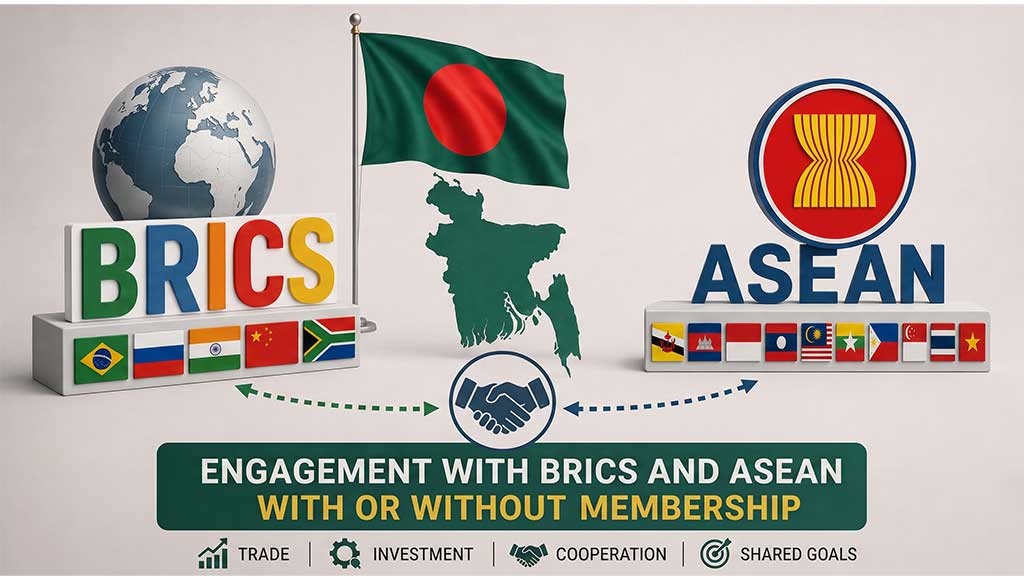
FOR small countries, membership in international associations can be particularly attractive. Being a part of some forum creates visibility. Membership in the club provides access to key officials and institutions that are usually inaccessible to ordinary countries. It is possible to use membership in the association to show that the country has achieved a certain level of influence on international affairs. Bangladesh has not remained indifferent to the above factors.
Over the past several years, two names have repeatedly appeared in discussions of the country’s future foreign policy positioning: BRICS and ASEAN. The past government of Sheikh Hasina has shown great interest in Bangladesh’s membership in BRICS, especially as the association began to expand beyond its initial five members. Bangladesh has long sought closer ties with ASEAN, and the idea of becoming more involved with this organisation continues to enjoy support across various political and policy circles. Both ambitions deserve to be considered carefully. However, perhaps we have been asking the wrong question.
Instead of debating the relative importance of the two associations and discussing their differences regarding geographical position or direction in the context of the geopolitical situation, it seems more reasonable to ask another question: does Bangladesh really need to be a member of either BRICS or ASEAN? And then we need to determine which goals can be achieved through such membership that are not achievable through bilateral relations, trade deals or other forms of partnership.
It makes sense to begin with BRICS. Undoubtedly, the political weight of BRICS is constantly growing. The forum initially united five countries — Brazil, Russia, India, China and South Africa. Now it includes a much wider range of large emerging countries, major energy producers, middle powers and countries dissatisfied with varying degrees with the traditional dominance of Western countries in international affairs. For China and Russia, BRICS is one of the tools to create a more multipolar world order, and for countries like India, Brazil, Indonesia and the United Arab Emirates, participation in BRICS is much more complex and controversial. They maintain close relations with the USA and Europe while seeking to increase their strategic autonomy and play an increasingly prominent role in the developing countries. Therefore, it is incorrect to consider BRICS an exclusively anti-Western association, but the political factor cannot be ignored in discussions of BRICS expansion as well. And Bangladesh should pay attention to this issue.
The usual argument used in support of membership in BRICS begins with impressive statistics. BRICS countries account for a large share of the world’s population and economic activity. China and India are among the world’s largest economies. BRICS includes major energy producers and seeks to play a more active role in discussions on international finance, trade, development and the reform of international institutions. Yes, it is all correct, but it does not explain why Bangladesh should become a member of BRICS. China is already one of Bangladesh’s largest economic partners and its biggest importer. India is Bangladesh’s largest neighbour and one of its most important political, economic and security partners. Bangladesh can strengthen ties with Brazil, South Africa, Saudi Arabia, the UAE or Indonesia without becoming a member of BRICS. Membership itself will not give preference in access to these markets. BRICS is not a free-trade area or a customs union. Such a mechanism does not exist whereby Bangladeshi-made clothes will gain free entry into China, Brazil or India simply because Bangladesh has become a part of BRICS. And membership will not automatically increase foreign investment. Certainly, it will provide more opportunities for summits and policy coordination, international recognition, and for Bangladesh to take part actively in discussions on the reform of international financial institutions and governance. And for the country that has traditionally fought for the interests of developing countries, such membership will be attractive, but the economic aspect of such membership seems less important.
The point becomes especially clear when the topic of the New Development Bank is discussed because it can be considered the most important financial institution that was created based on BRICS. Bangladesh is not a member of BRICS. However, Bangladesh is already a member of the New Development Bank and has access to financing of NDB without being a part of BRICS. In such a way, now Bangladesh needs to use its opportunities provided by the NDB to finance development projects. Thus, the question arises: if Bangladesh already has access to one of the most important economic institutions of BRICS, then what additional economic benefits will membership in BRICS provide? Of course, there can be some arguments related to diplomatic prestige, political influence and access to the states that use the term ‘Global South’ to emphasise their shared concerns in international affairs., but they should not be mistaken with economic ones.
In addition, there are certain risks, though they are more difficult to evaluate. Bangladesh is in an unusual position within the international economy. Almost everything it imports comes from Asia, particularly China and other Asian countries, including machinery, industrial raw materials, chemicals, textiles, electronics and other production requirements. But most of what Bangladesh exports are still bought by consumers in Europe and North America. Therefore, Bangladesh buys more from the East but sells more to the West. This fact should be taken into consideration when formulating Bangladesh’s foreign policy. The prosperity of the country is based on the maintenance of good relations with China, India, Japan, the EU, Great Britain, the USA, the Gulf countries and Southeast Asia. Bangladesh wins when there is competition for investment from these powers but loses when the country is seen as too deeply involved in the strategic agenda of one of them. This is because becoming a member of the BRICS group will not be equated with Bangladesh opting for China and Russia over the West. The fact that India itself is a member of the BRICS group, despite its close strategic and economic relations with both the US and Europe, illustrates this point very well. But membership implies certain political signals and Bangladesh needs to understand whether these signals offer sufficient additional benefits to justify membership. And for the moment this is not obvious.
There is another problem. Small states tend to overestimate the influence that membership in large multilateral organisations has on them. Bangladesh will be a member of BRICS, along with China and India, two giant neighbouring countries, as well as Russia, Brazil, and Gulf and middle powers that are becoming increasingly influential. It is not clear what Bangladesh’s ability will be to influence the BRICS agenda. Membership will give a chance to sit at the table, but it will not guarantee influence on the menu served there. None of this means that Bangladesh should stay away from BRICS. Bangladesh should attend BRICS meetings if invited, cooperate with BRICS economies, make full use of the NDB and establish trade and investment relations with every BRICS member willing to cooperate with Bangladesh on favourable terms. But cooperation does not necessarily imply membership.
ASEAN raises other issues, and in the economic context membership in this association looks even more appealing. Southeast Asia has become one of the centres of manufacturing, investment, trade and supply chains. Countries such as Singapore, Malaysia, Thailand, Indonesia and Vietnam represent different models of integration in the international economy. This region lies between the Indian and Pacific Oceans and occupies an increasingly important position among China, Japan, India, Australia and the USA. Southeast Asia should be a priority in foreign policy, but ASEAN and membership in ASEAN are not the same thing. First, there is an insurmountable institutional barrier. According to the ASEAN Charter, a new member state must be located within the recognised geographical region of Southeast Asia, and Bangladesh is a South Asian country, both geographically and historically. Of course, Bangladesh’s membership in ASEAN is not metaphysically impossible, since international institutions can change their rules and geographical concepts. But under current conditions, Bangladesh is not a candidate for ASEAN membership, quite obviously. The example of Timor-Leste should not make hopes for Bangladesh’s membership in ASEAN too high. Timor-Leste is undoubtedly located in Southeast Asia yet spent almost 14 years progressing from an ASEAN observer to full membership. Therefore, for Bangladesh, it is difficult to justify the expenditure of diplomatic capital in pursuing full membership in ASEAN at present.
However, this does not mean that ASEAN is unimportant for Bangladesh. On the contrary, this circumstance makes it more urgent to adopt a more pragmatic policy. Bangladesh should understand what it wants from ASEAN. If it is additional trade, investment, connectivity, supply chain integration, political dialogue and cooperation with Southeast Asia, it is possible to achieve much of this without being a member of ASEAN. Bangladesh has sought the status of ASEAN Sectoral Dialogue Partner and already participates in the ASEAN Regional Forum. It is possible to expand bilateral relations considerably with individual Southeast Asian countries, while cooperation can be deepened in maritime affairs, energy, food security, technology, migration, tourism, connectivity and investment. The most important task is to consider the opportunity of economic integration through mechanisms such as the Regional Comprehensive Economic Partnership. RCEP has potentially much greater importance for Bangladesh’s economy than the mere political symbolism of ASEAN membership. This partnership unites ASEAN economies with China, Japan, South Korea, Australia and New Zealand, placing it at the centre of a vast production and trade network in Asia. For Bangladesh, inclusion in this economic space will eventually help diversify exports, attract investment and connect domestic industries with regional production chains. But again, there are certain risks. Trade liberalisation becomes quite attractive until inefficient domestic industries are forced to compete with manufacturers from China, Vietnam, Thailand or Malaysia. Bangladesh currently protects many industries with tariffs and other measures, and economic integration can reduce tariff revenues, expose manufacturers to tougher competition and require significant changes in intellectual property regulation, digital commerce, customs regulations, standards and investment policy. Premature membership of an economic association can lead to more problems than opportunities.
This is why the broader discussion should move beyond membership politics. Bangladesh is approaching a stage where its old economic model will face difficulties. Graduation from the category of least developed countries, rising wages, automation in manufacturing, competition from other developing countries and even the loss of preferential market access can force Bangladesh to switch to a new economic strategy. The country’s prosperity will not depend on invitations to various summits, but on Bangladesh’s capacity to be competitive. The crucial questions will be whether it will be possible to diversify exports, develop pharmaceuticals, electronics, light engineering, agro-processing, information technology and high value manufacturing, make more effective Chattogram port, provide reliable electricity and gas for enterprises, decrease customs clearance from days to hours, enable foreign investors to repatriate profits reliably, to guarantee contract enforcement, to improve education and skills of workers, and conclude adequate trade agreements before preferential access disappears. All this matters much more than whether the flag of Bangladesh appears in BRICS or ASEAN summits.
Of course, this does not mean international associations are unimportant. Membership can be very important when it gives certain benefits. Being a member of the World Trade Organization is important because it establishes a country’s rights and obligations within the world trade system. Free trade area membership is important because it changes tariffs and market access. Development bank membership is important because capital becomes accessible and security arrangements can be important when they really guarantee security. But the criterion is always additionality. What additional advantage will Bangladesh get with the membership? In the case of BRICS, there is the diplomatic additionality, but economic additionality is questionable. In the case of ASEAN, there are potentially far greater economic benefits in its regional architecture, but insurmountable geographical and institutional obstacles hinder membership. This should lead Bangladesh to pragmatism, and not disappointment. Bangladesh does not need to be a member of ASEAN to position Southeast Asia as one of its main economic horizons in the future, and it does not need to be a member of BRICS to maintain close relations with China, India and other BRICS members.
This principle should be applied by Bangladesh in relation to its interactions with Western nations as well. The Western market is essential for Bangladesh, but Bangladesh does not need to turn into a strategic junior of the United States and the European Union. The Chinese investments are good for the country, but China’s worldview should not be accepted by it. The geographical vicinity with India cannot be avoided, and it is important to cooperate with it, but it does not mean that geographical closeness excludes the strategic independence of Bangladesh. The purpose of diplomacy is not to prove the loyalty but to create additional opportunities. This is especially true in case of relatively small states in an increasingly polarised world. The large countries can allow themselves ideological foreign policy due to their huge domestic markets, military capabilities and financial resources, but Bangladesh does not have such opportunities. Thus, the diplomacy of the country should be transactional in the best sense of this term — not opportunistic but focused solely on national interests. In relation to BRICS, Bangladesh needs to understand what it can gain in addition to already good bilateral relations and NDB membership. In relation to ASEAN, it should determine whether it wants to become a member of the organisation or whether it is more important to Bangladesh to have access to the market and economic ties with Southeast Asia. It is an entirely different question from the question whether Bangladesh should look eastward or westward.
Bangladesh does not need to choose between east and west. It needs exports to the west, inputs and investments from Asia, energy from the Gulf, connectivity with India, infrastructure and technology from competing partners and access to as many markets as possible. The country should be cautious before treating membership in international associations as a goal of foreign policy. Sometimes membership can be important; sometimes partnership will be enough; sometimes a trade agreement can be more useful than a political association; and sometimes staying outside the association while maintaining excellent relations with everyone inside is more flexible. Bangladesh should be ready to consider membership in BRICS if future developments provide tangible economic or strategic advantages. Bangladesh should deepen relations with ASEAN and Southeast Asia while recognising the formidable obstacles to full membership. It should study the Regional Comprehensive Economic Partnership and other trade agreements seriously in terms of their economic merits rather than their geopolitical significance.
And most importantly, Bangladesh should apply one simple criterion before joining any international association: what will ordinary Bangladeshis gain from it? Will it create jobs, increase exports, attract investment, provide technology, reduce financing costs, strengthen energy security, expand markets or increase diplomatic leverage? If yes, then membership needs to be pursued. If no, then not so much. The aim of foreign policy must not necessarily be to join as many clubs as possible; the better course for Bangladesh would be to have as much opportunity as possible with as little constraint on strategy as possible. That does not mean isolation; it means strategic maturity.
Zillur Rahman is a political analyst and president of the Centre for Governance Studies. He hosts Tritiyo Matra on Channel i and writes on geopolitics, strategic affairs, and governance.
This article was originally published on newage.
Views in this article are author’s own and do not necessarily reflect CGS policy.