
Report on the Event of Meet the Ambassador: Germany
20 May 2026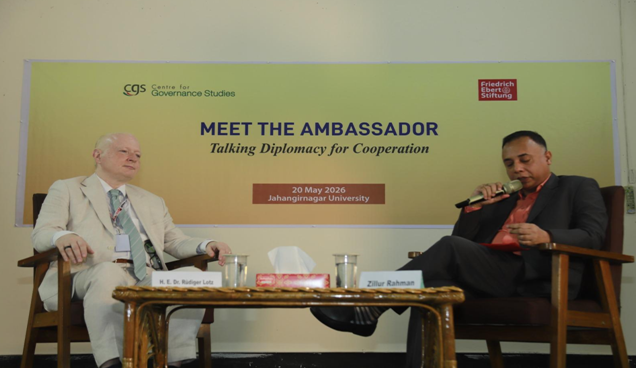
On Wednesday, 20 May 2026, the Centre for Governance Studies (CGS), in collaboration with Friedrich-Ebert-Stiftung (FES) Bangladesh, hosted a session of the “Meet the Ambassador” series at the Senate Hall of Jahangirnagar University. The program featured H.E. Dr. Rüdiger Lotz, Ambassador of the Federal Republic of Germany to Bangladesh, as the keynote speaker. The session focused on the evolving relationship between Bangladesh and Germany, with particular attention to development cooperation, education, youth engagement, climate and sustainability, and people-to-people relations.
The session began with introductory remarks by Felix Gerdes, Resident Representative of Friedrich-Ebert-Stiftung (FES) Bangladesh, followed by remarks from Parvez Karim Abbasi, Executive Director of CGS. Dr. Mohammad Kamrul Ahsan, Vice Chancellor of Jahangirnagar University, also addressed the audience and welcomed the initiative. After the opening remarks, H.E. Dr. Rüdiger Lotz joined a moderated discussion with Zillur Rahman, President of CGS, where they discussed key aspects of Bangladesh-Germany relations and areas of mutual cooperation
FES Bangladesh Resident Representative Dr. Felix Gerdes thanked the participants for attending the event. He expressed gratitude to Jahangirnagar University for hosting the programme and stated that FES has long been working on social justice, democracy, political participation, and international cooperation. He emphasized that such dialogues help young people better understand global politics, diplomacy, and international relations. He further noted that strengthening Bangladesh–Germany relations requires greater collaboration in education, research, youth engagement, and mutual cooperation. He expressed hope that the discussion would prove insightful and help build stronger future partnerships.
CGS Executive Director Parvez Karim Abbasi stated that CGS is a think tank working on human rights, democracy, rule of law, freedom of expression, and good governance. He noted that FES has been a long-standing development partner of CGS. He explained that the purpose of the “Meet the Ambassador” series is to make foreign diplomats more accessible and relatable to the broader public of Bangladesh. He emphasized that Bangladesh is not limited to Dhaka’s elite areas such as Banani, Gulshan, or Baridhara, and that meaningful engagement between ambassadors and diverse communities across the country is essential for strengthening people-to-people connections and international understanding.
Jahangirnagar University Vice-Chancellor Prof. Dr. Md. Kamrul Ahsan said that the “Meet the Ambassador” series has successfully brought diplomacy, education, youth, and knowledge-sharing onto a single platform. He emphasized that such initiatives provide students with valuable opportunities to understand global politics, higher education, and international cooperation. He further noted that Bangladesh’s young population is highly talented and promising, and that research, skills development, and practical education are essential to harness this potential. He added that Germany’s experience in education, technology, research, and innovation is highly relevant for Bangladesh.
The Vice-Chancellor also expressed hope for expanded collaboration between Bangladesh and Germany in trade, higher education, climate change mitigation, renewable energy, governance, and human resource development. He called for stronger academic partnerships between Jahangirnagar University and German universities, research institutions, and scholarship programs. He urged students to actively engage in such discussions and build their capacity for the global stage.
German Ambassador Dr. Rüdiger Lotz said that Bangladesh and Germany share a long-standing, close and friendly relationship. “Germany is currently one of Bangladesh’s largest export destinations and an important trade partner in Europe. Beyond the ready-made garment sector, there are significant opportunities to expand cooperation in technology, skilled human resources, renewable energy, research, and innovation-based industries,” he added.
He further stated that the world is entering a multipolar international order, where dialogue and cooperation between states are becoming increasingly important. In this context, Bangladesh and Germany both value democratic principles, international cooperation, and dialogue-based engagement. He emphasized that people-to-people contact, education, and skills development will further strengthen bilateral relations in the future.
Expressing his pleasure at visiting Jahangirnagar University, the Ambassador said the campus was highly inspiring and vibrant. He noted that today’s students will become the future leaders of Bangladesh—as diplomats, policymakers, researchers, and development professionals—and therefore must develop skills, knowledge, and a strong sense of responsibility.
He also highlighted Germany’s cooperation with Bangladesh in areas such as climate change mitigation, renewable energy, labour rights, skills development, technical training, and good governance. He added that Germany continues to provide humanitarian support in addressing the Rohingya crisis.
During the question-and-answer session, moderator Zillur Rahman raised key issues including bilateral relations, trade, higher education, skills development, migration, climate change, and the Rohingya crisis.
Responding to a question on the future of Bangladesh–Germany relations, Dr. Lotz said there is significant potential for further strengthening ties. He noted that Germany is already playing an important role in trade, investment, skills development, climate cooperation, and higher education, and that future cooperation could expand further in technology transfer, industrial diversification, and human resource development.
On the issue of visa delays for Bangladeshi students applying for higher education in Germany, he explained that there is currently a large backlog of applications—around 60,000 cases under process. He noted that many applicants apply multiple times and that each application requires thorough verification of documents. In some cases, false or inaccurate documentation is also identified, requiring additional scrutiny and time-consuming evaluation.
He further stated that in some instances, students attempt to enter the labour market instead of pursuing studies, which also requires careful assessment by visa authorities. However, he expressed optimism that once the backlog is reduced, visa processing time will improve significantly. He reaffirmed Germany’s interest in welcoming more Bangladeshi students for higher education.
On the Rohingya crisis, the Ambassador said that Bangladesh has set an important example by hosting forcibly displaced Myanmar nationals. He stressed the need for stronger and more coordinated international efforts to ensure a sustainable solution to the crisis.
At the end of the program, Shadhan Kumar Das, Program Advisor of Friedrich-Ebert-Stiftung (FES) Bangladesh, delivered the vote of thanks. In his remarks, he expressed sincere appreciation to H.E. Dr. Rüdiger Lotz for his valuable participation and for engaging with the audience in an open and thoughtful discussion. He also thanked Jahangirnagar University for hosting the program and extended his gratitude to the university authorities, faculty members, students, invited guests, and all participants for their active presence and contribution to the session. He further acknowledged the joint efforts of CGS and FES Bangladesh in organizing the event and emphasized the importance of such dialogue-based platforms in encouraging young people to engage with diplomacy, international relations, and democratic discourse.
Click the link bellow for the full seminar
(539) MEET THE AMBASSADOR Talking Diplomacy for Cooperation - YouTube