
Building Digital Shield, Not Digital Sword
Roman Uddin | 19 November 2026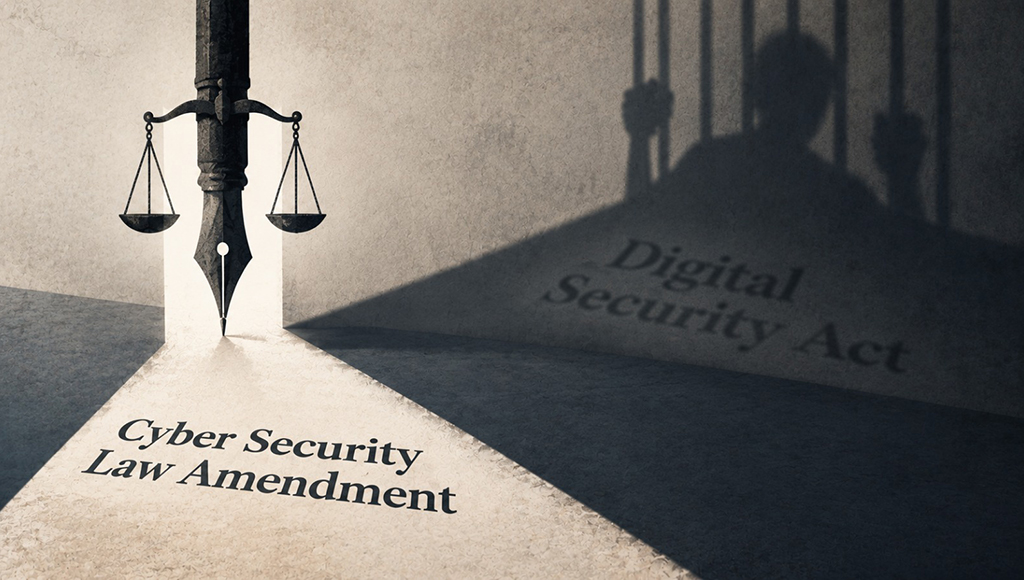
LAW is made to govern the state and establish rules and regulations to keep everything functioning correctly, ultimately for the betterment and ensuring the rights of citizens. But sometimes, law becomes a weapon to destroy the very rights it was designed to protect. Writing on the decline of Rome, Montesquieu warned that there is no tyranny more cruel than the one exercised in the shadow of the laws and under the colours of justice. Bangladesh has lived inside that sentence, and the Digital Security Act of 2018 was exactly such a law.
In the digital era, crime has chosen new paths, making cybersecurity necessary for citizens’ safety. But in Bangladesh, the history of cyber laws is a bitter experience. The journey began with the Information and Communication Technology Act of 2006, where Section 57 laid the groundwork for online repression. This was followed by the draconian Digital Security Act enacted just before the 2018 election and later the Cyber Security Act in 2023, rushed through before the 2024 election. Enacting or amending cyber laws right before a national election became a common feature. It could either show the public a facade of goodwill or warn the people that another non-democratic election was approaching, so digital platforms must remain silent.
Following the July uprising, the interim government introduced the Cyber Security Ordinance 2025, which was comparatively better than the previous oppressive cyber laws. The current government subsequently approved that ordinance in the parliament, officially adopting it as a law on April 10, 2026, with a formal amendment passed on June 30, 2026. This legal transition was a breath of fresh air. But now, the government has brought forward a draft of the Cyber Security (Amendment) Act 2026. This unexpected amendment has created a new wave of fear among citizens that these revised sections can be severely misused and act as a weapon just like the notorious Digital Security Act.
As a think tank researcher, I had the sobering opportunity to work closely with journalists who were victims of being accused under the Digital Security Act. Interviewing them and analysing their case data unveiled dangerous and heartbreaking experiences. Many of these courageous individuals broke down and cried during the interviews, while others were so gripped by fear that they frantically searched for secluded, safe places just to speak with us. The data we collected painted a grim picture. Journalists were subjected to midnight arbitrary arrests and blindfolded interrogations. They were trapped in a cycle of no chargesheets, prolonged pre-trial detentions, and outright denial of bail. The judicial process itself became the punishment for the accused persons, who languished in uncertainty without ever receiving a proper judgement.
The DSA became so feared because vague speech offences were combined with severe criminal procedure. Section 25 punished ‘offensive’ or ‘false’ information and speech said to ‘annoy’, ‘insult’ or ‘humiliate’. Section 29 criminalised defamation. Section 31 covered speech said to create ‘enmity’, ‘unrest’ or deterioration of law and order, while Section 28 addressed hurting religious sentiment. These terms can describe genuine harm, but without narrow definitions they also allow criticism to be recast as a crime. Working through those case records, we found Sections 25 and 29 were each invoked more than 150 times, Section 31 appeared 76 times, and 95 per cent of recorded incidents involved multiple offences. Vagueness, backed by arrest powers and non-bailable charges, gave the law its chilling force.
The current draft deserves scrutiny because some of those design problems are returning. Proposed Section 25 would reintroduce criminal defamation into the cyber law, alongside offences described as ‘humiliation’ and ‘bullying’. The maximum penalty would be five years in prison and Tk 20 lakh, with the punishment doubled when the victim is a woman or a minor. Protecting women, children and victims of serious online sexual abuse is essential. But the draft places offences such as sextortion, revenge pornography and child sexual abuse material alongside reputation-based offences whose boundaries are far more subjective. This distinction matters under international free-expression standards: the UN Human Rights Committee says criminal defamation should be reserved for the most serious cases and that imprisonment should never be used as a punishment for defamation.
Proposed Section 26A raises a different danger. It would criminalise ‘rumour’ and ‘fake news’ with penalties of up to 10 years and Tk 40 lakh. Under the draft, a rumour is anything unverified that unsettles the public or that merely carries the potential to do so. Journalism often begins with allegations requiring verification, while public debate contains opinion, satire and contested interpretation. When criminal liability turns on whether information was unconfirmed or on how an official describes the reaction to it, the boundary between harmful deception and legitimate expression becomes uncertain. The DSA taught us that such uncertainty gives enormous discretion to whoever enforces the law.
The draft also expands Section 8 content-blocking powers beyond law enforcement to the ministry of information and broadcasting and other government-authorised bodies. It adds grounds, including defamation and material considered derogatory to the state, allows intervention based on suspicion that an offence may occur, and would remove the current requirement to disclose blocked content publicly. Several offences involving contested speech could also be handled by mobile courts. Questions of truth, reputation, public interest and intent are highly context-specific and deserve careful judicial examination. Administrative speed should not replace due process.
We do not need to assume that this government has the same malicious intention as past regimes. But we urgently want the government to address the critical matters on which civil society and international bodies have raised valid concerns. Transparency International Bangladesh has warned that the draft could normalise unchecked surveillance and impunity, the Committee to Protect Journalists has urged that it be withdrawn or revised, and nineteen rights and media groups have jointly asked for a substantially revised draft. The Centre for Governance Studies’ earlier research on the DSA shows why such safeguards matter. The government must pay attention to these voices.
A burnt child dreads the fire. Bangladesh has already seen what can happen when vague words, broad discretion and criminal penalties meet a sensitive information environment. We experienced a genuinely bitter era of fear, where draconian laws were misused to silence the innocent. Now, any draft echoing that past triggers profound anxiety. The government should not proceed with any amendment that leaves room for the misuse the Digital Security Act invited. It should revise the draft thoroughly in light of stakeholder views, define every cyber offence narrowly enough to remove ambiguity, and ensure that the National Cyber Security Council can function independently. The focus must remain on actual cybersecurity, not on policing civilian thoughts.
A democratic state thrives on the free flow of information and the fearless expression of its people. Law is meant to be a shield for the vulnerable, not a sword for the powerful. As we look towards a reformed and progressive Bangladesh, we must ensure that our legal frameworks reflect the values of justice and human dignity. If we allow unjust cyber regulations to creep back into our system, we betray the very spirit of our democratic aspirations. Let the law govern with fairness, not with fear.
This article was originally published on Newage.
Roman Uddin is a senior research associate at the Centre for Governance Studies.
Views in this article are author’s own and do not necessarily reflect CGS policy.