
Findings
Part I: Ruling Party Pledge Implementation
The February to August 2026 reporting period saw the Bangladesh Nationalist Party (BNP), as the ruling party, undertake a range of legislative, policy, and institutional measures aimed at translating its election pledges into action. Progress was visible in several priority areas, including stronger rights and data protection, recognition of enforced disappearance as a crime against humanity, support for participants in the July uprising, cyber-security measures, and expanded programmes for women, minorities, and vulnerable groups. At the same time, significant challenges remain, particularly in ensuring independent oversight, reducing judicial delays and strengthening independence, safeguarding media freedom and privacy, preventing the misuse of cyber laws, and implementing reforms in a transparent and inclusive manner.
In the case of pledges classified as stalled, this report does not discuss in detail those for which no relevant update, initiative, policy action, legislative step, or institutional development was identified during the reporting period. However, some stalled pledges are included where notable updates were observed, such as political discussion, official statements, parliamentary attention, preliminary proposals, or other limited initiatives. The inclusion of these developments should not be interpreted as evidence of positive progress towards fulfilment. Rather, they are presented to provide a more complete account of relevant activity surrounding the pledge. Where such discussions or initiatives have not translated into concrete implementation, institutional change, or measurable outcomes, the pledges remain classified as stalled.
Theme 1: Minorities and Inclusive Citizenship
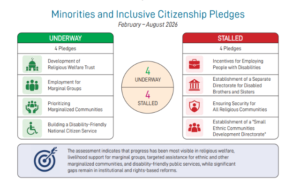
The BNP Election Manifesto 2026 includes several pledges related to Minorities and Inclusive Citizenship, of which this analysis focuses on eight major pledges: Development of Religious Welfare Trust; Incentives for Employing People with Disabilities; Establishment of a Separate Directorate for Disabled Brothers and Sisters; Employment for Marginal Groups; Prioritizing Marginalized Communities; Building a Disability-Friendly National Citizen Service; Ensuring Security for All Religious Communities; and Establishment of a “Small Ethnic Communities Development Directorate.” From February to August 2026, four pledges were assessed as Underway and four as Stalled. The progressing pledges are Development of Religious Welfare Trust; Employment for Marginal Groups; Prioritizing Marginalized Communities; and Building a Disability-Friendly National Citizen Service. The stalled pledges are Incentives for Employing People with Disabilities; Establishment of a Separate Directorate for Disabled Brothers and Sisters; Ensuring Security for All Religious Communities; and Establishment of a “Small Ethnic Communities Development Directorate.” The assessment indicates that progress has been most visible in religious welfare, livelihood support for marginal groups, targeted assistance for ethnic and other marginalized communities, and disability-friendly public services, while significant gaps remain in institutional and rights-based reforms.
Figure: 3
Compiled by Centre for Governance Studies
Development of Religious Welfare Trust
BNP pledged to strengthen religious welfare institutions across Muslim, Hindu, Buddhist, and Christian communities and expand support for marginalized groups (BNP Election Manifesto, 2026, pp. 16, 42). Between February and August 2026, the government introduced a monthly honorarium programme covering 16,992 religious leaders associated with 4,908 mosques, 990 temples, 144 Buddhist monasteries, and Christian institutions.1 The programme was substantially expanded on 4 August 2026, with Tk 1,100 crore allocated in the FY2026–27 budget to provide honorariums and training-based welfare support to 256,074 personnel from 82,656 mosques, 3,000 temples, 752 Buddhist monasteries, and 301 churches, representing one-fourth of the intended nationwide coverage. Under the scheme, imams, priests, Buddhist monastery heads, and pastors will receive Tk 5,000 per month; muezzins, temple caretakers, assistant monastery heads, and assistant pastors Tk 3,000; and mosque khadims Tk 2,000, alongside an annual festival allowance of Tk 2,000. Payments will be made through mobile financial services or bank accounts, while the government plans to bring all eligible religious
institutions under the programme within four years.2 Support also extended to religious infrastructure: renovation of Sri Sri Rakshakali Temple and Sri Sri Durga Temple in Mohakhali began on 7 March as part of an election commitment, while five temples in the Dhaka-17 constituency received financial assistance in April.[3][4]
These measures suggest meaningful progress in expanding state support across different religious communities, particularly through the scaling-up of the honorarium programme and targeted assistance to religious institutions. However, the available evidence is concentrated mainly on financial support, allowances, and selected infrastructure interventions, and does not yet demonstrate broader institutional reform or equal long-term benefits across all religious communities. The planned four-year expansion of the programme also means that nationwide coverage has not yet been achieved. Further assessment will therefore depend on the transparency of beneficiary selection, consistency of implementation across communities and regions, effective monitoring of fund distribution, and whether the initiative leads to sustained institutional strengthening beyond short-term financial assistance.
Employment for Marginal Groups
BNP pledged to introduce targeted employment programmes for rural illiterate people, homemakers, the elderly, and the long-term unemployed through activities such as duck and poultry rearing, livestock, handicrafts, cottage industries, small businesses, computer and digital skills training, alongside low-cost microcredit and equipment support (BNP Election Manifesto, 2026, p. 16). During the Months, the government also adopted the Dhaka Hawker Management Policy 2026, which provides registered hawkers with digital ID cards and designated vending spaces, including holiday and night markets, while restricting vending on major roads, at intersections, metro stations, and bus stops.5 On 30 April 2026, the Dhaka South City Corporation (DSCC) began implementing the initiative by distributing digital ID cards to 100 hawkers from Gulistan and relocating them to designated vending areas, demonstrating an initial shift from policy announcement to practical rehabilitation.6
The policy represents an important shift from treating informal workers primarily as an urban- management problem toward recognizing them within a regulated livelihood framework. Nevertheless, implementation remains concentrated in Dhaka and has faced challenges in sustaining regulated vending arrangements. Expansion, consistent enforcement, and protection against arbitrary displacement will therefore be necessary before the programme can demonstrate broader and more durable employment protection for marginal workers.
Prioritizing Marginalized Communities
BNP pledged to prioritize marginalized groups in social protection, including third-gender and Bede communities; provide rehabilitation, training and employment support for floating and internally displaced people; strengthen legal protection for domestic and gig workers; and gradually bring indigenous communities under full social protection coverage (BNP Election Manifesto, 2026, p. 12). Since taking office, the government has taken several measures particularly concerning ethnic and indigenous communities. On 2 April 2026, Bijon Kanti Sarkar was appointed Special Assistant to the Prime Minister for Hindu, Buddhist, Christian and Ethnic Minority Affairs with the rank of state minister.7 The revised Finance Bill 2026 expanded tax exemptions for ethnic communities to include salary income and extended eligibility to communities living in both the plains and the three hill districts.8 In addition, a Tk 100 crore development fund was created for small ethnic communities living in the plains; in Thakurgaon, assistance included housing, bicycles, sewing machines and educational stipends, with support distributed among 418 beneficiaries.9
Attention to the Chattogram Hill Tracts also increased through both policy and budgetary measures. The government introduced a 180-day action programme focused on balanced development, including education, health, agriculture and infrastructure.10 This was reinforced by the FY2026–27 national budget, which allocated Tk 1,457 crore to the Ministry of Chittagong Hill Tracts Affairs, up from Tk 1,359 crore in the revised FY2025–26 budget.11
These measures, alongside the minority-affairs appointment, tax relief and targeted assistance, indicate meaningful progress in prioritizing marginalized communities. However, important structural challenges remain, particularly the incomplete implementation of the CHT Peace Accord and unresolved land-related issues, suggesting that sustained implementation and consultation with affected communities will be necessary for lasting inclusion.
Building Disability-Friendly National Citizen Service
BNP pledged to build a disability-friendly national citizen service and provide free travel for persons with special needs on buses, trains, and launches (BNP Election Manifesto, 2026, p. 12). The government has since announced measures to strengthen disability-friendly public services, including one-stop service centres providing healthcare, education, rehabilitation, skills development and employment assistance, mandatory accessibility features such as ramps, lifts and disability-friendly toilets in new public infrastructure, and facilities for wheelchair users in planned electric buses. The Shishuswarga programme, initially launched in Dhaka’s Korail area, is also planned for expansion to 20–25 upazilas to provide early detection, treatment, referral and long-term rehabilitation support for children with disabilities.[12][13] These measures indicate promising progress toward disability-friendly public services and greater institutional accessibility. However, many of the initiatives remain at the pilot or planning stage and have yet to be implemented nationwide. Their impact will therefore depend on effective expansion, funding, and enforcement across the country.
Government action during the reporting period shows visible but varied progress in advancing the rights and welfare of minority, marginalized, and disability communities. Progress is most evident through welfare programmes, fiscal support, administrative appointments, targeted assistance, and disability-accessibility initiatives, while institutional and rights-based reforms remain limited. Several commitments are still incomplete, including permanent mechanisms for minority and disability affairs, nationwide disability-related transport entitlements, and an operational security mechanism for religious minorities. The Bangladesh Puja Udjapan Parishad’s proposal for a Home Ministry focal-point officer was positively received by the Home Minister, but there is no evidence that the mechanism is yet operational.14
However, the continuing concerns surrounding Indigenous rights and the Chittagong Hill Tracts indicate that the central challenge lies in translating existing commitments into effective
implementation. As TIB Executive Director Iftekharuzzaman has emphasized in recent public discussions, sustainable peace requires a clear, time-bound roadmap, stronger institutions, meaningful stakeholder participation, and effective mechanisms for resolving land disputes and protecting rights.15 At the same time, demands for constitutional recognition, protection from land grabbing and eviction, effective land commissions, and a 5% quota for Indigenous peoples in education and public employment reflect broader concerns over representation, equality of opportunity, and access to state institutions. Durable progress will therefore depend on coordinated legal, administrative, and policy measures that can turn these longstanding demands into measurable and accountable outcomes.
Theme 2: Law Enforcement and National Security
The BNP Election Manifesto 2026 includes several pledges related to law enforcement and national security. This analysis covers ten major areas: Taking a Strict Position to Stop Border Killings, Push-ins and Smuggling; Building a People-Friendly, Professional, and Service-Oriented Police Administration; Zero Tolerance and National Consensus Against Terrorism; Review of the “Police Commission” Ordinance; Domestic Defence Industry; Establishment of a National Security Council and Depoliticization of the Armed Forces; Expanding Online Complaint Filing Facilities; July Uprising Inquiry Commission; Parliamentary Review of an Independent Criminal Investigation Service; and Formation of a Police Commission.
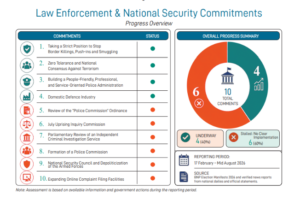
Based on the pledges assessed so far, four are rated Underway: Taking a Strict Position to Stop Border Killings, Push-ins and Smuggling; Zero Tolerance and National Consensus Against Terrorism; Building a People-Friendly, Professional, and Service-Oriented Police Administration; and Domestic Defence Industry. The Review of the “Police Commission” Ordinance is assessed as Stalled. Although the government indicated that a revised framework could be introduced later, the ordinance ultimately lapsed, and no functioning Police Commission was established during the reporting period. The July Uprising Inquiry Commission, Parliamentary Review of an Independent Criminal Investigation Service, Formation of a Police Commission, and other pledges where no concrete government initiative or implementation could be identified are also assessed as Stalled. In these areas, progress remains limited either because initial steps did not lead to implementation, as in the case of the Police Commission, or because no visible action has yet been taken.
Of the ten BNP pledges on Law Enforcement and National Security, four are underway while six remain stalled. Progress is visible in border security, counterterrorism, police professionalism, and domestic defence production, while major gaps remain in police reform, independent investigation mechanisms, and accountability-related institutions.
Figure: 4
Compiled by Centre for Governance Studies
Taking a strict position to stop border killings, push-ins and smuggling
BNP pledged to take firm and effective measures to stop border killings, push-ins and cross-border smuggling (BNP Election Manifesto, 2026, p. 21). The government has pursued this commitment through both border enforcement and bilateral engagement. At the 57th Border Guard Bangladesh (BGB) and Border Security Force (BSF) Director General-level conference in New Delhi from 8 to 11 June 2026, Bangladesh called for border killings to be brought down to zero and urged India to stop push-ins, while reaffirming that verified Bangladeshi nationals should be returned through established repatriation procedures. The concern is significant given that official figures recorded at least 2,303 people being pushed into Bangladesh between May 2025 and January 2026, including 126 Indian and 38 Myanmar nationals.16 During the reporting period, BGB reported thwarting more than 30 push-in attempts since early June, while the Home Minister later told Parliament that 36 attempts had been
foiled. The two sides also agreed to strengthen joint patrols, surveillance and information sharing to address smuggling, illegal crossings and other border crimes.[17][18]
Field-level enforcement has also remained active. In July, BGB foiled alleged push-in attempts involving 15 people through the Chapainawabganj and Kushtia borders and later prevented a woman and three children from entering through the Feni border, followed by a protest to BSF.[19][20] However, repeated incidents show that the problem remains unresolved. A Bangladeshi youth was killed in BSF firing near the Kulaura border on 12 June, although BGB reported that he had crossed into Indian territory with a group allegedly involved in smuggling.21 Overall, the government has taken visible operational and diplomatic measures under the pledge, but continued border incidents indicate that sustained enforcement and cooperation with India will be necessary to achieve more consistent results.
Zero Tolerance and National Consensus Against Terrorism
NP pledged to maintain a zero-tolerance policy against terrorism, militancy, and extremism, while also seeking national consensus and public participation in addressing such threats (BNP Election Manifesto, 2026, p. 21). On 8 April 2026, Parliament passed the Anti-Terrorism (Amendment) Bill, 2026, providing legal backing for restrictions on activities linked to the Awami League under anti-terrorism laws. The government presented the amendment as part of its broader security policy and commitment to preventing organisations considered threats to national security from operating in Bangladesh.22
The amendment demonstrates concrete legislative action toward implementing the zero-tolerance commitment. However, progress toward the manifesto’s broader objective of national consensus remains less clear, as opposition lawmakers raised concerns about limited time for parliamentary scrutiny and the transparency of the process. The pledge can therefore be considered progressing, although continued implementation will require balancing security measures with adequate political consultation, legal safeguards, and protection of democratic space.
Building a people-friendly, professional, and service-oriented police administration
BNP pledged to develop a people-friendly, professional, and service-oriented police administration, restore public trust, reduce political influence, and advance Police Commission reform (BNP Election Manifesto, 2026, p. 43). Several measures during the reporting period indicate progress toward these objectives. On 28 March, Home Minister Salahuddin Ahmed said the police would be kept free from political interference and called for a people-friendly and reform-oriented force.23 On 2 May, he instructed police stations nationwide to eliminate middlemen and provide services honestly and fairly.24 During Police Week in May, Prime Minister Tarique Rahman directed police to maintain neutrality, act against offenders regardless of political affiliation and rebuild public trust.25 The government also initiated recruitment of 180 police sergeants and announced plans to recruit 10,000 additional constables, subject to Finance Ministry clearance.26 Administrative restructuring continued in July, when the government compulsorily retired 33 senior police officers, including 14 DIGs, 18 Additional DIGs and one Superintendent of Police.27
However, the government has taken some steps toward improving police professionalism, service delivery and political neutrality through operational directives, recruitment and administrative measures. And sustained implementation will be necessary to determine whether these initiatives lead to lasting improvements in institutional neutrality, accountability and public trust. Progress on the Police Commission, however, remains incomplete. The Police Commission Ordinance, 2025 lapsed in April after it was not passed by Parliament within the required period, despite a parliamentary committee recommending its adoption with amendments. The government subsequently stated that the Commission had not been abandoned and that a revised bill would be introduced after further review.28 Overall, the government has taken visible steps toward improving police professionalism, service delivery and political neutrality, but the long-term impact will depend on sustained implementation and whether the proposed Police Commission is ultimately established with sufficient independence and authority.
Review of the “Police Commission” Ordinance
BNP pledged to review the Police Commission Ordinance and, if necessary, amend relevant laws to strengthen police reform and accountability (BNP Election Manifesto, 2026, p. 11). On 12 March 2026, Parliament referred 133 ordinances issued by the interim government, including the Police Commission Ordinance, to a special parliamentary committee for review. The committee later recommended that the Police Commission Ordinance be passed with amendments. However, it was not brought before Parliament as a bill within the required period and consequently lost validity in April.29
The government maintained that the reform had not been abandoned and said the Police Commission provisions would undergo further scrutiny before being introduced through revised legislation, although no specific timeline was provided.30 The opposition criticised the failure to retain the ordinance, raised specific concerns over the Police Commission and other reform measures, and joined a parliamentary walkout alleging a breach of earlier consensus.31
Transparency International Bangladesh (TIB) also called for a stakeholder-based review of the Police Commission framework. TIB argued that the existing ordinance did not provide sufficient guarantees for an independent and neutral Police Commission and therefore required broader consultation before a new law was enacted.32 Therefore, although the promised review was initiated, it did not produce a revised law or functioning Police Commission during the reporting period. With the previous ordinance expired and new legislation still pending, implementation of the pledge remains stalled.
Domestic Defence Industry
BNP pledged to promote military research and develop Bangladesh’s domestic defence industry to strengthen indigenous defence capabilities (BNP Election Manifesto, 2026, p. 21). On 8 July 2026, Prime Minister Tarique Rahman told Parliament that the government was preparing a defence industry policy under the “Made in Bangladesh” initiative and considering establishing a dedicated defence industrial
zone. The government has also identified drone technology, sensor systems, electronics and defence equipment as priority areas for domestic production, while cooperation with partner countries through technology transfer is continuing. A more visible step is the establishment of an unmanned aerial vehicle (UAV) factory in Bogura, indicating that some domestic production capacity is already being developed.33
These developments indicate concrete progress toward building a domestic defence industry, particularly through policy formulation, planned industrial infrastructure and initial steps toward local production. However, much of the broader initiative remains at the planning and development stage, and the proposed defence industrial zone and defence industry policy have yet to be fully implemented. Progress will therefore depend on whether these plans translate into sustained domestic production, technological capacity and reduced reliance on foreign defence suppliers.
Therefore, Government action during the reporting period shows visible but uneven progress across law enforcement and national security commitments. Progress has been most evident in operational and policy measures, including stronger border surveillance and bilateral engagement, legislative action under anti-terrorism laws, efforts to improve police professionalism and political neutrality, and initial steps toward developing a domestic defence industry. However, implementation remains uneven. Continued border killings and push-in attempts indicate that stronger enforcement has not fully resolved longstanding border-security challenges, while the broader objective of building national consensus around counterterrorism remains less clearly demonstrated. More significant gaps remain in institutional reform. The Police Commission Ordinance ultimately lapsed without producing a functioning oversight body, leaving questions about police accountability and institutional independence unresolved. Similar limitations are evident in the proposed July Uprising Inquiry Commission. As of 27 April, investigations remained incomplete in more than 90 percent of 1,855 cases related to killings and violence during the uprising,34 while subsequent progress in cases before the International Crimes Tribunals did not amount to the establishment of the proposed independent inquiry commission. Several other initiatives also remain at the directive, planning or early implementation stage rather than representing completed structural reform. Overall, progress has been more visible where immediate executive, administrative or operational action was possible, while reforms requiring new institutions, durable legal frameworks and independent oversight have moved more slowly. Sustained progress will therefore depend on whether these measures translate into functioning institutions, consistent implementation, stronger accountability and measurable improvements in public trust and national security.
Theme 3: Judiciary and Rule of Law
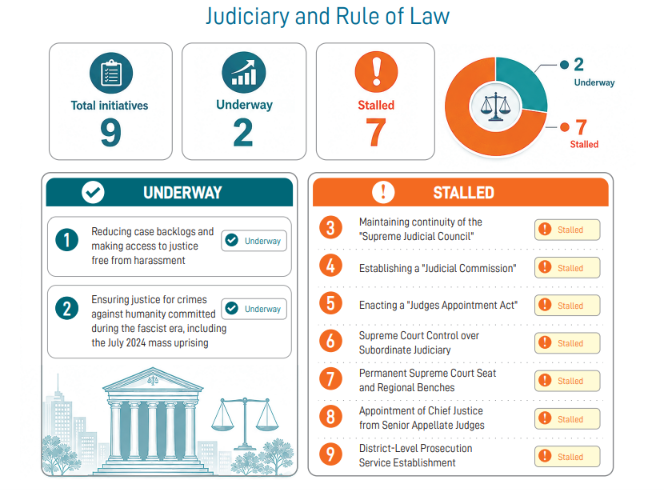
The Judiciary and Rule of Law reform agenda shows uneven progress between February and mid-August 2026. Of the nine identified initiatives, only two are underway: reducing case backlogs and improving harassment-free access to justice, and advancing accountability for crimes against humanity, including those linked to the July 2024 mass uprising. The remaining seven initiatives are stalled, including key structural reforms related to the Supreme Judicial Council, a Judicial Commission, judges’ appointment legislation, Supreme Court control over the subordinate judiciary, regional benches, the appointment process for the Chief Justice, and district-level prosecution services. Overall, the picture suggests that while some progress has been made in judicial service delivery and accountability, major institutional reforms necessary for strengthening long-term judicial independence, transparency, and the rule of law have yet to move forward.
Figure: 5
Compiled by Centre for Governance Studies
Reducing Case Backlogs and Ensuring Access to Justice Free from Harassment
BNP pledged to reduce case backlogs and ensure that citizens can access justice without harassment, discrimination, or unnecessary delay. The manifesto identified judicial delay as a major barrier to justice and promised to appoint qualified judges and address structural inequalities in the justice system (BNP Election Manifesto, 2026, p. 10).
April marked the most significant progress toward this pledge. On 9 April 2026, Parliament passed the Legal Aid Services (Amendment) Bill, 2026, introducing mandatory mediation at district legal aid offices before certain cases proceed to court; settlements certified by the Chief Legal Aid Officer now carry the same legal force as a court decree, aiming to promote early dispute resolution and reduce pressure on the courts.35 On 16 April 2026, the Code of Criminal Procedure (Amendment) Act, 2026 was passed in the National Parliament, following its earlier promulgation as an ordinance. The reform responds to the backlog of over 40 lakh pending cases in the lower courts, as highlighted by the Law Minister, and introduces procedural changes aimed at speeding up criminal trials and improving efficiency in the justice system.[36][37]
The government also acknowledged the scale of the judicial backlog: as of 31 December 2025, over 4,041,924 cases were pending in lower courts. In response, several administrative and digital reforms were introduced, including SMS and voice-based summons delivery, online filing of complaints and affidavits, direct cross-examination provisions, simplified procedures for absconding accused persons, expanded digital case processing, and online recording of certain testimonies. Institutional capacity was strengthened through the establishment of 871 courts, the creation of 232 judicial posts with 304 more proposed, the recruitment of 150 assistant judges, and the expansion of judicial support staff. Additional initiatives such as e-bail, e-family courts, online marriage registration, and the proposed e-Judiciary project further support judicial modernisation, while the Civil Courts (Amendment) Bill, 2026 increased the monetary jurisdiction of lower courts, enabling more cases to be resolved at the district level.38
Compared to the original pledge, the government has taken significant steps through mediation, procedural reform, digitalisation, legislative amendment, and institutional expansion. However, the effectiveness of these reforms will depend on implementation capacity, infrastructure readiness, and whether these measures actually reduce case backlog and improve access to justice in practice.
Ensuring Justice for Crimes Against Humanity Committed During the Fascist Era,
Including the July 2024 Mass Uprising
BNP pledged to ensure justice for crimes committed during the July 2024 mass uprising and the subsequent authoritarian period, including enforced disappearances, killings, torture, extrajudicial actions, and systemic impunity linked to state and political power. The pledge also emphasises investigation of previously unaddressed cases and swift accountability for perpetrators (BNP Election Manifesto, 2026, p. 9).
Between 17 February and mid-August 2026, several judicial developments indicated continued movement on this pledge. A significant development was the verdict in the Abu Sayed killing case on 9 April. The International Crimes Tribunal-2 sentenced former assistant sub-inspector Amir Hossain and former constable Sujan Chandra Roy to death for their roles in Abu Sayed’s killing during the July 2024 uprising. Other accused received life imprisonment or varying prison terms. The case involved 30 accused and included charges relating to murder, attempted murder, superior command responsibility, abetment and complicity in crimes against humanity. At the time of the verdict, 24 accused remained fugitives.39
Further judicial action was recorded in the Rampura crimes-against-humanity case. On 28 June, International Crimes Tribunal-1 sentenced former Dhaka Metropolitan Police Commissioner Habibur Rahman and two other former police officials to death over killings and shootings in Rampura during the July 2024 uprising. A former sub-inspector received life imprisonment and another former police official was sentenced to 20 years. Four of the five convicted individuals were reported to be absconding at the time of the verdict.40 This represented another completed trial within the broader accountability process, although the absence of several convicted individuals from custody remains a limitation in terms of enforcement.
Proceedings also continued in other July uprising-related cases. In the case against Obaidul Quader and six other senior Awami League and affiliated organisation leaders, testimony concluded on 2 August after 28 prosecution witnesses had testified. On 12 August, the prosecution completed its closing arguments, after which the state-appointed defence began presenting its arguments. All seven accused were reported to be absconding41 In addition, the tribunal took cognisance of formal charges against 19 individuals in the Ashabul Yamin killing case on 26 July and issued arrest warrants against 13
absconding accused. In the case concerning the killings of Mir Mahfuzur Rahman Mugdho and ten others, the tribunal fixed 20 August to determine whether charges should be framed against 26 accused. These proceedings suggest that judicial activity has extended beyond a small number of prominent cases, although many remain at preliminary or trial stages.42
Some progress was also recorded regarding enforced disappearances and alleged secret detention, which fall within the broader scope of the manifesto commitment. On 19 April, the International Crimes Tribunal ordered former MP ABM Fazle Karim Chowdhury and retired Major General Ziaul Ahsan to be shown arrested in a crimes-against-humanity case concerning the alleged abduction, enforced disappearance and killing of former union parishad chairman Syed Abu Jafar.43 The tribunal also authorised their interrogation in connection with the investigation.44 On 1 August, ICT judges, prosecutors, investigators and defence representatives inspected the Task Force for Interrogation facility at RAB-1 headquarters in Uttara as part of an ongoing trial concerning allegations of enforced disappearances and torture. The inspection followed a tribunal decision allowing examination of alleged secret detention facilities as part of the evidentiary process.45
Taken together, these developments provide a reasonable basis for assessing the pledge as “Underway.” In this assessment, however, “Underway” refers mainly to identifiable government, prosecutorial and judicial initiatives and does not mean that the pledge has been accomplished or fully implemented. Verdicts have been delivered in some cases, while other investigations and trials have advanced during the review period. At the same time, a substantial part of the broader accountability process remains incomplete: several cases are still under investigation or trial, a number of accused remain absconding, and the wider range of allegations relating to killings, enforced disappearances and torture has not yet reached final judicial resolution. There are also concerns regarding the quality of the process. Human Rights Watch, for example, raised concerns in July 2026 about due-process and fair-trial safeguards in some ICT proceedings. Therefore, continued progress should be assessed not only through the number of cases initiated or verdicts delivered, but also through the consistency, evidentiary basis, procedural fairness and effective enforcement of the accountability process.46
Effective Independence of the Judiciary
BNP pledged to ensure the effective independence of the judiciary in line with the Constitution and the Masdar Hossain case, aiming to reduce executive interference in judicial administration (BNP Election Manifesto, 2026, p. 10).
On 9 April 2026, Parliament passed the Supreme Court Judges Appointment (Repeal) Bill and the Supreme Court Secretariat (Repeal) Bill, revoking earlier ordinances issued during the interim period that had aimed to establish a Supreme Judicial Appointment Council and a separate Supreme Court Secretariat under the Chief Justice. With these repeals, judicial administration and appointment structures largely reverted to their previous constitutional framework under Articles 95 and 116.47
The ruling party argued that the repeal was necessary for further review and to design a more refined and transparent legal framework for judicial independence, with the Law Minister stating that past structural weaknesses had contributed to politicisation in the judiciary and that future reforms would be developed through broader consultation. However, critics, including opposition voices and civil society, argued that the repeal weakened judicial independence, warning that removing these safeguards could restore executive influence over judicial administration and allow political control over judicial appointments. Retired judges and legal experts stressed the need for a transparent and independent appointment system and warned against politicisation of the judiciary.[48][49]
On 19 May 2026, further complications emerged when the Law Ministry abolished the Supreme Court Secretariat and reassigned its officials. The High Court questioned the legality of the move, noting that it was taken before final adjudication by the Appellate Division.50 Lawyers described the action as potentially contemptuous, while the state later filed an appeal against the High Court order.51
Earlier judicial observations had already declared parts of Article 116 inconsistent with constitutional principles and directed the establishment of a separate Supreme Court Secretariat within a fixed timeline. However, the ordinance issued in 2025 was not converted into law and was later repealed, leaving the reform process incomplete.
This sequence of events raised concerns over executive interference in judicial administration. The abolition of the Secretariat before final judicial resolution has been viewed as undermining judicial independence. This pledge is therefore assessed as stalled.
Overall, progress under the Judiciary and Rule of Law theme remains uneven. The government has taken visible steps to address case backlogs through procedural reform, mediation, digitalisation, expansion of judicial capacity, and amendments intended to improve court efficiency. At the same time, accountability mechanisms for crimes connected to the July 2024 uprising and earlier allegations of enforced disappearance and torture have moved forward through investigations, trials and verdicts. However, these developments should be viewed as indicators of institutional activity rather than evidence that the respective pledges have been fully achieved. Their long-term significance will depend on implementation, enforcement, procedural fairness and whether improvements translate into more timely and accessible justice.
More critically, progress in judicial efficiency and accountability has not been matched by comparable advancement in structural judicial independence. The repeal of measures relating to the Supreme Court Secretariat and judicial appointment arrangements, together with subsequent disputes over executive involvement in judicial administration, has left a central reform commitment unresolved. This creates an important tension within the broader reform agenda: improvements in court administration and accountability may have limited institutional impact if the judiciary itself does not operate with sufficient structural independence from the executive. The overall assessment is therefore one of selective progress rather than comprehensive judicial reform, with future performance depending on whether operational improvements are accompanied by credible safeguards for judicial independence, due process and consistent implementation.
Theme 4: Economy and Anti-Corruption
The BNP Election Manifesto 2026 includes a broad range of commitments related to economic recovery, financial-sector governance, anti-corruption, investment, infrastructure, energy, agriculture, trade, and social protection. During the reporting period, 13 pledges are assessed as Underway, while the remaining commitments are assessed as Stalled. In this assessment, “Underway” does not mean that a pledge has been fully implemented or that its intended outcomes have already been achieved; rather, it indicates that the government has taken identifiable initial steps, introduced relevant measures, or begun implementation during the reporting period.
Economy and Anti-Corruption reforms show mixed progress, with 13 pledges underway, particularly in banking reform, procurement accountability, asset recovery, renewable energy, infrastructure, agriculture, and investment facilitation. However, many major commitments remain stalled, indicating limited overall progress on deeper economic and institutional reforms.
Progress has been most visible in banking and financial-sector reform, public procurement and audit accountability, recovery of laundered assets, renewable-energy development, selected infrastructure projects, agricultural support programmes, investment facilitation, and the introduction of Farmers’ and Family Cards. At the same time, The stalled pledges under the Economy and Anti-Corruption agenda include the abolition of the Banking Division; establishment of the National Trade Competitiveness Council and Strategic Textile Fund; reactivation of closed industries and diversification of the export sector; nationwide launch of the “One Village One Product” programme; introduction of the Digital IPO Express system for start-ups and SMEs; formation of the Capital Market Reform Commission and Economic Reform Commission; expansion of international payment facilities; establishment of a Food and Drug Control Authority; abolition of the leasing system for water bodies, coastal canals, and haors; launch of the Agro-Entrepreneurship Start-Up Initiative for Youth; establishment of agricultural export zones in the northern region; expansion of SME loans and linkages with platforms such as Amazon and Alibaba; and establishment of a legal framework for appointments to the PSC, ACC, and CAG. Overall, these commitments showed limited or no identifiable operational progress during the reporting period and largely remained at the commitment, planning, or preliminary policy stage.
Figure: 6
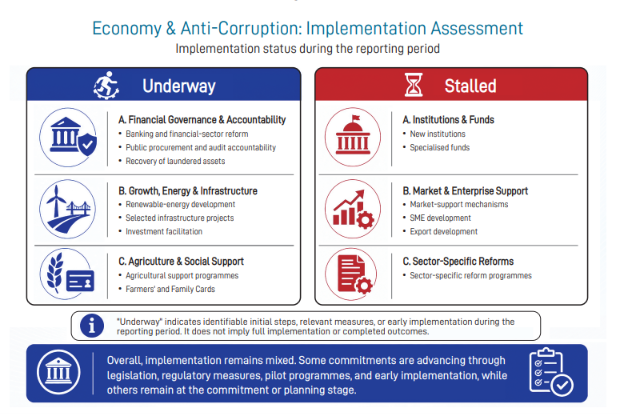
Compiled by Centre for Governance Studies
Ensuring Discipline, Supervision, and Transparency of Financial Institutions
BNP pledged to ensure discipline in financial institutions by strengthening the autonomy, authority, supervision, and transparency of Bangladesh Bank, with stronger oversight of public and private banks and financial institutions (BNP Election Manifesto, 2026, p. 29). During the reporting period, the government pursued several legislative measures relevant to financial governance. In April, Parliament passed the Certain Laws Relating to Finance (Second Amendment) Bill, 2026, converting an interim financial measure linked to the FY2025–26 financial framework into permanent law.52 Parliament also enacted the Bank Resolution Bill and Deposit Protection Bill, strengthening the legal framework for dealing with troubled financial institutions and protecting depositors. The Grameen Bank (Amendment) Bill and Bangladesh Bank (Amendment) Bill were also passed as part of the wider financial-sector legislative package.53 The Bangladesh Bank amendment removed the previous maximum age limit of 67 for the governor while retaining the four-year term and provision for reappointment, allowing experienced candidates to be appointed or retained regardless of age and potentially supporting continuity in central-bank leadership.54
Alongside these government-led reforms, Bangladesh Bank introduced measures to strengthen supervision and financial transparency. In March, the central bank appointed observers to National Bank, Al-Arafah Islami Bank, Premier Bank and IFIC Bank to monitor their boards and operations more closely.55 It also introduced a forward-looking credit-loss framework based on International Financial Reporting Standard 9 (IFRS 9), under which banks will make provisions for expected losses before loans actually become non-performing, with the aim of improving early risk detection and financial reporting transparency56 In June, Bangladesh Bank announced an 18-month roadmap to address non-performing loans through measures including risk-based supervision, Asset Quality Reviews, capital-restoration plans and stronger loan-recovery mechanisms.57
These developments demonstrate visible progress in strengthening financial-sector discipline, supervisory capacity and regulatory tools. However, progress on Bangladesh Bank’s institutional
autonomy remains less clear. On 25 February 2026, the government ended Ahsan H. Mansur’s tenure before its scheduled expiry in August 2028 and appointed Md Mostaqur Rahman as governor, prompting criticism from economists and banking-sector stakeholders over institutional stability and central-bank independence.58 Questions were also raised over the new governor’s previous involvement with the BNP’s election steering committee, while Mansur’s removal was subsequently challenged before the High Court. At the same time, removing the governor’s age ceiling may widen the pool of experienced candidates and support leadership continuity, but it does not by itself strengthen independent decision-making or protection from political influence. Overall, the pledge is Underway because substantial legal, regulatory and supervisory measures have been introduced, although stronger safeguards around appointments, tenure security and institutional independence remain necessary to demonstrate comparable progress in Bangladesh Bank’s autonomy.
Open Tendering, Real-Time Audits, and Public Financial Accountability
BNP pledged to strengthen transparency and accountability through open tendering, asset declarations, real-time audits, and a stronger Right to Information framework (BNP Election Manifesto, 2026, p. 9). Several measures during the reporting period advanced the audit and procurement components of this commitment. On 8 April, Parliament passed the Public Accounts Audit Bill, 2026, strengthening the Comptroller and Auditor-General’s authority to determine the scope and method of audits, conduct performance audits and make audit reports public after their placement before Parliament.59 Parliament subsequently passed the Public Procurement (Amendment) Act, 2026, which made electronic Government Procurement (e-GP) mandatory and introduced measures aimed at improving competition, efficiency and transparency in public procurement.60 In May, the Comptroller and Auditor-General (C&AG) submitted 38 compliance and performance audit reports covering 17 ministries and divisions and their associated agencies and projects.61 Parliamentary oversight was further strengthened in July through the formation of the 15-member Public Accounts Committee, while the government also formed a high-level committee to review procurement laws and recommend further reforms.62
Taken together, these measures demonstrate meaningful progress in public procurement, audit oversight and financial accountability. However, a fully operational real-time audit system has not yet been demonstrated, while progress on asset declarations remains limited. The manifesto’s related commitment to strengthen the Right to Information framework also remains incomplete, as the Right to Information (Amendment) Ordinance lapsed in April. The pledge is therefore Underway, although implementation remains uneven across its different components.
Rebuilding a Fragile Economy and Promoting Private-Sector Investment
BNP pledged to rebuild the economy through greater inclusiveness, reduced oligarchic control and stronger private-sector investment, with the long-term goal of achieving a trillion-dollar economy by 2034 (BNP Election Manifesto, 2026, p. 10).
a. Strategic Recovery and the Trillion-Dollar Economy
The government began developing a broader economic recovery framework during the reporting period. In March, Bangladesh Bank eased capital-repatriation rules for foreign investors, allowing banks to process proceeds of up to Tk 100 crore from sales and share transfers without prior central-bank approval, compared with the previous Tk 10 crore threshold. The measure was intended to reduce procedural barriers and improve the investment environment.63 In April, Finance Minister Amir Khosru Mahmud Chowdhury told Parliament that the government had prepared an action plan covering investment, employment, production and other areas to pursue the goal of transforming Bangladesh into a trillion-dollar economy by 2034. A draft five-year strategic framework subsequently projected higher investment and economic growth as part of this transition. [64][65]
The strategy became more concrete in May, when the National Economic Council approved a five-year plan aimed at stabilising the fragile economy, increasing investment and creating one crore jobs by 2030 while moving toward the trillion-dollar target. The framework identified deregulation and improvement of the business climate, investment-led growth, job creation and institutional reform among its principal pillars.66 In June, the FY2026–27 national budget reinforced this approach through a
three-stage: Recovery and Stabilisation, Restoration, and Reconstruction for Acceleration designed to move from immediate stabilisation toward institutional rebuilding and higher growth over a one-to-five-year period.67
b. Financial Stabilisation and Fiscal Reform
Financial-sector stabilisation has formed an important part of the broader recovery effort. On 10 April, Parliament passed the Bank Resolution Bill, 2026, establishing a legal framework for dealing with distressed financial institutions and providing mechanisms for resolution, restructuring and other corrective measures. The bill was passed amid opposition objections. Opposition MP Saiful Alam Khan Milon argued that changes to the earlier Bank Resolution Ordinance could create legal loopholes for bank looters and expose taxpayers to renewed financial risks. In response, Finance Minister Amir Khosru Mahmud Chowdhury said the amendments were intended to strengthen the banking sector, reduce pressure on public finances and facilitate the recovery of distressed institutions through private capital rather than greater reliance on government funds.68 On the same day, Parliament passed the Deposit Protection Bill, 2026, increasing the maximum protected deposit from Tk 100,000 to Tk 200,000 per depositor and establishing protection arrangements covering both banks and finance companies.69 These measures are relevant to economic recovery because financial stability, depositor confidence and the functioning of credit institutions directly affect private investment and business activity.
A wider package of fiscal legislation also moved forward. Parliament converted a number of interim-era financial measures into permanent law, including the Finance (FY2025–26) Act and the Value Added Tax and Supplementary Duty (Amendment) Act, 2026. The Finance Bill 2026 was subsequently passed in June alongside the FY2026–27 budget with changes to tax provisions.70 These measures indicate continued restructuring of the fiscal and revenue framework, although their contribution to recovery will ultimately depend on implementation and the government’s ability to improve revenue mobilisation.
The Bank Resolution Act nevertheless generated significant controversy because the newly added Section 18(A) provided a legal route through which former owners of distressed or merged banks could seek to regain control subject to specified financial and regulatory conditions. Critics argued that allowing former owners associated with troubled institutions to return could weaken accountability
and conflict with the manifesto’s commitment to reduce oligarchic control.71 Following criticism from economists, banking-sector stakeholders and other groups, the Finance Minister announced on 29 June that the government had decided to repeal Section 18(A) based on stakeholder feedback.72
The scale of banking-sector weakness nevertheless remains substantial. By 31 May, non-performing loans across nine state-owned banks had reached nearly Tk 1.89 trillion (Tk 1,88,701.75 crore). The government and Bangladesh Bank subsequently outlined measures including classified-loan resolution guidelines, stronger credit-risk management, implementation of International Financial Reporting Standard 9 (IFRS 9), and stricter measures against willful defaulters.[73][74] These actions demonstrate a response to the problem, but the size of the bad-loan stock indicates that financial-sector recovery will require sustained enforcement and institutional reform rather than legislation alone.
c. Private Investment and Industrial Recovery
The government also introduced measures to mobilise private capital and revive underused productive assets. On 5 July, the Bangladesh Investment Development Authority opened 44 closed or loss-making state-owned enterprises, covering more than 10,000 acres of land, to domestic and foreign private investment. Investors were invited to participate through public-private partnerships, joint ventures, long-term leases and other arrangements, with the stated objectives of reviving underperforming industrial assets, creating employment and reducing the fiscal burden on the government.75
Bangladesh Bank also introduced a Tk 20,000 crore pre-finance scheme for closed and capital-starved industrial and service-sector enterprises. Operational guidelines issued in July incorporated eligibility requirements, anti-fraud and anti-money-laundering declarations, monitoring provisions and quarterly reporting requirements. The scheme permits financing of up to Tk 200 crore for an individual borrower, while participating banks are required to monitor the use and recovery of funds.76
These measures provide concrete mechanisms for industrial recovery and private-sector participation. However, their impact will depend heavily on borrower selection, transparent allocation of financing, effective monitoring, and the prevention of politically connected lending. In this respect, implementation quality will be as important as the scale of the financing itself.
d. Investment Governance and the Business Environment
A significant institutional reform came in July through the Invest Bangladesh Bill, 2026. Parliament passed the bill on 15 July, paving the way for a unified Invest Bangladesh Authority by consolidating the Bangladesh Investment Development Authority, Bangladesh Economic Zones Authority and Public-Private Partnership Authority. The government said the new structure would reduce overlapping functions, streamline investor services, introduce clearer timelines for approvals and deliver investment-related services through a unified digital platform.77
The bill was not without criticism. Opposition lawmakers questioned the speed of its passage, argued that the required notice and supporting documents had not been provided sufficiently in advance, and criticised the decision not to refer the bill to a parliamentary standing committee for greater scrutiny. The government responded that the legislation primarily consolidated existing authorities rather than introducing an entirely new regulatory structure.78
The government’s broader investment message was reinforced later that month. At the Foreign Investors’ Chamber of Commerce and Industry (FICCI) Foreign Direct Investment (FDI) Conference on 23 July, Prime Minister Tarique Rahman called on domestic and foreign investors to become long-term partners in Bangladesh’s economic transformation and linked the trillion-dollar target to private-sector-led growth. He pledged stronger legal protection, simpler regulations and a more business-friendly environment for investors.79
e. Trade, Employment and External-Sector Resilience
The recovery agenda has also included efforts to maintain export competitiveness and protect external-sector stability. In July, the government retained export incentives and cash assistance across 43 sectors for FY2026–27. The measures covered both traditional and diversified exports, including jute products, leather, agro-processed goods, light engineering, footwear and technology-related exports.80
Overseas employment also remained relevant to economic recovery because of its connection to household income and remittance flows. After earlier efforts to reopen the Malaysian labour market, Malaysia resumed access for Bangladeshi workers in July.81 This development is particularly relevant given the continuing importance of remittances to Bangladesh’s external-sector stability.
The government also began preparing for the structural challenges associated with LDC (Least Developed Country) graduation. On 19 July, a five-year trade-capacity action plan was presented
focusing on non-tariff barriers, regulatory compliance, the investment climate, export competitiveness and regulatory reform. The programme was narrowed from 52 initial proposals to 12 priority interventions. However, at the time of reporting it remained at the consultation and validation stage, meaning its practical impact had yet to be demonstrated.82
External-sector indicators showed improvement but also revealed continuing vulnerabilities. Bangladesh Bank data reported in July showed that the current-account deficit had narrowed to $301 million during July–May of FY2025–26, compared with $778 million in the corresponding period a year earlier. Record remittances played a major role in the improvement. However, weak economic activity continued to constrain trade and investment, while the trade deficit remained a significant weakness.83 This suggests that external stability had improved, but the recovery remained more dependent on remittance inflows than on a strong expansion of productive investment and exports.
Taken together, government action during the reporting period demonstrates broad and visible progress in economic stabilisation, financial-sector reform, private investment, industrial recovery and trade competitiveness. The five-year recovery framework, Bank Resolution and Deposit Protection legislation, fiscal reforms, industrial refinancing, opening of state assets to private investment, investment-governance restructuring and preparation for post-LDC challenges show that government activity has moved beyond general commitments into legislation, institutional reform and financing mechanisms. However, the broader economy remains structural weaknesses continue to constrain the recovery. The FY2026–27 national budget of Tk 9.38 trillion projected an overall deficit of Tk 2.43 trillion, equivalent to 3.6 percent of GDP. While the government’s 3R strategy provides a clearer medium-term direction, ambitious revenue mobilisation targets and continued reliance on borrowing create implementation risks. Longer-term external debt obligations are also emerging as a concern. External debt-servicing costs have been projected to reach approximately $7.565 billion in FY2028–29 as grace periods expire on major foreign-funded projects and Bangladesh increasingly shifts toward more expensive financing following LDC graduation.84 The pace of reform itself also remains an important issue. On 14 July, Finance Minister Amir Khosru Mahmud Chowdhury said that economic reforms would be implemented gradually in accordance with Bangladesh’s economic realities and public interests,85 adding that the IMF also recognised that major reforms could not be introduced overnight. Discussions on the foundations and implementation stages of a possible new IMF loan programme were continuing.86 The IMF offered a more cautionary assessment, identifying weak revenue mobilisation, banking-sector vulnerabilities and high inflation as major economic challenges. It warned that
medium-term growth could fall if effective reforms were not implemented and emphasised stronger revenue collection, banking-sector reform, prudent fiscal management and tight monetary policy. These concerns highlight the distinction between progress in policy and institutional reform and recovery in actual economic performance. High non-performing loans, weak private investment, revenue constraints, inflation, trade imbalances and rising debt-servicing obligations remain significant vulnerabilities. The controversy surrounding Section 18(A) of the Bank Resolution Act also demonstrated the continuing importance of preventing financial reform from recreating opportunities for oligarchic influence, although the government’s subsequent decision to remove the provision represents a corrective step. The pledge is therefore assessed as Underway. A substantial policy, legislative and institutional framework for rebuilding the economy has emerged during the reporting period. However, the longer-term success of the pledge will depend on whether these measures translate into sustained productive private investment, stronger employment and exports, improved banking-sector health, effective revenue mobilisation, lower inflation and broader economic inclusion.
Legal and Systematic Reforms to Fight Corruption
The BNP pledged to combat corruption through comprehensive legal, institutional and procedural reforms aimed at making governance more transparent, accountable and less vulnerable to political influence (BNP Election Manifesto, 2026, p. 9). A central development during the reporting period concerned reform of the Anti-Corruption Commission (ACC). The Anti-Corruption Commission (Amendment) Ordinance lost validity in April after it was not enacted within the constitutionally required period. Opposition lawmakers criticised the lapse, arguing that it weakened previously agreed reform efforts, and staged a parliamentary walkout over the failure to retain several reform ordinances, including the ACC ordinance. The government subsequently stated that a stronger ACC legal framework would be pursued through further discussion and consensus. Institutional restructuring of the ACC, however, saw significant progress in August. Following the resignation of the ACC chairman and two commissioners in March, the commission remained without a full leadership structure for more than five months, limiting its ability to approve new inquiries, corruption cases, charge sheets and other major enforcement decisions. On 22 June, the government formed a five-member search committee to recommend candidates for new ACC leadership.87 Based on the committee’s recommendations, the government reconstituted the commission on 17 August, appointing retired Appellate Division Justice AKM Asaduzzaman as chairman, while Dr Jahangir Alam Khan and Dr Md Sazzad Hossain Bhuiyan were appointed as commissioners under the Anti-Corruption Commission Act, 2004. The new leadership formally assumed office on 19 August, ending a 166-day institutional vacuum.88
The restoration of ACC leadership represents an important institutional step, as the prolonged vacancy had constrained several core functions of the commission. With the new commission in place, attention has shifted toward restoring operational effectiveness, addressing accumulated complaints and ensuring continuity in ongoing investigations. The newly appointed leadership has begun reviewing pending matters and inherited a significant backlog created during the period without a functioning commission.
Meanwhile, the broader legal reform process remains ongoing. The ACC has continued preparing a new legal framework drawing from the Anti-Corruption Commission Act, 2004, and elements of the previously lapsed amendment ordinance. The proposed reforms reportedly include provisions allowing the ACC to initiate cases against judges and public officials without prior government approval and expanding its jurisdiction over financial crimes, including money laundering, insider trading and tax and customs-related offences. However, concerns remain regarding certain proposed institutional safeguards and whether the final legal framework will sufficiently protect the commission’s independence and effectiveness.89
Other transparency and preventive measures also continued during the reporting period. In April, Parliament disclosed the country’s top 20 loan-defaulting companies, as total non-performing loans in the banking sector reached approximately Tk 5.44 lakh crore at the end of December 2025.90 The disclosure increased public transparency regarding large-scale financial irregularities, although meaningful accountability will depend on effective recovery mechanisms, enforcement actions, and the ability to hold influential defaulters accountable. In July, the State Minister for Housing and Public Works announced that contractors found responsible for corruption or irregularities in development projects would be blacklisted, while project quality would undergo independent assessment alongside government monitoring mechanisms.
Overall, the government has taken visible but uneven steps toward legal and institutional anti-corruption reform. The reconstitution of the ACC, following a prolonged leadership vacuum, marks a significant institutional development by restoring the commission’s decision-making capacity and enabling it to resume full operations. Greater transparency regarding major loan defaults and stronger oversight mechanisms in public projects also indicate progress toward improving accountability. However, the lapse of the ACC amendment ordinance, the absence of a comprehensive replacement law, and continuing concerns regarding institutional independence demonstrate that the reform process remains incomplete.
Recovering Laundered Money and Stolen Assets
BNP pledged to stop money laundering and recover money and assets transferred abroad during the previous Awami League period. The manifesto also committed to publishing a comprehensive white paper on corruption and money laundering and using legal, diplomatic and administrative mechanisms to recover stolen assets (BNP Election Manifesto, 2026, p. 9).
The government took several steps during the reporting period to strengthen the asset-recovery process. In March, Bangladesh Bank Governor Md Mostaqur Rahman directed that stolen-asset recovery be placed on a fast-track footing to accelerate the identification and repatriation of laundered funds.91 In April, Prime Minister Tarique Rahman told Parliament that recovering assets laundered abroad was a government priority. Citing findings of the White Paper Preparation Committee, he said approximately $234 billion had been transferred out of Bangladesh between 2009 and 2023. The government identified 10 major destination jurisdictions, formed an inter-agency task force and 11 Joint Investigation Teams, and initiated legal proceedings in 11 priority money-laundering cases. By late March, assets worth around Tk 70,446 crore had been attached or frozen at home and abroad, while 141 cases had been filed, 15 charge sheets submitted and six cases concluded.92
International legal cooperation also advanced. By 21 April, the government had sent Mutual Legal Assistance Requests (MLARs) to 23 countries, with requests to another 21 countries under process. A dedicated Stolen Asset Recovery Division was also established under the Bangladesh Financial Intelligence Unit (BFIU) to coordinate and accelerate recovery efforts.93 A concrete development followed in May, when a court in Cyprus ordered the seizure of assets belonging to S Alam and his wife following a mutual legal assistance request from Bangladesh, demonstrating that the international legal process had begun producing asset-freezing outcomes abroad.94
The recovery mechanism was further expanded in June. The Finance Minister said 10 red notices had been issued against alleged money launderers, civil proceedings had begun in six of the 11 priority cases, and 30 affected banks were moving to engage nine international law firms to pursue asset recovery. The government also announced plans to update the money-laundering legal framework and establish a beneficial ownership register to make it harder to conceal the real ownership of companies,
trusts and partnerships.95 By 15 July, the BFIU reported that the value of attached and frozen assets in the 11 priority cases had increased to approximately Tk 76,000 crore, including around Tk 57,000 crore in Bangladesh and Tk 19,000 crore abroad.96
Overall, this pledge shows substantial procedural and institutional progress. The government has moved beyond general commitments by establishing specialised recovery mechanisms, pursuing priority cases, sending international legal requests and securing freezes on assets both domestically and abroad. However, freezing or attaching assets is not the same as successfully recovering and repatriating them. Investigators continue to face difficulties tracing funds routed through multiple jurisdictions and securing cooperation from foreign authorities, making international legal and diplomatic coordination critical.97 Moreover, while the government has relied on findings from the earlier White Paper Preparation Committee, the available evidence does not clearly demonstrate that a new comprehensive white paper specifically fulfilling the manifesto commitment has been published during the reporting period. The pledge is therefore assessed as Underway, although its ultimate success will depend on the actual return of frozen assets, completion of legal proceedings and transparent disclosure of recovered funds.
Power and Energy Sector Development
The government took several policy and implementation steps toward this target during the reporting period. In April, the government set a target of generating 10,000MW of solar power by 2030 and announced that unused or underutilised government land would be made available for renewable-energy projects involving both public and private investors. The government also discussed expansion of wind and biogas as part of the renewable-energy mix.98 A separate public-private partnership (PPP) framework introduced in April established procedures for using state-owned land for solar and wind projects, addressing land availability as a major constraint on large-scale renewable development.99
Implementation also moved beyond target-setting. On 27 April, the Bangladesh Power Development Board floated international tenders for 10 grid-connected solar projects with a combined capacity of 495MW, located across different regions and linked to existing or planned grid substations.100 In June, the FY2026–27 budget removed import duty, regulatory duty, supplementary duty and advance tax on key solar equipment, with the aim of reducing project costs and encouraging renewable-energy investment.101
The policy framework was further strengthened in July, when the Cabinet approved the National Renewable Energy Development Strategy 2026–2030, formally targeting 20 percent of electricity generation from renewable sources by 2030. The strategy also promotes rooftop solar, battery energy storage, smart grids and waste-to-energy projects, with a real-time monitoring dashboard and a National Policy Council proposed to oversee implementation.102 The government subsequently emphasised cluster-based solar projects and expansion of rooftop net metering to allow consumers to feed surplus solar electricity into the national grid.103
Alongside renewable-energy development, the government also pursued domestic energy security through expanded gas exploration. In May, it launched an international bidding round covering 26 offshore oil and gas blocks, while by July the government reported plans to complete drilling and workover activities in 150 wells by 2031, alongside seismic surveys and additional drilling capacity for BAPEX.104 These measures are aimed at increasing domestic energy production and reducing dependence on imported fuels.
Overall, the government has made visible progress through clearer renewable-energy targets, investment frameworks, competitive solar tenders, fiscal incentives and a formal implementation strategy. However, the scale of the remaining challenge is substantial. In April, installed renewable-energy capacity was reported at only 1,059MW, or about 3.7 percent of total installed capacity, while an earlier large solar tender had attracted significantly less investment than expected.[105][106] Achieving the 2030 target will therefore depend on converting tenders and policy
commitments into operational projects, mobilising sufficient private finance, strengthening grid and battery-storage capacity, and maintaining consistent implementation. The pledge is therefore assessed as Underway, although measurable increases in actual renewable generation will be the key test of progress.
Construction of the Bhola-Barishal Bridge
BNP pledged to construct the Bhola-Barishal Bridge to ensure seamless communication in the coastal region and create new economic opportunities (BNP Election Manifesto, 2026).
The project made visible preparatory progress in April. On 7 April, Road Transport and Bridges Minister Shaikh Rabiul Alam told Parliament that the proposed 10.86-kilometre bridge, estimated to cost around Tk 17,466 crore, was being treated as a high-priority project and that the government expected to announce a construction timeline after completing the necessary approval process. The feasibility study had already been completed between 2022 and 2024.107 On 8 April, the Cabinet Committee on Economic Affairs granted in-principle approval for the project under the Public-Private Partnership framework, representing a more concrete step toward implementation.108
The project has therefore progressed beyond a general political commitment into the formal PPP approval process. However, the official PPP Authority continued to classify the Bhola-Barishal Bridge as CCEA Approved (In Principle) and in the Identification Phase, rather than the procurement or implementation stage.109 However, the pledge is assessed as Underway, but remains at an early preparatory stage; future progress should be measured by final approval, financing, procurement and commencement of construction.
Canal Excavation and River Restoration
BNP pledged to excavate, re-excavate, and restore 20,000 kilometres of rivers and canals, linking the programme to restoring disappeared rivers and canals, improving natural water flows, and increasing irrigation efficiency (BNP Election Manifesto, 2026, p. 14).
Preparatory work began early in the reporting period. In March, the government launched a Tk 31.57 crore programme to identify and classify more than 30,000 canals and develop a GIS-based national database, providing a systematic basis for future excavation, recovery and protection.110 In March, Prime Minister Tarique Rahman formally inaugurated the nationwide canal excavation and re-excavation programme, with activities scheduled to begin across 54 districts under the initial phase. Under the initial 180-day programme, approximately 1,204 kilometres of canals were targeted for excavation and re-excavation, while the government retained the broader target of 20,000 kilometres over five years.[111][112] The programme continued through the FY2026–27 development agenda. In June, the government announced plans to excavate around 111 kilometres of new canals and re-excavate approximately 680 kilometres of canals, irrigation channels and drainage systems during the fiscal year.113 The Local Government Division also formed separate committees for Dhaka North and Dhaka South City Corporations to identify and demarcate canal boundaries within three months. This is an important preparatory step for recovering encroached canals and carrying out subsequent excavation and protection works.114
Overall, the pledge has moved beyond announcement into early implementation through nationwide excavation, quantified work targets, canal mapping and boundary demarcation. However, the scale of the challenge remains substantial. In July, the Dhaka Chamber of Commerce and Industry reported that more than 55 percent of the country’s waterways were no longer functional because of siltation and encroachment, while experts highlighted weak coordination among responsible agencies and the need for long-term maintenance.115 The pledge is therefore assessed as Underway, although achieving the 20,000-kilometre target will require sustained excavation, effective removal of encroachments, restoration of natural water connectivity, stronger inter-agency coordination and transparent reporting of kilometres actually completed.
Agricultural Insurance and Loan Waiver
BNP pledged to introduce and expand crop, livestock, fisheries, and poultry insurance, with subsidies if necessary, to reduce farmers’ risks during natural disasters and ensure stability in agricultural production (BNP Election Manifesto, 2026, p. 14).
The loan-waiver component moved relatively quickly into implementation. On 26 February, the government approved the waiver of agricultural loans of up to Tk 10,000, including interest, covering crop, fisheries and livestock loans.116 The measure was aimed particularly at providing relief to small farmers burdened by old agricultural debt and was closely aligned with the manifesto commitment. Implementation became visible in July, when 5,892 farmers in Boda, Panchagarh received loan-waiver certificates and the return of mortgaged land documents after around Tk 8.73 crore in agricultural loans through Sonali Bank and Rajshahi Krishi Unnayan Bank were cleared.117
Progress on agricultural insurance has been more gradual. In March, Agriculture Minister Mohammed Amin Ur Rashid announced that the government would introduce crop insurance to compensate farmers for losses caused by floods and other natural disasters.118 The commitment was subsequently incorporated into the FY2026–27 budget, which identified agricultural insurance as a measure to reduce farmers’ exposure to climate and disaster-related risks and support more stable agricultural production.119 These steps indicate that agricultural insurance has moved into the policy-development stage, although evidence of a nationwide operational scheme covering crops, livestock, fisheries and poultry has not yet emerged.
Overall, the pledge shows clear but uneven progress. The agricultural loan-waiver commitment has advanced from policy approval to actual delivery for some farmers, providing direct financial relief. Agricultural insurance, however, remains largely at the policy and planning stage. Experts have also highlighted the absence of sufficiently developed insurance business models and risk-sharing mechanisms needed for large-scale implementation. The pledge is therefore assessed as Underway, although full implementation will require an operational insurance framework with clear premium subsidies, risk assessment, claim-settlement procedures and effective coverage for crop, livestock, fisheries and poultry producers.
Farmers’ Card, Fair Prices, and Cold Storage Network
BNP pledged to introduce a Farmers’ Card to ensure fair prices for agricultural produce and provide access to subsidies, easy loans, agricultural insurance, and state-managed markets. The manifesto also promised a sound marketing policy, union-level procurement centres, protection of farmland from non-agricultural use, and a nationwide cold-storage network (BNP Election Manifesto, 2026, p. 5).
The Farmers’ Card programme moved into initial implementation in April. On 14 April, Prime Minister Tarique Rahman inaugurated the programme in Tangail, with 22,065 farmers in 11 upazilas receiving Tk 2,500 each directly through mobile-linked bank accounts under the pre-pilot phase.120 The programme is intended to gradually connect farmers with benefits including agricultural inputs, subsidies, credit, insurance, market information and opportunities to receive fairer prices.121 The card also began to be linked with agricultural finance. In June, Bangladesh Bank instructed banks to give priority to marginal and landless Farmers’ Smart Card holders when providing loans under agricultural refinancing schemes, creating an early institutional link between the card and easier access to farm credit.122 In July, the Department of Agricultural Extension began collecting farmer and agricultural-land information across upazilas to develop the database required for wider nationwide implementation.123
Progress was also visible in efforts to improve farmers’ market access and prices. In April, the government inaugurated a “Krishoker Hat” direct farmers’ sales centre in Sylhet, designed to allow producers to sell agricultural products directly to consumers with fewer intermediaries and reduce the influence of market syndicates.124 For the 2026 Boro season, the government also set procurement targets of 500,000 tonnes of paddy at Tk 36 per kilogram and 1.25 million tonnes of parboiled rice at Tk 49 per kilogram. These measures provide some support for fair-price access, although farmers continued to raise concerns that procurement prices did not adequately reflect production costs and called for stronger direct procurement mechanisms.125
The pledge to protect agricultural land also recorded legislative progress. In April, Parliament passed the Land Use Control and Agricultural Land Protection Act, 2026, establishing a legal framework to regulate land use and protect agricultural land from inappropriate conversion to non-agricultural purposes.126 Cold-storage infrastructure also moved into the planning and expansion stage. The government announced plans to establish around 2,000 small solar-powered cold-storage facilities close to farming areas to reduce post-harvest losses and allow farmers to preserve produce rather than being forced to sell immediately when market prices are low.127 The proposed model is intended to bring storage facilities closer to producers and strengthen their ability to choose when to sell agricultural products.
Overall, the pledge shows visible but uneven progress. The Farmers’ Card has moved from a pre-pilot programme toward wider data collection and has begun to connect with agricultural credit; direct farmer-to-consumer marketing has been introduced on a limited scale; farmland protection has received a statutory basis; and a large mini cold-storage network has been announced. However, nationwide Farmers’ Card coverage has not yet been achieved, the proposed cold-storage network remains largely at the implementation-planning stage, and there is still limited evidence of a nationwide system of union-level procurement centres and state-managed agricultural markets. Fair-price protection also remains incomplete. The pledge is therefore assessed as Underway, although future progress should be measured by nationwide card coverage, operational cold-storage facilities, functioning procurement and marketing networks, and measurable improvement in the prices received by farmers.
Family Card for Low-Income Families
BNP pledged to introduce a Family Card to provide marginal and low-income families with Tk 2,500 per month in cash or an equivalent amount of essential commodities (BNP Election Manifesto, 2026, p. 5).
The programme entered pilot implementation on 10 March 2026, initially covering 37,567 women in 14 pilot areas with monthly payments of Tk 2,500.128 By the FY2026–27 budget, the government reported that 60,044 female heads of households were receiving the allowance and proposed Tk 14,500 crore to provide Family Cards to 41 lakh women during the fiscal year.129 By mid-July, reported coverage had
reached 69,387 women-headed families across 55 upazilas in 44 districts.130 The programme’s projected cost of around Tk 1.34 lakh crore over five years also indicates the substantial fiscal resources that would be required for nationwide expansion.131
However, the early rollout has also exposed implementation weaknesses. An April review found that 6,487 of 35,844 verified pilot recipients around 18 percent did not meet the eligibility criteria, raising questions about the accuracy of beneficiary selection.132 In late July, allegations of political influence and disputes surrounding recruitment of field personnel for the programme created additional concerns about maintaining neutrality and transparency as coverage expands.133
Overall, the pledge is Underway because cash transfers are operational and beneficiary coverage is expanding. However, the programme remains at an early stage compared with the proposed nationwide scale, and the gap between 69,387 reported beneficiaries and the 41 lakh FY2026–27 target remains substantial. Future assessment should therefore focus on actual expansion rather than announced targets, accurate and politically neutral beneficiary selection, fiscal sustainability, and whether the Tk 2,500 monthly benefit produces measurable improvements for low-income households.
Single-Window Clearance and Investment Facilitation
BNP pledged to reduce harassment and red tape in business and commerce by creating single-window clearance, one-stop services, and fully digital workflows, with the manifesto also emphasising reduced direct physical contact to curb bribery and illicit transactions (BNP Election Manifesto, 2026, p. 9).
Implementation during the reporting period included both expansion of existing digital services and institutional restructuring. In March, BIDA, BEZA, PPPA and MIDA adopted a joint 180-day action plan aimed at improving the investment environment and strengthening coordination among investment-related agencies.134 BIDA subsequently expanded its online One Stop Service (OSS), including integration of banking services, while its royalty-payment, technical-assistance-fee and
related remittance approval process became fully digital, allowing applications, payments and tracking to be handled online rather than through physical document submission.[135][136] In June, the government also announced development of a central online “one-stop window” and proposed BIDA-coordinated joint inspections to reduce repeated visits to different government offices.137
The broader institutional reform advanced in July when Parliament passed the Invest Bangladesh Bill, 2026, paving the way for a unified Invest Bangladesh Authority and a single digital platform for investment-related approvals, licences and government services.138 The legislation is intended to reduce overlapping responsibilities and establish clearer service procedures and timelines. However, BIDA stated that the new framework would take effect only from a date specified through an official gazette notification, meaning passage of the law did not itself make the new authority fully operational.139 Opposition lawmakers also criticised the bill’s rapid passage, arguing that they had insufficient time and documentation for scrutiny and that it had not been referred to a parliamentary standing committee.140
Overall, the pledge is Underway. Digital investment services have expanded and the government has created a legal framework for a more unified clearance system. However, the main test will be whether the new arrangement becomes operational and whether investors can obtain approvals, licences, utility connections and other services through a genuinely integrated digital system without having to maintain parallel offline procedures or visit multiple agencies.
Government action under the Economy and Anti-Corruption theme shows visible but uneven progress across different types of commitments. The strongest movement has been in areas where the government could act through legislation, regulation, administrative decisions or pilot programmes, including banking supervision, public procurement and audit reform, asset-recovery mechanisms, renewable-energy policy, investment facilitation, agricultural support and the Farmers’ and Family Card programmes. However, several other commitments—particularly those requiring the establishment of new commissions, specialised authorities, dedicated funds, market-support
structures or entirely new institutional mechanisms—have shown limited or no operational progress. The assessment of Underway should therefore be understood as evidence of identifiable initial action, not as confirmation that the underlying pledge has been fully implemented or that its intended results have already been achieved.
A recurring concern across the progressing pledges is the gap between policy development and measurable outcomes. Financial-sector reforms have introduced new laws, supervisory tools and mechanisms for resolving distressed institutions, but non-performing loans remain extremely high and questions over Bangladesh Bank’s institutional independence persist. Anti-corruption and asset-recovery efforts have expanded through investigations, international legal requests and asset freezes, but actual repatriation of laundered money remains limited, while ACC reform has been affected by a prolonged leadership vacuum and the lapse of an earlier amendment ordinance. Similarly, renewable-energy targets, major infrastructure projects, canal restoration, agricultural insurance and investment-facilitation reforms have moved forward, but several remain at the tendering, preparatory, pilot or early implementation stage rather than producing nationwide outcomes.
The broader economic environment also places constraints on implementation. High levels of bad loans, weak revenue mobilisation, inflation, investment constraints, trade imbalances and rising future debt-servicing obligations continue to create structural risks. Social and agricultural programmes such as the Farmers’ Card and Family Card have begun reaching beneficiaries, but their current coverage remains far below intended national scale, while targeting accuracy, political neutrality, fiscal sustainability and effective monitoring remain important concerns. Overall, the theme demonstrates that the government has initiated a significant number of reforms and programmes, but the main test will be whether these initial measures develop into sustained institutional change, transparent implementation and measurable improvements in economic performance, investment, employment, financial stability, corruption control and household welfare.
Theme 5: Human Rights and Freedom of Expression
The assessment of Human Rights and Freedom of Expression for the period from 17 February to 14 August 2026 reveals a mixed pattern of progress across the eight commitments reviewed. In this assessment, “Underway” does not mean that a pledge has been fully achieved or that concerns no longer remain; rather, it indicates that identifiable legislative, policy, administrative, or institutional initiatives have been taken toward implementation. On this basis, four commitments are assessed as Underway: review of the Cyber Security Act, ensuring protection of human rights, prevention of enforced disappearances and related legal safeguards, and legal and constitutional protection for July Uprising participants. The other four commitments are assessed as Stalled: ensuring freedom of the media and expression, justice and protection for journalists, formation of an accountable regulatory framework, and establishment of a Truth and Healing Commission, as these areas have shown little visible implementation or remain largely at the discussion or planning stage. Overall, the findings present an evenly divided picture: while there has been visible movement in several legal and human-rights reform areas, substantial gaps remain in media freedom, journalist protection, regulatory reform, and transitional justice.
Figure: 7
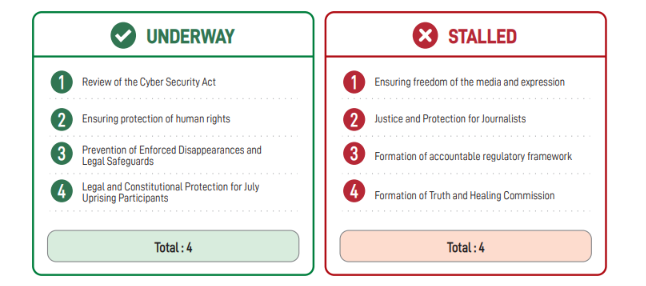
Compiled by Centre for Governance Studies
1. Ensuring Protection of Human Rights
BNP pledged to ensure human rights protection in accordance with the Universal Declaration of Human Rights. The manifesto also committed that appointments to the National Human Rights Commission would be made based on specific and defined criteria (BNP Election Manifesto, 2026, p. 10).
During the reporting period from 17 February to mid August 2026, the government took several legislative and institutional steps related to this commitment, particularly concerning the legal framework, appointment process, composition, and independence of the NHRC. On 9 April 2026, Parliament repealed the NHRC framework introduced through the 2025 ordinance and restored the National Human Rights Commission Act, 2009.141 The government maintained that the 2025 framework contained legal and operational ambiguities and required further review. However, opposition lawmakers and rights advocates criticised the restoration of the 2009 law, arguing that it could increase executive influence over the Commission and weaken its institutional independence.142
The government subsequently began preparing a new NHRC framework, proposing changes to the commissioner-selection process and the Commission’s institutional structure. However, stakeholders raised concerns that the draft could weaken some of the independent powers granted under the 2025 ordinance. In particular, the NHRC could be required to rely on reports from the government or heads of disciplined forces when examining alleged violations involving those forces, while the proposed selection mechanism could still allow significant government influence over appointments.143 In June, Transparency International Bangladesh (TIB) submitted 19 recommendations, calling for transparent and merit-based appointments, clearer qualification criteria, greater institutional and financial independence, and stronger representation of women, ethnic minorities, and marginalised groups.144
A major development came on 10 August 2026, when the Cabinet gave final approval to the draft National Human Rights Commission Act, 2026. The proposed Commission would consist of a chairperson and four commissioners, while the selection process would involve representatives from academia, civil society, and ethnic or disadvantaged communities. The government also stated that at least one woman would be included and that qualified candidates from ethnic and disadvantaged communities would receive priority.145 These measures represent identifiable progress toward the manifesto commitment to establish clearer criteria for NHRC appointments.
However, concerns regarding institutional independence remain. On 12 August, TIB said that although the revised framework contained positive provisions, the commissioner-selection process could still permit significant government influence and that stronger safeguards were required for the Commission’s administrative and investigative independence.146 The government also introduced reforms related to privacy and digital rights, including legislation covering personal data protection, cyber security, and national data governance.147 These measures created a broader statutory framework for protecting personal information. At the same time, concerns persisted about surveillance, executive powers, and freedom of expression under the digital-governance framework.148
Overall, the pledge is assessed as Underway because identifiable legislative and institutional measures have been taken to reform the NHRC, develop clearer commissioner-selection procedures, and strengthen legal protections relating to privacy and digital rights. However, implementation remains incomplete, and significant concerns persist regarding executive influence over the NHRC, institutional independence, privacy and surveillance safeguards, and freedom of expression. The effectiveness of these reforms will ultimately depend on the final legal framework, transparent and merit-based appointments, independent oversight, and consistent protection of human rights in practice.
2. Prevention of Enforced Disappearances and Legal Safeguards
BNP pledged to prevent enforced disappearances and take legal measures in line with the UN International Convention for the Protection of All Persons from Enforced Disappearance. The manifesto described enforced disappearance as an extreme violation of human rights and emphasised that Bangladesh had not achieved justice in even a single enforced disappearance case (BNP Election Manifesto, 2026, p. 10).
In April, Parliament allowed the Enforced Disappearance Prevention and Redress Ordinance, 2025 to lapse, which drew criticism from opposition lawmakers, victims’ families, and rights advocates. Critics argued that the ordinance should have been amended rather than discontinued, as its lapse removed the existing standalone legal framework for defining, investigating, and addressing enforced disappearance. The government, however, maintained that the ordinance contained legal weaknesses and stated that a stronger standalone law would be developed following consultations with relevant stakeholders.149
At the same time, Parliament passed the International Crimes (Tribunals) (Amendment) Bill, 2026 on 7 April 2026, formally recognising enforced disappearance as a crime against humanity under the ICT framework.150 This strengthened the legal basis for prosecuting serious cases of enforced disappearance, although the ICT framework is primarily focused on criminal accountability and does not provide the broader preventive, complaint, and victim-support mechanisms expected under a dedicated law. The government then moved forward with developing a new standalone framework. On 17 May 2026, a draft Prevention and Remedy of Enforced Disappearance Act, 2026 was presented at a stakeholder consultation. The draft proposed a new structure for investigating and prosecuting enforced disappearance, but concerns were raised about assigning investigations mainly to the police,
particularly in cases where members of law-enforcement agencies themselves may be implicated.151 In June, UN human rights experts also highlighted possible weaknesses in the draft, including a potential loophole that could allow short periods of secret detention without necessarily meeting the legal definition of enforced disappearance. They also raised concerns about the proposed use of the death penalty and whether the provisions on victim reparation were sufficiently comprehensive.152 Alongside the legislative process, the government announced measures to support affected families. On 26 June, it announced plans to introduce a special allowance for families of enforced- disappearance victims.153
By late July, the proposed legislation had progressed further. On 27 July 2026, the government published the draft Prevention and Remedy of Enforced Disappearance Act, 2026 for public feedback. The draft recognises enforced disappearance as a distinct and continuing offence, extends liability to those who order, assist, conceal, or fail to prevent such acts, introduces responsibility for superior officers, and includes provisions for victim protection, compensation, rehabilitation, and legal assistance.154 However, TIB criticised the initially limited consultation period and called for broader and more meaningful participation by victims, civil-society organisations, and other stakeholders before the law is finalised.155
Overall, the pledge is assessed as Underway based on the legislative and policy measures taken during the reporting period. These include recognising enforced disappearance as a crime against humanity under the ICT framework, developing a new standalone prevention and redress law, consulting stakeholders, and introducing measures aimed at supporting victims and their families. At the same time, the process remains incomplete, and concerns continue over the independence of investigations, safeguards against secret detention, victim reparations, and the proposed penalties. The effectiveness of the pledge will ultimately depend on the final form of the legislation and how consistently and independently it is implemented in practice.
3. Legal and Constitutional Protection for July Uprising Participants
BNP pledged to ensure legal and constitutional protection for those who participated in the historic July student-mass uprising, a pledge that is politically and symbolically important because the July uprising is central to the current democratic transition narrative (BNP Election Manifesto, 2026, p. 8).
Early in the reporting period, the government signalled that protection and rehabilitation of July uprising participants would remain a priority. The most significant legal step came on 8 April 2026, when Parliament passed the July Mass Uprising (Protection and Liability Determination) Bill, 2026, converting the earlier ordinance into permanent legislation.156 The law provides that civil and criminal cases arising solely from participation in the uprising may be withdrawn and prevents new cases from being filed on that basis. However, allegations of killings may still be referred to the National Human Rights Commission (NHRC) for investigation. The law also contains safeguards intended to prevent officers from the same institution or force as a victim from conducting such investigations.
The role assigned to the NHRC nevertheless generated debate. NCP MP Hasnat Abdullah argued during passage of the bill that the Commission’s independence should have been secured before giving it responsibility for determining serious allegations involving uprising participants. Outgoing NHRC commissioners later also warned that restoring the NHRC Act, 2009 could weaken the Commission’s ability to independently investigate allegations involving state agencies.[157][158]
Protection measures were accompanied by welfare and access-to-justice initiatives. On 10 April, Parliament passed legislation providing for the welfare and rehabilitation of July martyrs’ families and July fighters. On 25 April, the government also moved to bring July martyrs’ families and July fighters under the state legal-aid framework, enabling eligible beneficiaries to receive free legal assistance from lower courts through the Appellate Division, whether involved in proceedings as complainants or defendants. In addition, by 18 June 2026, the government reported that 13,344 of 14,369 gazetted July warriors were receiving monthly allowances, while 152 seriously injured participants had been sent abroad for specialised treatment. A database had also been prepared for rehabilitation and employment support, with 1,937 people referred for training and rehabilitation assistance.[159][160]
Implementation challenges remained, particularly in financial assistance. In July, the July Shaheed Smriti Foundation reported a serious funding shortage that was delaying assistance to some remaining families and injured participants. However, government-administered monthly allowances, free medical treatment, and rehabilitation programmes continued separately.161
Overall, the pledge is assessed as Underway because the government has taken identifiable legislative and administrative steps to provide legal protection, welfare, rehabilitation, and access to legal assistance for July uprising participants. The April protection law represents the clearest legal safeguard, while subsequent allowance, treatment, rehabilitation, and legal-aid measures demonstrate implementation. At the same time, questions remain regarding the independence of the NHRC mechanism, the consistency of welfare support, and the extent to which the manifesto’s commitment to constitutional protection, beyond statutory safeguards, will be formally incorporated and implemented.
4. Ensuring Freedom of the Media and Expression
BNP’s manifesto promised to build a liberal and inclusive democratic society where freedom of expression, independent media, and unhindered thought would be ensured (BNP Election Manifesto, 2026, p. 6).
During May and June, Information Minister Zahir Uddin Swapan announced that the government would establish an independent Media Commission to promote media freedom, improve accountability, and protect media workers’ rights. The proposed commission is expected to be formed through stakeholder consultation and to support the free flow of information while addressing misinformation. The government also announced plans to introduce digital TRP and print-circulation verification systems to improve transparency in media regulation and government advertisement allocation.162
These announcements indicate the government’s intention to strengthen the media sector through institutional reform. However, the initiative remains at the planning stage, and no concrete institutional changes have yet been implemented. Its effectiveness will ultimately depend on the commission’s legal mandate, independence, appointment process, and protection from political influence.
5. Reforming the Cyber Security Act
BNP’s manifesto pledged that the Digital Security Act would be reviewed to reduce legal complications and harassment, suggesting a rights-oriented reform approach, particularly in relation to digital expression and the misuse of law (BNP Election Manifesto, 2026, p. 43).
A significant legislative step was taken in April 2026, when Parliament passed the Cyber Security Act, 2026, converting the earlier Cyber Security Ordinance into permanent law.163 The framework retained several reforms introduced after the repeal of the previous Digital Security Act, including the removal of a number of controversial provisions used against online expression and mechanisms for cancelling cases filed under repealed sections. These changes represent tangible progress toward reducing some of the legal risks associated with the earlier cyber-law framework.
However, concerns over implementation emerged soon afterward. At a discussion on 6 May, legal and digital-rights experts argued that several provisions of the new law remained vague and potentially open to misuse. Participants pointed to arrests over social-media activity and warned that broadly defined concepts relating to public disorder or anxiety could still be applied against legitimate expression.164 Further legal questions arose on 21 June, when the High Court questioned the constitutionality of Section 50(5) of the Cyber Security Act. The provision allows cases filed under repealed sections of previous cyber laws to be cancelled, but concerns were raised that its broad application could also terminate cases involving cyber sexual harassment, stalking, impersonation and online gender-based violence.165
On 30 June, Parliament passed the Cyber Security (Amendment) Act, 2026, which was gazetted on 1 July. Contrary to some early media reports describing a broader package of amendments, the enacted legislation primarily repealed Section 20, relating to online gambling, after Parliament moved gambling offences into a separate legal framework.166
Meanwhile, the government began considering additional amendments to the cyber-security framework. On 2 July, a cabinet committee was formed to review a further amendment proposal, and discussions continued during July.167 Reported proposals included new provisions addressing rumours,
disinformation, defamatory material and AI-generated deceptive content. Digital-rights experts expressed concern that broadly framed criminal provisions could recreate some of the problems associated with the former Digital Security Act if adequate safeguards, proportionality standards and judicial oversight are not included.168
Overall, the pledge is assessed as Progressing. The passage of the Cyber Security Act and the removal of several controversial provisions demonstrate identifiable legislative progress toward reforming the previous digital-security framework. However, concerns remain regarding vague provisions, arrests connected to online expression, legal uncertainty surrounding the cancellation of earlier cases, and proposed new restrictions on misinformation and defamatory content. The ultimate success of the reform will depend on whether future amendments strengthen safeguards against harassment and misuse rather than reintroducing broadly defined offences that could restrict legitimate digital expression.
Theme 6: Foreign Policy
The foreign policy agenda comprises 13 sub-themes covering a broad range of Bangladesh’s external relations and international engagement, including Rohingya repatriation, regional and multilateral diplomacy, economic and investment diplomacy, labour migration, water resources, and reforms aimed at creating a more investor-friendly environment. The assessment tracks the government’s commitments against developments since taking office, considering diplomatic initiatives, bilateral and multilateral engagements, policy measures, institutional reforms, and evidence of implementation. Of the 13 sub-themes assessed, 7 are underway, while 6 remain stalled. Overall, the government has demonstrated considerable activity in diplomatic outreach and policy formulation, although the pace of progress and implementation varies significantly across commitments. The detailed assessment gives greater attention to the underway commitments, as these areas have generated more substantive developments, policy initiatives, negotiations, or evidence of implementation during the period under review. By contrast, the stalled pledges receive comparatively limited discussion because there have been few or no significant updates or concrete government actions against which meaningful progress could be assessed. In particular, three stalled commitments the establishment of the Bangladesh International Commercial Court, the introduction of investor protection regulation, and the appointment of an FDI Captain with 24/7 active helpdesks have not been included in the detailed assessment due to the limited evidence of progress or concrete government action during the review period.
Figure: 8
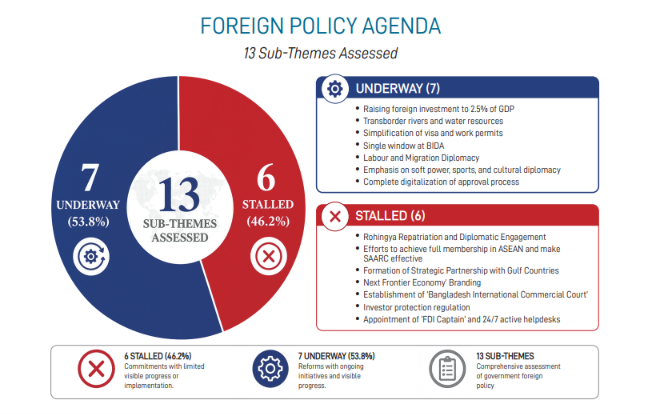
Compiled by Centre for Governance Studies
1. Rohingya Repatriation and Diplomatic Engagement
Ensuring the safe, voluntary, dignified, and sustainable repatriation of Rohingyas to Myanmar with full citizenship rights through effective diplomatic initiatives (BNP’s Election Manifesto 2026, p. 23).
On 9 July 2026, Prime Minister Tarique Rahman said the government was considering direct engagement with Myanmar’s military government, the Arakan Army and other relevant actors to create conditions for the safe, voluntary and sustainable return of the Rohingya population. The government also indicated that it would pursue the issue through bilateral, regional and multilateral channels, alongside continuing Rohingya data verification, exploring third-country resettlement, coordinating with the United Nations and donor agencies, and supporting The Gambia’s case against Myanmar at the International Court of Justice.169
On 13 July, the government moved to strengthen domestic coordination by forming an 11-member National Strategy Formulation Committee on Rohingya Affairs, chaired by the Prime Minister. The committee assigned a specialised board, led by the Principal Staff Officer of the Armed Forces Division and involving the Directorate General of Forces Intelligence, to prepare a comprehensive national strategy for Rohingya repatriation within 90 days.170
On 22 July, Bangladesh raised the Rohingya issue during discussions with China, seeking cooperation on matters including regional connectivity and broader issues affecting Myanmar. The following day, 23 July, Bangladesh used the ASEAN Regional Forum to call for stronger regional cooperation to create conditions in Myanmar conducive to the safe, voluntary, dignified and sustainable return of the Rohingya.[171][172]
Toward the end of July, reports emerged suggesting that Myanmar had agreed to take back 300,000 Rohingyas from Bangladesh. However, on 30 July, State Minister for Foreign Affairs Shama Obaed Islam clarified that no such agreement or discussion had taken place between Bangladesh and Myanmar. The clarification cast doubt on the reported progress and indicated that no concrete breakthrough had been reached on repatriation.173
As of 30 July 2026, the government had taken steps to establish a national repatriation strategy and broaden diplomatic engagement with Myanmar, China and regional forums, but there was no confirmed agreement with Myanmar for the actual return of Rohingyas. The absence of a verified repatriation arrangement, combined with the government’s clarification regarding the reported return of 300,000 Rohingyas, suggests that the pledge remains stalled.
2. Emphasis on soft power, sports, and cultural diplomacy
Emphasis on soft power, sports, and cultural diplomacy: A pool of education-exchange programmes, teachers, researchers, writers, cultural personalities, private policy makers, and youth-politicians will be developed. To expand cultural diplomacy, Bangladesh’s culture minded younger generation will be engaged globally, thereby increasing soft power (BNP’s Election Manifesto 2026, p. 12).
The government showed initial progress on the BNP’s 2026 manifesto pledge to strengthen soft power, sports, and cultural diplomacy during Prime Minister Tarique Rahman’s June 22–26 visit to China.
Alongside agreements on trade, infrastructure, security, and regional connectivity, Bangladesh and China agreed to expand people-to-people cooperation through media exchanges, think-tank collaboration, youth programmes, sports, cultural activities, education, healthcare, and human resource development. Bangladesh also joined China’s Global Development Initiative, which includes cooperation in education and Mandarin-language teaching in Bangladeshi schools.174
These steps are relevant to the manifesto commitment to build a pool of teachers, researchers, writers, cultural figures, private policymakers, and young political leaders for international engagement. The proposed exchanges could create new platforms for Bangladeshi youth, academics, media professionals, and cultural actors to engage globally and improve the country’s diplomatic visibility.175
However, the initiatives remain largely at the agreement and planning stage. No clear implementation timeline, budget, participant-selection process, or measurable target has yet been announced. Sustained progress will depend on transparent programmes, reciprocal exchanges, and meaningful participation by independent cultural and academic institutions over the coming years.
On 21 June 2026, Prime Minister Tarique Rahman began a two-day official visit to Malaysia. During the visit, Bangladesh and Malaysia signed a memorandum of understanding on cultural cooperation, creating a basis for exchanges between artists, cultural institutions, and professionals. Bilateral discussions also covered academic cooperation, technical skills development, artificial intelligence, information technology, and capacity-building, which could expand opportunities for students, teachers, researchers, and young professionals. Malaysia’s support for Bangladesh’s deeper engagement with ASEAN and RCEP may increase the country’s regional visibility and influence.[176][177]
However, the outcomes remain diplomatic commitments rather than implemented programmes. No roadmap, funding mechanism, participant-selection process, or measurable target has been announced for cultural or academic exchanges. Progress should therefore be assessed as promising but preliminary.
3. Raising foreign investment to 2.5% of GDP
Raising foreign investment to 2.5% of GDP: According to the one trillion-dollar economic roadmap, efforts will be made to raise foreign direct investment from 0.45% to 2.5% of GDP (BNP’s Election Manifesto 2026, p. 29).
Under the government’s one trillion-dollar economic roadmap, efforts were pledged to raise foreign direct investment from 0.45% to 2.5% of GDP. In line with this objective, the government has taken several steps to improve the investment environment and attract foreign capital. On 17 July 2026, Parliament passed the Invest Bangladesh Bill, 2026, paving the way for the merger of BIDA, BEZA, BHTPA and PPPA into a single investment promotion authority. The new authority is expected to streamline investment services, reduce bureaucratic delays and establish a unified one-stop platform for investors.[178][179]
These institutional reforms have been accompanied by efforts to attract investment through international economic engagement. On 10 July, Bangladesh and Türkiye agreed to establish a joint-venture drone manufacturing facility in Bogura, combining foreign investment with technology transfer, while the EU urged Bangladesh to accelerate reforms addressing non-tariff barriers and other obstacles to trade and investment.180,181 On 9 July, the government also began preparations for negotiations with India on a Comprehensive Economic Partnership Agreement, aimed at improving market access and diversifying economic relations.182 Earlier, on 5 July, the government invited US companies to expand investment in Bangladesh, offering assurances on policy stability, equal treatment and profit repatriation.183
Taken together, these measures indicate meaningful progress in strengthening the institutional and policy framework for attracting foreign investment. However, the available developments do not yet demonstrate an increase in FDI to the targeted 2.5% of GDP. The pledge can therefore be considered to be progressing in terms of policy and institutional reforms, while its stated investment target remains to be achieved.
4. Formation of Strategic Partnership with Gulf Countries
Formation of Strategic Partnership with Gulf Countries: Bangladesh wants to build a strategic partnership with member states of the Gulf Cooperation Council (GCC), the goal of which will be to achieve economic integration by combining the surplus capital of Gulf Countries with Bangladesh’s productivity and human resources. This partnership will work to increase mutual food security, digital transformation, cybersecurity, and military industry and training support (BNP’s Election Manifesto 2026, p. 23).
On 4 August 2026, Prime Minister Tarique Rahman told visiting Saudi Vice Foreign Minister Waleed Elkhereji that Bangladesh wanted to develop ties with Saudi Arabia into a “strategic, multidimensional and long-term partnership.” Discussions included potential Saudi investment in processed food, agro-industry, IT, AI and renewable energy, following a Saudi transport delegation’s July discussions on infrastructure and strategic projects.184
While this reflects progress in Bangladesh-Saudi relations, the broader pledge remains stalled, as Saudi Arabia is only one of the six GCC member states and there has been limited evidence of comparable strategic engagement with the others.
5. Transborder rivers and water resources
Pledged to secure a fair share of water from the Padma, Teesta and other transboundary rivers (BNP’s Election Manifesto 2026, p. 22). Progress has been most visible in the renewal of the Ganges Water Sharing Treaty with India and renewed efforts on the Teesta.
On 25 June 2026, China pledged full support for Bangladesh’s management of the Teesta and other rivers during Prime Minister Tarique Rahman’s visit to Beijing. China also agreed to support the Teesta River Comprehensive Management and Restoration Project, along with cooperation on flood prevention, river dredging, hydrological forecasting and irrigation.[185][186]
The Chinese commitment provides Bangladesh with an additional diplomatic and strategic avenue on the Teesta and potentially strengthens its negotiating position with India. India subsequently said its approach to the Teesta issue would take into account “all related developments,” suggesting that China’s involvement could influence the broader regional context, although it does not itself constitute a water-sharing agreement.187
Meanwhile, on 9 July, State Minister for Foreign Affairs Shama Obaid said Bangladesh and India were continuing negotiations on renewing the 1996 Ganges Water Sharing Treaty and expressed hope for a positive outcome.188 By 16 July, Bangladesh was seeking restoration of a legally backed guarantee mechanism for predictable dry-season flows, with a draft agreement expected by September or October.189
These developments show progress in both diplomatic engagement with India and broader Teesta water-resource management. However, the Teesta water-sharing dispute with India and agreements on other transboundary rivers remain unresolved. The pledge can therefore be considered underway, but remains only partially fulfilled.
6. Complete Digitalization of Approval Process
The government also pledged to fully digitalise investment approvals, including VAT and customs refunds, to create a “plug-and-play” environment for investors (BNP’s Election Manifesto 2026, p. 29). On 13 June 2026, its deregulation package proposed mandatory online processing for business approvals, digital company registration, online tax and VAT services, automated refunds and provisional approvals allowing some businesses to begin operations before completing remaining requirements.190 The subsequent Invest Bangladesh legislation further provides for investment and business services to be consolidated through a unified digital platform.191
The measures demonstrate clear progress towards the government’s digitalisation objective, particularly in streamlining approvals and automating tax, VAT and refund processes. However, as these reforms are still being introduced and implemented, the pledge has not yet been fully achieved.
7. Simplification of Visa and Work Permits
The government pledged to simplify visa and work permit procedures for investors and necessary officials, with visas and work permits to be issued within 10 days and a five-year multiple-entry investor visa to be introduced (BNP’s Election Manifesto 2026, p. 23).
On 13 June 2026, the government’s deregulation package proposed issuing work permits for foreign experts within seven days and investor visas within 10 days. It also included consideration of five-year multiple-entry investor visas as part of efforts to make Bangladesh more attractive to foreign investors and skilled professionals.192
On 2 July, the government was formulating Visa Policy 2026 by revising the existing 2006 framework. The proposed policy seeks to simplify the entry and departure of foreigners, facilitate foreign investment and business, and promote technology and knowledge transfer while maintaining national security and diplomatic reciprocity. A cabinet committee headed by the finance minister was formed to review and finalise the draft.[193][194]
These developments show that the government has moved beyond the pledge at the policy level, with specific timelines and visa reforms under consideration. However, the proposed measures have not yet been fully implemented.
8. Single Window at BIDA
‘Single Window’ at BIDA: A ‘single window’ will be launched under the Bangladesh Investment Development Authority (BIDA), where all approvals and registrations will be provided in one place. Company registration will be completed within 48 hours, and work permits within 7 days (BNP’s Election Manifesto 2026, p. 29).
On 3 June 2026, the government said it was working to introduce a one-stop service to simplify investment procedures and speed up approvals for foreign investors. The initiative was discussed during Prime Minister Tarique Rahman’s meeting with a Mitsui & Co delegation, with the government stressing its intention to create a more investment-friendly environment.195 A subsequent June
proposal specified that the single-window system would bring approval and licensing procedures under a mandatory online platform, with company registration within 48 hours and work permits within seven days.196
The pledge is therefore progressing, although the available evidence shows that the system and its timelines were still being developed rather than fully implemented.
9. Labour and Migration Diplomacy
The government pledged to use labour and migration diplomacy to expand opportunities for skilled Bangladeshi workers in the global labour market. Progress has been visible through efforts to reopen existing markets, diversify destinations and match Bangladeshi skills with specific overseas demand (BNP’s Election Manifesto 2026, p. 23).
On 8 June 2026, the government said diplomatic negotiations were ongoing with Malaysia, Oman, the UAE and Bahrain to reopen or expand labour markets. The same update noted that a Japan Cell had been established to coordinate a target of sending 100,000 workers to Japan over five years.197 The government also began collecting demand forecasts from Bangladeshi missions abroad to identify country-specific labour requirements.198
Engagement with new and existing destinations has also expanded. Qatar expressed interest in recruiting Bangladeshi electricians, plumbers, AC technicians and welders, while Bangladesh and Thailand discussed employment opportunities for around 10,000 workers.199,200 During his June visit to Malaysia, Prime Minister Tarique Rahman also urged Malaysia to reopen its labour market, while both countries agreed to establish a Joint Working Group to revise their labour-migration framework.[201][202]
These developments show active use of diplomacy to expand and diversify overseas employment, particularly for skilled workers. However, several markets remain restricted and much of the progress is still at the negotiation or planning stage.
However, despite considerable diplomatic activity, the assessment reveals a gap between the government’s foreign policy commitments and their translation into concrete outcomes. Progress has been strongest in areas that can be advanced through bilateral engagement, policy formulation and institutional initiatives, particularly investment diplomacy, labour migration, water resources, and engagement with China and Malaysia. However, several commitments remain at the level of negotiations, agreements or proposed reforms, with limited evidence of implementation or measurable results. The most significant concern remains Rohingya repatriation, where expanded diplomatic engagement has yet to produce a confirmed agreement with Myanmar, while the proposed GCC strategic partnership has so far shown more visible movement with Saudi Arabia than across the wider GCC. Investment-related reforms also remain uneven, with progress on Invest Bangladesh, digitalisation and visa facilitation contrasted by stalled commitments on investor protection, an international commercial court and dedicated FDI support mechanisms. Overall, the government has been active in expanding diplomatic outreach and initiating reforms, but the effectiveness of its foreign policy agenda will ultimately depend on converting these commitments into concrete agreements, functioning institutions and measurable outcomes.
Theme 7: Women’s Leadership and Gender Equality
Women’s leadership and gender equality remain important areas for assessing the government’s commitment to inclusive governance, women’s empowerment, protection, and representation. Under this policy area, 10 pledges have been identified. Four are currently Underway: women’s social and economic empowerment; providing a Family Card in the name of the female head of the family; introducing strict legal measures to address gender-based and online violence, hatred, and bullying; and providing free education for women up to the master’s level. The remaining six pledges are Stalled: financial and skills support for women entrepreneurs; installation of vending machines for health and hygiene; establishment of day-care and breastfeeding corners at workplaces; creation of special union-level women support cells; enforcement of exemplary punishment for rape and abuse against women; and ensuring that at least 10% of members of the upper chamber are women. The following figure summarizes these pledges and their current implementation status.
Figure: 9
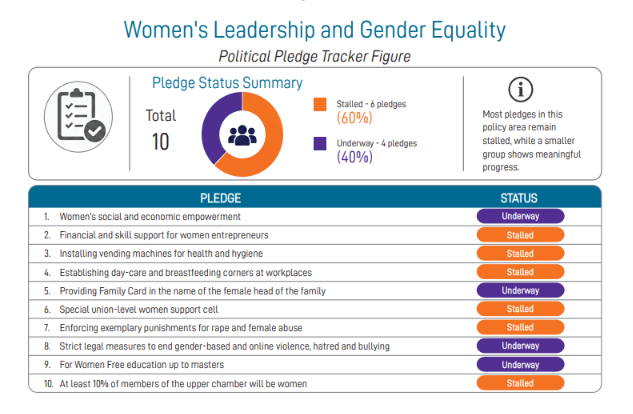
Compiled by Centre for Governance Studies
1. Women’s Social and Economic Empowerment
BNP pledged to place women at the centre of family and social development, with the manifesto emphasising women’s health, rural development, employment, and the safety and healthy development of girl children (BNP Election Manifesto, 2026, p. 13).
On 27 April 2026, Prime Minister Tarique Rahman announced plans to introduce LPG cards for women alongside the ongoing Family Card programme. Speaking at a public rally in Jessore, he said the initiative would be gradually implemented across the country to reduce women’s daily difficulties in managing cooking fuel and household needs, and also announced plans to make girls’ education free up to degree level and provide stipends for high-performing students.203 On 3 May 2026, the government announced additional measures to improve women’s mobility and safety in Dhaka, including nine
women-only buses on eight routes operated by female drivers and assistants, and a bicycle-sharing service around Uttara metro rail stations with six bicycle stands, 150 bicycles, and approximately six kilometres of cycle lanes. The government is also preparing a 180-day action plan to rationalise bus routes, introduce electric buses, expand licensing opportunities for transport workers, and explore light rail or monorail services in densely populated areas where metro rail may not be suitable.204
The government also announced the project “Providing Bicycles to Schoolgirls for Adolescent Empowerment” to address transport barriers faced by female students, particularly in remote areas. Led by the Department of Women Affairs, the pilot project has an initial allocation of Tk 25 crore and will provide bicycles to 16,000 Grade 6 students across 48 upazilas in eight districts.205
Together, these initiatives are relevant to women’s social and economic empowerment. LPG cards could reduce household fuel expenses, ease women’s unpaid domestic workload, and support safer cooking practices, particularly in low-income households. Free education and merit-based stipends could improve girls’ access to higher education and contribute to their future employment, social mobility, and economic independence. Similarly, safer and more accessible public transport could strengthen women’s participation in education, employment, and public life. However, these measures should currently be considered partial progress, as the government has not yet provided detailed programme designs, eligibility criteria, budget allocations, implementation timelines, or monitoring frameworks.
2. Providing a Family Card in the Name of the Female Head of the Family
BNP pledged to introduce the Family Card primarily in the name of female heads of households. The manifesto stated that the programme would initially cover five million poor rural families and gradually expand to all families in the country. Through this card, families would receive monthly financial assistance of Tk 2,000 to Tk 2,500 or essential food items such as rice, lentils, oil, and salt, explicitly linking the programme to poverty reduction, hunger elimination, and women’s economic empowerment (BNP Election Manifesto, 2026, p. 13).
On 10 March 2026, the government launched the Family Card programme to provide Tk 2,500 per month to 37,567 women in 14 pilot areas. Prime Minister Tarique Rahman formally inaugurated the programme in Dhaka and described it as part of the government’s agenda for women’s empowerment, economic inclusion, and social justice.[206][207] On 28 April 2026, it was reported that the programme is expected to
cost Tk 1.34 lakh crore over five years; more than 37,000 cards had already been distributed on a pilot basis, and the government planned to provide cards to 86,000 families by June, with beneficiaries to be selected through a survey of 4.10 crore families.208
This is one of the clearest examples of direct manifesto implementation. The amount of support, the focus on female heads of households, and the poverty-reduction objective align closely with the pledge. However, the planned scale is very large and financially demanding, and the projected cost of Tk 1.34 lakh crore over five years raises questions about fiscal sustainability, targeting accuracy, and long-term funding. The pledge is underway because the government has launched the programme and begun cash transfers, but the next stage must ensure transparent beneficiary selection, prevention of political capture, reliable financing, a grievance-redress mechanism, and regular public reporting.
3. Strict Legal Measures to End Gender-Based and Online Violence, Hatred, and Bullying
BNP pledged to end gender-based violence and discrimination against women. The manifesto also committed to increasing awareness against digital and online violence, hatred, bullying, and women’s online harassment, along with effective legal and administrative steps (BNP Election Manifesto, 2026, p. 13).
On 10 April 2026, Parliament passed the Women and Children Repression Prevention (Amendment) Bill, 2026, converting the earlier Women and Children Repression Prevention (Amendment) Ordinance, 2025 into law. The government presented the amendment as a measure to make the justice process faster, more efficient, and more accountable.209
According to the ruling party, the amendment fixes timeframes for investigation and trial, reduces delays for victims, strengthens victims’ safety, privacy, and dignity, improves the use of digital evidence, and reinforces a zero-tolerance policy against violence against women and children. This development is strongly relevant to the gender-based violence component of the pledge. However, the manifesto also referred specifically to awareness, online hatred, bullying, and women’s online harassment, and the update does not provide evidence of a broader prevention strategy, digital-safety campaign, victim-support mechanism for online abuse, or administrative coordination with cyber authorities. The pledge is therefore progressing through legal reform, but prevention, awareness, and online-specific enforcement require further development.
4. Free Education for Women up to Master’s Level
BNP’s manifesto pledged to create opportunities for free education for women students up to the postgraduate level, along with strong academic and technical education opportunities so that girls in rural and urban areas could acquire skills to shape their futures. The manifesto also noted Begum Khaleda Zia’s role in advancing women’s education in Bangladesh (BNP Election Manifesto, 2026, p. 13).
The proposed FY2026-27 budget included a major increase in education-sector allocation. On 11 June 2026, the education-sector allocation was raised to Tk 136,606 crore, equivalent to 2 percent of GDP, up from Tk 87,206 crore in FY2025-26. The budget highlighted free education for girls up to the undergraduate level, technical education from Grade 6, third-language learning, digital classrooms, free Wi-Fi, AI and coding exposure, and mid-day meals, alongside stronger industry-academia links, internships, startup support, and engagement of skilled Bangladeshi professionals abroad in education and research.210
This indicates progress in expanding education spending and girls’ access to education. However, the manifesto pledge specifically referred to free education for women up to the postgraduate level, while the budgetary announcement highlighted free education only up to the undergraduate level. The pledge is therefore progressing, but full alignment with the manifesto will require extending support to postgraduate education and ensuring that rural and urban girls can access both academic and technical opportunities.
A key concern is that progress has been concentrated on welfare and access-oriented measures, while commitments requiring institutional change, dedicated resources and stronger enforcement have received comparatively little attention. The absence of movement on women’s entrepreneurship support, workplace daycare and breastfeeding facilities, union-level support cells, exemplary punishment for rape and abuse, and women’s representation in the upper chamber is particularly notable. These are not simply supplementary measures; they address women’s ability to earn independently, remain in the workforce, access institutional support, seek justice and participate in political decision-making. The government therefore needs to move beyond announcing broad programmes and address these less visible but important areas if its gender equality commitments are to produce meaningful structural change.
Theme 8: Transparency and Governance Mechanisms
The assessment reviews government initiatives across a range of transparency and governance commitments, with “Underway” used primarily to indicate that identifiable government initiatives, policy steps, discussions, legislative actions, or institutional measures have been undertaken; it does not mean that a pledge has been fully accomplished or implemented. Progress has been observed in
areas such as Election Commission reform, strengthening local government and meaningful decentralization, re-establishing fair elections as the legitimate source of state power, opposition leadership of the Public Accounts Committee, and the neutral caretaker government issue. At the same time, several commitments remain stalled, including constitutional reform through the July National Charter and parliamentary process, broader implementation of the 31 Points and the July National Charter, formation of an Administrative Reform Commission, appointment of an Ombudsman, enactment of laws to ensure the financial and fund-management autonomy of local government institutions, placing local government elections under the direct supervision of the Election Commission, referring most bills to an upper chamber, amending Article 70 to provide MPs greater freedom on specified parliamentary matters, appointing one Deputy Speaker from outside the ruling party, creating a 100-member upper chamber, ensuring a balance of power between the President and the Prime Minister, and creating the post of Vice President. These stalled classifications indicate that the respective commitments have remained delayed, unresolved, or without sufficient visible implementation progress during the period under review.
Figure: 10
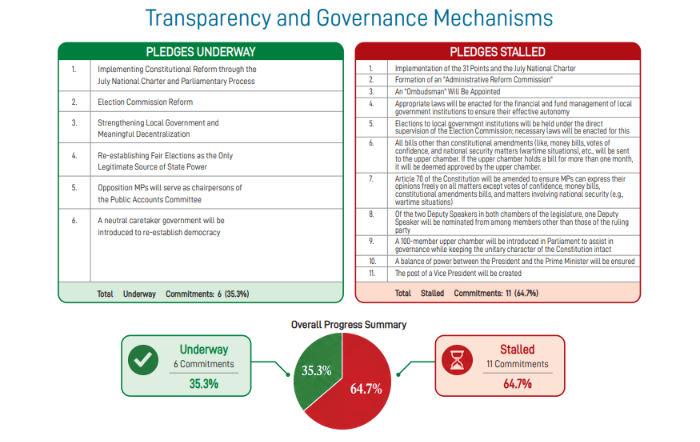
Compiled by Centre for Governance Studies
1. Parliamentary Inclusion and Institutional Power Sharing
BNP pledged that one of the two deputy speakers in the legislature would be nominated from outside the ruling party (BNP Election Manifesto, 2026, p. 7). In March 2026, the government verbally offered the position to Jamaat-e-Islami. However, Jamaat declined the offer, arguing that it was insufficient without a clear commitment to implement the July Charter.211 As the position remained unfilled by the opposition, the initiative stalled, highlighting the need for broader political consensus rather than symbolic inclusion alone.
2. Election Commission Reform
BNP pledged to establish an effective and politically neutral Election Commission in line with the July National Charter (BNP Election Manifesto, 2026, p. 7). On 6 April 2026, Parliament passed the A significant institutional step was taken on 6 April 2026, when Parliament passed the Election Commission Secretariat (Amendment) Bill, 2026, alongside other electoral reform bills concerning electoral rolls, constituency delimitation, election officers, and the Representation of the People Order.212 The amendment was enacted on 10 April 2026, retaining key provisions introduced through the 2025 ordinance. It formally established a dedicated Election Commission Service and clarified the Secretariat’s responsibilities in areas including voter-list management, constituency delimitation, political-party registration, election administration, publication of election results, and review of electoral laws.213 These reforms provide a stronger institutional basis for improving the professional capacity and administrative continuity of the Election Commission.
However, concerns regarding political neutrality emerged in July 2026. On 23 July, former Election Commission official Shamsul Alam was appointed Additional Secretary of the EC Secretariat on a one-year contract. He had previously served on a BNP committee on parliamentary constituency delimitation. Although Alam maintained that his appointment was not political, election and governance experts raised concerns about its possible impact on perceptions of the Commission’s neutrality. An Election Commissioner also stated that the Commission itself had no role in the appointment, as it was made by the government, raising questions about the EC’s authority over senior administrative appointments within its own Secretariat.214
The broader reforms envisaged under the July National Charter, particularly regarding constitutional safeguards and the appointment and institutional independence of election commissioners, also remained incomplete. Parliament formed a special constitutional amendment committee on 13 July, and in August the committee began reviewing constitutional reform proposals with the July National Charter at the centre of the process. However, as of 14 August 2026, no new constitutional mechanism for appointing the Chief Election Commissioner and other election commissioners had been adopted.215
Overall, the pledge is assessed as Progressing but concerns remain regarding political neutrality in senior Secretariat appointments, the Commission’s practical authority over its administration, and the unfinished constitutional reforms relating to the appointment and independence of election commissioners.
3. Re-establishing Fair Elections as the Legitimate Source of State Power
BNP pledged to rebuild a sustainable democratic framework through necessary electoral and constitutional reforms and to re-establish the people’s vote as the only legitimate source of state power. The manifesto also stated that democracy should not be confined only to elections but should be practised in daily governance through transparency, accountability, and self-reliance (BNP Election Manifesto, 2026, p. 6).
On 6 April 2026, Parliament passed the Representation of the People (Amendment) Bill, 2026 and the Election Officers (Special Provisions) (Amendment) Bill, 2026. The amendments strengthened the Election Commission, improved candidate accountability through mandatory asset disclosure, restored paper-based voting and the “No Vote” option, prevented individuals from avoiding legal proceedings by running for office, introduced penalties for AI-generated disinformation, and enhanced protection for election officials.[216][217]
These measures may improve electoral integrity, accountability, and public confidence. However, their success will depend on effective enforcement, political neutrality, campaign-finance oversight, independent monitoring, and credible dispute-resolution mechanisms.
4. Strengthening Local Government and Meaningful Decentralisation
BNP pledged to strengthen elected local government institutions, ensure adequate funding, reduce administrative interference, and improve transparent and accountable service delivery (BNP Election Manifesto, 2026, p. 11).
On 9 April 2026, Parliament passed the Local Government (District Council) (Amendment) Bill, 2026, the Local Government (Municipality) (Amendment) Bill, 2026, the Local Government (City Corporation) (Amendment) Bill, 2026, the Local Government (Upazila Parishad) (Amendment) Bill, 2026, and the Local Government (Union Parishad) (Amendment) Bill, 2026, all relevant to the broader pledge of strengthening local government, decentralisation, and local democratic institutions.218
However, the City Corporation (Amendment) Bill drew controversy because it allowed unelected administrators to remain in office for an indefinite period under broadly defined “special circumstances.”219 Opposition lawmakers warned that the measure could weaken democratic accountability, increase political control over local institutions, and undermine the commitment to meaningful decentralisation. However, the government subsequently moved toward restoring elected local bodies through phased local government elections. In June, the Local Government Minister told Parliament that elections could begin in September or October 2026, with Union Parishad elections likely to be held first.220 In July, the Election Commission finalised recommendations for amendments to election laws governing all five tiers of local government.221 By 9 August, the EC had prepared a draft roadmap proposing that phased local polls begin in early October, alongside preparations for voter lists, polling centres, electoral rules, and security arrangements
The passage of the bills represents progress in reforming the legal framework of local government. However, the continued reliance on appointed administrators remains inconsistent with the goal of strengthening elected local bodies.
5. Article 70 and Constitutional Reform
BNP pledged to amend Article 70 of the Constitution to allow MPs to express independent opinions on most parliamentary matters, except votes of confidence, money bills, constitutional amendments, and national security issues (BNP Election Manifesto, 2026, p. 12).
On 13 July 2026, Parliament approved the formation of a 12-member special parliamentary committee, chaired by Home Minister Salahuddin Ahmed, to oversee the constitutional amendment process after the opposition declined to nominate members to the originally proposed 17-member committee. The government stated that the committee would consult constitutional experts, legal professionals, civil society, and political parties before preparing recommendations for the 18th Constitutional Amendment Bill.222
Disagreement over the reform mechanism nonetheless persisted. Jamaat-e-Islami, the National Citizen Party (NCP), and other opposition parties rejected the committee, arguing that the July National Charter should instead be implemented through a Constitutional Reform Council established under the July National Charter Implementation Order. In protest, opposition MPs walked out of Parliament. BNP maintained that constitutional reform must proceed through the existing constitutional framework, arguing that the proposed Reform Council lacked a constitutional basis.223
The process moved forward on 4 August, when the special committee held its first meeting and decided to review the Constitution more broadly, taking the July National Charter and relevant manifesto commitments into account. The committee also announced plans to consult constitutional experts, lawyers, political parties, civil society, journalists, and other stakeholders before preparing its recommendations.224 In addition, in accordance with article 70, a writ petition challenging the constitutional validity of Article 70 was also filed in the High Court on 13 August, reflecting continuing legal and political debate over restrictions on MPs’ independent voting.225
The establishment of the parliamentary committee represents tangible progress toward constitutional reform. However, continued disagreement over the appropriate reform mechanism has slowed implementation and highlighted broader political divisions over whether constitutional change should occur through Parliament or through the July Charter’s proposed Constitutional Reform Council.
6. Implementation of the 31 Points and the July National Charter
The 19 Points of President Ziaur Rahman, the Vision-2030 of Prime Minister Begum Khaleda Zia, the 31-Point State Reform agenda of BNP Chair Tarique Rahman, and all the points and clauses on which consensus has been reached and formally signed in the “July National Charter”, will be implemented in the agreed-upon parliamentary process with the highest priority (BNP’s Election Manifesto 2026, p. 6).
The implementation process encountered an institutional dispute immediately after the new government took office. On 17 February 2026, BNP lawmakers declined to take the separate oath as members of the Constitution Reform Council, arguing that the body had no basis under the existing Constitution.226 The Council, which had been envisaged under the July National Charter implementation mechanism, consequently did not become operational. On 31 March, the government instead proposed pursuing constitutional reforms through a special all-party parliamentary committee, maintaining that constitutional amendments should proceed through Parliament.227
The disagreement continued as opposition parties, including Jamaat-e-Islami and the NCP, maintained that the Charter should be implemented through the Constitution Reform Council. On 13 July, Parliament formed a 12-member special parliamentary committee on constitutional amendments after the opposition declined to nominate members and walked out in protest.228 The committee held its first meeting on 4 August and decided to review the Constitution with the July National Charter and BNP’s manifesto commitments as reference points, while also planning consultations with political parties, experts, civil society, and other stakeholders.229
The government has continued to reaffirm its commitment to both reform agendas. On 20 July, BNP Secretary General Mirza Fakhrul Islam Alamgir said the government remained committed to implementing the 31-point agenda and the July National Charter, while the Law Minister later stated that constitutional amendments would be pursued through the parliamentary process.[230][231] However,
these commitments and the establishment of the parliamentary committee have not resolved the fundamental disagreement over the implementation mechanism.
Overall, the pledge is assessed as Stalled. Although some individual reforms associated with the 31-point agenda have progressed separately, the Charter’s agreed implementation mechanism has not become operational, political consensus over the constitutional reform process remains unresolved, and the broader package of reforms has not yet been translated into a coherent set of constitutional and institutional changes. The parliamentary committee represents preparatory movement, but as of 14 August 2026, it had only begun its work and substantive implementation of the overall commitment remained incomplete.
7. Opposition MPs Will Serve as Chairpersons of the Public Accounts Committee
Opposition MPs will serve as chairpersons of the Public Accounts Committee, Privileges Committee, Estimates Committee, and Committee on Public Undertakings of the National Parliament. In addition to these committees, chairperson posts of various ministry-related standing committees in parliament will be ensured to be appointed from the opposition in proportion to the number of seats obtained in parliament (BNP’s Election Manifesto 2026, p. 12).
A visible step was taken on 8 July 2026, when Parliament formed the 15-member Public Accounts Committee and appointed Opposition Deputy Leader Syed Abdullah Mohammad Taher, a Jamaat-e-Islami MP, as its chairman.232 The appointment placed one of Parliament’s key financial oversight bodies under opposition leadership and therefore directly advanced the manifesto commitment.
Overall, the pledge is assessed as Underway because the specific institutional arrangement promised by BNP has been implemented. However, its longer-term significance will depend on whether the committee can exercise independent and effective scrutiny of government expenditure, audit findings, and financial irregularities.
8. Introduction of a Neutral Caretaker Government
BNP pledged to restore a neutral, non-party caretaker government system to ensure credible and impartial national elections.
A major legal development occurred on 9 July 2026, when the Appellate Division of the Supreme Court upheld the High Court verdict that had invalidated the provisions of the 15th Constitutional Amendment
abolishing the caretaker government system. As a result, the constitutional provisions relating to the caretaker government system and referendums were restored.233 The ruling represented a significant advancement of the substance of BNP’s commitment, although the restoration resulted from judicial proceedings rather than legislation initiated by the government.234
Following the verdict, the Law Minister stated that the next national parliamentary election would be held under a caretaker government, describing restoration of the system as a political commitment of the government. However, he also noted that the detailed process for forming the caretaker government and determining its composition would depend on the full judgment and subsequent arrangements.235
Overall, the pledge is assessed as Underway because the constitutional basis for the caretaker government system has been restored and the government has publicly committed to using the mechanism for the next national election. However, the pledge cannot yet be considered fully implemented, as the practical procedures for constituting and operating the caretaker government have not yet been tested.
Part I: Cross-Cutting Observations
Five broader patterns are visible across the ruling party’s pledge implementation record.
First, government activity is often treated as progress even when implementation and outcomes remain uncertain. Laws, committees, targets, and pilot projects are frequently classified as “Underway,” although enforcement, funding, nationwide coverage, and measurable impact are still unclear.
Second, visible welfare programmes are advancing faster than structural institutional reforms. Initiatives such as the Family Card, Farmers’ Card, loan waivers, and honorarium programmes have moved quickly, while judicial independence, local-government autonomy, parliamentary power-sharing, and decentralisation remain contested or stalled. This suggests that distributing benefits is easier than transferring institutional power.
Third, there is a tension between reform and centralisation. Some measures are presented as promoting independence and accountability but may still preserve executive control, particularly in local government and judicial administration.
Fourth, many pledges are being implemented only partially. Government actions often address the easiest component of a broader promise, such as providing loan waivers instead of agricultural insurance.
Finally, the overall status system appears optimistic. Many pledges are labelled “Underway” even when they remain at the announcement, legislative, planning, or pilot stage. Overall, the implementation record can be described as broad but shallow, with substantial policy activity but limited evidence of complete and outcome-based implementation.
Part II: Opposition Party Pledge Monitoring and Accountability Role
In this report, the opposition refers mainly to the parliamentary opposition coalition, particularly Jamaat-e-Islami and the National Citizen Party (NCP). Both parties were active during the monitoring period through parliamentary engagement, public rallies, legal participation, and public statements, focusing on constitutional reform, implementation of the July Charter, anti-corruption, minority inclusion, local government elections, and democratic accountability. Although they acted within the same opposition bloc in Parliament, Jamaat-e-Islami and the NCP also advanced their own manifesto-based priorities. Their role therefore reflected both coordinated opposition pressure and party-specific efforts to hold the ruling party accountable to its commitments and to the broader reform expectations created after the July uprising and referendum.
Theme 1: Law Enforcement and National Security
1. Prevent Political Misuse of Law-Enforcement Agencies
The NCP pledged that exemplary justice would be ensured for all crimes against humanity committed during the era of Awami fascism, including the July massacre, the Shapla Square massacre, the BDR massacre, enforced disappearances, and extrajudicial killings, and that a Truth and Reconciliation Commission would be established (NCP Election Manifesto, 2026, p. 11).
On 8 April 2026, Parliament passed the July Mass Uprising (Protection and Liability Determination) Act, 2026, granting legal protection to participants in the July Uprising while assigning the National Human Rights Commission (NHRC) responsibility for investigating allegations of killings. The following day, Parliament passed the National Human Rights Commission (Repeal and Re-enactment) Act, 2026, restoring the National Human Rights Commission Act, 2009 by repealing the 2025 ordinance.[236][237]
During the session, NCP MP Hasnat Abdullah opposed the restoration of the 2009 framework, arguing that an NHRC lacking institutional independence could become an “Opposition Suppression Commission” rather than an effective human rights body, and maintained that accountability mechanisms would only be credible if they operated independently of political influence.
These interventions reflect the NCP’s continued emphasis on ensuring that justice and accountability institutions remain free from political interference, consistent with its pledge to prevent the political misuse of law-enforcement and related state institutions.
Theme 2: Judiciary and Rule of Law
1. Independent Commission for July Charter Implementation Timeline and
Accountability Framework
The NCP pledged to form an independent commission to establish an implementation timeline and accountability framework for the July Charter provisions that depend on laws and administrative orders, placing the Charter at the centre of post-election accountability and institutional reform (NCP Election Manifesto, 2026, p. 11).
On 25 April 2026, NCP Convener and Opposition Chief Whip Nahid Islam stated that Parliament and the streets may unite if necessary to implement the July Charter and the referendum verdict. He said the opposition was raising the issue inside Parliament while other leaders remained active on the streets, and accused the government of politicising universities, institutions, and the judiciary.238
This activity shows that the NCP is actively linking its manifesto pledge to the continuing political debate over the July Charter, treating Charter implementation not only as a legal or administrative matter but also as a democratic mandate arising from the referendum. Nahid Islam’s warning indicates that the NCP views delays or rejection of the referendum verdict as a violation of democratic accountability. The party’s engagement therefore reflects both institutional pressure inside Parliament and public mobilisation outside it. While no formal commission has yet been established, the NCP’s continued advocacy keeps the pledge visible in the national political debate.
2. Ensure Judicial Independence Through Separation of Powers
Jamaat-e-Islami pledged to ensure an independent and effective judiciary by establishing full separation between the judiciary and the executive in accordance with constitutional principles (Jamaat Election Manifesto, 2026, Law and Justice System, Point 1).
On 9 April 2026, Parliament passed the Supreme Court Judges Appointment (Repeal) Bill and the Supreme Court Secretariat (Repeal) Bill, repealing ordinances introduced during the interim government period that had established a Judicial Appointment Council, specified qualifications for judicial appointments, and created an independent Supreme Court Secretariat under the Chief Justice.239
Jamaat-e-Islami, the NCP, and other opposition lawmakers strongly criticised the repeal, arguing that the council-based appointment process had provided a more transparent framework and reduced the possibility of executive interference in judicial appointments and administration. They warned that removing these safeguards could allow political individuals to be appointed to the judiciary and make judicial administration vulnerable to executive influence.240
The opposition maintained that the government could have amended and improved the ordinances instead of repealing them entirely. Although the government argued that judicial reforms required a more permanent constitutional framework, the opposition considered the immediate repeal a rollback of institutional safeguards.241 Jamaat-e-Islami’s opposition to the bills was therefore consistent with its pledge to defend judicial independence and uphold the separation of powers.
Source notes
238 Dhaka Tribune. (2026, April 25). Nahid Islam: Parliament and streets will become one if needed. https://www.dhakatribune.com/bangladesh/politics/408573/nahid-islam-warns-streets-and-parliament-could
Theme 3: Economy and Anti-Corruption
1. Ensure Transparency, Integrity, Accountability, and Effective Oversight
Jamaat-e-Islami pledged to ensure transparency, integrity, and accountability at every level of government and to establish effective oversight mechanisms to prevent corruption. During the
monitoring period, both Jamaat-e-Islami and the National Citizen Party actively raised concerns regarding banking governance, public expenditure, budget implementation, loan recovery, and financial accountability (Jamaat Election Manifesto, 2026, Corruption-Free Bangladesh, Point 3).
Jamaat-e-Islami mainly pursued an institutional and preventive approach to accountability. Its activities focused on strengthening parliamentary scrutiny, improving lawmakers’ capacity, reviewing government economic policies, and identifying risks before public funds were spent. On 6 June 2026, Jamaat organised a two-day budget training workshop for its 77 lawmakers to improve their understanding of budget analysis, economic policy, inflation, employment, parliamentary procedures, and welfare-oriented budgeting.242 The initiative indicated an effort to equip its MPs with the knowledge required to examine government expenditure and economic decisions more effectively.
On 12 June, the party criticised the government’s proposed FY2026-27 budget as overly ambitious and heavily dependent on deficit financing. It questioned the feasibility of the government’s GDP growth, inflation, revenue, and borrowing targets, warning that excessive borrowing from banks could reduce private investment, limit employment opportunities, and slow industrial growth, and called for a more realistic, investment-friendly, and welfare-oriented budget.243
Overall, Jamaat’s approach was mainly preventive. It sought to promote accountability through stronger parliamentary capacity, scrutiny of budget assumptions, and institutional monitoring, although it did not present a detailed proposal for creating a new independent anti-corruption oversight mechanism.
2. Investigative Accountability and Enforcement
The NCP pledged to combine public transparency, through disclosure of assets and expenditure, with institutional accountability, through a stronger ACC and parliamentary scrutiny, and citizen oversight, through public hearings and digital complaint mechanisms. Its lawmakers focused on identifying possible financial misconduct, questioning government decisions, exposing legal loopholes, and demanding explanations regarding influential business groups and banking irregularities (NCP Election Manifesto, 2026, Corruption-Free Citizen Services through Transparency, Accountability, and Modernisation, Section 2; 36-Point Manifesto, Point 4).
The NCP pursued a corrective accountability approach, using parliamentary scrutiny and public criticism to challenge financial irregularities. It opposed Section 18(Ka) of the Bank Resolution Bill, warning that it could enable former bank owners accused of misconduct to regain control and weaken
depositor protection. NCP MP Hasnat Abdullah also questioned the recovery of S Alam Group’s loans, the money laundering of Bashundhara Group, possible government understandings with influential groups, and the financing and oversight of major budget programmes, while criticising unrealistic revenue targets and risks of greater IMF dependence.[244][245][246]
Overall, Jamaat-e-Islami emphasised preventive accountability through parliamentary and institutional oversight, while the NCP emphasised corrective accountability through investigation, disclosure, and enforcement. Together, their activities kept the pledge vibrantly active, although most interventions remained at the level of scrutiny and political pressure rather than producing permanent new oversight institutions.
Theme 4: Transparency and Governance Mechanisms
The March-July 2026 period was marked by opposition activity focused on transparency, institutional accountability, the July Charter, local government, public administration, and budget oversight. Jamaat-e-Islami and the National Citizen Party (NCP) raised similar concerns.
1. Realising the Aspirations of the July Uprising and the July Charter
Jamaat treated implementation of the July Charter as a test of the government’s democratic legitimacy and commitment to structural reform, arguing that the referendum result created a binding political, constitutional, and moral obligation to reform the state in line with the aspirations of the July uprising (Jamaat Election Manifesto, 2026, Law and Justice System, Point 1).
On 7 April, the Jamaat-led 11-party alliance announced a seven-day nationwide programme demanding implementation of the referendum verdict. When the Referendum Ordinance, 2025 lapsed on 11 April, the government argued that it had served its purpose and contained legal complications, whereas Jamaat viewed its expiry as weakening the formal legal pathway for implementing the Charter.[247][248]
The party subsequently intensified pressure through both parliamentary and street mobilisation. On 24 April, Shafiqur Rahman declared that the movement to implement the referendum verdict would continue both inside and outside Parliament, while alliance leaders warned that parliamentary action and street protests could merge if the Charter was not implemented. Throughout April, Jamaat consistently argued that implementing the July Charter was a constitutional obligation rather than a political choice.249
The issue remained central throughout the months. On 18 May, the High Court fixed 17 June to hear writ petitions challenging the legality of the July National Charter Implementation Order, 2025 and the Referendum Ordinance, 2025, with Jamaat and 66 of its MPs named as respondents.250 Jamaat Secretary General Mia Golam Parwar argued that the referendum mandate stood above ordinary parliamentary considerations and called for a constitutional reform session during the budget session, while Shafiqur Rahman warned that the government would not be given unlimited time to implement the Charter and reiterated that Jamaat would continue its movement both inside Parliament and on the streets.251
Analytically, Jamaat consistently combined legal engagement, parliamentary opposition, alliance activities, and public mobilisation to pressure the government to implement the July Charter, framing it as a constitutional obligation and a key measure of the government’s democratic legitimacy.
Like Jamaat-e-Islami, the National Citizen Party (NCP) also regarded implementation of the July Charter as a key benchmark for assessing the government’s commitment to post-uprising reforms. However, while Jamaat primarily emphasised the referendum mandate and democratic legitimacy, the NCP placed greater emphasis on constitutional consistency and the credibility of the reform process.
The NCP’s pledge supported implementation of the July Charter but placed greater emphasis on constitutional consistency and the credibility of the reform process (NCP Election Manifesto, 2026, Point 1).
Lawmaker and convener Nahid Islam accused the government of creating an artificial crisis over the Charter and delaying constitutional reform. The NCP also applied to become a respondent in the legal proceedings concerning the Charter and referendum framework, and its leaders warned that peaceful programmes could become tougher if the government continued to avoid implementation.252 Sarwar
Tushar alleged that the BNP government had already begun violating its reform commitments. The NCP continuously questioned the government’s positions on the proposed upper house, the caretaker government formula, and neutral appointments to constitutional institutions, and alleged that the government had selectively converted into law only those ordinances that served its political interests.
The NCP therefore used the July Charter as a standard for evaluating whether the government’s legislative, constitutional, and appointment decisions were consistent with post-uprising reform commitments.
2. Checks, Balances, Transparency, and Institutional Accountability
Jamaat pledged to establish an effective system of checks and balances in government and to ensure transparency, accountability, and good governance across all branches of the state (Jamaat Election Manifesto, 2026, Fundamental Reform of the Governance System, Point 3).
Jamaat linked the Charter debate to a broader concern that the government was centralising power and politicising institutions. On 29 April, Jamaat MP Rafiqul Islam Khan accused the government in Parliament of displaying partisan governance in an “Awami style.”253 He cited changes involving university vice-chancellors, the appointment of administrators in local government bodies, and decisions to make officials in the Secretariat and health sector “officers on special duty” (OSD).
Jamaat MP Shafiqur Rahman repeatedly accused the government of rejecting reform and moving toward one-party dominance, arguing that these appointments and administrative decisions showed a gap between the government’s stated commitment to reform and its actual exercise of power.
The party also sought to institutionalise its opposition role. Reports on 7 May indicated that Jamaat planned to maintain pressure inside Parliament and through public programmes on the referendum verdict, local government elections, fuel and commodity prices, law and order, political violence, extortion, and campus unrest. It planned divisional rallies from May to July, a major Dhaka rally in October, and the formation of a shadow cabinet within two months.254 These plans suggest that Jamaat was attempting to combine legislative scrutiny, public mobilisation, and alternative policy positioning rather than relying only on occasional protests.
The National Citizen Party (NCP) shared Jamaat’s concern over institutional accountability but framed the issue more explicitly in terms of institutional capture, corruption, and citizens’ access to justice.
The NCP pledged to ensure corruption-free public service delivery through transparency, accountability, and modernisation (NCP Election Manifesto, 2026, p. 20).
The NCP argued that meaningful checks and balances require independent institutions capable of protecting citizens rather than serving partisan interests. Lawmaker Hasnat Abdullah proposed a symbolic “Justice Card,” arguing that welfare initiatives alone were insufficient when citizens continued to face corruption, bribery in recruitment, broker networks in police stations, inadequate healthcare, and denial of justice.255 The NCP continuously alleged that major institutions, including the Anti-Corruption Commission, the Human Rights Commission, the judiciary, banks, universities, and the Bangladesh Cricket Board, had been captured by partisan or vested interests, and also criticised the proposed Bank Resolution Law, arguing that it could allow individuals accused of large-scale bank looting to regain control of financial institutions.
Overall, the NCP assessed government performance by examining whether state institutions remained genuinely independent, transparent, and capable of serving the public interest rather than partisan interests.
3. Local Government Oversight and Electoral Accountability
Jamaat pledged to establish an accountable, transparent, and democratic local government system by strengthening local government institutions, ensuring elected representation, and enhancing public participation and oversight (Jamaat Election Manifesto, 2026, Local Government System, Point 4).
On 9 April, Parliament passed five local government amendment bills allowing the government to remove elected representatives and appoint administrators in “special situations” or in the “public interest.” The government argued that many representatives had become absent, gone into hiding, or fled after 5 August 2024, making temporary arrangements necessary. Jamaat rejected this justification, arguing that local government institutions should be administered by elected representatives, not politically appointed administrators, and criticising the term “special situation” as vague and open to political misuse. After the Zila Parishad and Municipality bills were passed, Shafiqur Rahman led an opposition walkout, saying the opposition did not want to accept responsibility for legislation it considered anti-people.256
Throughout the months, lawmaker Shafiqur Rahman questioned whether upcoming local government elections would be free and fair, expressing concern about the direction of the electoral environment with reference to two recent by-elections. He also criticised the appointment of BNP-backed administrators in 42 areas, including individuals who had previously lost public mandates. At the same time, Shafiqur Rahman stated that Jamaat would support constructive government initiatives while opposing partisan, unfair, or undemocratic actions, allowing the party to present itself as a conditional watchdog rather than an entirely obstructionist opposition.257
Analytically, Jamaat identified a contradiction between the government’s democratic reform agenda and legislation that expanded executive control over elected local institutions.
4. Good Governance and Public-Service Accountability
Jamaat pledged to establish an accountable, transparent, and people-oriented public administration that ensures efficiency, integrity, and effective service delivery to citizens (Jamaat Election Manifesto, 2026, Accountable and People-Oriented Public Administration, Point 1).
Jamaat extended the governance debate beyond constitutional reform to everyday administrative performance. The Jamaat-led alliance held a protest march demanding implementation of the referendum verdict, resolution of the fuel crisis, control of commodity prices, and relief from public suffering, accusing the government of breaking its election promises, acting in an authoritarian manner, mishandling the fuel crisis, and allowing extortion to return within only two months of taking office.
This intervention connected good governance with practical outcomes. Jamaat argued that accountable administration should be measured not only by constitutional arrangements but also by the government’s ability to control prices, maintain fuel supplies, prevent extortion, uphold law and order, and respond to citizens’ economic hardship.
The National Citizen Party (NCP) raised similar concerns but placed greater emphasis on the quality of public-service delivery and the everyday experience of citizens.
The NCP argued that institutional reform would have little value unless it translated into better public services and stronger accountability. Lawmaker Nahid Islam criticised the government over rising prices, fuel shortages, failures in the public health sector, and repeated broken promises. The party also
highlighted ICU shortages, bribery in recruitment, broker networks in police stations, corruption, and barriers to accessing justice as evidence that governance reforms had yet to produce meaningful improvements in citizens’ daily lives.258
Overall, the NCP assessed good governance primarily through the state’s ability to deliver efficient, transparent, and accountable public services rather than through institutional reform alone.
5. Economic Governance and Budget Accountability
Jamaat pledged to ensure transparency, integrity, and accountability at every level of government and to establish effective oversight mechanisms to prevent corruption (Jamaat Election Manifesto, 2026, Corruption-Free Bangladesh, Point 3).
Jamaat approached the FY2026-27 budget through parliamentary preparation and fiscal scrutiny. Before the budget session, the party organised specialised training for its lawmakers on public finance, economic policy, inflation, employment, budget analysis, and parliamentary procedure, reflecting an effort to strengthen informed legislative oversight.259
Throughout June, Jamaat criticised the proposed budget as anti-people and overly dependent on taxation, loans, deficit financing, and bank borrowing, warning that excessive borrowing could raise living costs, crowd out private-sector investment, weaken employment generation, and slow industrial growth. It also raised concerns about banking-sector management, financial irregularities, inflation, and rising energy prices. Overall, Jamaat sought to strengthen budget accountability by identifying fiscal risks and questioning the sustainability of the government’s economic policies.
The National Citizen Party (NCP) shared Jamaat’s concerns regarding fiscal governance but complemented its criticism with a detailed alternative economic programme.
The NCP pledged to ensure corruption-free public service delivery through transparency, accountability, and modernisation (NCP Election Manifesto, 2026, p. 20).
The NCP combined budget criticism with an alternative economic framework. On 5 June, it presented a shadow budget titled “Bangladesh 2.0: Sustainable Growth through Reform, Employment, and Investment,” containing 71 proposals across 12 sectors, with priorities including education, employment, healthcare, energy security, and defence modernisation.260
The party subsequently used this framework to assess the government’s proposed budget, describing the revenue target as unrealistic and warning that revenue shortfalls could widen the fiscal deficit and increase dependence on external financing. The NCP also criticised limited progress in banking-sector reform, the requirement of TIN certificates for opening bank accounts, and advance tax collection from small businesses. While acknowledging increased allocations for education, health, and social protection, it argued that the budget failed to adequately address unemployment, energy insecurity, and weaknesses in the banking sector.
Overall, the NCP’s approach combined legislative scrutiny with alternative policy proposals, using its shadow budget to advocate a more transparent, accountable, and reform-oriented economic strategy.
Theme 5: Human Rights and Freedom of Expression
Jamaat-e-Islami and the National Citizen Party (NCP) pledged to uphold fundamental human rights, ensure accountability for past human-rights violations, including enforced disappearances, extrajudicial killings, and political violence, and strengthen democratic freedoms, justice, and the rule of law. Their manifestos also emphasised protecting freedom of expression while ensuring accountability for abuses committed under state patronage.
Opposition parties continued to emphasise accountability for past human-rights violations and the protection of democratic freedoms. While Jamaat-e-Islami consistently called for justice for enforced disappearances, extrajudicial killings, and other abuses committed under state patronage, the NCP focused on parliamentary scrutiny of accountability mechanisms. On 7 June 2026, NCP lawmaker Hasnat Abdullah asked in Parliament what legal action would be taken against journalists and media outlets accused of legitimising enforced disappearances, killings, vote rigging, bank looting, and political violence during the Awami League government.261 In response, State Minister for Information and Broadcasting Yasir Khan Chowdhury said no one is above the law, whether journalist, politician, businessman, or public servant, adding that anyone involved in unlawful activities or actions against democracy would face action under existing laws. The parliamentary exchange also covered
misinformation, disinformation, unregistered online media, and misuse of journalist identities, with the state minister saying the government was preparing a policy for approving online portals and digital media.
This intervention shows that opposition actors remained active in pushing for accountability over enforced disappearances, killings, political violence, and the role of media in manufacturing consent for state abuses. However, the government’s response remained broad and procedural. Concrete progress would require transparent investigation, due process, and clear protection for press freedom while addressing unlawful conduct.
Part II: Cross-Cutting Observations
Four broader patterns are visible across the opposition’s monitoring and accountability role.
First, the implementation of the July Charter has become the central issue shaping opposition activity. Jamaat-e-Islami and the NCP have treated the Charter as a democratic and constitutional mandate and used parliamentary debate, legal participation, rallies, and public mobilisation to pressure the government to implement it.
Second, the opposition has combined parliamentary engagement with street mobilisation. Speeches, walkouts, nationwide programmes, legal challenges, and public rallies have been used together to maintain pressure on the government over constitutional reform, local elections, and institutional accountability.
Third, both parties have focused strongly on institutional independence and preventing the concentration of executive power, repeatedly raising concerns about political influence over the judiciary, the Human Rights Commission, local government, financial institutions, and public administration.
Finally, the opposition’s role has primarily been one of monitoring, agenda-setting, and accountability. Through parliamentary debate, public mobilisation, policy criticism, and alternative proposals, Jamaat-e-Islami and the NCP have kept governance failures, corruption, public-service concerns, and institutional independence under continuous scrutiny. Their contribution has therefore been most visible in shaping public debate and pressuring the government to respond to contested policy and reform issues.