
Methodology
Overview and Current Status of Political Commitments
The parliamentary election was held on 12 February 2026, and the newly elected government formally assumed office with the formation of the cabinet on 17 February 2026. This report assesses political pledges over the period from February 2026 to mid-August 2026, covering approximately the government’s first six months in office. This marked the beginning of a new government and administrative phase, as the government began translating its electoral commitments into policy decisions, legislation, and public programmes.
The Pledge Tracker website has been developed to assess whether commitments made by political parties in their election manifestos are being translated into concrete actions and measurable outcomes. Systematically monitoring these commitments helps determine the extent to which campaign promises move beyond political rhetoric and enter the sphere of actual governance. In doing so, the Tracker promotes transparency, strengthens accountability, and enables citizens, researchers, and policymakers to evaluate political performance against publicly declared pledges.
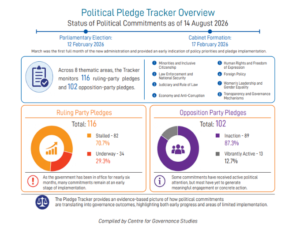
Across eight thematic areas, the Tracker monitors 116 ruling-party pledges and 102 opposition-party pledges. Of the ruling-party pledges, 34 are underway, while 82 remain stalled. As the government has been in office for nearly five months, many commitments remain at an early stage of implementation. Among the opposition-party pledges, 13 are classified as Vibrantly Active, while 89 remain under Inaction, indicating that although some commitments have received active political attention, most have yet to generate meaningful engagement or concrete action. Figure 1 summarises this aggregate picture as of mid-august 2026.
The Pledge Tracker assesses political commitments from February to mid-August 2026 across eight thematic areas, covering 116 ruling-party pledges and 102 opposition-party pledges. Of these, 34 ruling-party pledges are underway while 82 remain stalled, and 13 opposition-party pledges are classified as Vibrantly Active while 89 remain under Inaction.
Figure 1. Pledge Tracker aggregate status summary, as of August 14, 2026
Compiled by Centre for Governance Studies
Identification of Political Pledges
The Pledge Tracker is a non-partisan monitoring framework developed to assess political commitments made by both ruling and opposition parties. Its purpose is to document, classify, and evaluate the extent to which political pledges are reflected in post-election conduct, legislative process, public advocacy, and institutional action. The methodology is designed to maintain transparency, consistency, and neutrality. It does not seek to judge political intention or motivation. Instead, it records observable actions, decisions, statements, and outcomes based on verifiable public evidence.
Political pledges are identified through a systematic review of four major sources: official election manifestos of ruling and opposition parties; statements and assurances made by political actors during CGS-facilitated multi-party dialogues; public records such as parliamentary proceedings and official speeches; and credible media reports on policy announcements and political developments.
Thematic Categorization
All pledges are categorized under eight thematic areas to ensure structured analysis and comparison across political actors:
Table 1. Eight Thematic Categories
| Category | Theme |
|---|---|
| A | Minorities and Inclusive Citizenship |
| B | Law Enforcement and National Security |
| C | Judiciary and Rule of Law |
| D | Economy and Anti-Corruption |
| E | Human Rights and Freedom of Expression |
| F | Foreign Policy |
| G | Women’s Leadership and Gender Equality |
| H | Transparency and Governance Mechanisms |
This thematic structure allows the Tracker to present developments in a consistent and comparable format. It also supports theme-wise visualization and helps citizens, researchers, journalists, and policymakers understand which areas of reform are receiving political attention and which remain neglected.
Status Assessment Framework
The Tracker applies separate status frameworks for ruling and opposition parties because their institutional roles and powers differ. The ruling party exercises executive authority and can introduce laws, allocate budgets, adopt policies, establish institutions, and implement programmes. Opposition parties do not exercise the same executive power; their role is mainly to scrutinize government actions, raise issues in Parliament, propose alternatives, mobilize public opinion, and hold the government accountable.
The Tracker uses separate assessment frameworks for ruling and opposition parties. The ruling party is assessed on implementation through laws, policies, and programmes. Opposition parties are assessed on scrutiny, advocacy, and accountability.
Table 2. Ruling-party status categories
| Status | Definition |
|---|---|
| Accomplished | The pledge has been fully implemented. |
| Underway | Actions or initiatives related to the commitment have been initiated or are ongoing |
| Stalled | Work has started, but it appears unlikely to be completed based on current developments. |
| Pledge Broken | The pledge has been abandoned, reversed, or contradicted by government action. |
Table 3. Opposition-party status categories
| Status | Definition |
|---|---|
| Vibrantly Active | Vigorous engagement, including pointed questions in parliament, mobilizing public support, or efforts to keep the pledge visible in public discourse. |
| Parliamentary Endorsement | The party moves beyond speeches and attaches its name to a formal instrument, such as a bill, amendment, committee report, or other official parliamentary mechanism. |
| Inaction | A relevant debate, vote, or political development occurs, but the party provides no meaningful contribution, presence, or intervention. |
Conceptual Framework: The Pledge-to-Performance Accountability Framework
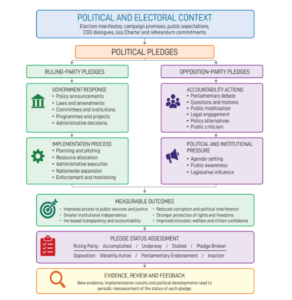
The Pledge Tracker explains how pre-election political commitments are translated into government actions, institutional reforms, public programmes, and measurable outcomes. It also examines how opposition parties contribute to accountability by monitoring, questioning, endorsing, or challenging government actions. The framework rests on the assumption that the fulfilment of a political pledge is not a single event but a gradual process that moves through several stages: political commitment, formal action, implementation, institutionalization, and measurable public impact. The framework, therefore, distinguishes between announcements or legislative activity and the actual achievement of sustainable outcomes.
Figure 2: The Pledge-to-Performance Accountability Framework
Compiled by Centre for Governance Studies
Election Manifesto. An election manifesto is an official document published by a political party before an election. It presents the party’s policies, priorities, programmes, and promises to voters and explains what the party intends to do if elected. In this report, election manifestos serve as the main reference for assessing whether political parties act on their declared commitments after the election.
Political pledges. Pledges are the set of commitments made by political parties through election manifestos, public statements, parliamentary assurances, and CGS-facilitated dialogues. These pledges establish the standards against which post-election political conduct is assessed. The Tracker covers commitments across eight thematic areas, including governance, the judiciary, human rights, the economy, national security, foreign policy, gender equality, and inclusive citizenship.
Ruling party pledges implementation. For the ruling party, the framework assesses pledges that are translated into laws, policies, budgetary measures, institutions, programmes, and public services.
Opposition accountability role. Opposition parties generally lack the executive authority to implement their pledges directly. Their performance is therefore assessed through their watchdog and accountability functions, including parliamentary questioning, legislative proposals, formal amendments, legal engagement, public mobilisation, budget scrutiny, political advocacy, and alternative policy proposals. Opposition activity may influence government behaviour by generating political pressure, exposing policy weaknesses, maintaining issues on the public agenda, and demanding institutional accountability. Nevertheless, political pressure alone does not necessarily produce formal laws or permanent institutional reforms.
Definitions of Factors Influencing Pledge Implementation. The relationship between pledges and outcomes is affected by several intervening factors: political commitment (the willingness of political leaders to prioritise and sustain a pledge); political consensus (cooperation or disagreement between the government and opposition); institutional independence (freedom of the judiciary, Election Commission, Human Rights Commission, Anti-Corruption Commission, and other bodies from political interference); administrative capacity (the ability of public institutions to implement policies effectively); financial capacity (the availability and sustainability of budgetary resources); legal safeguards (the existence of clear rules, independent oversight, and effective remedies); transparency and monitoring (public access to information, regular reporting, and institutional scrutiny); and citizen participation (opportunities for affected communities to influence implementation and provide feedback). These conditions may strengthen, delay, distort, or reverse pledge implementation.
July Charter. The July Charter refers to the political and constitutional reform framework developed from the aspirations of the July 2024 uprising. It sets out commitments related to democratic reform, institutional accountability, constitutional change, and the prevention of excessive concentration of state power.
Scope and Limitations
The Pledge Tracker examines the post-election performance of ruling and opposition parties across eight thematic areas, covering 116 ruling-party pledges and 102 opposition-party pledges. It assesses whether political commitments are reflected in legislation, policy decisions, institutional action, parliamentary engagement, public advocacy, and observable implementation. The analysis is based on publicly available and verifiable evidence, including election manifestos, parliamentary records, official statements, CGS-facilitated dialogues, government documents, and credible media reports.
The assessment nonetheless has several limitations. Most importantly, the government has been in office for only about 6 months, meaning that many commitments are still at an early stage, and it may be too soon to assess their overall effectiveness, sustainability, or long-term impact. Many pledges remain at the announcement, legislative, planning, or pilot stage, making it difficult to evaluate their practical outcomes. Second, the framework relies primarily on publicly accessible information; unpublished administrative decisions, internal implementation data, budget-release details, and beneficiary-level evidence may not be fully captured. Third, the status categories reflect the evidence available during the monitoring period (February to mid-August) and may change as new information emerges. Finally, visible political or legislative activity does not necessarily indicate full implementation, institutional sustainability, or measurable improvement in citizens’ lives.
Accordingly, the findings of the Pledge Tracker should be interpreted as a preliminary and evolving assessment rather than a final judgement on government or opposition performance. The current classifications reflect the evidence available within the first six months of the government’s tenure and may change as policies move from announcement and legislation toward implementation and measurable outcomes.
The Pledge Tracker covers 218 political commitments across eight thematic areas using publicly available and verifiable evidence. However, as the assessment covers only the first six months of the government’s tenure, many pledges remain at early stages, and their long-term impact cannot yet be fully measured. The findings should therefore be viewed as preliminary and subject to change as implementation progresses.