
China and India’s interests and stakes in Myanmar
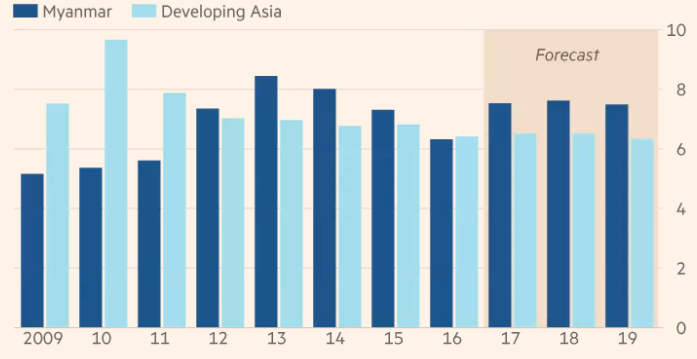
Myanmar’s interaction with the rest of the world has been limited until the country initiated democratic reforms in post-2010s, resulting in low growth and development. However, since its transition to democracy, the country witnessed higher GDP growth, although in recent years, growth has shown a declining trend (Figure 1).
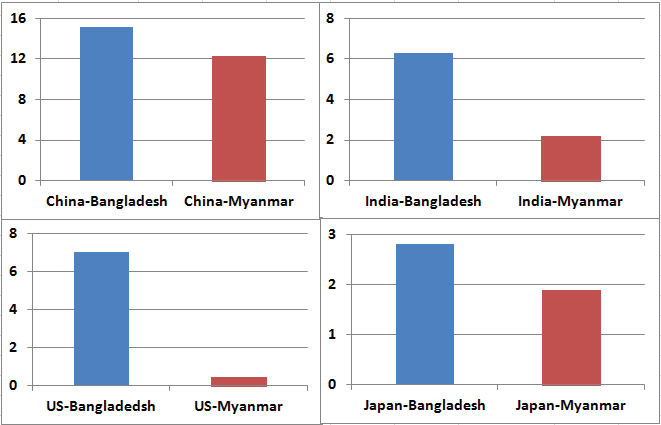
It is interesting to note that Bangladesh is in better-placed vis-à-vis Myanmar when it comes to trade relations with almost all the major regional and global powers. As reported in Figure 2, even the two-way trade between China and Bangladesh is higher than Myanmar-China trade. Similarly, Bangladesh is ahead of the country when it comes to trade with India, Japan, and the United States. Then what makes Myanmar so crucial to big powers, notably China and India?
Myanmar importance lies in its geographical location. Thanks to its favourable geography, the country is becoming a vital connectivity hub of Asia. There are at least three cross-border transport corridors being developed in Myanmar. They are:
i. East-West Corridor: Pathein – Yangon/ Thilawa – Bago – Thaton – Hpa An – Kawkareik –
Myawaddy – Mae Sot – Tak – Bangkok: promises a strong potential to become an economic corridor in Myanmar providing easy access to regional and global markets and value chains.
ii.
The Northern corridor: Ruili – Muse – Lashio – Mandalay – Monywa – Kalewa – Kale – Tamu – Moreh – Imphal. It is a strategic corridor of India, Myanmar, and China with strong potential for growth in the medium and long term. It could potentially benefit Bangladesh as well if BCIM EC eventually takes off.
iii. The Southern Corridor: Dawei – Kanchanaburi – Bangkok (Thailand) – Cambodia – Vietnam.XXV Figure 2: Bangladesh and Myanmar’s trade with China, India, United States and Japan (in Billion US$, 2016)
The Ministry of Construction of Myanmar has been upgrading 36 North-South roads and 45 East-West roads to Union Highways forming a national network of highways. The aim of these projects is to upgrade all Union highways to tarred road when the ASEAN community takes shape in 2020 to promote the balanced development of all regions and states of the country.
Besides, the government has been developing three special economic zones along with three rivers and ports, namely, Thilawa, Dawei, and KyaukPhyu. Thilawa is a deep river port, located 25 km off south Yangon. The Dawei deep-sea port and special economic zone are located in Tanintharyi Region, closer to Thailand. The government aims to transform Dawei into Myanmar’s and Southeast Asia’s largest industrial and trade zone. The KyaukPhyu project, which is the largest of all, is located in Rakhine state. China is the key stakeholder of the $10 billion megaproject. That said, we now look at two major powers , namely China and India’s interest and stakes in Myanmar.
China and India’s stakes in Myanmar
While economic interdependence between China and India increases, their geopolitical rivalry is also on the rise. Beijing and New Delhi have competing for visions to expand their geo-economic interests and perhaps supremacy in the region and beyond.
China has launched its grand vision under the aegis of Belt and Road Initiative (BRI), previously known as One Belt, One Road (OBOR) in 2013. The ocean-based 21st Century Maritime Silk Road and the overland Silk Road Economic Belt to increase trade and connectivity are backed by Beijing’s financial might. India’s vision is to expand its economic and strategic interests in its immediate neighbourhood and forge comprehensive ties with ASEAN. New Delhi intends to access overland routes to Europe and Central Asia bypassing Pakistan, reflected in its port development in Chabahar, Iran.
China is well ahead of India at this stage, expanding its strategic vision with an expectation that all roads will lead to Beijing. New Delhi is opposing China’s BRI leading to geopolitical rivalry in Asia. There are heightened tensions between China and India on the former’s development of multibillion-dollar China-Pakistan Economic Corridor.
The standoff between the two giants at the high altitude of Himalaya (Doklam) in 2017 is yet another example of New Delhi’s policy to arrest Beijing’s strategic interests in South Asia. It is China’s port, and other strategic infrastructures build up in Sri Lanka, particularly during the regime of Mahendra Rajapaksa, that forced India to adopt a more pro-active stance against Chinese infrastructure build-up in the Bay of Bengal, in particular, and the Indian Ocean, in general.
Nevertheless, Myanmar is the place where both China and India’s presence is visible more than anywhere else. To be more precise, it is the troubled Rakhine State of Myanmar, bordered by Chattogram to the northwest and the Bay of Bengal to the west, which sees greater presence of China and India with their investment and influence. Myanmar, which has been highly dependent on China for political and economic backing in the past, is now diversifying its portfolio partnering with India and other countries, including Japan.
China’s stakes in Myanmar
China and Myanmar share a close linguistic link. The Burmese and Chinese are both parts of the Sino-Tibetan language and people. They were also involved in war and conflict in the past. The Qing dynasty fought the Sino-Burmese War (1765-79). Myanmar was the first non-communist country to recognise the People’s Republic of China. It was the critical times of World War II China realised that Burma occupied a military necessity and geostrategic position of some importance. Not to mention the “Burma Road” has become a concrete and the most well-known example illustrating Chinese understanding of Myanmar’s importance for China.
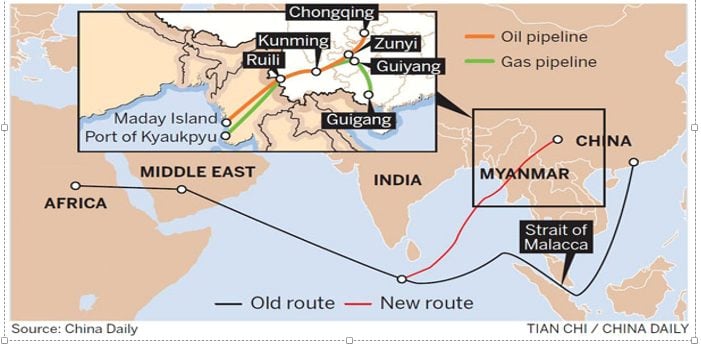
Yunnan province that shares a long border with Myanmar opens China to the Southwest connecting two oceans, the Pacific and the Indian, as well as East Asia, Southeast Asia, and South Asia. Yunnan shares 4,060 km land border with Laos, Myanmar (2000 km) and Vietnam. There are 11 first-category ports, 9 second-category ports, and over 90 passages to the outside world in Yunnan province. It is the linkage point between China’s southwest, the Southeast Asian peninsula, and the South Asian Subcontinent. The province is the starting point of the Yangtze River Delta economic zone as well as the Pearl River Delta economic zone. Sharing borders with Myanmar, Lao PDR, and Vietnam, Yunnan serves as the connective link between China, South Asia, and Southeast Asia. It offers an alternate route to the passage of goods through the Straits of Malacca and is the fastest land route for goods to travel from China to South Asia, the Indian Ocean, Europe, and Africa.
Beijing intends the country’s frontier provinces Yunnan and Xinjiang, in particular, play a vital role connecting international borders facilitate trade, commerce, and other interactions. In this connection, Myanmar becomes very critical to Beijing, both economically and geo-politically. The government of Yunnan Province has invested US$10 billion in Myanmar (in hydroelectricity, minerals, and agriculture), while Myanmar entrepreneurs have also invested $100 million in the province. Overall, between 1998 and 2014, China invested nearly $15 billion in the country in a host of infrastructure and industrial projects (Graph 2).
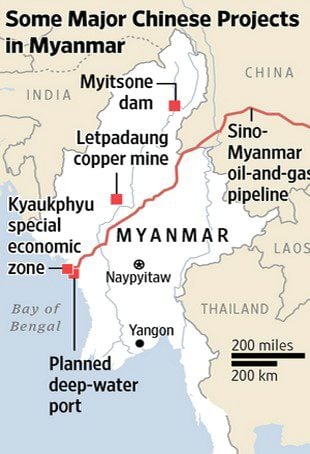
Source: China Moves to Revive its Sway in Myanmar”, The Wall Street Journal, February 28, 2016
Yunnan province has a strategy on transport connectivity termed ‘Yunnan International Passage’ consisting of three vertical lines, three horizontal lines, and nine passages. In light of Yunnan’s road layout on International Passage, three road lines are reaching the China-Myanmar border in the six lines of three vertical and three horizontal. In “Nine passages”, two passages are leading to Myanmar. The roads of Kunming-Ruili-Yangon and Kunming-Tengchong-Myanmar-India are the updated versions of the Burma Road (the Stilwell Road).
The Kunming-Ruili-Muse-Mandalay-Yangoon is the leading trade and connectivity route of China and Myanmar. In the China-Myanmar border, there are two main trading ports and cross-border industrial zones- Ruili and Wanding. The project on Opening-up and Experimental Zone and the Border Financial Comprehensive Reform Pilot Area in Ruili has been adopted.
Bordering Myanmar, the Ruili Development and Experimental Zone (RDEZ) was established in Ruili, which is the biggest land port of Yunnan. RDEZ is located at the intersection of Southeast Asia and South Asia. The China-Myanmar oil and gas pipeline (793 km gas pipeline and 771 km oil pipeline) project also passes through the region. Ruili is linked with Muse, a border town and port in Myanmar’s northern Shan state, which is connected to Myanmar’s second-largest city Mandalay via Lashio. The historic Burma Road (the Ledo Road) reaches Yunnan through Mandalay, Lashio, and Muse.
China’s $10 billion investment in Rakhine state
China has invested heavily in Rakhine state. A $2.45 billion pipeline from Rakhine to China’s Yunnan province is already operational, securing a key route for Beijing to import crude oil from the Middle East (Graph 3). The pipeline that stretches 770 kilometres from Kyaukpyu in western Myanmar (Rakhine state) to Southwest China is aimed at reducing the country’s reliance on oil supplies that pass through the US controlled Strait of Malacca, giving the country greater energy security. The pipeline can carry up to 22 million tons of oil a year, about 5 to 6 per cent of China’s annual oil imports.
Moreover, it has an ambitious infrastructure development plan worth $7.3 billion in the state. The Kyaukphyu Special Economic Zone and deep-sea port project is one of the major projects of China’s BRI project in the region connecting the country to the Bay of Bengal. A consortium led by China’s CITIC Group has proposed taking a 70-85 per cent stake in the $7.3 billion deep seaport, which is far higher than the joint venture (50/50) proposed by Myanmar. The port is part of two projects that include an industrial park, to develop a special economic zone. CITIC was awarded the lead role in both initiatives in 2015.
India’s stake in Myanmar
Myanmar, formerly known as Burma, was once the province of British India in 1886. In 1937, it was made a crown colony of Britain using it as a buffer zone between India and the rest of Asia. The British initially termed the country ‘Further India’. However, in the post-independence era (after 1948), the relations between India and Myanmar varied markedly. While China backed the Military government of Myanmar, India rendered its support to the country’s pro-democracy movement. However, since the 1990s the relationship between the two countries has changed for the better as Delhi reversed its decades-old policy of isolation and began to deal directly with the Military junta.
New Delhi’s adoption of Look East Policy in the 1990s lifted Myanmar’s importance as it is the land bridge between South- and Southeast Asia. India’s current Prime Minister Narendra Modi unveiled India’s new “Act East Policy,” in 2014 convincing Southeast Asian countries that his government is serious about boosting ties with the region. From security perspectives, Myanmar is very critical to maintaining political stability in Northeast India. The four states of NEI (Arunachal Pradesh, Manipur, Mizoram, and Nagaland) share a common border of 1,643 km with Myanmar. India and Myanmar work closely to limit the influence of Naga insurgency. Moreover, as China’s clout increases in Myanmar and the Bay of Bengal, New Delhi intends to counter the influence increasing its presence in the country. The confluence of all these factors has prompted Delhi to initiate maritime and other infrastructure development in Myanmar. They include the Kaladan multimodal project, a road-river-port cargo transport project, and India-Myanmar-Thailand Asian Trilateral Highway.
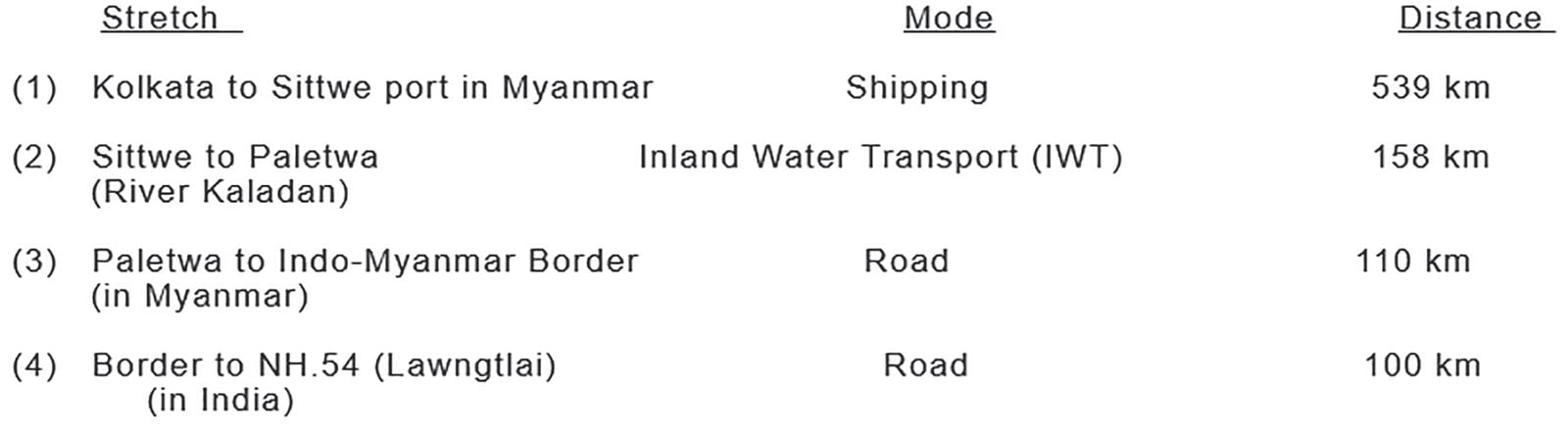
In April 2008 India and Myanmar signed the agreement of the Kaladan Multi-Modal Transit Transport Project. The project, consisting of river dredging and port and road construction, will connect Sittway in Rakhine State with Mizoram in India, providing land-locked northeastern India with a vital route to the Bay of Bengal along the Kaladan River (Table 1). The project is divided into three phases and is being pushed forward with the redevelopment of Sittway port.
Table 1: The Kaladan Multi-Modal Transit Transport Project segments
India-Myanmar Friendship Road and Border Road in Chin State
The India-Myanmar Friendship Road is an integral part of India-Myanmar-Thailand Tripartite highway. The 160 Km Tamu-Kalewa road in Sagaing Region was built and commissioned in February 2001. Upgrading of the road had been carried out in recent years.
In addition to Tamu which was opened as a border trade point in April 1995, while the second Myanmar-India border trade point Reedkawdah in Chin State was launched in January 2004. There are two border roads linking India and Myanmar in Chin State, namely the Falam-Reedkawdah Road (67 miles) and Tiddim-Reedkawdah Road (32 miles). Myanmar and India have agreed to upgrade the Tiddim-Reedkawdah Road. The road currently is an earth road and Public Works of the Ministry of Myanmar is commissioned to upgrade it phase by phase.
China is ahead of India in terms of investment and influence in Myanmar. However, New Delhi is an answer, at least partly, to Naypyidaw’s current policy to reduce its over-dependency on Beijing. In doing so, the country faces enormous diplomatic challenges to manage the two Asian giants. Nevertheless, there are some real challenges both for China and India beyond their rivalry. Myanmar’s volatile politics and fragile society are some constant worry for Beijing and New Delhi as they pump billions of dollars in the country. While there is a ceasefire with several ethnic groups, the country has been waging the world’s longest continuing civil war in which the ethnic Bamar Buddhist majority seeks to dominate dozens of non-Buddhist ethnic minorities. The volatile Rakhine, the home of Rohingyas, is a real worry for all the parties.