
Myanmar: An anthropologist’s paradise and a statesman’s nightmare
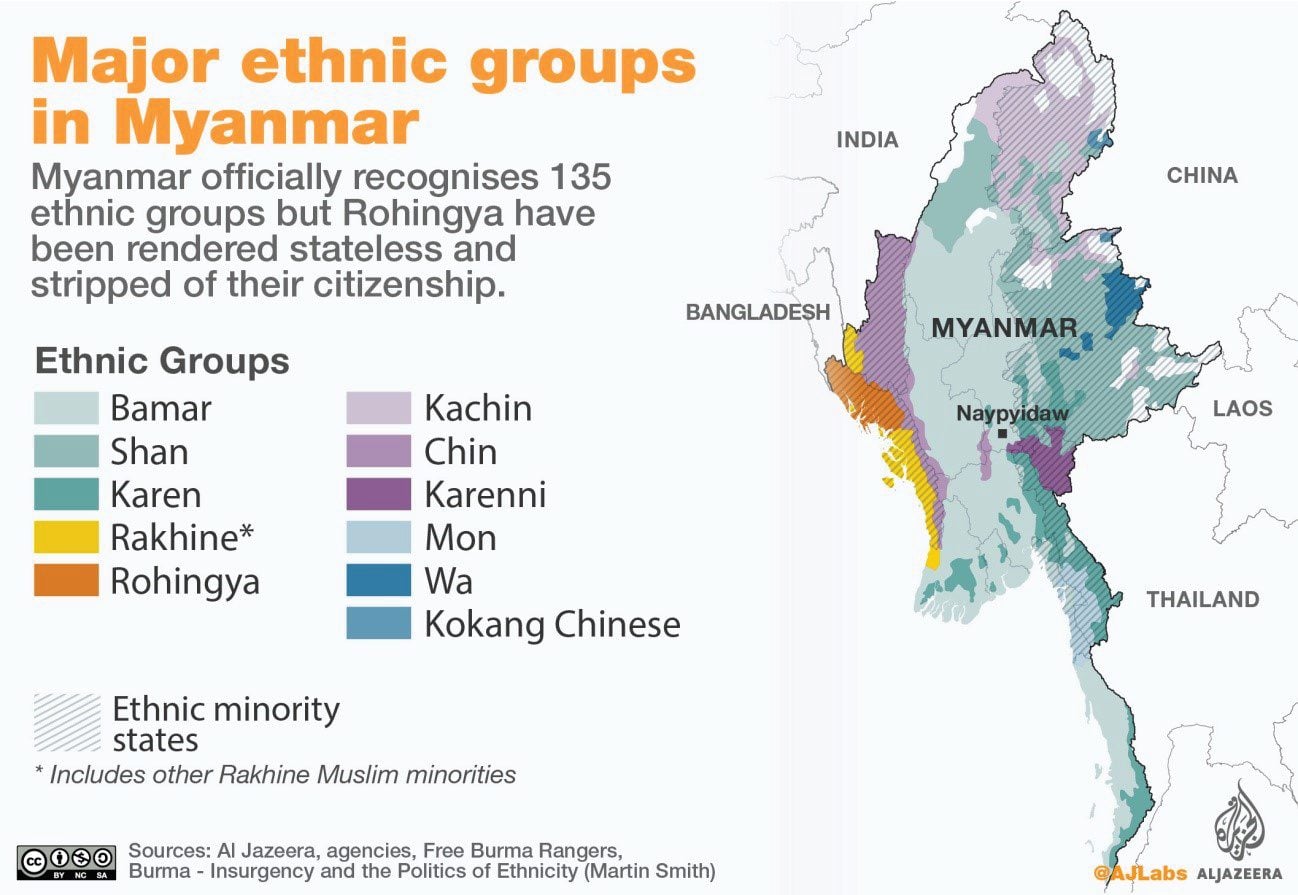
Myanmar is a highly complex society given the presence of a large number of ethnic groups and the country’s linguistic and cultural diversity. It has 11 major ethnic groups (Graph 1).
There are Seven Bamar regions and seven ethnic states and six self-administration areas. The country has 93 political parties, two-thirds of which are ethnic-based. There are 110 armed organisations of varying sizes, most of them ethnic-based.
Civil war and ethnic conflict have been a constant feature of Myanmar’s socio-political landscape since the country attained independence from the British in 1948. In fact, ever since the British landed in Burma in 1886, it adopted infamous ‘divide and rule’ policy empowering the ethnic minorities instead of Bamar, majority of the population, sowing the seed of century-long ethnic conflicts. During World War II, ethnic minorities fought defending Britain. On the other hand, Aung San, the Burmese nationalist leader, and father of Aung San Suu Kyi led the Bamar backed Japan, but switched sides at the eleventh hour when the allied victory was apparent. Burma’s ethnic conflict is the world’s longest continuing civil war in which the ethnic Bamar Buddhist majority seeks to dominate dozens of non-Buddhist ethnic minorities resulting in enormous cost for the country. Consequently, from being the best-educated (apart from Japan) country in East Asia, it spiralled down over the ensuing 65 years to being possibly the worst educated as well as one of the poorest.
After independence, the Burmese military controlled the country fighting communists and various ethnic groups. The military has been involved in long term conflict with several ethnic groups. They include the Kachin conflict, between the Pro-Christian Kachin Independence Army and the government, a civil war between the Rohingya Muslims, and the government and non-government groups in Rakhine State, and a conflict between the Shan, Lahu, and Karen minority groups. Armed conflict between ethnic Chinese rebels and the Myanmar Armed Forces resulted in the Kokang offensive in February 2015 forcing 40,000 to 50,000 civilians to flee their homes and seek shelter on the Chinese side of the border. The actions of the Burmese army, particularly in eastern Burma, have been argued to count as. The Burmese government’s oppression against the Rohingya Muslims has been termed as a textbook case of ethnic cleansing by the United Nations. In its recent crackdown, over 3000 Rohingyas were killed, and half a million sought refuge in Bangladesh.
During the 1970s and 1980s, the military aimed to crush the ethnic armed groups. Having failed to do so, the government has adopted a reconciliatory approach in the 1990s assimilating all ethnic minorities, and faiths save Rohingya Muslims into the Bamar Buddhist majority. During 2011-16, a national ceasefire agreement was reached involving armed ethnic groups, although half of them did not sign on it.
In addition to adopting a reconciliatory approach with various ethnic groups, the military government initiated democratic reforms in the mid-2000s. In this pursuit, a new constitution was adopted in 2008, and a national election was held in 2010, resulting in a quasi-democratic government dominated by the military. However, in a free and fair election in 2015, the National League for Democracy (NLD) led by Daw Aung San Suu Kyi won in a landslide. Aung San Suu Kyi and her party took office in April 2016, although she was barred from the presidency. A new position is created titled state counsellor (Union Minister for Foreign Affairs), but analysts believe that it is the military that pulls strings behind the scenes. Thus, the country’s democracy is very fragile, given its incomplete democratic transition, which left the military with three key ministries, a quarter of seats in parliament and control over the army and police. Some even doubted that if the country will at all make the transition. As a seasoned expert of the country’s politics observed that “if the elected civilian government cannot make attempts to change the game, the transition will die a slow death, in the graveyard of hybrid regimes.”