

Judiciary
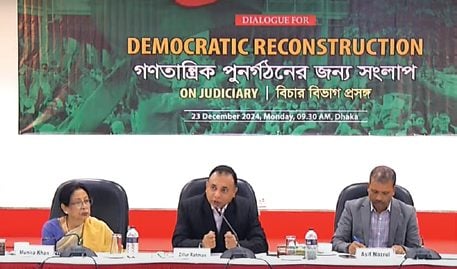
As part of the Centre for Governance Studies (CGS) series of dialogues on priority reform areas for the interim government, a discussion on judiciary reform was held on December 23, 2024 (Monday), at the Centre for Integrated Rural Development for Asia and the Pacific (CIRDAP) auditorium in Dhaka. This discussion addressed existing problems within the judiciary, possible solutions, and the need for judicial independence. A summary of the key discussions is presented below.
The Judiciary as a Tool of Oppression
Participants in the dialogue emphasized that under the previous government, the judiciary was weaponized to suppress opposition parties, dissenting voices, and ideological opponents. They argued that the ruling regime used the judiciary to justify its governance, including the abolition of the caretaker government system, which allowed for centralized power.
Several discussants pointed out that the judicial system played a critical role in criminalizing opposition views, treating political dissent as sedition. They noted that the judiciary provided legal cover for politically motivated lawsuits, police brutality, enforced disappearances, extrajudicial killings, and systematic repression.
Ensuring Transparency in Judicial Appointments
Participants raised concerns about the lack of independence and transparency in judicial appointments, which they argued has led to widespread corruption within the judiciary. Some discussants pointed out that the extraordinary powers of the appellate division were frequently used to strengthen authoritarian rule. Even when cases reached the higher courts, many participants noted that justice remained inaccessible, as political influence undermined judicial neutrality.
Several participants stated that as the higher courts lacked independence, the lower courts also became deeply corrupt. Instead of upholding people’s rights, discussants observed that both the higher and lower courts had been used as instruments of rights violations.
To address these challenges, participants proposed the following reforms:
Establishing a separate monitoring body within the higher courts to oversee judicial activities and ensure that politically unbiased laws are drafted.
Reforming the judicial appointment process to ensure equal opportunities for both men and women.
Providing regular training for lawyers and judges to enhance professional competence and uphold ethical standards.
Implementing lower court reforms to bridge the gap between lower and higher courts and improve case management efficiency.
Judicial Independence

Participants expressed strong concerns about the politicization of judicial appointments, arguing that it has prevented the establishment of an independent judiciary. Many discussants pointed out that the Prime Minister’s control over judicial appointments has resulted in judicial decisions being influenced by political considerations.
Several participants noted that politically appointed judges have often served as enforcers of the ruling party’s will, turning the judiciary into an extension of the executive branch rather than an independent institution. Some discussants also highlighted that judicial promotions and transfers have been used as tools to control and manipulate judges, weakening their ability to issue independent rulings.
To ensure judicial accountability and integrity, participants proposed that:
The judicial appointment process must be transparent and free from political influence.
The judiciary must be free from the dominance of political parties and economic elites.
The judiciary should be restructured as an autonomous institution with a strong governance framework.
Judicial appointments should be based on experience, competence, and merit, rather than political affiliation.
Reducing Judicial Backlog and Delays
Participants identified delays in the judicial process as a major factor behind public distrust in the judiciary. Several discussants noted that cases are frequently delayed due to prolonged investigations and bureaucratic inefficiencies, leading to years of legal limbo for litigants.
To address these issues, participants recommended:
Setting a legally mandated time frame for case resolution to prevent delays and reduce litigation costs.
Easing the burden on lower courts by reforming village courts and allowing them to handle minor disputes efficiently.
Making pre-action protocols mandatory so that a significant number of cases can be settled at an early stage without requiring full trials.
Hiring court stenographers to increase case processing speed and improve judicial efficiency.
Establishing a Higher Judicial Oversight Council
Participants suggested that to align Bangladesh’s judicial system with international standards, a Supreme Judicial Council and an
independent ombudsman system should be introduced. Many discussants proposed that the ombudsman should be responsible for monitoring judicial activities, ensuring judicial accountability and transparency.
Additionally, several participants argued that the ombudsman could oversee government ministries and public officials, ensuring that executive actions remain lawful and transparent.
Judicial Decentralization and Structural Reform
Participants pointed out that a single high court system is inadequate for Bangladesh’s large population. While lower court inefficiencies have been widely recognized, they noted that no serious steps have been taken to establish a decentralized dispute resolution mechanism.
To address this, participants recommended:
Establishing sub-district courts alongside district courts to handle local disputes more efficiently.
Creating specialized courts to handle family disputes, labor cases, and financial disputes, ensuring faster case resolution.
Conducting public awareness programs to educate citizens on their legal rights and improve access to justice.
Continuously reforming the legal system to modernize outdated laws and improve the efficiency of the judicial process.
Ensuring judicial decisions and legal processes are made publicly available, increasing transparency and accountability in the judiciary.
The dialogue was moderated by CGS’s Executive Director, Zillur Rahman, and featured several distinguished speakers. The speakers were;
- Asif Nazrul, Advisor of Law, Justice and Parliamentary Affairs, Interim Government of Bangladesh
- Advocate Nitai Roy Chowdhury, Former Minister and, Vice Chairman, Bangladesh Nationalist Party (BNP)
- Mujahidul Islam Selim, Former President, Communist Party of Bangladesh
- Munira Khan, Chair, Centre for Governance Studies (CGS)
- Barrister Sara Hossain, Executive Director of Bangladesh Legal Aid and Services Trust (BLAST)
- Ikteder Ahmed, Former District Judge, Columnist and Legal Consultant
- Dr. Borhan Uddin Khan, Professor, Department of Law, University of Dhaka
- Advocate Muhammad Tajul Islam, Chief Prosecutor of the International Crimes Tribunal
- Barrister Shameem Haider Patwary, Former Member of Parliament, Gaibandha-1
- Ataur Rahman Dhaly, Adviser to the Bangladesh National Party (BNP) Chairperson
- SM Badrul Islam, Lawyer, Supreme Court of Bangladesh
- Advocate Rokhsana Khandakar, Executive Director, Khan Foundation
- Musharaf Ahmed Thakur, University Teacher and Politician
- Barrister M Sarwar Hossain, Lawyer, Supreme Court of Bangladesh
- Barrister Shihab Uddin Khan, Advocate, Supreme Court of Bangladesh
- Molla Mohammad Faruque Ahsan, Member, Jatiya Nagorik Committee
- Didarul Alam, Activist and Digital Security Act (DSA) Victim
- Rafid Azad Shoumik, Student, Law, University of Dhaka & Activist
- Fahin Rahman Aungkita, Graduate Student, Criminology, University of Dhaka & Activist
