
Impact Of Covid-19 Pandemic On Journalists Of Bangladesh
Being one of the frontliners during the pandemic time, journalists had to face multifaceted problems. “At a time when the public needs to rely on credible independent journalism to stay safe and informed, journalists and news organizations are grappling with a mental health crisis, financial peril, physical safety threats, and press freedom attacks, while simultaneously battling pandemic levels of disinformation”
- observes International Center for Journalists. The present study is an attempt to see
where Bangladeshi journalists stand in terms of the challenges posed by the pandemic. This section analyzes the study findings on the impacts of the pandemic on the journalists of Bangladesh.
Health Impact
Due to their nature of job, globally journalists were in a greater risk of contracting Corona virus. Geneva-based Press Emblem Campaign (PEC) observes, “Journalists are at great risk in this health crisis because they must continue to inform, by going to hospitals, interviewing doctors, nurses, political leaders, specialists, scientists, patients.”6 According to PEC, over the period March 2020 to February 2021, at least 840 journalists died of Covid-19 in 68 countries while with 44 deaths, Bangladesh ranks 6th in the world in terms of coronavirus-related deaths among journalists.7 As will be shown in the following sub-sections, not only the Bangladeshi journalists themselves, their families and neighbors were also apprehensive of their being infected. The present study finds that this apprehension was not a speculative one; the journalists indeed got infected by the virus at a high rate, 34 per cent of the respondent journalists were infected by corona virus. As Dhaka was the most affected region of the country, journalists from Dhaka showed higher rate of infection (41 per cent) compared to their fellows working outside Dhaka (26 per cent).The rate of infection among the respondent journalists appears to be quite high if it is compared with other professional groups. A study was conducted on health workers working in Mugda Medical College Hospital, a dedicated government hospital for corona patients, over the period 15 April – 05 June 2020. During this period 10.8 per cent of the health care workers of the hospital were tested covid positive.8 In another report it was shown that by mid July 2020, out of 200000 members of Bangladesh Police Force, a total of 13000 were infected by corona virus which makes the infection rate to be less than 1 per cent.9 Due to small sample size and non-random sampling method, the finding of higher infection rate for journalists cannot be generalized. Puƫng differently, the extremely higher infection rate might be the result of sample error. But, further discussion with journalists through KIII and FGD suggests that the Covid infection rate among journalists was no less than other frontliners like doctors, if not higher.
Impact on Working Condition
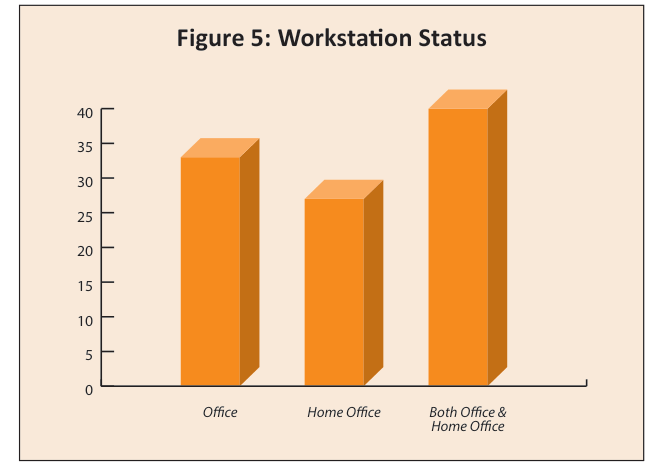
With the blessing of modern technologies, the pandemic sparked a culture of home office activities. The present study tried to see to what extent did the media houses of Bangladesh practice this home office culture. It found that less than one third (27%) of the respondent journalists totally worked from home while 40 per cent had to work both at home and office. The rest 33 per cent physically attended the office during the study period. The finding of the present study is consistent with the finding of MRDI survey which found that 75 per cent of the field level journalists covered assignments from the spots resulting in serious risks for themselves and their families.
Some observe that though at the very outset of the pandemic, a large part of the media staff was asked to work from home, within a very short time, media employees feared being treated redundant and started going to work risking their health.10 Respondents of the present survey who worked from home, were further asked whether working from home acted as a barrier to their work through, for example, hindering proper communication with colleagues and other relevant persons/offices. About half of the respondents (47%) felt that they have faced problems in this regard. The respondents were further asked whether their offices had provided any logistic support (tab, laptop etc.) to conduct home offices; only 29 per cent responded in affirmative.
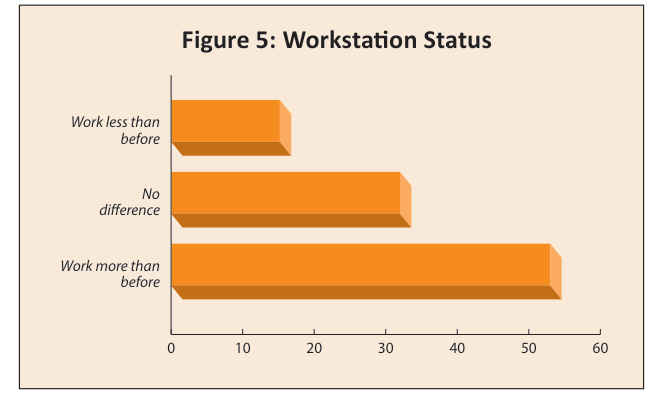
Finally, the survey respondents were asked whether the pandemic has increased their workload. 53 per cent respondents said that during pandemic they had to work more than before while 15 per cent reported that they had to work less during the pandemic. 32 per cent saw no change in workload. It can be noted here that prior to the pandemic, working hour of journalists varied with their type of responsibilities. The previous trend continued during the pandemic. The pandemic brought changes in working pattern which included home office and rotation of duties. These changed pattern of work along with lay-off and fear of lay off contributed to increased working hour for the journalists.
Financial Impact
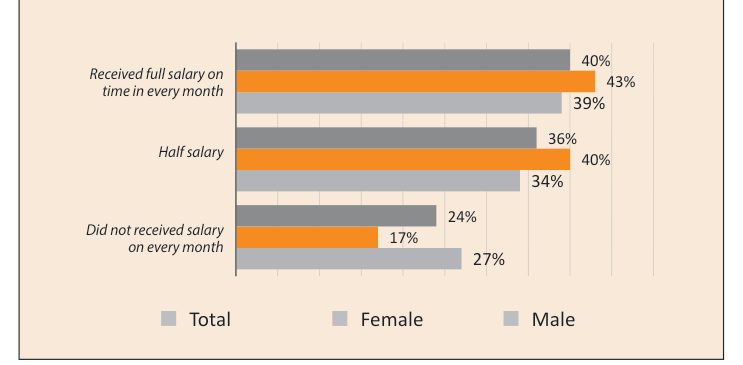
As mentioned before, the Covid-19 pandemic had profound impact on global economy. ILO estimates that the loss of global working hours during the second quarter of 2020 was equivalent to 305 million full-time jobs which is approximately four times greater than the loss caused by the global financial crisis in 2009.11 The media houses were no immune to this economic stalemate. In the ICJ-TCDJ joint study on 125 countries, 89 per cent respondents reported that their news organization had enacted at least one COVID-19 related austerity measure which include job losses, salary cuts and outlet closures.12 Scenario of Bangladesh was expected to be worse as the pandemic appeared here in an already shrinking media market. Even before the outbreak, the media revenues were falling as rise of social media and increased consumption of mobile internet challenged the traditional way of selling content. The pandemic made the situation worse. Advertisements dried up as businesses closed and subscription nose-dived leaving an adverse effect on the routine operations of the media industry.13 By as early as May 2020, the media houses started feeling the pinch, even though additional financial uncertainty was yet to be noticeably felt by the journalists.14 It is in this context that the present survey asked the respondents about the economic impact of the pandemic. It found that less than half of the respondents could retain their pre-pandemic salary flow. As can be seen from Figure 7, 40 per cent of the respondent received full payment regularly while 36 percent were paid half of their salary. For the rest 24 per cent, salary payment was full but irregular. Moreover, 8 per cent of the respondent journalist lost their job due to the pandemic.
Figure 7: Impact on Job and Salary Status
| Lost job | 8 | % | Did n | ot lose job | 92% | ||||||
|---|---|---|---|---|---|---|---|---|---|---|---|
| Regular fu | ll salary 40 | % | Irregualr f | ull salary 2 | 4% | Half | salary 36% |
The present study did not find any vivid discrimination against female journalists in terms of salary payment. As can be seen from Figure 8 compared to their male counterparts, more of female journalists received regular full salary. Though incidence of receiving half salary is higher for female journalists, they were in better position in terms of regularity of payment. To gain a broader picture, the present study further discussed the financial impact issues in KIIs with senior journalists. The interviews reveal that during the pandemic year 2020, about 1500-1600 journalists of Bangladesh lost their job, of whom 1200 were from Dhaka. About 3000 journalists experienced salary cut, consolidated salary or deferred payment. For about 500 journalists, payment was overdue for six to even 18 months. “The year 2020 was the worst year for the journalists since independence” comments one senior journalist. According to the interviewees, almost all media houses reduced salary and almost none of them followed the payment structure suggested by the existing Wage Board for journalists. Even those newspapers which followed the Wage Board suggested payment structure before the pandemic, discontinued during the pandemic time. More importantly, during the pandemic, media houses widely practiced consolidated salary which is in violation of the existing labour law.
The interviewees suggested that reduced revenue of the media houses was one of the reasons of such practices. During the pandemic, print media suffered from dual crisis of falling advertisement revenue and drastic cut in subscription. Though electronic media did not see reduction in subscription, their advertisement revenue also fell. Of the 32 television channels now on air in Bangladesh, about 20 reduced their manpower significantly during the pandemic. Local newspapers were disproportionately affected by the pandemic. A survey by the Bangladesh Independent Journalists Network (BIJN) conducted in June 2020 found that more than 60 per cent of 457 local newspapers published in 34 districts of the country have been completely shut down. The KII participants of the present study echoed this finding.
Irregular payment of salary of journalists, however, cannot be fully attributed to the Covid-19 pandemic. As mentioned before, in pre-pandemic time too, many media houses were struggling to pay its stuffs regularly. It is these media houses whose stuffs suffered more from pay cut and job loss – discussion Irregular payment of salary of journalists, however, cannot be fully attributed to the Covid-19 pandemic. As mentioned before, in pre-pandemic time too, many media houses were struggling to pay its stuffs regularly. It is these media houses whose stuffs suffered more from pay cut and job loss – discussion with journalists reveals. They also highlighted that fear of job loss in a shrinking job market made journalists to compromise while negotiating about their rights in issues like working hour, benefits, safety measures and timely and full payment of salary.16
Case Study 1
The Tale of a Journalist during the Pandemic
Nazmul Hasan (pseudo name) started his career as journalist in a newspaper which started its journey immediately before the pandemic set in. The pandemic was a blow to the nascent newspaper. At the very beginning of the pandemic, the newspaper laid off about 60 per cent of its workforce – from junior to senior, even at the sub editor level. As the team became smaller, workload increased manifold. Instead of 7 hours, he started working 10-12 hours a day. His working hour increased but salary decreased. Holiday roster was also not followed by his office. In 2020, he worked in the two Eid vacations but did not get any bonus. When he wanted to quit his job, his office did not cooperate. They delayed his NOC and deprived him of the salary of last two months. Hasan then joined a renowned news agency of Bangladesh as sub editor. In his new office, there was no problem with salary but workload was very high as there was so few sub editors to do so many tasks. Due to excessive workload, he quit this job too. This time his office cooperated with his quiƫng job but the office still owes him the salary of last one month.
Psychosocial Challenges
During the pandemic, journalists found themselves immersed in various social and psychosocial challenges which took a heavy toll on them. In the aforementioned survey conducted jointly by the International Center for Journalists (ICFJ) and Tow Centre for Digital Journalism, 70 per cent of the respondents identified the psychological and emotional impacts of dealing with the COVID-19 crisis as the most difficult aspect of their work, and 82 per cent reported at least one negative emotional or psychological reaction as a result of the pandemic. The Reuters Institute for the Study of Journalism and the University of Toronto interviewed 73 journalists from international news organizations in June and got similar finding; 70 per cent of their respondents were found to suffer from some levels of psychological distress.17 Condition of Bangladeshi journalists is not much different as suggested by the findings of the present survey. Among the respondents, 60 per cent reports facing some sort of
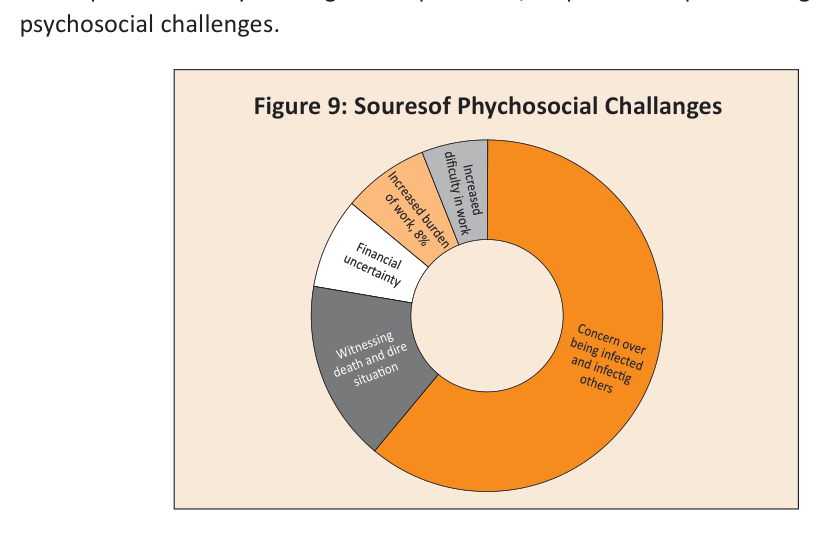
The respondents of the CGS survey identified the following sources of psychosocial challenges.
- Journalists not only worked with continuous fear of being infected, they also had been in constant concern that the type of their job had put their family members in risk. Concern over health risk of family members was the single most important source of psychosocial challenges among the journalists.
- Witnessing lots of death cases and dire situations had psychosocial impact.
- Financial uncertainty also had its psychosocial toll.
- Increased burden of work, new working environment, additional challenges of work arising from lack of proper communications and difficulty in movement due to lockdown were other major sources of psychosocial challenges.
In the present sample, psychosocial challenges were more common among male journalists compared to their female counterparts. Sixty-seven per cent of male respondents faced psychosocial challenges; for female respondents, the share was 33 per cent. No distinctive pattern, however, could not be observed between the male and female respondents regarding the sources of psychosocial challenges.
Social Challenges
Like in other countries, journalists of Bangladesh were acknowledged as “front-liners” during the Covid-19 pandemic, it could not prevent many from facing social stigma. About one fourth of the respondents of the present survey faced social stigma whereby they were suspected by community members as probable carrier of the virus and hence were avoided.
Those respondents who faced such social challenges said that as they had to continue their outdoor duties during lockdowns, people started avoiding them in fear of contagion. Neighbors started keeping a distance from them and stopped talking. Even some of the journalists themselves avoided their colleagues who were on outdoor field-level duties. Some respondents said that at times they felt socially isolated for being journalists and continuing duties during the pandemic.
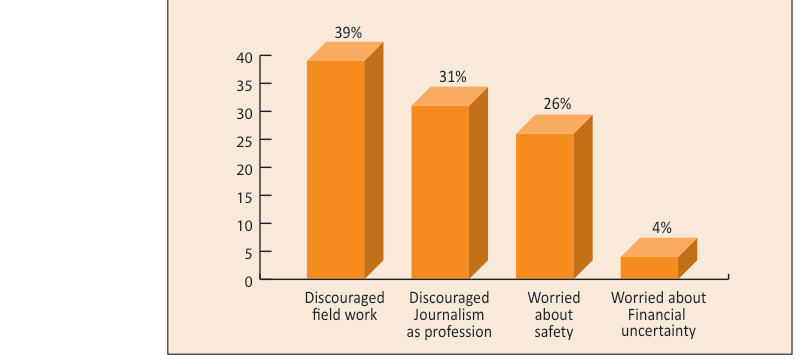
Unfortunately, for a similar number of respondents, the aƫtude of family members was discouraging to the journalists during the pandemic. Thirty nine per cent of the respondents had to face such situation where their family members were worried about their safety and discouraged them in performing field duties. In many cases, family members discouraged or even put pressure to leave this profession. Figure 10 analyzes the discouraging aƫtude of family members during the Corona Pandemic.
Notes
- Radcliffe, Damian. “The impact of COVID-19 on journalism in Emerging Economies and the Global South.” Available at SSRN 3796666 (2021). ↩
- “Bangladesh 6th in Covid-19 death toll among journalists”, Available at https://archive.dhakatribune.com/health/coronavirus/2021/03/05/bangladesh-6th-in-covid-19-death-tollamong-journalists, accessed on 09 February 2022. ↩
- Yasmin, Rubina, Rahnuma Parveen, Nazim Al Azad, Sudip Ranjan Deb, Nandita Paul, Md Manjurul Haque, Md Ahsanul Haque, and Shehreen Azad. “Corona virus infection among healthcare workers in a COVID dedicated tertiary care hospital in Dhaka, Bangladesh.” Journal of Bangladesh College of Physicians and Surgeons (2020): 43-49. ↩
- Md. Kamruzzaman, “Bangladesh: Police force faces brunt of virus COVID-19 death toll in police hits 50”, available at https://www.aa.com.tr/en/asia-pacific/bangladesh-police-force-faces-brunt-of-virus/1909056, accessed on 02 February 2022. 11 ↩
- Reza, S. I. “Bangladesh media: Pre and post-Covid-19 realities and opportunities.” The Business Standard (2020), available at https://www.tbsnews.net/thoughts/bangladesh-media-pre-and-post-covid-19-realities-and-opportunities-133591, accessed on 11 February 2022. 12 ↩
- International Labour Organization, op. cit. ↩
- Julie Poseƫ, Emily Bell and Pete Brown, “Journalism and the Pandemic: The Global Snapshots of Impact”, Tow Center for Digital Journalism, May 13-June 30, 2020. 13 ↩
- Reza, S. I., op. cit. ↩
- Ahmed Shatil Alam and Wahida Alam, “COVID-19 challenges for journalists”, New Age, available at https://www.newagebd.net/print/article/106209, accessed on 11 February 2022. 14 ↩
- Nawaz Farhin Antara, “Survey: Over 60% of local newspapers have shut down in Covid-19 pandemic”, Dhaka Tribune, available at https://archive.dhakatribune.com/bangladesh/2020/07/11/survey-over-60-of-local-newspapers-have-shutdown-in-covid-19-pandemic, accessed on 09 February 2022. . 15
- Islam, Kazi M. Anisul, Md Sumon Ali, Asma Islam, Shahariar Khan Nobel, Nazmul Hasan Shajib, Mohammad Abdullah Al Mamun Chowdhury, and Rydwanul Islam. “Safety Measures of Journalists During Corona Pandemic in Bangladesh.” Global Journal of Human-Social Science (2020): 29-45.16 ↩
- Selva, M., and A. Feinstein. “COVID-19 is hurting journalists’ mental health. News outlets should help them now”, Reuters Institute (2020).17 ↩