
Supports Provided To The Journalists
Safety Measures at Work
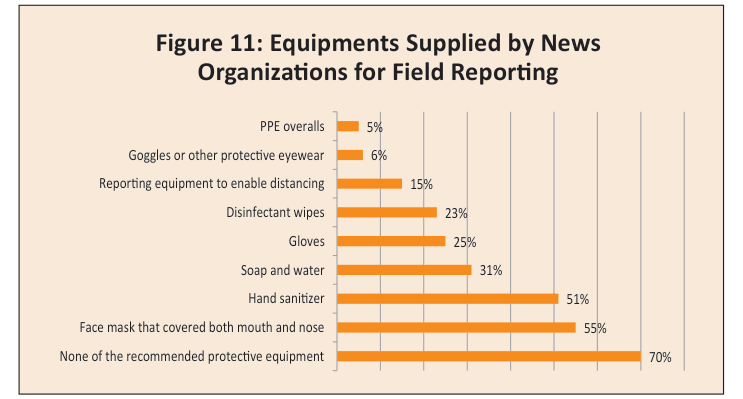
When it comes to the question of ensuring safety of the journalists by the employers, the global picture appears to be grim. The ICJ-Tow Center study indicates widespread failure of employers to supply basic recommended safety equipment for journalists engaged in field reporting during the Covid-19 pandemic – ranging from protective clothing and hygiene products to PPE (see Figure 11). In their study, 30 per cent of the respondents reported that field reporters had not been supplied with a single piece of safety equipment.
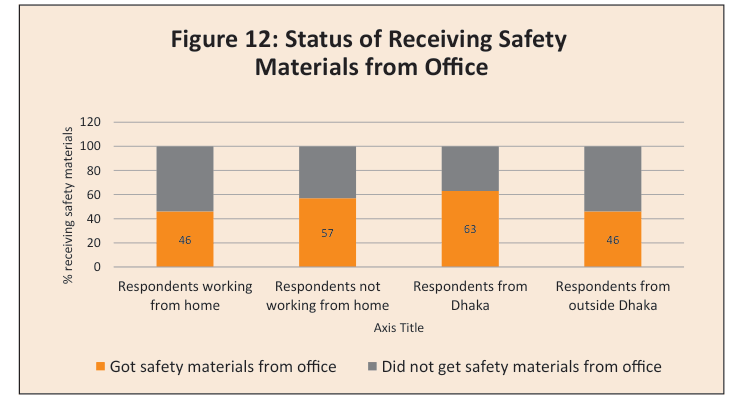
In the present study, the respondents were asked whether they got PPE or other safety materials like masks, sanitizers, etc. from their office. In response, a mixed picture emerged. Of those respondents who worked outside home, only 57 per cent received safety materials. In most cases the safety materials provided by office included facemask and hand sanitizer. Interestingly, even half of those respondents who worked from home, received safety materials. Respondents from Dhaka got more safety materials than their fellow colleagues from outside Dhaka.
The findings of the present survey regarding safety materials is close to that of Mondal and Paul (2020).18 They found that 62 per cent of their respondents had collected PPE. Of those who could collect PPE, half got it from the employer and the other half had to purchase it. Amidst the nationwide lockdown when public transport came to a total halt, providing transport by office became a necessity for the journalists not only to facilitate their daily operations but also to protect them from the virus. But during the present study, only 50 per cent of the respondents reported to have such facility. It can be mentioned here that in Bangladesh, for many journalists, especially of print media, travelling allowance is included in their salary and it is mentioned in their contracts. It is this section of journalists, especially those who do not have private transport, who suffered most during the lockdown. The respondents were also asked whether health safety protocols for Covid-19 were maintained at their offices. 70 per cent responded that health safety protocols were well maintained in their office.
Case Study 2
Covid and Transport
Ishrat Parvin (pseudo name) works in a news agency. Like many others, her travel and daily allowance (TA/DA) is included in the salary. During the first lockdown when public transport as well as ride sharing was halted, she had to travel through CNG at her own expense. Every day she had to spend BDT 500-1000 for covering news; sometimes the expenditure reached to BDT 1500-2000. Her travel expenditure increased but her salary did not. In some months during the pandemic, she had to spend even half of her salary as travel expenditure. Yet, she could not bargain with her office about travel expenditure as it was mentioned in her job contract. “Covid created an extraordinary situation for us but many media housed failed to respond accordingly” – she expresses her disappointment.
Support for Covid affected Journalists
While ensuring health security of the journalists was a crucial responsibility for the media houses, providing support for those who got infected was no less important. To see, to what extent such support was practiced, the present study asked the respondents whether they received any support, for example, regarding testing facility, financial support and psychosocial counseling, from their office aŌer they suspected or tested COVID-19 positive. 56 per cent of the respondents said that they had received such support from the office.
Support for Vaccination
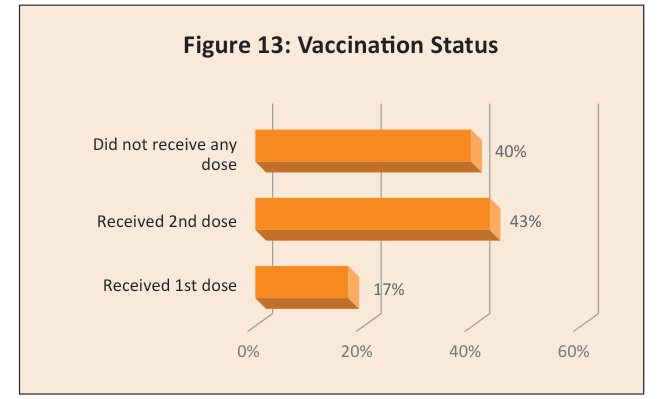
Vaccination status of the journalists is crucial to understand the safety and security status of the journalists. Therefore, respondents were asked about their COVID-19 vaccination status. At the time of the survey, 43% of respondents had received two doses of vaccine, 17% had received only the first dose, and 40% did not receive any vaccine at all. The respondents were further asked whether they got vaccinated through their offices or by self-arrangement. It was found that two third of those who were vaccinated, got vaccine through self-arrangement and the rest one third got the shots through official arrangements.
Notes
- Mondol, Beauty, and Basudev Paul. “Journalism in Bangladesh During the COVID-19 Pandemic: An Overview.” Current Res. J. Soc. Sci. & Human. 4 (2021): 45. 20 ↩