

Research & Publications Web edition
Conclusion
The first credible official report detailing the incident came from the United Nations Human Rights Council on 16 August. This report also provides a preliminary overview of key human rights violations and concerns related to recent events in Bangladesh. It compiled data from various open sources and other reliable remote sources, offering an initial assessment of the human rights issues that emerged during the protests and the state’s response from July until 6 August 2024.According to the report, the student protests in Bangladesh began peacefully but escalated into violence and significant human rights abuses by security forces. An estimated 650 people, including at least 32 children, lost their lives, and thousands were injured. There are strong indications, warranting further independent investigation, that the security forces employed excessive and disproportionate force. Alleged violations include extrajudicial killings, arbitrary arrests and detentions, enforced disappearances, torture, ill-treatment, and severe restrictions on freedom of expression and peaceful assembly. The report made several recommendations for the Interim Government to ensure accountability for those responsible for human rights violations, in accordance with Bangladesh’s international human rights obligations, and to uphold victims’ right to effective remedies. It also offered recommendations to the international community to reduce tensions, prevent recurrence through the security sector and other essential reforms, and ensure a democratic, peaceful, and inclusive transition in line with human rights principles.
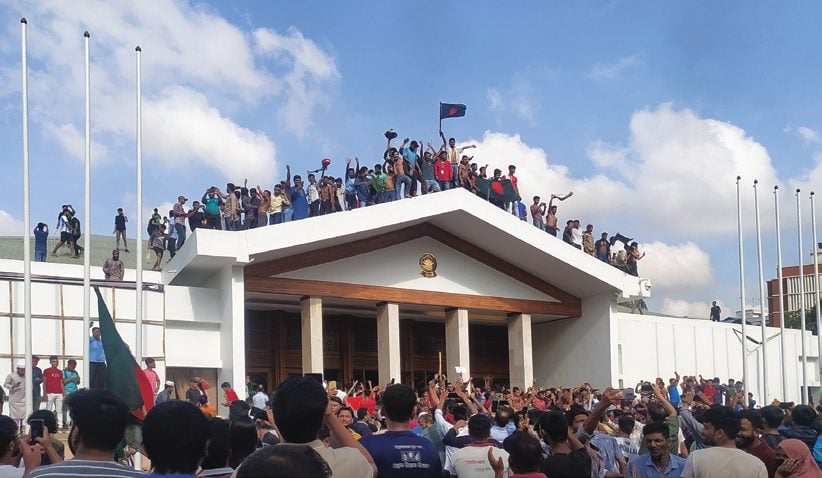
The power vacuum left behind caused several days of lawlessness in Bangladesh as there was no government, and the police force was entirely dysfunctional. Many police stations were attacked and burnt down nationwide. Firearms were looted from at least 22 abandoned police stations. Even after the interim government took office on 8 August, the police force took several days to begin operations nationwide, leaving communities to fend themselves against looters and organized criminals. There have also been reports of targeted attacks against minorities, particularly Hindus, in the immediate aftermath of the government transition. On August 5th and 6th, Hindu homes and properties were reportedly attacked, vandalized, and looted across 27 districts. Several places of worship were also damaged, including an ISKCON temple in Meherpur, Khulna division, which was vandalized and set on fire. In response, various student organizations and ordinary citizens have reportedly formed groups to protect minorities and safeguard religious sites belonging to these communities. Dr. Yunus, the Chief Advisor to the Interim Government, strongly condemned the attacks on minority communities, labeling them as “heinous.” The Religious Affairs Adviser, AFM Khalid Hossain, noted that a comprehensive list of damaged places of worship and properties had been compiled, and a hotline was established to report attacks on minorities. At the time of writing, Bangladesh remains in a precarious position. As long as a new election is not held and democracy is not restored, most of the state’s functions are handicapped. The interim government now has to perform the monumental task of restoring peace, stability, and democracy to a nation that was under autocratic rule for over 15 years.
45/1 New Eskaton (2nd Floor), Dhaka 1000, Bangladesh Phone: +880258310217, +880248317902, +8802222223109 Email: [email protected] Website: www.cgs-bd.com