
Research & Publications Web edition
The Uprising
31st July, 2024
On Wednesday the ‘March for Justice’ by the anti-discrimination student movement sparked widespread protests in at least 23 districts, including Dhaka and Chittagong. The demonstrations, joined by students, teachers, and lawyers, faced significant resistance from law enforcement, with police using tear gas, sound grenades, and batons to disperse crowds. Clashes occurred in various locations, leading to injuries and detentions. 6 people were arrested for the clashes in Khulna District. At least 341 arrests were made on the day of the March for Justice. During a confrontation between Doel Chattor and the High Court area, a police officer twisted University of Dhaka lecturer Shehreen Amin Bhuiyan’s arm while she intervened to stop the apprehension of a student. Shehreen said to Dhaka Tribune “When the police tried to apprehend a student, I intervened, asking what his crime was and insisting they check in front of us. However, the police did not listen and used force. A policeman twisted my arm and tried to take the student away. I fell while trying to stop them again.” The coordinators of the movement were still in DB custody. Despite these obstacles, the movement announced a new program, “Remembering Our Heroes,” to honor those affected by the protests through online and offline activities, including reminiscences and artistic expressions.
1st August, 2024
The Detective Branch released six coordinators of the anti-discrimination student movement after detaining them for up to six days. Upon their release, some revealed they had been kept in separate rooms and had staged a 32-hour hunger strike. Sarjis Alam expressed on Facebook that the ongoing repression would not deter their movement for justice and reform. On Thursday, the anti-discrimination student movement’s ‘Remembering Our Heroes’ program featured mass songs, street plays, wall writings, and demonstrations across 16 districts, including Dhaka. Students, teachers, and lawyers participated, despite police obstructions and detentions. Protests were held in various cities, including Dhaka, Sylhet, Mymensingh, and Barisal, where police disrupted activities and arrested participants. In Sylhet, students protested for hours, while Mymensingh saw road blockades. Despite police interference, demonstrations continued with road blockages, graffiti, and silent marches in other areas. The movement announced a new program, ‘Droh Jatra’ to follow Jumma prayers on Friday. The government banned Jamaat-e-Islami and its student wing, Islami Chhatrashibir, through a gazette notification under the Anti-Terrorism Act. This decision, made following allegations of terrorism and involvement in violence during the quota reform movement, marks the fourth ban on Jamaat-e-Islami since its inception in 1941. The ban follows the Election Commission’s cancellation of Jamaat’s registration and a Supreme Court ruling upholding it.
2nd August, 2024
Six coordinators of the anti-discrimination student movement revealed they were forcibly detained by the Detective Branch (DB) and coerced into announcing the withdrawal of their movement. After a hunger strike and subsequent release, they condemned the government’s actions and vowed to continue protesting for justice and the release of detained students. On Friday, thousands rallied in Dhaka for the ‘Droho Jatra’ starting at the National Press Club and concluding at Central Shaheed Minar. Participants, including students, teachers, and activists, demanded government resignation, an end to mass arrests, trials for July’s killings, and the reopening of educational institutions. The event, marked by protests, street plays, and speeches, turned into a unified demonstration against ongoing repression. While the people in the press club and Shaheed Minar area were chanting uninterrupted, clashes erupted in Dhaka’s Uttara between police, local Awami League activists, and students during a mass procession. Police used sound grenades, tear gas, and rubber bullets, injuring at least six students. The violence began when Awami League and its various wing members, armed with rods and weapons, confronted the students. Witnesses reported that ruling party activists attacked students preparing for a peaceful march, leading to widespread chaos. Some students were beaten as they tried to flee. One AL member tried to strangle a female student when she tried to raise her voice. Apart from Capital’s Uttara, clashes also broke out in five districts during the mass procession. In Habiganj, a worker was killed, while a policeman was beaten to death in Khulna. The death toll rose to 215 according to Prothom Alo. Violence erupted in Sylhet, Khulna, Laxmipur, and Narsingdi as well as leaving at least 370 people injured.
3rd August, 2024
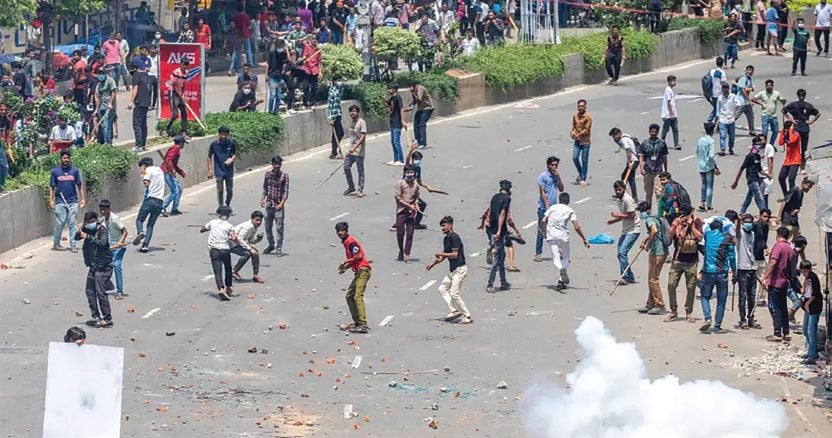
In response to concerns about discrimination, mass killing, and arrest, a large crowd including mass from every walk of life gathered at the Central Shaheed Minar in Dhaka. Protesters demanded justice, calling for one point demand, the resignation of Prime Minister Sheikh Hasina. The movement spread to 33 districts, with some incidents of violence. The student-led initiative announced plans for a nationwide uprising and ‘Non-cooperation movement’. Demonstrations by the antidiscrimination student movement in 33 districts led to violent clashes, resulting in two deaths, and at least 130 injuries. The violence included shootings in Cumilla, an attack on the Education Minister’s house in Chittagong, and multiple highway blockades across the country. In Naogaon, clashes between protesters, AL goons, and police injured at least 13, including police and journalists. On the same day, Awami League General Secretary Obaidul Quader announced a new two-day program.
The party is set to hold rallies in wards, districts, and metropolises in the capital on 4th August. On the next day, AL was to bring out a mourning procession from in front of the Institution of Engineers, Bangladesh (IEB) to Bangabandhu Bhaban on 5th August to pay homage to the Father of the Nation and other martyrs of the August 15 carnage and the recent violence. The premier on the other hand urged the agitating students to sit with her at Ganabhaban to prevent violence centering the quota reform movement. The overwhelming support from the public towards the protestors forced her to state, “The doors of Ganabhaban are open. I want to sit with the quota protesters, I want to listen to them. I don’t want conflict.” The military who were seen to harass the protestors alongside the police, came forward to help them. Army Chief General Waqar-uz-Zaman affirmed the Bangladesh Army’s commitment to standing beside the people, ensuring their safety, and safeguarding state interests while urging vigilance against social media rumors.