

Section II
Growth, Savings and Investment
The central questions revolving economic growth are concerned with the nature of growth, how the growth will be achieved and for whom the growth will be. GDP or economic growth matters little when the whole world has been rampaged by the pandemic. Government as the largest spender in the economy rather required to take the mantle in rehabilitation, recovery and reconstruction of the economy from the global crisis. The downturn will be swollen by income reduction, diminished savings and hence dwindling investment which has been hovering around 23 percent in the last few years. Loss of jobs and reduction of remittance earnings as migrant workers have been sent back because of the crisis, will dampen consumption spending in turn constricting the GDP since private consumption is 70 percent of the GDP. The share of savings has lessened to 27.42 percent in FY 2017-18. The private sector growth of credit flow dropped to 10.04 percent by the end of October from 11.32 percent by the end of the last fiscal year. Recovery and reconstruction at this moment seems farfetched but yet requires prudent measures beforehand.
Inconsistency in growth estimation
Government estimation of growth rate of 5.2 percent in the previous fiscal year remains questionable. Estimations by international organizations in the ex-post pandemic era determine the growth rate to be anywhere from 1.8 percent to 3.8 percent, as opposed to 7.3 percent before the pandemic emerged. The performance of some productive sectors in the economy has been in peril during the latter half of the FY 2019-20 due to COVID-19 pandemic. Comparing the projected contribution of each of the sectors in 2019-2020 to the respective losses incurred in the three months of economic shutdown may give an estimation of GDP (Table 2).
Table 1 : Losses and contributions of some productive sectors in growth during COVID-19
Estimates of Loss Sectors Projected Contribution to
2
Actual estimated Percentage
4
(in crores BDT) to GDP in 2020
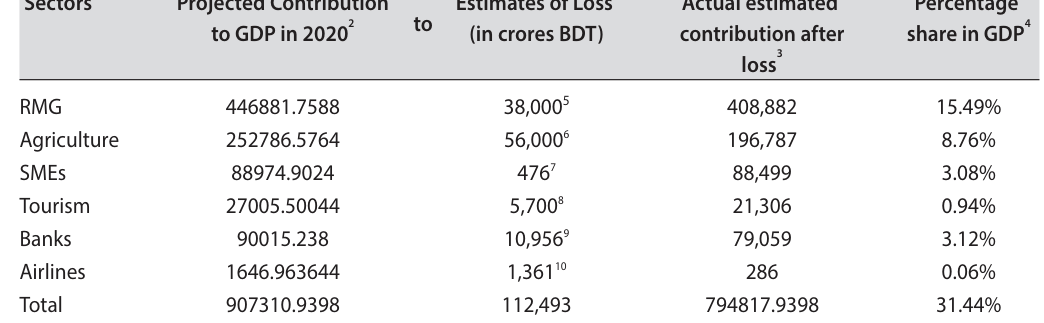
The losses incurred by all sectors shows a 12.4 percent drop in the overall contribution of these sectors in the GDP. As their total weight in the GDP is 31.44 percent, a 12.4 percent drop in their contribution will mean a 3.9 percent fall in the total GDP.
Table 2 : Estimation of GDP
Expected % drop in Provisional Sectorial Expected Nominal Real Real nominal GDP sectorial nominal GDP loss as %

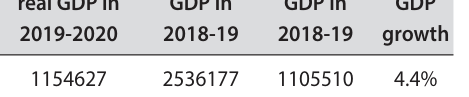
The percentage change between the GDP figures between two fiscal years show the expected nominal and real GDP growth rate for Bangladesh, 9.4 percent and 4.4 percent respectively. This is still a moderate estimation yet lower than that of proposed by the government.
Unrealistic growth target
The growth rate projection for the next fiscal year might have irked many as the government proposes a full and quick recovery of the economy from the covid-19 crisis. The growth rate projection of 8.2 percent in the 2020-21 fiscal year may be deemed unrealistic. Firstly, there is no predicting the end of the Coronavirus as the number of cases still rising in the country and yet to flatten out. There remains also the possibility of a second or third wave of contagion. Secondly, in order to achieve the desired GDP, the economy needs to grow three percent faster than present something which no country has achieved.
Table 3 : Changes in growth rate
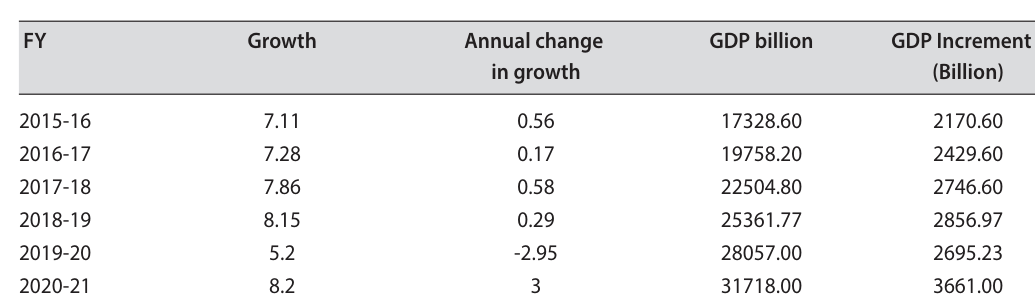
Figures illustrated in Table 3 illustrate the change in the growth rate for Bangladesh from 2015 to 2021. During the time, change in growth was negative in 2007-08 by -1.05 percent, which was followed by further fall of 0.96 percent in the following year. Ever since GDP growth rate dipped below seven percent in 2007-08, it remained hovering around five to six percent, until in 2015-16 when the economy finally crossed the seven percent mark. It can be observed that a complete roundabout recovery from a -2.95 percent change in GDP growth in one fiscal year is but a pipe dream. Ready-made garments industry, remittance and agriculture are the main drivers of the economy. The country, however, lacks control over the course these sectors will take as the global economy is still in recession and require longer to return to its pre-covid state. Export earnings in April fell by 83 percent compared to last year. Remittances will also take time to rebound. Even though the overall earning in the first eleven months surpassed the amount earned last year, the remittance earnings in April and May were the lowest in the recent times. The growth rate hinges most importantly upon the covid-19 scenario as a two-month shutdown shrunk the economy by almost three percent. Any extension in the current scenario will dash the hopes of achieving such a mammoth task at hand. Majority of the physically disjointed sector is based upon e-commerce and F-commerce avenues which have suffered greatly during the shutdown as consumer preferences shifted from the purchase of non-essential goods such as clothing and accessories, to essential goods such as medicines and personal hygiene. On the other hand, agro-businesses experienced a sharp rise in their turnover as more consumers were drawn to fresh produce that is home delivered11. In 2017, the contribution of the physically disjointed sectors accounted for BDT 9 billion in the GDP of the country, which is relatively insignificant to the BDT 1335.71 billion contributed by the physically interactive sectors in the same fiscal year.12
Notes
- Bangladesh Economic Review 2019
- Author‘s calculation
- Author‘s calculation
- BRAC Rapid Research Response to Covid – 19
- BRAC Rapid Research Response to Covid – 19 3
- Lightcastle Partners. Covid Impact on Startups of Bangladesh
- https://tbsnews.net/bangladesh/tourism-sector-lose-tk5700cr-because-covid-19-toab- 66058?fbclid=IwAR2AuEFKHQxA9i4VlxodDRdA7LaQm7ns7fUZJR1InuYQFF3hjsC8loqxCYo.
- https://tbsnews.net/economy/banking/state-owned-banks-project-tk7717cr-losses-amid-pandemic-80671
- https://www.dhakatribune.com/business/2020/05/16/airlines-count-tk-1-361cr-in-losses-in-covid-19-lockdown4
- https://thefinancialexpress.com.bd/education/pandemic-disrupting-f-commerce-businesses-1589991125 ↩
- https://thefinancialexpress.com.bd/views/e-commerce-in-bangladesh-where-are-we-headed- 1578666791#:~:text=In%202016%2C%20%2450%20million%20was,made%20by%20the%20retail%20market.5 ↩