

Section VI
Financing
A plummeting revenue collection
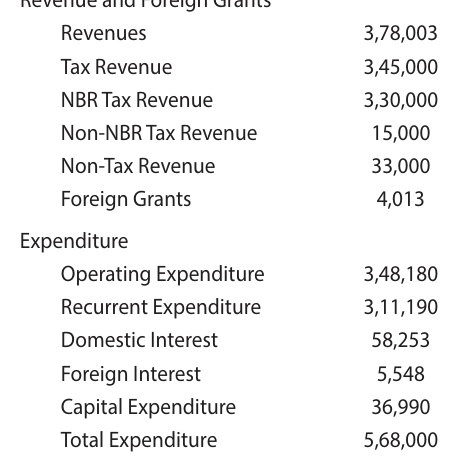
Covid-19 crisis has dealt a massive blow to the revenue collection of the government. Revenue collection may face a negative growth of six percent in the FY2020-21 due to the economic shutdown. Revenue collected by NBR in the first 10 months of FY2019-20 is BDT 62,000 crores less than the revised target due to economic halt and loss in real sectors as an impact of coronavirus. Tax collection was BDT 1, 73,797 crores in July-April of FY20 against a target of BDT 2, 35,796 set for the period (New Age, 2020). Revenue may fall short of BDT 80,500 crores by the end of FY20 against the revised target of BDT 3, 00,500 for the year. Losses faced by the businesses as well as income reduction due to the shutdown will result in downward tax collection in the FY2020-21 as well. VAT collection will also get shrink due to the low consumption spending. Revenue collection has been poor even for the last few years. Government expenditure has grown manifolds faster than the revenue collection resulting in higher fiscal deficit (IMF, 2020). NBR collected BDT 2, 34,684 crores in the previous FY19. Revenue collection grew only by 0.64 percent in the July-April period of FY20 (New Age, 2020). The revenue target for FY2019-20 was BDT 325,600 crores in the original budget, which is being revised to BDT 300,500 crores. In total, the finance division has estimated a revenue of BDT 378,003 crores for the next fiscal year, including BDT 15, 000 crores from the taxable sector beyond the NBR and BDT 33,000 crores from the non-tax sector.
Table 4 : Revenue collection (in billion taka)

Curtailing of fiscal space
The fiscal space of a government is determined by its ability to alter financing plans for a planned intervention in a manner that does not hinder the operations of the financial markets or long-term cope of public finance. Fiscal space may be measured by a framework of “the composition and trajectory of public debt; financing needs and ease of borrowing; assets that can be drawn upon; future spending commitments; the effectiveness of fiscal policy; and the strength of fiscal institutions.”15 Restoring the economy to pre-Covid scenario will require a concerted effort and mix of both monetary and fiscal policy measures. The goal is to create new employment and increase the earnings. The government will need to look for alternative sources for financing as revenue earnings from tax and VATs will face steep decline due to income losses and declining consumption spending. Around one and half billion dollars from undocumented foreign workers can be collected in Bangladesh, the activation of transfer pricing cell to reduce tax avoidance and re-examination of tax exemptions given to politically influential conglomerates.
Fiscal gap according to IMF looks to widen in the next fiscal year to 0.6 percent of the GDP as revenue collection will go down significantly. The size of the national budget has increased by 8.6 percent from the previous fiscal year, followed by a strikingly less than 0.1 percent increase in revenue; however, estimates show that revenue mobilization efforts are required to be 49.5 percent16 higher in the FY2020-21. The budget remains at 17.9 percent of GDP, whilst revenue target has slightly decreased from 13.2 percent to 12 percent for the next fiscal year. NBR calculation casts doubt on the targeted revenue collection of 3, 30,000 crores BDT for next fiscal year amidst the ongoing crisis. NBR projects tax collection of 2, 50,000 crores BDT in the next fiscal year looking at the current scenario. Such low tax collection will raise the deficit to 8.5 percent of the GDP. In addition, foreign grants have constituted only 0.1 percent of the GDP at current prices in FY2019-20. More efficient debt management could have been brought about by a streamlining and downscaling of the ADP allocation significantly more than the 9800 crores BDT17 that has been debited, in order to allow for a freer fiscal space. Government borrowing from banks is at all-time high as in the last fiscal year government borrowed 138 percent more than the previous year. Government projection of 25.3 percent private investment will require an additional 4, 65,781 crores BDT. Government borrowing from banks to finance the deficit will cast doubt on achieving the investment target. Vacuuming funds from the banking sector for deficit financing amidst an excess liquidity position may leave the private sector credit growth in peril as private investment is crowded out, reflected in the lowest growth of eight percent in March and April. Borrowing from external sources for financing will raise the debt to GDP ratio. Thinning fiscal space will require government to cut expenditure. Widespread corruption in ADP has to be kept in check, as the insignificant reduction in ADP allocation despite revenue concerns indicates the existence of possible clientelist expectations and self-interest18.
A financial market crisis and lapse in private investment in the making
The banking sector is acting as the main source of finance for the stimulus packages provided by the government for loss-inflicted strategic industries. Furthermore, the dependence on the banking sector to assist in 44.72 percent of the borrowing target of BDT 84,000 crores in deficit financing in the budget for FY2020-21 is likely to aggravate the woes19. Although the liquidity position of banks have been improved by easing of regulatory requirements from the central bank and creation of new money, standing at 6.5 percent of GDP, an increase in the excise duty on deposits higher than BDT 1 million is likely to curb saving propensities which may prove to be harmful in the face of withdrawal pressures on banks20. On the other hand, the budget projects a surge in private investment from 12.7 percent in the current fiscal year to 25.3 percent, implying that an investment of BDT 446,000 crores will be required for such an unrealistic leap in a post-Covid fiscal year.
One of the striking strategies for the financial and capital market proposed in the budget has been the offered opportunity of sanctioning undisclosed money into the capital market. There is expressed concerns regarding the effectiveness of this particular initiative as the government lock-in on capital market investment is likely to deter investment into safer options such as bank deposits, savings certificates and real estates21.
A worsening of national debt
There will also be a big gap due to the over estimation of GDP by the government. Government projection of 8.2 percent GDP growth is based on the current GDP. Due to the advent of the pandemic, the Unnayan Onneshan (2020) estimate that, the growth rate will instead be at 4.4 percent. Holding the revenue percentage of GDP with the same level, the estimated revenue might come down to BDT 3, 63,035.4 crores. In reality, the collection will be even lower. In the 10 month of the fiscal year there is already a gap of BDT 62,000 crores in the revenue earning from the target according to last budget. The gap widens to BDT 82,000 crores when compared to the revised budget of 2018-19. In this scenario, overestimation of GDP growth rate by the government will widen the gap even more, by around BDT 14,000 crores.
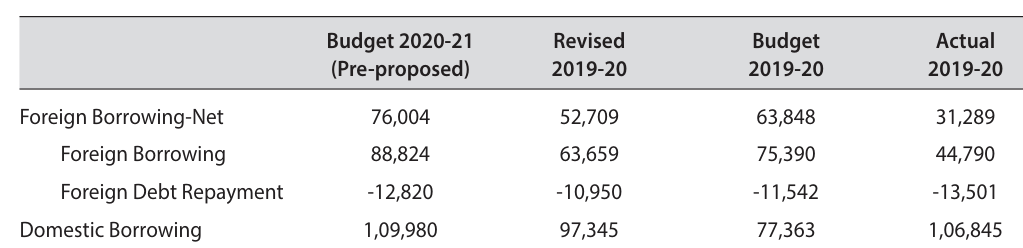
The waning revenue has forced the government to resort to heavy borrowing from banks and crowding out private investments and subsequent liquidity crisis. Private sector credit growth has dwindled to 8.86 percent in March, the lowest since December, 2008. Domestic borrowing from banking sector has increased to BDT 84,980 crores in 2020-21 budget from BDT 82,421 crores in 2019-20. Government has opportunity to borrow many from foreign countries and organizations at lower interest rate than that of domestic sector but subverting foreign borrowing is jeopardizing the private investment making the banking sector drowned in multiplied crisis.
Table 5 : Financing (crore taka)
Borrowing from Banking System

Need for a coherent, well-oiled strategy in debt financing
Under such circumstances, the government is required to launch a well-coordinated strategy. First, cutting down unnecessary expenditures such as government largesse and cost over runs without resorting to austerity measures will save the government a lot. Still now, unnecessary expenditure covers a large portion in the national budget. High allocation in the public administration sector is a burning example of this. This sector occupies 19.9 percent allocation of total budget. Operating budget in this sector has increased to 12.5 percent in 2020-21 from 9.8 percent in 2019-20. In the government civil service, designated posts have become full to the brim. The problem is often deepened further through promotion of personnel to higher level. Recently, 123 government bureaucrats have been promoted to “Joint Secretary” which is questionable indeed in terms of necessity.22 Apart from this, many officers are kept idle by making Officer on Special Duty (OSD) which is basically a punishment. Through this indirect punishment, officers cannot conduce their incumbent duties but get salaries. This practice reduces possibilities of getting sufficient service from the government. Government needs to take stern actions to shift the cost from this malpractice to real sectors or universal basic needs. Second, new sources of revenue should be searched like of taxing undocumented foreign workers in Bangladesh, reducing tax avoidance and re-examining tax exemptions given to politically influential conglomerates. Tax exemptions of multinational companies (MNCs) should be reviewed whether these business entities need waiver or not. Third, increased foreign aid from bilateral and multilateral sources may reduce the burden on private banks. At the same time obtaining multilateral and bilateral loans with low rate of interest, longer repayment and grace period through negotiations shall be the priority to ease debt servicing, as well as seeking relief, writing off and deferrals of debts. Bangladesh in this regard has failed to take advantages as government is yet to take the debt relief opportunity declared by the G-20 nations due to the pandemic (TBS, 2020). Finally, the government has to primarily source from the central bank even if this requires printing of the currency as banks are already in liquidity crisis and treasury bills and savings certificates are costly.
The central bank has to provide more financial packages to the vulnerable groups like micro-finance borrowers. Given that some banks‘ overexposure in advance-deposit ratio and deposit to banks may not increase in near future, the central bank can opt for a working capital taka loan window and need-based statutory liquidity ratio and cash reserve ratio requirements for a short-term. Another objective would be to ensure stability in the exchange rate to avoid disruption in trade flows. A selective capital control measures to discourage speculative trading can also be introduced. For maintenance of adequate supply of foreign exchange, negotiations should be initiated with the IMF and other multilateral organizations for relief and suspension from debt servicing and additional grants for budgetary support.
Table 6 : Revenue and expenditure (crore taka)
Budget 2020-21 (Pre-proposed)
Revenue and Foreign Grants Revenues
Overall Deficit (Including Grants) -1,85,987 Overall Deficit (Excluding Grants) -1,90,000
Source: Ministry of Finance, 2020
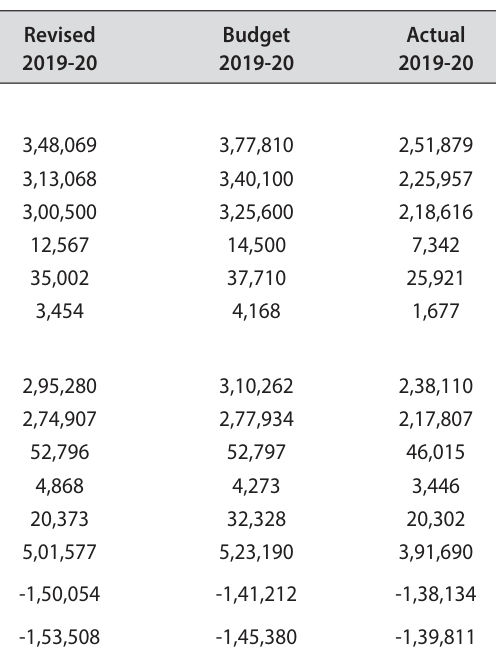
Every year there remains huge discrepancies between the actual budget and the revised budget. The absence of parliamentary scrutiny on revised budget, the ineffective role of auditor and comptroller general on monitoring and the lack of oversight power of the parliament on budget proposal give birth to those discrepancies. In addition, it is important to improve the efficiency of budget allocation as well as the ability to use the allocated funds properly. A significant amount of budgetary allocation remains unutilized or underutilized at the end of each fiscal year. The efficiency, accountability, transparency and representation when forming as well as implementing budgetary measures is prerequisite to get the expected results from the provisions.
Why recovery will be delayed
The myriad economic fallouts from the recession are at risk of being left unaddressed when a recovery plan is formulated. Recovery is often deemed to be following either a U, V or W shape
- optimists project a rapid and quick recovery in markets as the economy will simply bounce
back to its previous growth path, resembling a V-shaped curve. The rapid rise from a 5.2 percent to 8.2 percent growth rate in one fiscal year reverberates this line of thinking. However, recovery may in reality be slow and delayed representing a more U-shaped curve, for several underlying shortcomings in the assumptions and strategies made.
Firstly, concerns may be expressed regarding the aspect of inclusion in the budgetary framework. Poverty and inequality no longer remain under the auspices of a straightforward headcount ratio during such unprecedented times of peril, signifying the importance of inclusion of groups without entitlements – of the new poor, of small businesses, of female-headed enterprises – in formulating social security, and a possible basic income grant.
Secondly, it is very likely that the emergence of a new poor population will remain unnoticed. As discussed earlier, the number of migrant workers who may face income erosion from loss of jobs and existing debt, and a large cohort of urban informal sector workers facing job losses and minimal savings, who are otherwise considered as being vulnerable to poverty, are at risk of falling back under the poverty line. This situation is expected to worsen the further the economic slowdown prolongs into the future, leading to more and more people falling into poverty. As a result, this might lead to a widespread surge in unemployment in both rural and urban areas, heralding the need for creation of employment opportunities and re-skilling initiatives for a large new poor population. Thirdly, derived from the lack of inclusivity, several labor intensive, small-medium-cottage industries are often out of the bounds of the mainstream financial sector i.e. the `unbanked‘ population. As a result, these firms lack access to credit to keep their business afloat, which is more crucial during a recession. The negligence of a credit guarantee for the self-employed, small business owners and vendors is reflected in the budgetary framework, which may be a deterrent in bouncing back to previous growth rates. Fourthly, recovery does not equate to a cash transfer. Money changing hands at random does not ensure that it reaches where it is needed the most. An expansionary monetary policy of flushing in more liquidity into the economy therefore may fail to ensure economic recovery, lest a rapid one. Henceforth, recovery may not take place unless a strong, discretionary fiscal policy is put in place and effectively implemented. Fiscal policy has the capacity to be directed and driven towards specific groups that eases the process of targeted interventions. Fifthly, a large part of the economic recovery may be delayed due to an age-old deficit in governance. Albeit a crash may be staved off by the financing packages announced in the budget, it will be to no avail if shortcomings in management are not addressed. Finally, a stench of short-sightedness wafts off the direction of budgetary allocations and increments. This is particularly noticeable in the case of budget allocations for the apparel industry that previously received a stimulus package during shutdown. The focus on an exporting industry that is encountering cancellation of orders and the global scenario of a pandemic that showcases bleak potential for exports of apparel to take off in the near future given that export destination countries are badly infected as well, expresses a lack of forward thinking in terms of government investment in industries.
Oversight becomes crucial
There are certain gaps in the constitutional provisions relating to budget— including the lack of sufficient information, the limited scope for participation, the lack of incentive for participation, the over-centralization problem etc. The flow of information is controlled by the Finance Minister and is not required by law to furnish all relevant information for consideration of budget. On the other hand, the parliament may accept or reject the budget as a whole, but cannot alter it. The legislators cannot vote against party line. The approval of the budget is automatically guaranteed. Again the MPs cannot include the projects from their constituencies. There is a lack of enthusiasm among the members to discuss on the budget. This has resulted from the exclusion of MPs from the process of allocation of resources. In many cases, the budget sessions became irrelevant as the major opposition party boycotted the budget session. As a result, the oversight power of the parliament does not hold.
Need for a monitoring and results framework in place
The efficiency in allocating and distributing budget requires strong monitoring. The role of the auditor and comptroller general is very much crucial in this regard. The proper use of technology, the ability to make quick decisions and work together with development partners can bring significant positive results through reducing waste, speeding up cost management and bringing real benefits to the citizens. Strong monitoring can ensure the accountability of the budgetary provisions.
A debt management strategy that is efficient, effective
Unsustainable public debts have possibility to negatively affect the poverty alleviation and economic growth through repressing the public spending. The economic reality stemmed from COVID-19 unquestionably vindicates an efficient and effective debt management strategy. The optimization of debt portfolio and revealing the government‘s borrowing plan through proper debt management strategy can significantly result in positive outcome in allocation and distribution of budget and help the growth of capital market. In this regard, it is, however, necessary to provide adequate training and skill development programs for the bureaucrats and other authorities concerned.
Notes
- IMF Blog. Economic Preparedness: The Need for Fiscal Space. https://blogs.imf.org/2018/06/27/economic- preparedness-the-need-for-fiscal-space/. Accessed on June 18, 2020.17 15 IMF Blog. Economic Preparedness: The Need for Fiscal Space. https://blogs.imf.org/2018/06/27/economic- preparedness-the-need-for-fiscal-space/. Accessed on June 18, 2020. ↩
- Centre for Policy Dialogue, 2020 ↩
- Ministry of Finance, 2020. Budget at a Glance. https://mof.gov.bd/sites/default/files/files/mof.portal.gov.bd/ budget_mof/020ecd9a_fcbc_4ae4_962a_c1700f92e6f3/BB_01_At_a_Galance_Eng.pdf. Accessed on June 18, 2020 ↩
- During the Covid-19 crisis, medical supplies were issued with 5 to 10 times higher prices according to TIB study.18 19The Business Standard. Government rides on banks to source deficit financing. https://tbsnews.net/economy/ budget/government-rides-banks-source-deficit-financing-92173?fbclid= IwAR0sRS9glZVMLF0LnjxFtT33t3FA1iUdDgQPKkVke6oy6LqIKrRvNwVgqbI. Accessed on June 18, 2020 20The Business Standard. No love for banking sector in FY21 budget. https://tbsnews.net/economy/ budget/no-love-banking-sector-fy21-budget-. 92119?fbclid=IwAR167JHvAGDbs4UDbhhgR7_ jA8ct23C4KsP43Sl85nrp8xuYCMzYLG38mAA. Accessed on June 18, 2020 21https://tbsnews.net/economy/budget/equity-analysts-takeaway-budget-93244?fbclid= IwAR0ChV2HUXtJU6UeY5QtE23Wf_5gJidf0G8Ic0q2k6xuPh9KOe5mRurp3eE 19 ↩
- https://bdnews24.com/bangladesh/2020/06/05/government-promotes-123-officers-to-joint-secretaries20 ↩