
Bangladesh Politics at A Crossroads
The upcoming election will test Tarique Rahman’s leadership and his grasp of electoral politics
Smruti S Pattanaik | 02 January 2026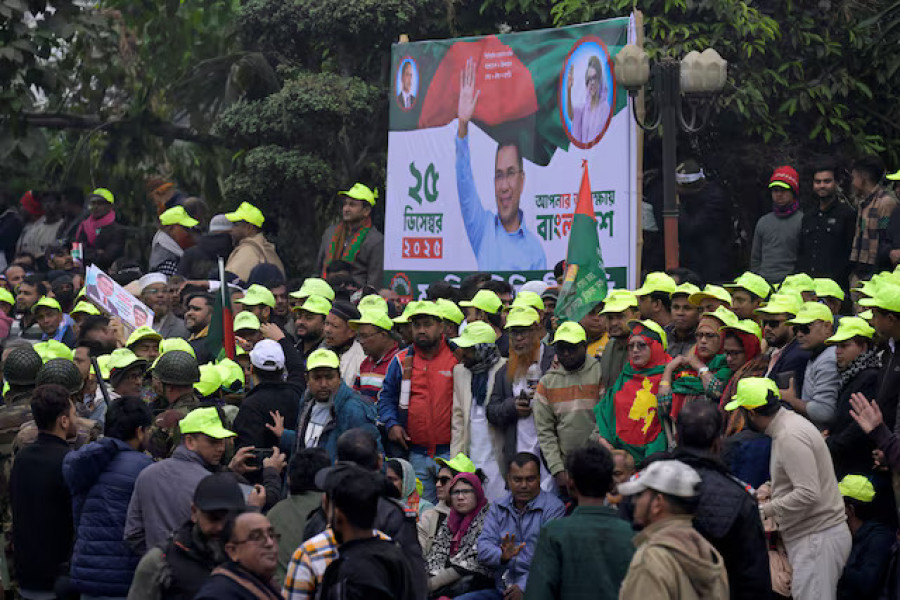
The passing away of Begum Khaleda Zia, the first female prime minister of Bangladesh, on December 30, is going to leave a major void not only within the Bangladesh Nationalist Party (BNP) but also in the country’s national politics. She ushered in multiparty parliamentary democracy in Bangladesh when she was elected to power in 1991. Yet her legacy has been both: a reflection of the immense resilience of a young widow and also that of her controversial decisions. She steered the party that faced factionalism after her husband Zia ur Rahman’s assassination and provided much-needed leadership. She is credited with the institutionalisation of the Caretaker Government (CTG) in 1996. But she also undermined this in 2006 when she appointed President Iajuddin Ahmed to head the CTG without exercising other options provided by the constitution. She also established the Rapid
The BNP will feel the void deeply. It is her leadership that kept the senior party leaders together in the past as second-rung leaders emerged around her son, Tarique Rahman, the current acting chairman of the BNP. While leaders closer to Rahman gained prominence, senior party leaders, some of whom were close to her husband, were sidelined. It is believed that while Rahman wanted BNP’s alliance with the Jamaat-e-Islami (JeI) to continue, the senior leaders who fought the liberation war along with Zia were not comfortable with this idea. This alliance, however, led to a respectable rehabilitation of the JeI, gave it political prominence and allowed it to expand its network through two ministries it occupied in the BNP government. Yet, both political parties are contesting the upcoming election separately.
As Begum Zia was convicted and jailed in corruption cases, now withdrawn by the interim regime headed by Mohammad Yunus, the party was remotely managed by Rahman, who lived in exile in London. He exerted control over the party, directed it and regularly held online meetings with senior leaders. For all practical purposes, he was managing the party and deciding its nomination both in 2018 and now. It goes to Rahman and the BNP leaders’ credit that, except for a few, most of the leaders remained loyal to the party and withstood both state repression as well as the temptation of power.
Rahman’s return to Bangladesh from 17 years of exile on December 25 has given the party the much-needed moral boost. As the election approaches, the responsibility for any decision taken by the party will lie with Rahman, as this is the first election held under his leadership. As the Awami League (AL) is banned from participating in the election, it will be a two-way contest between the BNP-led alliance and the JeI-led alliance.
Rift within the NCP
What has emerged as one of the most important recent developments in the National Citizen Party (NCP) is that the student front, which emerged after the removal of Sheikh Hasina, announced an alliance with the JeI. Though many in Bangladesh have always labelled the party as the Jamaat B team from the beginning, this came as a surprise. When the NCP was formed, it refused to give leadership positions to ChhatraShibir leaders who had played a significant role in the uprising to maintain an ideological distance.
Thirty founding members of the NCP also wrote to Nahid Islam, former adviser for Information and Broadcasting of Bangladesh, against the decision to join the JeI-led eight religious political parties’ alliance and resigned from the party, including some prominent leaders. Some female student leaders also decided to leave the party and will contest the election independently. It is believed that the decision to align with the JeI was deliberately taken at the last minute, without consultation, to prevent many NCP ticket seekers who had presumed that the NCP would contest all seats in the forthcoming election. Interestingly, one of the prominent women leaders, TasnimJara, who left the NCP, is trying to gather signatures of 1 percent of verifiable registered voters in her constituency to enable her to file her nomination amid the Election Commission’s server outage.
The party that promised new politics, away from the old politics, has disillusioned many with its decision to align with the JeI, which had opposed Bangladesh’s liberation war. Like the BNP, the NCP argues that this is an electoral alliance and not an ideological one. The positions of the Jamaat and the NCP on many political issues, including the ban on the AL, were the same. It is reported that the NCP initially tried to form an alliance with the BNP but failed, though the details of these negotiations are unknown. As the NCP cannot win the election without aligning with other major political parties, this coalition, though political suicide for the party, is seen as a necessity. Two of the advisers, who recently resigned from the interim regime to contest elections—Asif Mahmud and MahfuzAlam—are not running for the election. While Mahmud has joined NCP as its spokesperson, Mahfuz has distanced himself from it. According to sources, both sought nominations from the BNP but did not succeed.
The February 12 polls, though non-inclusive, will determine Bangladesh’s future political trajectory. It will be a test of Rahman’s leadership and how he navigates the electoral politics. His political experience will be scrutinised through electoral politics and his ability to lead the BNP to victory. In the absence of the AL, the BNP’s political narrative would be shaped by the JeI, and it would no longer raise the slogans ‘Islam in danger’ and ‘sovereignty is at stake’. Perhaps the JeI would use these slogans; there are noticeable social media posts linking Rahman to India in an attempt to delegitimise his leadership. However, the BNP under the leadership of Rahman holds promise of navigating the complex political terrain of the post-July uprising.
Pattanaik is a research fellow at the Manohar Parrikar Institute for Defence Studies and Analyses, New Delhi, India.
This article was originally published on The Kathmandu Post.
Views in this article are author’s own and do not necessarily reflect CGS policy