
When The Neighbor Becomes The First Target
Khalaf Ahmad Al-Habtoor | 04 March 2026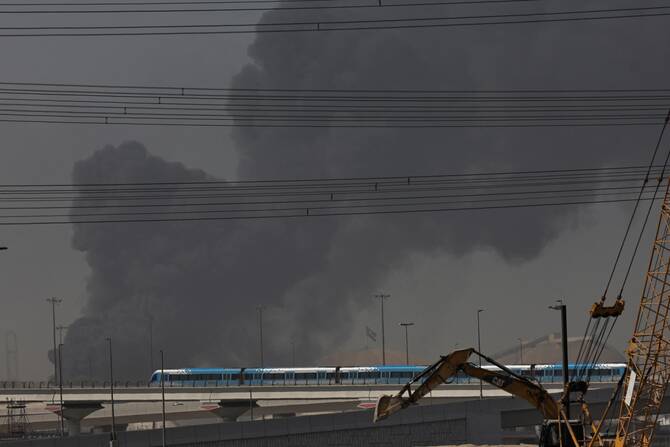
War has broken out. But what reveals the true trajectory of this conflict is not the moment it began; it is where the first retaliatory blows were directed.
Within hours, missiles were heading toward the Gulf Cooperation Council states, and most visibly toward the UAE.
This raises the central question: Why was this neighborhood Iran’s first target?
The war launched by US President Donald Trump and Israel against Iran has not resulted in the collapse of the Tehran regime. Even after the killing of Supreme Leader Ali Khamenei and several senior Iranian officials in the opening strikes, developments that sent shock waves across the region and triggered uncertainty about succession, the political system remains in place and state institutions continue to function, despite the sensitivity of the transition.
Yet Iran’s response did not confine itself to the two direct combatants. It expanded rapidly toward the Gulf.
If the objective was to retaliate against Washington, why was the Arab neighborhood the first to be struck, particularly when the Gulf states had made it clear they would not allow their territories to be used as launchpads for attacks? And if Israeli strikes were intended to strategically contain Iran, was the regional fallout part of the calculation or was the cost of dragging the Gulf into a war it did not start simply disregarded?
Washington argues that it is acting to prevent a future nuclear threat and protect American interests. But was there an imminent danger that justified igniting a confrontation of this magnitude at this precise moment? Was military escalation the only available path?
Israel, too, must confront a similar question. If its operations are essential to its security, does expanding the theater of confrontation into an economically sensitive regional environment truly enhance long-term stability or does it risk entrenching broader instability that will eventually affect all sides?
The economic consequences are already emerging. In Israel, daily war expenditures are estimated in the hundreds of millions of dollars. In Iran, reconstruction costs may run into the tens of billions amid oil export disruption and mounting inflation. In the US, energy markets have reacted immediately, fueling inflationary pressure and exposing the economy to further volatility should the conflict persist.
These are measurable costs.
But the deeper shift is this: the Gulf has been drawn into a deterrence equation not of its own making.
Iran claims it is targeting American interests in the region. Yet the missiles crossing Gulf airspace do not distinguish between “interests” and human lives. They endanger cities hosting millions, including hundreds of thousands of Iranians who have lived peacefully in the UAE and across the Gulf for decades.
Nor can it be ignored that the ignition of this confrontation was itself the product of a US-Israeli decision. If Iran’s response is dangerous, the opening of the door to that response was not accidental either. Wars are rarely the product of a single reaction; they are the outcome of accumulated strategic decisions.
If any party believes that pressuring Gulf economies will create a new balance of power, it is profoundly mistaken
The UAE and other GCC states were not parties to the decision to go to war. Yet they found themselves immediately within its trajectory. Was this merely a military spillover or has the Gulf become a pressure lever within a wider strategic contest?
The speed with which Gulf states were targeted, within hours of the outbreak of hostilities, suggests that this was not a spontaneous reaction. It appears instead to be a calculated move embedded in a preprepared scenario.
If any party believes that pressuring Gulf economies will create a new balance of power, it is profoundly mistaken. The Gulf is not the weak link of the Arab world; it is its economic heart. Targeting it will not fragment the region; it will strengthen cohesion and unity.
That cohesion is already visible.
The Gulf, and the UAE in particular, remains central to global trade flows. Dubai is not merely a city; it is a gateway connecting Asia to Europe and the West, a hub for logistics, finance and supply chains. Disrupting it is not a regional act, it reverberates globally.
If this trajectory continues, the consequences will not be confined to military exchanges. They will extend into energy corridors, shipping routes, financial markets and global stability.
There is no victory in a war that expands the theater of conflict, destabilizes a region’s economic core and multiplies uncertainty.
History will not judge only those who fired the first shot. It will judge those who chose to make their neighbor the first battlefield.
Khalaf Ahmad Al-Habtoor is a prominent UAE businessman and chairman of the Al-Habtoor Group and Dubai National Insurance and Reinsurance Company. X: @KhalafAlHabtoor
This article was originally published on Arab News
Views in this article are author’s own and do not necessarily reflect CGS policy.