
Democracy Cannot Survive on Silence and Fear
Zillur Rahman | 06 January 2026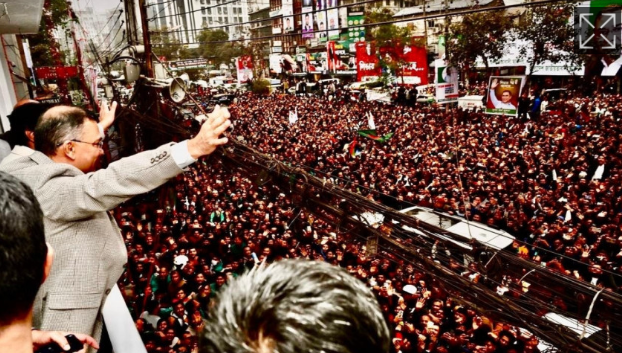
After a long stretch away from the country, Tarique Rahman's return to Bangladesh marks the beginning of a tougher chapter, one that's about real responsibility, not symbolic. Naturally, the Bangladesh Nationalist Party (BNP) and its followers are feeling a mix of excitement and hope. But it's important to remember that this moment isn't just about one leader or party. It is a time when the democratic environment in Bangladesh appears unstable.
There had been a troubling trend in the weeks leading up to Rahman's return: attacks on political figures and the very institutions that support democratic life. Two major independent media outlets, Prothom Alo and The Daily Star, faced grave dangers. Journalists found themselves trapped in their own office, which was set on fire. Many were caught in chaotic situations, while others had to escape. Cultural institutions tied to Bangladesh's secular and pluralist heritage, like Chhayanaut and Bangladesh Udichi Shilpigoshthi, were also destroyed.
These attacks didn't happen in isolation. They were accompanied by targeted intimidation against individuals. Nurul Kabir, a respected editor and journalist, faced harassment and threats. In a particularly tragic event, Dipu Chandra Das, a citizen from the Hindu community, was brutally killed. This raised serious concerns about the safety of minorities and highlighted a growing atmosphere of impunity. All these incidents together seem to send a clear message.
When minorities feel unsafe, and journalists are intimidated, it sends a signal meant for those beyond the directly affected. It tells society who is allowed to speak and who isn't. Democracies can erode gradually when intimidation is normalised, silence is mistaken for stability, and fear replaces open dialogue.
Elections aren't standalone events. They depend on a wider ecosystem that includes enforcement of law, free flow of information, and protection of dissenting voices. When citizens are targeted based on their identity, newspapers are attacked, and editors face threats, elections risk becoming mere formalities rather than democratic milestones. While there is no alternative to a credible election, votes alone can't compensate for a compromised public sphere.
This isn't a new issue for Bangladesh. For over a decade, journalism has faced restrictions, opposing views have been silenced, and cultural expression has been stifled, both publicly and privately. Many viewed the July uprising as a reaction to this suffocation. It wasn't just about changing power; it was a call for accountability and dignity.
That's why the rise of mob violence is particularly alarming. It suggests that bigotry persists, even if political loyalties shift. Mob politics is inherently destructive. Once violence is justified as "public anger," accountability disappears. Mobs create chaos instead of supporting causes. They target minorities and journalists today, and tomorrow, they could go after political figures, ultimately consuming society as a whole.
Leadership today requires more than just words and mobilisation. It demands self-restraint. Clear boundaries need to be established and communicated. In these contexts, silence is often interpreted as complicity rather than neutrality. And in politics, interpretations can have serious consequences.
A genuine commitment to democratic renewal can't coexist with uncertainty about violence. A different tone is necessary, one that firmly opposes communal targeting, unequivocally defends media freedom, and clearly condemns attacks on journalists. These messages matter not just for party supporters but also for the broader public, who are weary of political cycles marked by retaliation and escalation.
However, it's important to recognise that no single person can shoulder this responsibility alone. Despite its constitutional ambiguities, the current interim government has a fundamental duty to uphold law and order fairly. Protecting citizens like Dipu Chandra Das, safeguarding journalists, and defending institutions that support free speech represent the bare minimum needed for effective governance.
Given the inconsistent responses to recent attacks, concerns about commitment outweigh worries about capability. When those who break the law aren't held accountable, while critics face intimidation, a troubling message emerges which even elections can't erase. Over time, these issues weaken institutions.
Internationally, speculations about Bangladesh's political future have grown. It's not just outsiders meddling. When democratic protections seem weak, foreign governments, human rights organisations, and multilateral bodies will inevitably take notice. Weak systems don't enhance sovereignty; strong systems that do.
But this situation isn't just a test for politicians or governments. It's a test for society as a whole. Journalists aren't the only ones affected when a newspaper is burned. When an editor faces threats, it silences many voices. The social contract starts to break down when a citizen is attacked because of their identity.
The upcoming election won't be judged solely on results and turnout. It'll be evaluated based on how freely journalists can operate, how safe dissenting voices feel, how secure minorities are, and whether law enforcement serves the public interest rather than those in power.
Tarique Rahman's return is undoubtedly significant. Yet, its true impact won't be measured by celebrations or conflicts but by what comes next. Democracy can't thrive in an atmosphere of silence and fear. How Bangladesh responds now will shape not just this election, but public trust for many years ahead.
Zillur Rahman is host of the current affairs talk show Tritiyo Matra. He also serves as president of the Centre for Governance Studies. His X handle is @zillur.
Disclaimer: Views in this article are author’s own and do not necessarily reflect CGS policy