
The BNP’s real test lies in Bangladesh’s beleaguered economy
In Bangladesh now, the economy dictates politics and not vice versa – as Sheikh Hasina discovered to her peril
Faisal Mahmud | 29 March 2026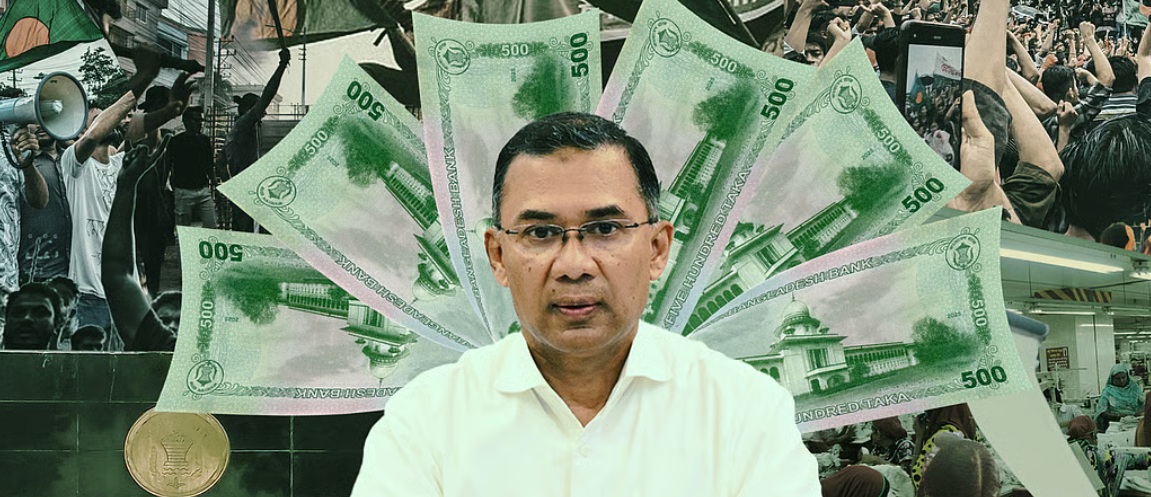
ON 25 FEBRUARY, the newly formed Bangladesh government under the Bangladesh Nationalist Party (BNP) unceremoniously removed Ahsan H Mansur, the man who had largely stabilised the economy in the turbulent aftermath of the July 2024 uprising that toppled Sheikh Hasina’s government, from the post of central bank governor. Mansur had adopted a tight and prudent monetary policy, raising interest rates to curb inflation while working to stabilise the exchange rate and rebuild foreign exchange reserves. He also initiated major reforms to restore confidence in the banking sector and improve financial governance. He was replaced by Mostaqur Rahman, a cost and management accountant by training, who pledged tighter oversight at the central bank and vowed to dismantle Bangladesh’s entrenched culture of crony credit.
The change has been controversial. While the government claimed that both Mansur’s removal and Rahman’s appointment were “in the public interest”, a writ petition filed at the High Court has challenged Mansur’s removal on the basis of a law that disallows the removal of a Bangladesh Bank governor unless they are found to be incapable or incompetent. Some have been critical of Rahman’s appointment to what is ostensibly an independent post because of his close ties to both industry and the government.
The move points to the new government underestimating the precarity of this moment – a matter of great worry. The BNP, with Tarique Rahman as the prime minister, has stepped into the fractured remains of a decade-long economic distortion that finally buckled under its own weight. The prime minister Tarique Rahman and his administration must realise that the patience of the Bangladeshi public has been depleted. The social contract that Hasina upheld, which once allowed for political repression in exchange for economic mobility, has been permanently revoked by the revolution that toppled her.
Conventional post-mortems of Hasina’s 2024 ouster focus on student-led protests and a surge of civil unrest. However, the collapse of her Awami League government was economic in its genesis, economic in its escalation and economic in its ultimate political fate. Any government that misreads this risks repeating the same terminal error: operating under the belief that the political apparatus failed first when in reality it was the economic foundation that first crumbled. In today’s Bangladesh, the political consequences of economic failure are more severe than ever before – and the performance of the new central bank governor will have great bearing on how the new government fares.
For much of the decade following 2013, when the Awami League consolidated power by cracking down on opposition forces, Bangladesh existed within a curious political paradox, where the erosion of civil liberties and the criminalisation of dissent were met with an eerie domestic silence from political parties and the public at large. This was due partly to a pervasive “culture of fear” and partly to the benefits accruing to the Bangladesh economy from global economic factors. Low global interest rates and high liquidity after the 2008 global financial crisis made external financing easier. Between 2009 and 2019, the country gained enormously from low global energy prices, a surge in Western consumer demand and abundant global liquidity. It benefited from strong global demand for garments – its largest export – as Western retailers shifted orders to Bangladesh from relatively higher-cost producers such as Turkey and some Eastern European countries. Remittance inflows from migrant workers in West and Southeast Asia also rose steadily, boosting foreign exchange reserves and domestic consumption.
During this period, GDP growth averaged roughly 6.7 percent annually, and the poverty rate – calculated at the time as the percentage of the population living on less than USD 1.9 per day – plummeted from 31.5 percent in 2010 to approximately 20.5 percent by 2019. The burgeoning lower-middle class, buoyed by rising real incomes and refrigerators that stayed full, effectively traded its democratic aspirations for the promise of economic stability. Authoritarianism was the price paid for an upgrade in material life.
However, the “Hasina Miracle”, as the rapid economic growth during her early years in power after 2008 came to be known, was less the product of skillful manoeuvring of the domestic economy and more a ride on a global tailwind. A shift in that wind sent the economy into heavy turbulence.
THE COVID-19 PANDEMIC provided the first stress test, exposing a banking sector riddled with rot. Hasina’s government imposed strict nationwide lockdowns as its primary policy response, which severely disrupted the informal economy – comprising street vendors, day labourers, small traders, transport workers and more – that accounts for roughly 85 percent of employment in Bangladesh. Many banks were already fragile and lacked the capacity to extend meaningful credit support to businesses facing sudden Covid-related disruptions. Hasina’s government announced stimulus packages that mostly relied on bank-mediated lending rather than direct fiscal transfers. Funds were slow to reach small businesses and informal workers. With little in savings or social protection, millions saw their incomes collapse, revealing the economy’s limited resilience to shocks. But global fuel prices were relatively low and external financing conditions remained supportive. As a result, foreign exchange reserves stayed at comfortable levels and the government could manage the shock without a full-blown balance-of-payments crisis.
If the worst hits of the pandemic were concentrated on the informal labour economy and small businesses, the Russian invasion of Ukraine in 2022 destabilised the country’s macroeconomy. Bangladesh is heavily dependent on imported fuel – especially oil, liquefied natural gas and coal – to run power plants and industry. The war drove global energy and commodity prices sharply up and Bangladesh’s fuel import bill surged. This sudden spike placed intense pressure on foreign exchange reserves, widened the trade deficit to a record USD 33.25 billion over 2021 and 2022, and pushed the economy from sectoral strain into nationwide emergency.
The government’s response was denial. To maintain the optics of a growing economy, policymakers attempted to artificially peg the taka against the US dollar, a move that drained foreign exchange reserves from a peak of USD 48 billion in August 2021 to below USD 20 billion in usable assets by 2024. The creation of an overvalued currency birthed a dysfunctional dual-market system where the “kerb market” rate for dollars far outstripped the official peg, punishing exporters and diverting vital remittances into hundis – informal money-transfer instruments used in many parts of Southasia – and other unregulated channels.
By mid-2023, there was total systemic failure. Banks could no longer honour letters of credit. Inflation, particularly for food, surged; it hit a 12-year high of 9.9 percent in mid-2024. At the epicentre of this implosion sat the banking sector, which had become a feeding trough for politically connected wilful defaulters. One example is the S Alam Group, a Chittagong-based industrial conglomerate and the single largest borrower in Bangladesh, with loans from banks and financial institutions amounting to about BDT 2.25 lakh crore – USD 18 billion – most of which it has defaulted on. The group was known to have close ties to the Awami League government under Hasina, which granted it both protection and favours.
Since 2016, non-performing loans (NPLs) have become a cancer. The central bank’s quarterly tally of NPLs was as high as 35.7 percent in September last year, and this was brought down to 30.6 percent by December through aggressive debt rescheduling. Capital was not being reinvested into Bangladesh’s domestic economic engine; rather, it was being siphoned off through over-invoicing and illicit outflows. According to a report in Bangla Outlook, investigators found that businesses linked to the S Alam Group exploited weaknesses in the banking system to move roughly USD 20 billion abroad through a web of around 470 shell companies across nine countries.
Similar patterns appear with other conglomerates. Investigations into the Beximco Group – one of Bangladesh’s largest and most politically connected conglomerates, spanning textiles, pharmaceuticals and energy – have pointed to an alleged BDT 33,470 crore, or USD 2.7 billion, having been siphoned abroad, with members of the family that heads the group accumulating BDT 846 crore worth of luxury property in London. Scrutiny of the Bashundhara Group points to over BDT 42,000 crore, or USD 3.4 billion, in bank borrowing, alongside allegations of BDT 2000 crore, or USD 163 million, in trade-based money laundering through bitumen imports. Members of the Bashundhara family reportedly hold vast and expensive properties in the United Kingdom – Bangla Outlook reported that these were worth as much as BDT 1000 crore, or USD 81.5 million.
These cases illustrate how capital generated within Bangladesh’s economy was allegedly diverted overseas instead of financing domestic investment and growth. A report by the Washington DC-based think tank Global Financial Integrity estimated such outflows to exceed USD 7 billion annually. Corruption within a national economy, while damaging, can still stimulate some local demand, but when massive corruption goes hand-in-hand with capital flight, it hollows out the country’s future entirely.
Remittances to Bangladesh formally peaked at USD 24.8 billion during the early pandemic years of 2020–21, then fell to less than USD 22 billion in 2022, reflecting growing use of informal hundi channels and declining confidence in the official financial system. This weakening of formal remittance flows compounded the damage from capital flight. With dollars earned abroad no longer returning through official channels, while billions left the country through over-invoicing and illicit transfers, the pressure on foreign exchange reserves became insurmountable.
The 2023–24 El Niño cycle brought record-breaking heatwaves to Bangladesh, with temperatures in Dhaka hitting 40.6 degree Celsius – the highest in more than five decades. This environmental stress sent electricity demand surging just as the government ran out of dollars to pay for liquefied natural gas and coal imports. The resulting “load-shedding” – intentional cutting of power when demand exceeds supply – crippled irrigation pumps in the northern rice belts and shuttered garment factories. Student protests were the match that ignited the July 2024 movement against Hasina, but the tinder was already in place in the form of the economic desperation of a populace that had seen its earnings, savings and purchasing power evaporate.
THE INTERIM ADMINISTRATION led by Muhammad Yunus, which stepped in to rule between the fall of Hasina’s government and the installation of Rahman’s served as a vital, if temporary, tourniquet. Through Mansur, the Yunus government moved with technocratic precision to stanch the economic bleeding, allowing the taka to float more freely. It oversaw a modest recovery in remittances, which jumped to USD 2.2 billion in August 2024 alone, as public confidence in the economy and in governance flickered back to life. It was helped along by the La Niña weather phenomenon, which brought cooler temperatures and reduced the immediate strain on the power grid. But Yunus’s tenure was a period of economic relief, not of any resolution of the underlying structural decay.
The Rahman administration does not have many fiscal options before it. Bangladesh’s tax-to-GDP ratio remains among the lowest in the world, at little more than 7 percent, and the government has hinted at tax hikes – a perilous proposition for households still reeling from three years of price shocks.
Furthermore, the garment sector, which accounts for more than 80 percent of export earnings, faces a triple threat: rising internal wage demands, Western brands increasingly shifting production closer to their home markets, and Bangladesh’s possible graduation from Least Developed Country status in 2026, which might strip away the duty-free access to raw materials that has underpinned the industry for decades.
The government confronts a far more difficult external environment. The war in West Asia between Iran on one side and the US and Israel has already triggered another global energy shock – something that could hit Bangladesh particularly hard because it imports about 95 percent of its fuel. The government has been forced to introduce fuel rations despite which fuel pumps in some parts of the country have run dry. Continued hostilities pose grave threats to trade and disruptions could hit Bangladesh’s export competitiveness, disrupt its labour markets and interrupt remittances. This, in turn, can increase inflation and pressure on foreign reserves.
Syed Akhtar Mahmood, an economist formerly with the World Bank, has long warned that Bangladesh must confront its structural weaknesses rather than rely on favourable global conditions. He told me that the country must “face the music sooner or later” and focus on productivity and resilience. If global fuel markets tighten because of a regional war, those structural weaknesses – energy dependence, weak productivity and limited export diversification – will become far more visible. Other economists have voiced similar concerns. The former World Bank chief economist Kaushik Basu has warned that global geopolitical conflicts can rapidly translate into inflation and balance-of-payments crises for import-dependent developing economies like Bangladesh.
In the current global economy, the market will always clear with supply somehow meeting demand. If the government attempts to block price signals for political expediency, the adjustment will instead come through unrest in the streets. The BNP must now govern with the sombrerealisation that in modern Bangladesh, politics no longer dictates the economy; rather, the economy has become the ultimate, unforgiving arbiter of political survival.
Faisal Mahmud is a Dhaka-based journalist who has reported on Bangladesh and Southasia for international outlets such as Al Jazeera, Anadolu Agency, Asia Times, Voice of America and Nikkei Asia, among others. He is a recipient of the Jefferson Fellowship and the Konrad Adenauer Stiftung Fellowship, and previously served as minister (press) at the Bangladesh High Commission in Delhi.
This article was originally published on Himal South Asian.
Views in this article are author’s own and do not necessarily reflect CGS policy.