
Bangladesh and RCEP: A Strategic Opening or a Step Too Far?
Shurat Rana Rushmi | 19 April 2026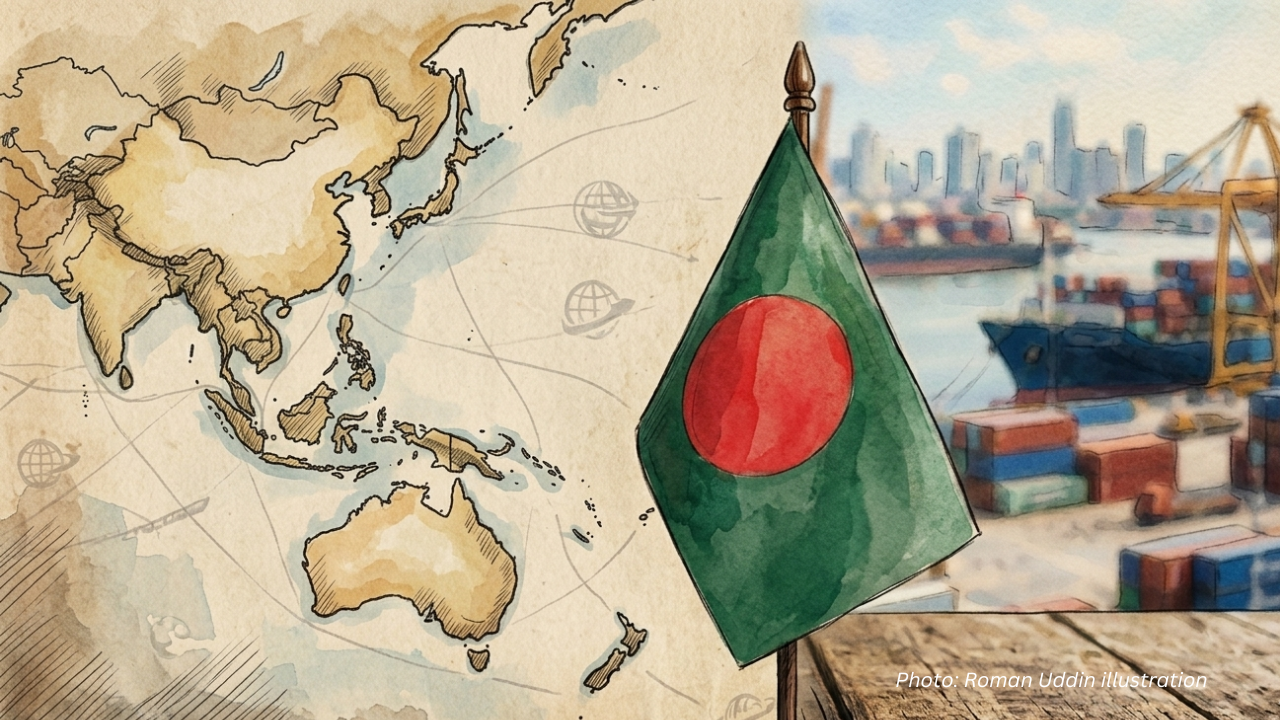
Bangladesh is entering a new phase in its economic journey, and that means old trade habits will no longer be enough. For years, the country benefited from special market access as a least developed country, which helped its exports, especially garments, grow rapidly. But that cushion will gradually disappear. Bangladesh had been scheduled to graduate from LDC status in November 2026, yet the government has since formally sought to postpone that transition, first through a request to the UN Committee for Development Policy and later through a letter to the UN secretary-general seeking at least a three-year deferral. Even if that delay is granted, it would only buy time. It would not remove the pressure to prepare for a more competitive trading environment once LDC-specific preferences begin to fade. That is why the debate over joining the Regional Comprehensive Economic Partnership, better known as RCEP, has become so important. Bangladesh has already signaled its interest in joining the bloc, and accession could help the country secure more predictable reciprocal market access in major Asian markets, offset part of the post-LDC preference loss, connect more deeply to regional supply chains, attract new manufacturing and services investment, and push export diversification beyond garments. In that sense, RCEP is not just a trade option. It is increasingly part of the broader strategy Bangladesh will need for its post-LDC future, although joining it would also require targeted domestic reforms and stronger competitiveness at home.
At first glance, the attraction is obvious. RCEP brings together 15 economies, including the 10 ASEAN countries, along with China, Japan, South Korea, Australia, and New Zealand. It is now the biggest regional trade arrangement in the world. For a trade-dependent country like Bangladesh, being connected to such a large economic network sounds not only appealing, but necessary. With Asia becoming the center of global production, investment, and commerce, staying outside the region’s most important trade framework may carry its own risks.
That said, Bangladesh should not treat RCEP as a miracle cure. Joining such a bloc will not automatically solve the country’s trade challenges, diversify exports overnight, or make domestic industries more competitive. If anything, accession without preparation could expose existing weaknesses more sharply. India’s position makes this even more sensitive. India remains outside RCEP and has publicly justified that decision by pointing to fears of import surges, weak rules-of-origin safeguards, and the risk of industrial pressure from goods flowing in from the China-centered regional supply chain. For Bangladesh, this matters because India is not just a neighboring country but one of its top trading partners, and recent disputes over transit and market access have already shown that bilateral trade ties can become vulnerable to political and logistical shocks. In that context, entering an arrangement that includes China but excludes India could create a new layer of strategic and commercial imbalance. It may widen Bangladeshi consumers’ access to cheaper imports, including Chinese products, but it could also intensify pressure on local producers and complicate Dhaka’s effort to maintain a stable trade relationship with New Delhi. The real issue, then, is not whether RCEP is attractive in principle. It is whether Bangladesh has the policy readiness, industrial resilience, and diplomatic balance to absorb its consequences in practice.
There are good reasons Bangladesh is interested right now. The first is timing. LDC graduation means the country must prepare for a future in which trade preferences become weaker. The second is competition. Several countries that compete with Bangladesh in export markets, such as Vietnam and Cambodia, are already part of RCEP. That gives them a stronger place in regional supply chains and may make them more attractive to foreign investors. The third is strategy. Bangladesh is no longer looking only at traditional regional arrangements. It is now thinking more actively about bilateral and regional trade deals as part of a broader effort to secure its economic future.
The strongest argument for joining RCEP is that Bangladesh needs deeper integration into Asian value chains. Today’s trade is not simply about producing a final good and shipping it overseas. It is increasingly about being part of a multi-country production process. Raw materials may come from one market, components from another, assembly from a third, and services from several others. Countries that are plugged into these networks usually gain more from trade than those that stand on the margins. Bangladesh has built a strong export base, but it still has limited integration into these broader regional production systems. RCEP could help change that.
There is also a longer-term case for export diversification. Bangladesh has done well with garments, but relying too heavily on one sector is always risky. A broader trade platform could create new opportunities in pharmaceuticals, leather, agro-processing, light engineering, and service sectors such as ICT. That kind of shift will not happen overnight, and it certainly will not happen just because Bangladesh signs onto a trade agreement. But RCEP could provide a stronger structure for that transition if domestic reforms move in the same direction.
Supporters also argue that membership could improve Bangladesh’s appeal as an investment destination. Investors usually look for more than low production costs. They also want predictability, access, and integration with bigger markets. If Bangladesh can present itself as both a manufacturing base and a gateway into a wider regional trade system, that could strengthen its position. But again, that benefit depends on whether the country can offer reliable infrastructure, smoother customs procedures, better standards compliance, and consistent policy.
This is where the optimism needs to be matched with realism.
Bangladesh is not yet fully prepared for an agreement of this scale. RCEP membership is not simply a matter of showing interest. Existing members would need to be convinced that Bangladesh can meet the obligations and open its market in a meaningful way. That is not a small requirement. The country still struggles with customs bottlenecks, high logistics costs, regulatory weaknesses, and a trade regime that often depends on protection. These are structural issues, not minor technical details. If they are not addressed, Bangladesh could find itself inside a major trade bloc without the capacity to make the most of it.
There is also the question of domestic industry. Trade liberalization often brings benefits over time, but the immediate pain can fall heavily on local producers that are not ready for open competition. Some industries may adapt and grow stronger. Others may suffer badly. Consumers may benefit from more choice and lower prices, but firms that rely on tariffs and protection could face real pressure. That is why joining RCEP cannot be approached as a public relations success. It has to be managed as an economic transition.
The fiscal side matters too. Bangladesh has long depended on trade-related taxes for a significant share of revenue. If tariffs come down under a major trade arrangement, the government will need stronger domestic tax collection to compensate. That means better VAT administration, stronger income tax systems, and a broader reform of public revenue. Without that preparation, trade liberalization could create new budgetary strain.
Another area that deserves attention is services. There is growing interest in the idea that Bangladesh could gain more from services trade under a framework like RCEP, especially in sectors such as travel, finance, and ICT. That may be true. But services liberalization is much more complicated than it sounds. It depends on regulations, institutions, digital systems, skills, and professional standards. Opening sectors without building those foundations would produce limited gains.
So, should Bangladesh move toward RCEP? The answer is yes, but carefully.
Bangladesh should view RCEP as a strategic direction, not a quick solution. The country cannot afford to stay disconnected from Asia’s main economic architecture forever. But neither can it afford to rush in unprepared. What is needed now is a serious readiness plan. That should begin with a detailed review of which sectors are likely to gain, which may face losses, how much revenue could be affected, and what institutional reforms are needed. It should also include support for industries that may struggle under stronger competition, along with investment in trade facilitation, standards, customs modernization, and negotiation capacity.
The RCEP question is bigger than trade policy alone. It is really a test of whether Bangladesh is ready to build a more competitive, more diversified, and more regionally connected economy.
If Dhaka sees RCEP as an easy route to market access, it may end up disappointed. But if it treats it as part of a broader economic transformation, then membership could become a smart and timely move. The opportunity is real, but so are the risks. Bangladesh should proceed with confidence, but it must do so with open eyes.
• Shurat Rana Rushmi is a Research Associate at Centre for Governance Studies (CGS)
Disclaimer: Views in this article are author’s own and do not necessarily reflect CGS policy