
Muizzu’s Maldives Cooks up A Sovereignty Dispute Over The Chagos Islands
Daniel Bosley | 02 May 2026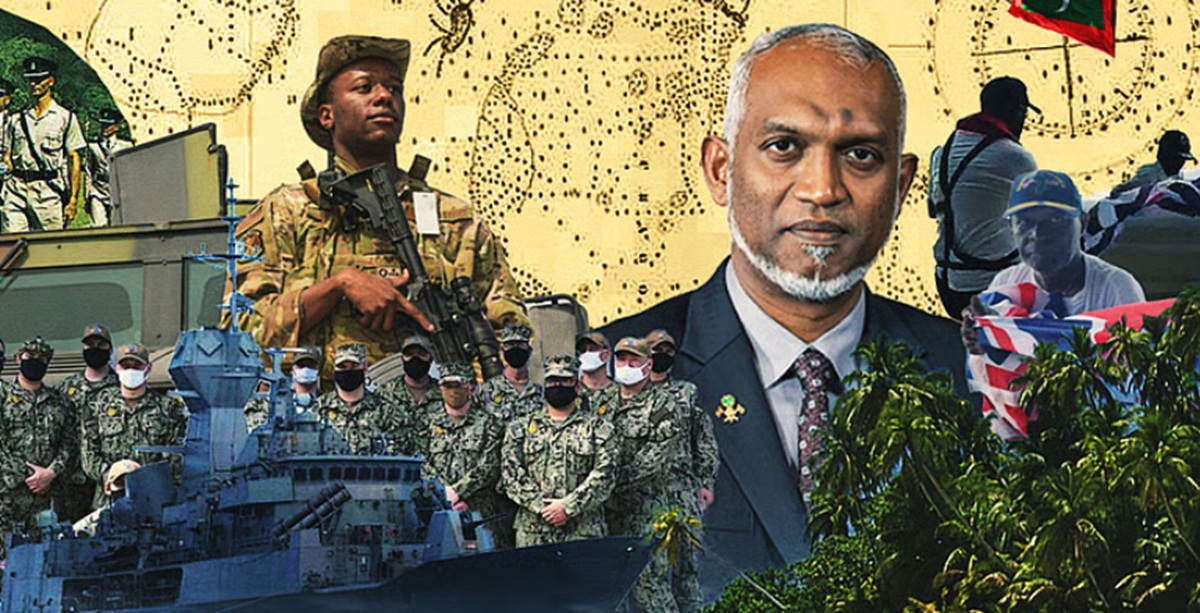
Under Mohamed Muizzu, the Maldives is contesting Mauritius’ claim to the Chagos archipelago, inserting itself into a geopolitical dispute also involving the United Kingdom and United States
The deserted island of Île du Coin, in the Peros Banhos atoll of the Chagos Islands, is not often in the news. Yet in mid-February, it made headlines after six Chagossians landed there, intending to set up a permanent home. Misley Mandarin, the Mauritius-born leader of the small group, said that his father, who had accompanied him, had been displaced from Île du Coin when he was 14 years old. “I am not in exile any more. This is my homeland,” he said as they set up tents, expressing their desire for more to join them. The Chagossians were aiming to throw a wrench in the works of a planned handover of the Chagos archipelago from the United Kingdom, which presently controls what is officially British Indian Ocean Territory (BIOT), to Mauritius, which claims sovereignty over the islands.
On 31 March, in a landmark verdict, a judge from the BIOT ruled that Chagossians, who had been expelled in their entirety from the archipelago by the United Kingdom in the 1960s, had a legal right to live on the islands. Justice James Lewis said the United Kingdom’s previous claims that the islanders could not move back due to security concerns related to a joint US-UK military base on the island of Diego Garcia no longer held as the UK government planned to hand the islands over to Mauritius. He also calculated that the cost of the Mauritius handover deal to the UK taxpayer, coming to GBP 51 billion, meant arguments claiming that it was too expensive to allow the return of Chagossians were now invalidated.
In looking to stall the handover, the Chagossians had an unlikely ally. Days after the Chagossians set up camp on Île du Coin, the British politician Nigel Farage, the leader of the right-wing Reform UK party, secretly travelled to Addu, the southernmost atoll in the Maldives, which lies some 500 kilometres from the PerosBanhos. He claimed he was there to transport aid to the Chagossians on PerosBanhos, who are also British citizens, and that he was prevented from doing so by British authorities. Standing on the pristine Addu shoreline, Farage expressed dismay that the United Kingdom was handing the Chagos archipelago over to Mauritius after years of international pressure had resulted in a bilateral treaty to this effect. Reports later surfaced that Reform UK donors had funded the Chagossians’ journey, helping fly the group to Sri Lanka, from where they had set sail.
Reform UK had long sought a way to block the deal, when the US-Israeli war on Iran in West Asia offered an unexpected opportunity to thwart the treaty’s looming ratification. When the United Kingdom initially refused to allow the United States to launch a pre-emptive attack on Tehran from the Diego Garcia base, the US president, Donald Trump, also turned on the deal. In a social media post just days before the war began, Trump hectored UK prime minister, Keir Starmer: “DO NOT GIVE AWAY DIEGO GARCIA”. On 11 April, it was reported that the UK-Mauritius deal had been shelved.
Taking advantage of these rapid shifts, the president of the Maldives, Mohamed Muizzu, is now staking a Maldivian claim to the archipelago. In January 2026, Muizzu had written to the United Kingdom to formally object to the UK-Mauritius deal, citing “profound historical and administrative ties” between the Maldives and Chagos Islands, including gravestones inscribed in Dhivehi, folk stories and a 16th-century patent from a Maldivian king asserting sovereignty over them. The previous month, in a phone call with the UK deputy prime minister, David Lammy, Muizzu had said that “any transfer of the archipelago must account for Maldivian interests.” Under Muizzu’s predecessor in office, Ibrahim Solih, the Maldives had recognised the Mauritian claim to the islands, but now, as Trump and Farage railed against the Chagos deal, Muizzu withdrew this, spying a chance to insert his country into a debate about sovereignty, influence and economic spoils in what he sees as the Maldives’ backyard. Muizzu sent patrol boats into waters south of Addu, in defiance of a 2023 ruling by the International Tribunal for the Law of the Sea (ITLOS) that had demarcated contested territory between Mauritius and the Maldives. This resulted in Mauritius suspending diplomatic relations with the Maldives.
DESPITE THE CHAGOS ATOLLS’ proximity to Addu, Maldivians were not the first to settle them. Instead it was the French, who established coconut plantations, populated by enslaved Africans, on the uninhabited islands in the late 18th century. The Chagos archipelago first came under British control after the United Kingdom’s defeat of the French in the Napoleonic Wars, when the French colony of Mauritius was ceded to the British.
The French, and then the British, governed the Chagos Islands from the Mauritian capital of Port Louis, located 2000 kilometres to the south-west. By 1968, with the United Kingdom shedding its colonies “East of Suez” in response to growing calls for self-determination for colonised territories, Mauritius declared its independence. Three years earlier, however, the Chagos Islands had been designated as the BIOT and detached from Mauritius.
This 1965 deal was immediately followed by a UK-US agreement to house a joint military base on the largest Chagossian island, Diego Garcia, which led to the brutal eviction of around 2000 islanders to Mauritius and the Seychelles. There they faced immense poverty and continued to fight for their return. The Diego Garcia base effectively replaced a British Royal Air Force base in Addu as the Maldives moved from British protectorate status to full independence that same year, with the departing British hegemon effectively leaving a light on in the Indian Ocean for its American successor.
The seven now-uninhabited Chagossian atolls became what many refer to as the United Kingdom’s “last colony”. While Mauritian leaders would later claim the “dismemberment” of Mauritian territory through the detachment of the BIOT had come under duress, the United Kingdom justified the forced depopulation of the islands by claiming that Chagossians, who had been living there for generations since before the islands were ceded to the United Kingdom, had been only contract labourers. Over the following decades, as the infamous Diego Garcia base became a crucial tool in the US wars in Iraq and Afghanistan, legal opposition to the BIOT’s existence reached the International Court of Justice (ICJ). In 2019, the court advised the United Kingdom to return the islands to Mauritius as soon as possible, with the UN General Assembly overwhelmingly endorsing this advice.
Under pressure, the United Kingdom eventually entered into negotiations with Mauritius in 2022. Three years later, a treaty was approved which would see the Chagos Islands handed over while the United Kingdom retained a 99-year lease on Diego Garcia. As the Mauritian prime minister, Navin Ramgoolam, hailed the deal as one that “completes the process of decolonisation”, his British counterpart said the threat of potentially binding legal rulings had been averted while protecting against foreign encroachment into the strategic Indian Ocean area.
Opponents of the deal, including Farage, have said it is a “strategic disaster” that would damage the United Kingdom’s “special relationship” with the United States and provide an opening for further Chinese influence in the Indian Ocean. In the short term, argue these critics, the deal could allow Chinese espionage within the Chagos archipelago. In the long-term, they suggest China’s growing commercial interests in Mauritius could be leveraged to gain political influence, undermining the tenure of the joint UK-US base and paving the way for a permanent Chinese military presence.
While Farage seems to have welcomed the Maldives’ claim, these same concerns would also disqualify the Maldives as a trustworthy steward of the Chagos Islands in the eyes of the critics of the Mauritius deal. Chinese and Indian one-upmanship in the Maldives over the past decade has polarised Male’s politics along geopolitical lines, culminating in Muizzu, perceived to be pro-China, running his election campaign on a belligerent “India Out” mantra. This campaign sought to expel Indian military personnel stationed in the Maldives and remove Indian influence in the country, countering Solih’s prior “India First” policy. Muizzu had to perform an embarrassing climbdown on this once in office, and ties with New Delhi have since stabilised. But after a campaign that included attacks on yoga events, the expulsion of Indian military advisors and a retaliatory campaign in India to boycott the Maldives as a tourism destination, and China’s involvement in constructing a USD 200-million bridge in the Maldivian capital, it’s unlikely New Delhi or Washington DC would back Maldivian sovereignty over the Chagos.
Members of the UK parliament have dismissed the legal dilemma posed by the BIOT’s existence. Others maintain that Marutius’ links to the Chagos are simply an accident of history, a colonial quirk the likes of which had also seen the islands of the Republic of Seychelles once administered from Port Louis.
The Chagossian diaspora – now around 10,000-strong and spread across the United Kingdom, Mauritius and the Seychelles – had mixed reactions to the 2025 treaty. Some welcomed the promise of resettlement after a handover, while others expressed distrust of the Mauritian government. Most have complained about a lack of consultation, calling for a greater say in future decisions made about the islands. Under the treaty’s terms, Mauritius remained free to resettle islanders anywhere except for on Diego Garcia, while the United Kingdom would have to be consulted about the presence of third-party armed forces in the area. The latter clause is of particular interest to India, which has had to balance its natural support for decolonisation with its desire for a US presence in the Indian Ocean to balance growing Chinese power. New Delhi’s fears of debt-trap diplomacy, “string-of-pearls” strategic encirclement by China and Beijing’s “maritime militia” have led to a race for influence in places like Mauritius and the Maldives. While India will be wary of instability, after the United States’ recent National Security Strategy had suggested Washington DC is losing interest in affairs beyond the Western Hemisphere, New Delhi may actually be encouraged by Trump’s renewed, if erratic, concern for Indian Ocean security.
THE MALDIVES’S PRIMARY CONCERN over the Chagos Islands issue has been the demarcation of its exclusive economic zone (EEZ) – a matter complicated by inconsistent policies and confusion over who it should be negotiating with. After the 2019 ICJ ruling, the ITLOS informed the Maldives that it now considered the sovereignty issue to be concluded and irrelevant to the EEZ dispute, which was what led to Solih’s recognition of the Mauritian claim to Chagos.
Despite the Maldives receiving a slightly larger share of the over 92,000 square kilometres of disputed territory thanks to the ITLOS ruling, the opposition cried treason, with Muizzu, then still a presidential hopeful, vowing to recover “forfeited territory”. The Maldives’ late claim over the Chagos Islands seems obscure, but supporters argue that the UK-Mauritius treaty would only serve to turn a “colonial defect” into a “neocolonial fraud”. The “Maldivians4Chagos” campaign, whose backers include the former Maldivian dictator Maumoon Abdul Gayoom, says Maldivian influence on the islands predates European colonisation. Muizzu’s government is reportedly considering its legal options.
After winning office on a platform of nationalism, Muizzu has little to lose by making his bold claim to the islands to the Maldives’ south. But with a US and UK military presence on Diego Garcia seemingly a non-negotiable in any settlement, for the Maldives – whose politics are defined by independence and Islam – to have the United States possibly bombing West Asia from a base on Maldivian territory would not poll well. Furthermore, as Maldivians increasingly migrate to the capital from the country’s far-flung atolls, few would be swayed by the addition of a few dozen more islands to the 1192 they already have. Muizzu’s practical concerns may lie in the possibilities of commercial fishing competition to the south, given that the area around the Chagos Islands has been closed off to Maldivian fishers for half a century since the United Kingdom established a marine protected area in part of the Chagos archipelago – another means, incidentally, to deny Chagossians their right to return. While Maldives’ economic dependence on fisheries is long gone, replaced by reliance on the tourism sector, the fishing industry remains key for jobs and exports. As the handover deal enters troubled waters, Muizzu’s priority will be to maximise the Maldives’ territorial gains.
Regardless of who claims sovereignty over the Chagos Islands, the United States clearly has no intention of departing Diego Garcia and there is no international court or competitor that can currently change this reality. Trump has said openly that he reserves the right to “militarily secure” Diego Garcia, while Starmer’s initial refusal to allow the United States to launch air strikes from the Chagos Islands quickly gave way to permission for “defensive” operations – and, eventually, to the shelving of the UK-Mauritius deal altogether.
Trump’s war in Iran has reminded many Chagossians that previous legal victories in UK courts were eclipsed after the War on Terror heightened Diego Garcia’s strategic importance. While commentators in London, Washington DC and Delhi discuss strategic theory and international law, the half-dozen islanders on PerosBanhos are a reminder of the voices ignored in decades of geopolitical drama. As BIOT authorities attempt another eviction, this group has already changed the legal conversation, interrupting the instructions of sovereign states and ensuring they are heard in the increasingly noisy debate over their home.△
Daniel Bosley is a British journalist and author of the book ‘Descent into Paradise: A Journalist’s Memoir of the Untold Maldives’. He has recently launched a Substack, ‘Trouble in Paradise’, focusing on small island developing states.
This article was originally published on Himal South Asian.
Views in this article are author’s own and do not necessarily reflect CGS policy.