
What Bangladesh Gained When Diplomacy Came to Dhaka
Roman Uddin | 14 October 2026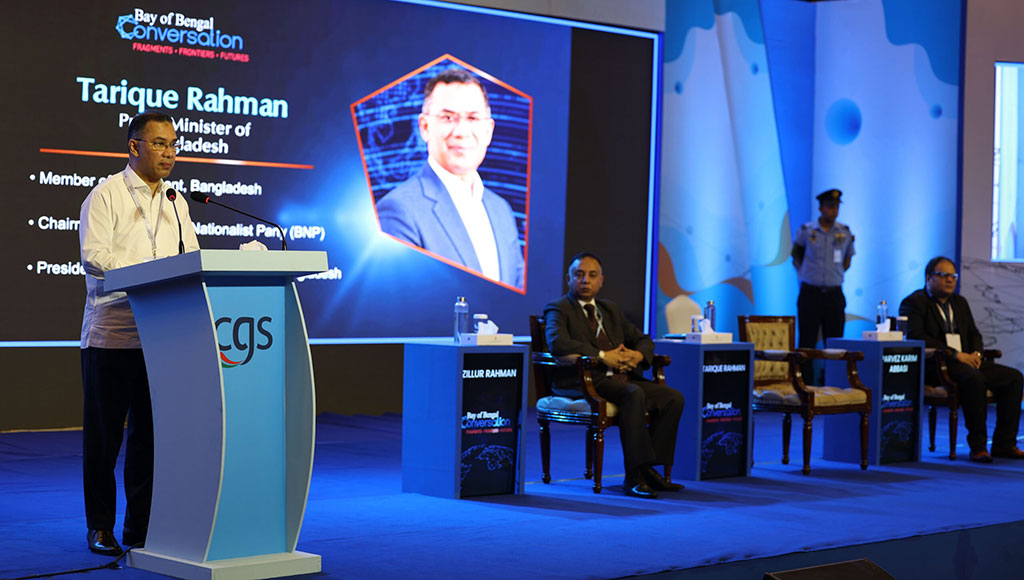
BANGLADESH’S foreign policy is passing through an unusually sensitive period. Relations with India have been strained by Sheikh Hasina’s presence in New Delhi, disputes over border push-ins and the approaching expiry of the Ganges Water Treaty in December. A reciprocal trade agreement with Washington, signed days before the election, set American tariffs on Bangladeshi goods at 19 per cent. In June, the prime minister’s visit to Beijing produced 13 memoranda of understanding and a public endorsement from Xi Jinping. In August, Dhaka said it viewed positively the Mecca defence pact signed by Saudi Arabia, Pakistan and Türkiye. Managing these relationships requires careful negotiation, but Bangladesh also needs places where its priorities can be explained and competing views can be heard.
The fifth Bay of Bengal Conversation, held in Dhaka on October 3–5, offered one such place. Organised by the Centre for Governance Studies, it brought foreign political leaders, ambassadors, researchers, business representatives and civil society actors into direct contact with Bangladeshi ministers, lawmakers and policy specialists. The value of this gathering becomes clearer when viewed through the diplomacy taking place inside it. Bangladesh had an opportunity to present its own understanding of regional affairs, hear how foreign partners assess the country and place its concerns within wider debates about security and development.
This matters partly because the geography of international dialogue shapes diplomatic visibility. Bangladeshi officials and experts regularly look towards major gatherings such as India’s Raisina Dialogue, Singapore’s Shangri-La Dialogue, the Munich Security Conference and the Doha Forum. Those platforms give their host countries opportunities to shape the subjects of debate and build relationships beyond formal state visits. In Dhaka, that direction was reversed. Foreign figures came to Bangladesh to discuss regional and global questions. Bangladesh was no longer simply a participant in someone else’s conversation. It helped provide the setting and the agenda.
The government used the platform as a Track 1.5 and Track 2 stage for public diplomacy. Opening the forum, the prime minister called for deeper regional cooperation in trade, energy, technology, climate and maritime affairs. He said the Rohingya crisis began in Myanmar and must end there. State minister Shama Obaed told an early panel that Bangladesh did not want to be a chessboard for other players. On the final day, state minister Humayun Kobir set out four principles, namely national interest, strategic autonomy, expanded partnerships and peace, and said Dhaka wanted cooperation without dependency. These were restatements rather than new doctrine. Their value lay in the audience of resident ambassadors, foreign scholars and regional journalists who carry such signals home.
The most consequential exchange came from the floor. During the session, India’s high commissioner Dinesh Trivedi faced direct questions on Sheikh Hasina. He said India had ‘hardly any choice’ but to let her aircraft land in August 2024 and that her return depended on a legal process with no fixed timeframe. He also said Bangladesh had the right to make its own decisions and that India’s relationship with Dhaka did not depend on Dhaka’s ties with other countries, a remark that carries weight while the Mecca pact debate continues. None of this changed India’s position. It did place India’s explanation on the public record, in Dhaka, under questioning from Bangladeshis. Formal channels rarely allow that.
Other diplomatic interventions revealed equally practical priorities. EU Ambassador Michael Miller connected future investment and employment with credible institutions, independent oversight and predictable rules. French Ambassador Jean-Marc Séré-Charlet, responding to a question, warned that European companies need a level playing field before investing. He also clarified that negotiations on a Bangladesh-EU free trade agreement had not begun. British high commissioner Sarah Cooke reaffirmed support over the Rohingya crisis and spoke about shared security interests in the Indo-Pacific. Nepal’s ambassador, Ghanshyam Bhandari, identified connectivity, electricity trade and investment as areas for deeper bilateral cooperation. These statements revealed what partners expect from Bangladesh and where cooperation may advance.
The presence of multiple diplomatic missions strengthened the gathering. Ambassadors and embassy officials participated as speakers and listeners, while audience questions took discussions beyond ceremonial courtesy. A question to the French envoy brought the commercial conditions for European investment into sharper focus. Questions to the Indian high commissioner opened a public discussion about unresolved bilateral problems. Such moments matter because diplomacy also involves interpreting priorities and testing assumptions. They let policymakers, journalists and students hear foreign positions directly rather than through an official summary.
The forum also created encounters that are increasingly difficult in formal regional diplomacy. Indian and Pakistani analysts joined the same gathering despite the political distance between their countries. A Russian security researcher shared a discussion with Indian and Bangladeshi policy voices. Iranian and Palestinian ambassadors joined a Pakistani analyst and a Bangladeshi scholar to discuss strategic autonomy. American experts also joined discussions with Russian analysts on competition and peace. These exchanges should not be mistaken for negotiations between governments. Their importance lies in keeping professional dialogue possible across political divisions. South Asia’s stalled regional cooperation makes that opportunity particularly relevant. Bangladesh provided a setting where disagreement could be expressed without requiring immediate agreement.
Three former national leaders added another layer to the discussion. Serbia’s former president Boris Tadić spoke about reconciliation and strategic choices in a fragmented world. Former Malian prime minister Moussa Mara discussed the fragility of democratic institutions. Former Maldivian president Mohamed Nasheed argued that climate-vulnerable countries are entitled to justice rather than charity. Their experiences connected Bangladesh’s democratic transition and climate vulnerability with wider global problems. Nasheed also cautioned that smaller countries cannot always refuse the demands of great powers, a useful challenge to easy claims about strategic autonomy. The presence of former leaders also opened channels for informal contact with Bangladeshi political and civic figures that rarely emerge through routine official diplomacy.
Bangladesh’s own questions remained visible across the dialogue. Sessions examined transboundary rivers, energy security, the Rohingya crisis, maritime competition, women’s political representation, trade, artificial intelligence and accountability after political change. In a discussion on river diplomacy, Bangladeshi participants raised concerns over upstream water withdrawals. In another, experts discussed the barriers to offshore exploration and renewable energy. Discussions on democratic trust placed Bangladesh’s institutional reform challenges alongside international experiences. Bangladeshi speakers were active contributors to these debates, rather than an audience waiting for external advice.
It would be premature to call these conversations diplomatic breakthroughs. A public statement is not a policy commitment, and a meeting between influential people does not guarantee cooperation. The more defensible achievement is that Dhaka briefly became a place where Bangladesh could explain its position, hear the expectations of its partners and bring competing regional perspectives into contact. The next task is to record diplomatic signals and pursue discussions on trade, water, investment and maritime cooperation through appropriate institutions.
Bangladesh has spent decades seeking influence in rooms convened elsewhere. The Bay of Bengal Conversation showed the diplomatic value of creating a room of its own. Its lasting importance will depend on the relationships Bangladesh can sustain after its guests leave Dhaka.
Roman Uddin is a senior research associate at the Centre for Governance Studies.
This article publish of Newage.com
Views in this article are author’s own and do not necessarily reflect CGS policy.