
Research & Publications Web edition
Asia’s Northern Ambitions in the Warming Arctic

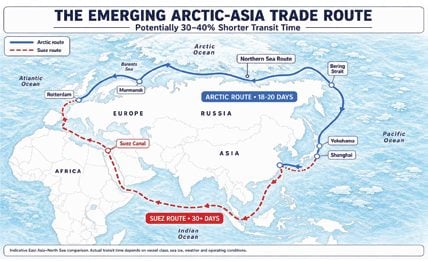
“Fear of missing out is pushing countries to be present in the Arctic and exert political influence, whether or not melting ice ultimately opens the region’ said Torbjorn Pederson, Professor in the Faculty of Social Sciences.1 The Arctic is emerging as a potential alternative to traditional maritime chokepoints such as the Strait of Hormuz and the Suez Canal. The Northern Sea Route is the primary artery of the Arctic maritime theater. The Northern Sea Route, stretching along Russia’s northern coast to the Bering Strait, could open new possibilities for Asia-Europe trade. China’s ambition to develop a Polar Silk Road connecting Asia and Europe depends on cooperation with Russia and access to the Northern Sea Route. Russia has presented the Northern Sea Route as an international commercial corridor, but it might not be the case on the ground.2 Russia treats this route as a historically developed national transport route, and maintains extensive regulatory authority over navigation along it. This raises questions about whether the NSR can truly function as an international commercial corridor.
‘ ‘
Russia wants to be a fallback partner for countries in the Indo-Pacific region in energy, logistics, and supply-chain resilience.
Melting ice has not only drawn major Asian countries like China, India, and Japan into the Arctic geopolitical arena but has also intensified regional tensions among Arctic countries such as Russia, Norway, the USA, and Denmark. Alongside the US’s ambitions to gain control of Greenland, another power drama is unfolding in Svalbard, Norway’s northernmost archipelago. This northern point has become a strategic arena of power projection because of both its geography and the 1920 Svalbard Treaty.3 Norway has absolute sovereignty over Svalbard, but citizens of the treaty’s signatory countries, including Russia and China, can work and live in Svalbard visa-free. Russia has strengthened its presence around Svalbard, causing friction with Norway. Alongside China, Japan and South Korea, another Asian country with a footprint in Svalbard is India. India established its first research station in 2008 on the island of Spitsbergen. To complement Himadri, India deployed the IndARC Observatory in July 2014.4 India’s legal right to operate in Svalbard stems directly from the 1920 Svalbard Treaty, to which British India was a signatory. Independent India actively revived this historic tie in 2007 by launching its first dedicated scientific expedition to Svalbard.5
Russia Opens the Arctic Door to India
The current blockade of maritime routes following the recent U.S. and Israeli military operations highlights the importance of reliable supply chain and logistics. The ongoing Middle East conflict has exposed how vulnerable modern warfare is to disruptions in fuel corridors and airlift capacity.6 In contemporary conflict, logistics is no longer a backstage function. It is the battlefield itself. Days before President Vladimir Putin visited India, Russia ratified the Reciprocal Exchange of Logistics Agreement (RELOS), a military pact which had been under negotiation with India for years. Though signed in Moscow on February 18, 2025, the agreement formally entered into force on January 12, 2026.7 RELOS allows India and Russia to provide reciprocal logistical support to each other’s warships and aircraft, including access to military bases, ports, repair facilities, refueling infrastructure, and maintenance services. For India, which still operates many Russian military platforms, access to maintenance facilities and spare parts is crucial. Strategically, RELOS also expands India’s reach into Russia’s Arctic and Far North, including facilities along the Northern Sea Route. Russia wants to be a fallback partner for countries in the Indo-Pacific region in energy, logistics, and supply-chain resilience. Given Russia’s strained relationship with Europe and the extensive sanctions imposed on it, Moscow is seeking greater integration with the Indo-Pacific region and greater access to naval ports around the Indian Ocean.
Asia’s Growing Stakes in the Arctic
No South Asian or East Asian countries have territory in
the Arctic. However, China, India, South Korea, Japan, and Singapore hold observer status in the Arctic Council without voting rights.8 Although they are all Asian countries, each is navigating icy waters according to its own geographical and economic interests. China has declared itself a ‘near Arctic state’ as a great power. On the other hand, Japan, South Korea and Singapore have greater commercial interest in the Arctic. South Korea, as a major shipbuilding nation, seeks to connect the Northern Sea Route shipping with the port of Busan. Among the Asian observer states, South Korea was the first to formulate an Arctic policy. Japan is geographically the closest nation to the Arctic. Japan describes its Arctic ambitions as part of its broader ocean strategy. Japan operates its research station on the island of Spitsbergen in Svalbard. Although Japan describes its Arctic policy as primarily research-based, Russia may ultimately stand in the way of Japan’s pursuit of greater economic opportunities in the Arctic.
The Arctic is no longer an isolated wasteland but is emerging as a high-speed corridor for global connectivity and digital infrastructure. Today, over 90% of data traffic between East Asia and Europe passes through vulnerable maritime chokepoints like the Red Sea and the Strait of Malacca.9 Recent cable cuts and geopolitical turmoil in the Middle East have exposed the fragility of global internet backbone infrastructure. Finnish, Japanese, and North American partners are developing Far North Fiber to connect Japan and Europe through the Northwest Passage and North America.10 Routing fiber through the ice-covered Arctic Ocean reduces latency between Tokyo, London, and the Nordics by 50 milliseconds while creating a secure alternative to traditional Southern routes.11 South Korea is expected to serve as one of ‘Polar Connect’s East Asian landing points. This project aims to establish a subsea optic network between Europe, Asia, and North America.12 It is currently in its second development phase, which runs from 2026 to 2028. It will provide data connectivity along the shortest route, while reducing dependence on vulnerable traditional corridors such as the Suez Canal, the Red Sea, and the Strait of Malacca.
Source: UK Government Office for Science, Future of the Sea: Implications from Opening Arctic Sea Routes (2017).
Balancing act with Russia
Since the very first India -Nordic Summit in 2018, relations between India and Nordic countries have become increasingly institutionalized. India and the four EFTA states signed the Trade and Economic Partnership Agreement (TEPA) in March 2024.13 Building on this broader cooperation, the official focus of his recent Gothenburg visit and the subsequent India-Nordic summit in Oslo centered on innovation, green transition, AI, and advanced manufacturing. On the surface, India-Nordic cooperation may appear to focus mainly on technological innovation and defense dialogue. But in reality, India is just broadening its network of strategic partners alongside Russia. Cooperation with the Nordic countries can be invaluable to India as these countries exercise considerable political influence in the world power game.14 One major source of tension in the India-Nordic relationship is India’s strategic alignment with Russia. The US has sanctioned several Indian companies and individuals for exporting “dual-use” goods that could be used in Russian defense manufacturing. India has been a long-standing ally of Russia and maintained close strategic and economic relations with Russia despite the war in Ukraine, while publicly advocating dialogue and diplomacy to end the conflict. India relies on Russia for crude oil imports, particularly as crude oil supplies from the Middle East have faced disruption.15 Only by carefully safeguarding the relationship with Nordic countries can India sustain its Arctic ambitions in the long term. India pursues a policy of strategic autonomy. It uses Nordic partnerships for technology, climate research, and green manufacturing, while partnering with Russia for energy security and polar maritime navigation. Russia accounts for roughly 53% of the Arctic coastline.16 Commercial use of the Northern Sea Route requires cooperation with Russia, as it runs along Russia’s Arctic coast. However, access to Arctic oil, gas, and critical minerals does not necessarily require Russian cooperation, as these resources are also found in other Arctic states.
Both South Korea and Japan recognize that growing risks in traditional chokepoints such as the Red Sea and the Suez Canal make Arctic routes strategically vital. South Korea is preparing a pilot Arctic voyage between Busan and Rotterdam in 2026 as part of its broader plan to establish a regular Korea–Europe Arctic shipping route by 2030.17 South Korea and Japan are investing heavily in next-generation icebreakers: for example, Japan’s ‘Mirai II’ research vessel and South Korea’s state-funded icebreaker initiatives.18 Both countries have deepened polar scientific, environmental, and diplomatic ties with western Arctic states such as Canada, the US (Alaska), Norway, and Denmark, focusing on green shipbuilding, autonomous navigation, and polar climate research. South Korea is also considering alternative routes to the NSR as it prepares for expanded Arctic shipping.
‘ ‘
The Arctic is no longer an isolated wasteland large-scale commercial expansion remains. The Bering Strait adds another strategic constraint because every NSR voyage must pass between Russia and Alaska. Climate change has reduced Arctic Sea ice and opened longer navigation windows, but conditions remain unpredictable. Floating ice, harsh weather, limited infrastructure, and political tensions continue to restrict year-round use. For Asian shippers, the NSR offers potential, but it is still far from becoming a reliable alternative to the Suez Canal.
Endnotes
1 Laura Paddieson, “Tensions Are Heating Up over a Remote Arctic Territory—and It’s Not Greenland,” CNN, July 10, 2026, https://edition.cnn.com/2026/07/10/climate/svalbard-greenland-geopolitics-russia-china-melting-ice.
2 Chia-Yun Po, “How China’s Arctic Ambitions Inflate Russia’s Geopolitical Leverage,” The Diplomat, April 17, 2026, https://thediplomat.com/2026/04/how-chinas-arcticambitions-inflate-russias-geopolitical-leverage/
3 Laura Paddieson, “Tensions Are Heating Up over a Remote Arctic Territory—and It’s Not Greenland,” CNN, July 10, 2026, https://edition.cnn.com/2026/07/10/climate/svalbardgreenland-geopolitics-russia-china-melting-ice.
9 Erin L. Murphy and Thomas Bryja, “The Strategic Future of 16 The Arctic Institute, “Russia,” Country Backgrounders, updated Subsea Cables: Egypt Case Study,” Center for Strategic and August 1, 2022, International Studies (CSIS), November 12, 2025, https://www.thearcticinstitute.org/country-backgrounders/ https://www.csis.org/analysis/strategic-future-subsearussia/cables-egypt-case-study 17 The Maritime Executive, “South Korea Names First Boxship for 10 Submarine Networks, “Polar Connect,” Submarine Networks, Arctic,” The Maritime Executive, 2026, accessed August 15, 2026, https://maritime-executive.com/article/south-korea-names-firsthttps://www.submarinenetworks.com/en/systems/trans- -boxship-for-arctic arctic/polar-connect.18 iMarine, “Japan Launches First Arctic Research Vessel ‘Mirai II,’” 11 Far North Fiber, “Far North Fiber,” accessed August 15, 2026, March 21, 2025, https://www.farnorthfiber.com/https://www.imarinenews.com/20819.html
12 Submarine Networks, “Polar Connect,” accessed August 15, 19 Dasha Thyssen, “Why Russia’s Northern Sea Route Is a Risk for 2026, Global Trade,” Deutsche Welle (DW), May 2, 2026, https://www.submarinenetworks.com/en/systems/transhttps://www.dw.comarctic/polar-connect 20 Mads Qvist Frederiksen and Andreas Raspotnik, “Asia Is Racing to 13 Nima Khorrami, “More Than Trade: Modi’s Visit to Sweden the Arctic, But It’s Not Easy,” The Diplomat, July 3, 2026, and Norway,” The Diplomat, May 27, 2026, https://thediplomat.com/2026/07/asia-is-racing-to-thehttps://thediplomat.com/2026/05/more-than-trade-modisarctic-but-its-not-easy/visit-to-sweden-and-norway/.
Debi Karmakar
14 Gaurav Yadav, “India-Nordic Relations – Explained Pointwise,” ForumIAS, May 20, 2026, Senior Research Associate Centre for Governance Studies and https://forumias.com/blog/india-nordic-relations- Assistant Editor, CLIPS explained-pointwise/.

Notes
- – 5 OCTOBER 2026 . DHAKA officials, business executives, technology innovators, academics, journalists, civil society representatives, and young leaders from different regions. The NAVIGATING POWER, TECHNOLOGY AND TRUST IN A WORLD REWRITTEN conference is designed as an inclusive and non-aligned forum for examining how geopolitical rivalry, technological disruption, economic realignment, climate pressures, and declining institutional trust are reshaping regional and international affairs. Its programme is organized around five strategic pillars: Power in Transition; the Technology Frontier; the New Economic Geography; Climate, Resilience and Human Security; and Trust, Democracy and the Future of Governance. These themes will be explored through plenary sessions, leadership forums, strategic dialogues, studio sessions, fireside conversations, and a Young Leaders Forum.Through dialogue across sectors and borders, the conference seeks to strengthen policy exchange, encourage informed debate, build networks for cooperation, and deepen understanding of the Bay of Bengal’s place within the Indo-Pacific and the wider international order.17 ↩
- National Centre for Polar and Ocean Research (NCPOR), “Himadri Station,” Ministry of Earth Sciences, Government of India, accessed August 15, 2026, https://ncpor.res.in/app/webroot/pages/view/340- himadri-station. ↩
- Captain Anurag Bisen, “India’s Arctic Policy, Strategy, Polar Research Vessel: Expert Explains,” The Indian Express, accessed August 13, 2026, https://indianexpress.com/article/explained/explainedglobal/india-arctic-policy-strategy-polar-research-vesselexpert-explains-10825204/ ↩
- Divya Malhotra and Anil Trigunayat, “Beyond Access: Why the India-Russia RELOS Pact Matters in a World at War,” Asia New Zealand Foundation, May 22, 2026, https://www.asianz.org.nz/beyond-access-why-the-indiarussia-relos-pact-matters-in-a-world-at-war ↩
- Times Now World, “India Joins Arctic Power Club: Putin Clears RELOS Ahead of Delhi Visit,” YouTube video, premiered December 3, 2025, https://youtu.be/catloretn1A?si=0JxLxbIPaBOpwQp4 ↩
- Calvin Heng and Eyck Freymann, “Outsiders Wanting In: Asian States and Arctic Governance,” Belfer Center for Science and International Affairs, Harvard Kennedy School, July 7, 2023, https://www.belfercenter.org/publication/outsiderswanting-asian-states-and-arctic-governance ↩
- TOI Business Desk, “India’s Russian Oil Imports Hit Record High in June amid Hormuz Disruptions,” The Times of India, June 30, 2026, https://timesofindia.indiatimes.com/business/india-business/ indias-russian-oil-imports-hit-record-high-in-june-amidhormuz-disruptions/articleshow/132091525.cms UPCOMING EVENT Bay of Bengal Conversation 2026 CONVERSATION BOOKLET The Bay of Bengal Conversation (BoBC) is an annual international strategic dialogue hosted by the Centre for Governance Studies (CGS) in Dhaka. Its fifth edition will take place from 3 to 5 October 2026 under the theme “Fragments, Frontiers & Futures: Navigating Power, Technology and Trust in a World Rewritten.” FRAGMENTS . FRONTIERS . FUTURES BoBC 2026 will bring together political leaders, policymakers, diplomats, military ↩