
Research & Publications Web edition
Red Sea Reckoning

Parvez Karim Abbasi
Weaponization of maritime choke points in the Arabian Gulf has been one of the most unsettling developments of the ongoing conflict in the Middle East between USA and Israel pitted against Iran and its regional proxies (namely, Houthis, Hezbollah, and Hamas). The closure of the Strait of Hormuz by the Iranians had wreaked havoc on the global economy in terms of disrupting maritime trade and energy supplies.1 The crisis has been further exacerbated by the comprehensive maritime blockade of Bab al-Mandeb shipping route enforced by Yemen’s Houthi rebels. This follows up on earlier threats made by senior members of the Iranian leadership in Tehran.2
Prime Real-estate Value
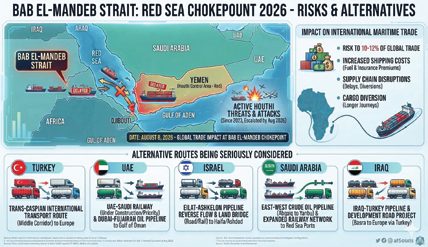
Bab el-Mandeb is a strait that connects the Red Sea to the Gulf of Aden, between Yemen and Djibouti at the southern end of the Red Sea. It is located between the southwestern tip of the Arabian Peninsula in Asia and the African continent, thus linking the Red Sea with the Gulf of Aden and the Indian Ocean. The strait is about 26-32 kilometers wide, with an average depth of 150 meters, between which some volcanic islands are scattered. At its narrowest point, of only 26 kilometers, it limits tanker traffic to two 2-mile-wide entry and exit lanes.3 The Red Sea corridor carries approximately 12 to 15 per cent of global trade volume and facilitates the transit of around 6 to 7 million barrels of oil and petroleum products per day.4 During that pre-war baseline, the strait facilitated the daily transit of roughly 12 percent of total seaborne traded oil and 8 percent of global LNG.5
Counting the Cost of Disruption
If the strait becomes impassable, ships on the Asia-Europe and Asia-North Atlantic trade lanes are forced into a massive detour around Africa’s Cape of Good Hope. These rerouting increases travel distances by 48 percent for cargo ships and 38 percent for tankers compared to pre-crisis baselines. Consequently, travel times can surge by up to 45 percent for cargo vessels.6 The increase in energy and transportation costs also disrupts global value chains and adversely affects food security, industrial production, and global trade. Countries such as Egypt that are heavily dependent on maritime traffic through the Suez Canal are also severely impacted. The ongoing impasse in the Hormuz Strait has ironically increased reliance on the Red Sea route for oil-exporting countries like Saudi Arabia’s East-West Pipeline, which connects the Abqaiq oil field in the Eastern Province to the port of Yanbu on the Red Sea.7 Thus, the Houthis have technically placed Saudi Arabia and other neighboring states in the region under a dual blockade by acting in tandem with Tehran.
Cashing in on Weaponized Interdependence
Iran’s ploy of blocking the Hormuz and Bab-el-Mandeb Straits can be analyzed and interpreted in light of the theoretical framework of “Weaponized Interdependence” advocated by Henry Farrell and Abraham Newman in 2019.8 They argue that global networks are structured around asymmetric hubs. States that control these hubs can exploit them through “panopticon effects”, enabling surveillance and information gathering, and “chokepoint effects”, allowing them to restrict or deny access to adversaries. States would engage in what can be described as a “war of connectivity”, where influence derives from control over the critical networks that sustain globalization. These include energy corridors, digital infrastructure, maritime routes, and financial systems. In such a context, interdependence itself becomes a weapon, and the power struggle unfolds through the manipulation of flows rather than the occupation of territory.
Push for Alternate Routes
The ongoing uncertainty and risks surrounding existing maritime routes in the Arabian Gulf and the wider Middle East have led to frenzied attempts at rerouting and alternate corridors in the region. Revival of interest in developing land corridors as a means of reducing risk exposure emanating from maritime corridors. One is the revival of the 1908 Hejaz Railway which would create a land corridor connecting Saudi Arabia and Turkey through Jordan and Syria. Turkey has recently signed two memorandums of understanding with Saudi Arabia covering railways and logistics. In theory, an integrated land corridor connecting Asia with Europe could come into place with a continuous rail connection stretching from Turkey through Syria and Jordan to Saudi Arabia and eventually the Gulf states.9 Israel, on the other hand, is promoting the India-Middle East-Europe Economic Corridor (IMEC) that would run through the Gulf States, Jordan, and Israel. However, there has been little or no visible progress on that front. Syria, on the other hand, is pushing the “Four Seas” project, an initiative designed to connect the Persian Gulf, Mediterranean Sea, Caspian Sea and Black Sea through an integrated transportation and energy network.10
Oil pipelines are also being considered as an alternative to maritime routes. Iraq is negotiating terms with Turkey for its existing 600-mile-long pipeline, which runs from Kirkuk to Ceyhan on the Turkish coast of the Mediterranean. The visit of Iraq’s new Prime Minister Ali al-Zaidi to the White House has also brought Iraq about $60 billion-worth of contracts with American companies in several key sectors, including energy. With Syria, Baghdad is planning to revive the defunct Kirkuk–Baniyas pipeline, and with Jordan, it has agreed to accelerate the Basra- Aqaba pipeline project.11
Regional Security Realignment
The ongoing conflict in the Middle East and the frequent missile and drone attacks launched by Iran and its regional proxies on commercial and physical infrastructure targets within Gulf nations have led to regionalization of security initiatives. US security umbrella is no longer seen as an effective or reliable guarantee by many Arab policymakers. On July 30th, Riyadh hosted the founding meeting of the fourteen-member Multinational Maritime Defense Alliance, a new group for collective defense to “protect freedom of navigation, secure international trade routes and safeguard energy supply lines across the Bab el-Mandeb Strait, the Red Sea and the Gulf of Aden.”12 On August 7, Saudi Arabia, Pakistan and Turkey signed a joint defense agreement in Mecca, dubbed the “Mecca Joint Defense Agreement”. The Agreement is intended to strengthen collective deterrence against any act of aggression and stipulates that an armed attack against any of the three would be regarded as an attack on all, they said in a joint statement.13 The fragmentation of regional security architecture and creation of competing blocs is a portent of the future.
‘
Turkey has recently signed two memorandums of understanding with Saudi Arabia covering railways and logistics. In theory, an integrated land corridor
‘
connecting Asia with Europe could come into place with a continuous rail connection stretching from Turkey through Syria and Jordan to Saudi Arabia and eventually the Gulf states.
Bangladesh’s Perspective
Bangladesh has been directly affected by the latest round of conflict between USA and Iran. Nearly 70 per cent of Bangladesh’s exports, particularly shipments to Europe and the eastern coast of the United States, pass through the Red Sea and the Suez Canal. Shipping disruptions have sharply increased logistics costs. Fuel prices, vessel charter rates and labour expenses have all risen, while war-risk insurance premiums for ships using the Red Sea have increased by around three-and-a-half times. Air freight has also become considerably more expensive, with transport costs rising from about US$0.50 per kilogram to almost US$2.50, making express cargo shipments significantly costlier. Meanwhile, vessels avoiding the Red Sea are sailing around the Cape of Good Hope, extending voyages by 10 to 15 days and adding between 3,000 and 4,000 nautical miles. Cargo that previously reached European hub ports from Chattogram in 28 to 30 days now typically requires around 45 days. The delays are particularly damaging for Bangladesh’s ready-made garment sector, where about 85 per cent of exports are tied to fast-fashion supply chains that depend on short delivery cycles. Congestion at transshipment hubs such as Singapore and Colombo has also reduced container availability, adding further costs for exporters and importers. The consequences extend beyond trade to inflation, foreign exchange reserves and energy imports. More than 40 per cent of Bangladesh’s remittances originate from the Middle East, reinforcing the country’s interest in maintaining stability along regional shipping lanes.14 Bangladesh’s participation in the Saudi-led Maritime Alliance can be viewed as a defensive maritime security measure driven by economic necessities.15 It would also allow the Bangladesh Navy to improve interoperability and operational coordination with partner countries.
Conclusion
Iran’s Weaponization of maritime chokepoints has not only disrupted freedom of navigation as well as global commerce, trade, and energy supply chains, but it is also a harbinger of long-term uncertainty regarding the prosperity and security of the Middle East. The formation of regional security blocs in West Asia indicates competing visions in the neighborhood, which offer radically different pathways for the concerned actors. This does not bode well for developing countries like Bangladesh, which are charting a tortuous course amid a global economic downturn and changing trade dynamics. The twin disruptions in the Hormuz and the Red Sea will continue to cast a long shadow on the fluid geopolitical and geoeconomic chessboard of the twenty-first century.
Endnotes
6 World Bank. (2025, February). The deepening Red Sea shipping crisis: Impacts and outlook (MENA FCV Economic Series Brief No. 2). https://documents1.worldbank.org/curated/en/099253002102539789/pdf/IDU10b8b59671dbc814cfc19c4a1299ff54854ba.pdf
7 Gornall, J. (2026, April 1). How Saudi Arabia’s East-West pipeline is easing the Hormuz chokehold on global oil markets. Arab News Japan. https://www.arabnews.jp/en/saudi-arabia/article_167192/
8 Farrell, H., & Newman, A. L. (2019). Weaponized Interdependence: How Global Economic Networks Shape State Coercion. International Security, 44(1), 42–79. https://doi.org/10.1162/isec_a_00351
9 Ben Ari, L. (2026, June 12). Turkey, Syria seek to sideline Israel in race to bypass Hormuz. Ynetnews. https://www.ynetnews.com/article/byiv00vyzfx
10 Ibrahim, A., Asthenidis, T., & Arayssi, D. (2026, June 8). The Four Seas Initiative. New Lines Institute. https://newlinesinstitute.org/middle-east-center/the-fourseas-initiative-2/
11 Sabaghi, D. (2026, July 27). The Middle East’s race to bypass the Strait of Hormuz. The New Arab. https://www.newarab.com/analysis/middle-easts-racebypass-strait-hormuz
12 Aluwaisheg, A. A. (2026, August 7). Saudi Arabia leads a new maritime alliance. Arab News. https://www.arabnews.com/node/2653778
Notes
- Ladnier, J. (2026, July). Conflict-driven chokepoint disruptions (Crisis Response Playbook No. 4). Council on Foreign Relations. https://www.cfr.org/reports/conflict-driven-chokepointdisruptions ↩
- Al Jazeera Staff. (2026, April 6). Iran threatens Bab al-Mandeb closure: How would that affect world trade? Al Jazeera. https://www.aljazeera.com/news/2026/4/6/iran-threatensbab-al-mandeb-closure-how-would-that-affect-world-trade ↩
- Qiao, J., Li, Y., & Huang, M. (2024, February 28). The geopolitical importance of Bab el-Mandeb Strait: A strategic gateway to global trade. Middle East Political and Economic Institute (MEPEI). https://mepei.com/the-geopolitical-importance-of-bab-elmandeb-strait-a-strategic-gateway-to-global-trade/ ↩
- Elmalı, B. (2026, April 8). Weaponising connectivity: The Iran war and the rise of chokepoint warfare. TRT World Research Centre. https://researchcentre.trtworld.com/publications/analysis/ weaponising-connectivity-the-iran-war-and-the-rise-ofchokepoint-warfare/ ↩
- Farahmand, A. (2026, June 4). After Hormuz: Will Bab al-Mandab be Iran’s next strategic lever? The New Arab. https://www.newarab.com/analysis/after-hormuz-will-gulfmandab-be-irans-next-strategic-lever 05 ↩
- Azhari, T., Shahid, A., & Gumrukcu, T. (2026, August 7). Saudi Arabia, Turkey, Pakistan pledge mutual defence as Middle East turmoil escalates. Reuters. https://www.reuters.com/world/asia-pacific/saudi-arabiaturkey-pakistan-sign-joint-defence-deal-amid-regionalturmoil-2026-08-07/ ↩
- Rahaman, M. M. (2026, August 1). Trade concerns behind Bangladesh’s support for Saudi-led maritime alliance: Experts. The Financial Express. https://thefinancialexpress.com.bd/trade/trade-concerns-behind-bangladeshs-support-for-saudi-led-maritime-allianceexperts ↩
- Abbasi, P. K. (2026, August 1).[title in Bangla] [Main reason for Bangladesh joining maritime defense alliance is economic]. Kaler Kantho. https://www.kalerkantho.com/print-edition/first-page/2026/ 08/01/1719176 Parvez Karim Abbasi Executive Director, CGS and Assistant Professor, Department of Economics East West University ↩