
Research & Publications Web edition
Panama Canal : How Fifty Miles of Central America Price Asian Trade
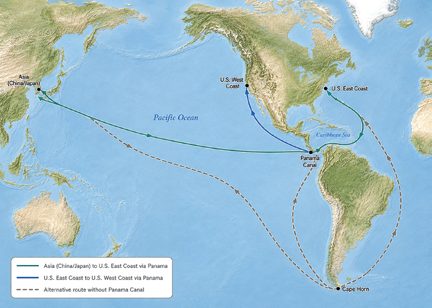

A container ship leaving Shanghai for New York has a choice most travelers never face. It can cross the Pacific, thread a channel through Central America, and reach the American Atlantic coast in a few weeks, or sail around Cape Horn,a once a journey of months. Before 1914, there was no choice at all, and rounding South America was the only option, roughly thirteen thousand nautical miles between New York and San Francisco. A fifty-mile cut through the Isthmus of Panama shortened that voyage to about five thousand two hundred miles, saving nearly eight thousand nautical miles1 on a single American route. That saving, repeated across every trade lane touching the Americas, is why a modest Central American waterway still shapes freight bills in Dhaka, energy costs in Tokyo, and diplomatic calculations in Washington and Beijing.
A Century in the Making
Interest in an interoceanic passage date to Spain’s colonial era, but the first serious attempt came only in 1881, when Ferdinand de Lesseps, fresh from building the Suez Canal,b tried a sea-level channel through Panama’s jungle. Disease and engineering company collapsed in 1889 after tens of thousands of workers, mostly felled by malaria and yellow fever, had died.2 Washington took up the project after Colombia’s Senate rejected an American treaty in 1903,c helping precipitate Panama’s separation from Colombia that same year. Within weeks, the new Panamanian governmentd signed the Hay-Bunau-Varilla Treaty,3 granting the United States rights to build and control a canal zone. American engineers, led eventually by George Goethals, finished the canal in 1914. Sovereignty passed to Panama under the Torrijos-Carter Treaties of 1977; full transfer was completed in 1999, and the Panama Canal Authority has operated the waterway since. A decade-long expansion, completed in 2016, added a third
Figure 1: Major Shipping Routes via the Panama Canal and Alternative Routes around Cape Horn.
miscalculation defeated him, and his
Source: Author’s illustration based on Panama Canal Authority trade-route information.
a Cape Horn is the rocky southern tip of South America, in Chile. Before the Panama Canal opened, ships could also round South America through the Strait of Magellan or the Beagle Channel, but many large sailing ships preferred Cape Horn’s open water to the narrower, harder-to-navigate straits.b The Suez Canal, opened in 1869, cuts through Egypt to link the Mediterranean and Red Seas, letting ships travel between Europe and Asia without sailing around Africa. Its success inspired the attempt to build a similar canal in Panama.c The treaty was the Hay-Herran Treaty, which would have given the United States rights to build a canal through Colombia’s Panama province. When Colombia’s Senate refused to ratify it, Panamanian business leaders revolted against Colombian rule weeks later, a revolt the United States quietly supported, including with naval ships that kept Colombian troops from reaching the isthmus.d This was the government of the newly declared Republic of Panama, formed only weeks after its break from Colombia. Its treaty with the United States was negotiated and signed on Panama’s behalf by Philippe Bunau-Varilla, a French engineer acting as Panama’s envoy in Washington, not a Panamanian citizen.
set of locks for larger Neopanamax vessels.e4
The canal now carries about five percent of world seaborne trade by the Authority’s own measure,5 a modest global share that understates its importance on particular routes. Roughly 40% of United States container traffic passes through it, and the United States is the origin or destination for around 70% of the canal’s cargo, with China a distant second at roughly a fifth.6 Trade between East Asia and the
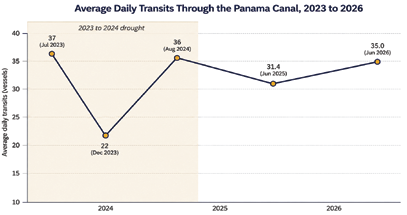
Figure 2: Average daily transits through the Panama Canal (vessels per day), selected observation dates,
American East and Gulf coasts,
July 2023 to June 2026. Sources, U.S. Energy Information Administration and Sea trade Maritime, citing Panama Canal Authority data; and the Panama Canal Authority’s fiscal year 2026 traffic report.
including containerized goods, liquefied natural gas, grain, and vehicles, depends on the canal because the alternatives, around South America or through Suez, add considerable time and cost. In fiscal year 2024, the waterway carried more than two hundred ten million long tons of cargo across roughly eleven thousand transits and generated over three billion dollars in tolls,7 with 2026 traffic running ahead of last year.8
A Question of Water
None of that moves without fresh water. Ships are lifted through the locks using water drawn from Gatun Lake, an artificial reservoir, and each transit consumes tens of millions of gallons that never return to the system. When rainfall runs short, the Authority rations water by limiting ship draft or daily transits. That happened in 2023, when an El Niño eventf left Panama with its third driest year on record, and Gatun Lake fell so far that daily transits were cut from a normal thirty-six to twenty-two by December 2023, with full capacity only returning that August.9 A scientific assessment found El Niño, not a detectable climate trend, roughly doubled the likelihood of that low rainfall, though rising water demand made it worse.10 A new El Niño developing through 2026 has prompted the Authority to cut Neopanamax draft limits in stages since July,11 though officials have so far avoided cutting daily transit numbers.
How Disruption Reaches Asia
Because so much of the canal’s business connects East Asia with the American East Coast, disruption there reaches Asian supply chains mainly through freight rates rather than any direct blockage of Asian ports. That mechanism was evident in 2023 and 2024. As Panama’s drought was cutting canal transits, a separate crisis broke out in the Red Sea,g where Houthih fighters began firing on commercial ships. Most shipping lines responded by avoiding the Red Sea altogether, sailing the long way around Africa’s Cape of Good Hopei instead.13 With two of the world’s main shortcuts constrained at the same time, container shipping rates from Shanghai to the American coasts and to Europe jumped sharply within weeks. The United Nations trade bodyj warned that if this continued, it could push consumer prices higher around the world.14 Not every Asian lane is equally exposed.
e Neopanamax refers to ships built to the maximum size the canal’s expanded locks can hold, roughly twice the cargo capacity of the older Panamax vessels the original locks were designed for.f El Nino is a recurring climate pattern in which the central Pacific Ocean warms and shifts rainfall away from parts of Central America, typically every two to seven years.g The Red Sea separates northeast Africa from the Arabian Peninsula and connects to the Mediterranean through the Suez Canal, making it one of two main shortcuts, along with Panama, between Asia and the West.h The Houthis are an armed group controlling much of Yemen. Beginning in late 2023, they started firing on commercial ships in the Red Sea, mainly in stated solidarity with Palestinians during the Israel-Hamas war. The Cape of Good Hope, at the southern tip of Africa, is the long alternate route ships take to avoid the Red Sea and Suez Canal, adding roughly
This refers to UNCTAD, the United Nations Conference on Trade and Development, which tracks global shipping and trade data.
i
one to two weeks to an Asia-Europe voyage.
j
Cargo bound for the American West Coast rarely needs Panama, while cargo destined for the American East and Gulf coasts, and American gas and farm exports to Asia, are most sensitive to a Panama slowdown.
That sensitivity has mattered again in 2026. Since this year’s Iran-United States-Israel war,15 Iran has intermittently closed the Strait of Hormuz,k through which around a fifth of the world’s oil and a substantial share of its liquefied natural gas normally passes.16 Ceasefires in April and June briefly reopened the strait before fighting resumed in July, and by August transits remained far below prewar levels while oil prices stayed elevated.17 Houthi forces resumed Red Sea attacks in solidarity with Iran, undercutting the cautious return to Suez routings carriers including Maersk had only just begun.18 There is no direct link between the Gulf and Panama. The connection is that when Hormuz, the Red Sea, and Panama’s water management are all under strain in the same year, shippers have fewer safe alternatives, and the cost pressure reaches Asian traders regardless of which chokepoint is blocked.
The Fight Over the Ports
A parallel dispute over the canal’s ports has run alongside these events. President Trump has repeatedly asserted that China effectively operates the waterway, a claim Panama has consistently rejected;19 the Panama Canal Authority has run the canal throughout. What his rhetoric actually pointed to was a Hong Kong company’s concession to run the Balboa and Cristobal port terminals.20 In January 2026 Panama’s Supreme Court voided that concession over alleged lost revenue, handing the ports on an interim basis to units of Maersk normally cross the Red Sea and Suez Canal rather than the Pacific route Panama serves.24 The exposure that matters for Dhaka runs instead through the compounding effects described above. When Hormuz and the Red Sea are disrupted while Panama manages its own water constraints, freight capacity tightens across every lane at once, and Bangladeshi exporters reported freight surcharges of several hundred dollars per container in 2026,25 alongside higher fuel costs tied to Gulf energy disruption.26 The link to Panama is indirect, but in a system where every major shortcut is under strain simultaneously, an economy as trade-dependent
‘
as Bangladesh has little insulation.
The connection is that when Hormuz, the Red Sea,
‘
and Panama’s water management are all under strain in the same year, shippers have fewer safe alternatives, and the cost pressure reaches Asian traders regardless of which chokepoint is blocked.
A canal finished in 1914 was built to shorten one nation’s coastal shipping. It has become something else, a pressure points where drought in Central America, war in the Persian Gulf, and great power rivalry in Panama City all register, almost at once, in the cost of moving a container from Asia to anywhere else. None of these pressures are likely to ease soon, and they rarely arrive one at a time. For the economies at the far end of these supply chains, from Tokyo to Dhaka, the practical lesson is not that any single chokepoint will fail, but that so many now sit exposed to the same run of bad luck at once.
Endnotes
5 Autoridad del Canal de Panama. “Connectivity.” Panama Canal Authority. https://pancanal.com/en/connectivity/
6 European Parliamentary Research Service. “The Panama Canal, Panama’s Sovereign Rights Under Threat.” Epthinktank, European Parliament, May 13, 2025. https://epthinktank.eu/2025/05/13/the-panama-canalpanamas-sovereign-rights-under-threat/
7 Panama Logistics Web Portal. “Statistics.” Georgia Tech Panama Logistics Innovation and Research Center. https://logistics.gatech.pa/en/logistics-platform/logisticsassets/panama-canal/main-features-panama-canal/ statistics/
8 Autoridad del Canal de Panama. “Panama Canal Reports Higher Transits and Tonnage While Preparing to Meet Demand Amid Expected El Nino Conditions.” Panama Canal Authority, July 22, 2026. https://pancanal.com/en/panama-canal-reports-highertransits-and-tonnage-while-preparing-to-meet-demandamid-expected-el-nino-conditions/
9 U.S. Energy Information Administration. “U.S. Energy Flows Through Panama Canal Rose Slightly in January.” EIA, February 21, 2024. https://www.eia.gov/todayinEnergy/detail.php?id=61443
10 World Weather Attribution. “Low Water Levels in Panama Canal Due to Increasing Demand Exacerbated by El Nino Event.” World Weather Attribution, May 1, 2024. https://www.worldweatherattribution.org/low-water-levelsin-panama-canal-due-to-increasing-demand-exacerbatedby-el-nino-event/16 Congressional Research Service. “The Strait of Hormuz, Security Developments and Impacts on Oil, Gas, and Other Commodities.” Library of Congress, Congress.gov. https://www.congress.gov/crs-product/R45281
17 U.S. Naval Institute News. “Strait of Hormuz Tanker Transits Up But Still Below Pre-War Levels.” USNI News, August 28, 2026. https://news.usni.org/2026/08/28/strait-of-hormuz-tankertransits-up-but-still-below-pre-war-levels
18 Al Majalla. “Traffic Slowly Returns to Egypt’s Suez Canal Despite Houthi Threat.” Al Majalla, July 14, 2026. https://en.majalla.com/node/332013/business-economy/ traffic-slowly-returns-egypt%E2%80%99s-suez-canaldespite-houthi-threat
19 Atlantic Council. “What to Know About Trump’s Day One Promise to Take Back the Panama Canal.” Atlantic Council, January 21, 2025. https://www.atlanticcouncil.org/blogs/new-atlanticist/whatto-know-about-trumps-day-one-promise-to-take-back-thepanama-canal/
20 CNBC. “Panama Cancels China-Linked Port Deal, Hands Canal Terminals to Maersk, MSC.” CNBC, February 24, 2026. https://www.cnbc.com/2026/02/24/panama-officially-voidsannuls-ck-hutchison-contracts-interim-control-maerskmsc-canal-dispute.html
21 CNBC, “Panama Cancels China-Linked Port Deal.” https://www.cnbc.com/2026/02/24/panama-officially-voidsannuls-ck-hutchison-contracts-interim-control-maerskmsc-canal-dispute.html
Notes
- HISTORY. “Panama Canal, History, Impact and Canal Zone.” A&E Television Networks, updated April 30, 2026. https://www.history.com/articles/panama-canal ↩
- HISTORY. “Why Building the Panama Canal Was So Difficult, and Deadly.” A&E Television Networks, updated January 2, 2026. https://www.history.com/articles/panama-canalconstruction-dangers ↩
- Convention for the Construction of a Ship Canal (Hay-Bunau-Varilla Treaty), November 18, 1903. Avalon Project, Yale Law School. https://avalon.law.yale.edu/20th_century/pan001.asp ↩
- Autoridad del Canal de Panama. “Discover the Expanded Canal.” Panama Canal Authority. https://pancanal.com/en/discover-the-expanded-canal/k The Strait of Hormuz is a narrow passage between Iran and Oman at the mouth of the Persian Gulf, through which tankers carrying Gulf oil and gas must pass to reach open water.12
- gCaptain. “Panama Canal to Tighten Draft Limits Again as Water Levels Continue to Fall.” gCaptain, August 2026. https://gcaptain.com/panama-canal-to-tighten-draft-limitsagain-as-water-levels-continue-to-fall/ ↩
- Notteboom, Theo, Athanasios Pallis, and Jean-Paul Rodrigue. “Main Trade Routes Using the Panama Canal, 2024.” Port Economics, Management and Policy. https://porteconomicsmanagement.org/pemp/contents/ part1/interoceanic-passages/main-trade-routes-panamacanal/
- Sheng Lu. “Red Sea Attacks and the Global Textile and Apparel Trade.” FASH455 Global Apparel and Textile Trade and Sourcing, University of Delaware, updated January 2024. https://shenglufashion.com/2024/01/09/red-sea-attacks-and-the-global-textile-and-apparel-trade-updated-january- 2024/ ↩
- United Nations Conference on Trade and Development. “Suez and Panama Canal Disruptions Threaten Global Trade and Development.” UNCTAD. https://unctad.org/news/suez-and-panama-canaldisruptions-threaten-global-trade-and-development ↩
- Council on Foreign Relations. “Conflict with Iran.” Global Conflict Tracker, Council on Foreign Relations. https://www.cfr.org/global-conflict-tracker/conflict/confrontation-between-united-states-and-iran 13 ↩
- Council on Foreign Relations. “China in Latin America, March 2026.” Council on Foreign Relations, April 30, 2026. https://www.cfr.org/articles/china-in-latin-america-march- 2026
- The Maritime Executive. “Report, MSC and BlackRock Push to Complete Hutchison Deal for Port Ops.” The Maritime Executive, March 3, 2026. https://maritime-executive.com/article/report-msc-andblackrock-push-to-complete-hutchison-deal-for-port-ops
- The Daily Star. “Red Sea Crisis, What Does It Mean for Bangladesh?” The Daily Star, January 7, 2024. https://www.thedailystar.net/business/news/what-does-itmean-bangladesh-3512726 ↩
- Daily Sun. “Iran War Fallout, Freight Surge Chokes Bangladesh Trade Routes.” Daily Sun, April 7, 2026. https://www.daily-sun.com/20/866461 ↩
- The Daily Star. “From Suez to Hormuz, A Stress Test for Bangladesh’s Export Logistics.” The Daily Star, March 11, 2026. https://www.thedailystar.net/opinion/views/news/suezhormuz-stress-test-bangladeshs-export-logistics-4120041 Roman Uddin Senior Research Associate Centre for Governance Studies (CGS) ↩