
Research & Publications Web edition
The Strait of Hormuz: When Geography Becomes Power-And a Trap

Once again into the age of protracted conflict,1 the Strait of Hormuz repeated a rule in international politics, which can be echoed this way that geography might change, but it never dies.2 Operation Epic Fury, which was initiated by the U.S. and Israel against Iran on February 28, 2026,3 woke it. Iran did back its counterattack with drones, missiles, speedy boats, and naval mines. But what was surprising is that a narrow sea became a weapon. Though Iran attained bargaining power, it did not achieve a clear strategic victory. Need to take this into consideration that Hormuz protects Iran only while the world relies on it; abuse of it will make other states possibly be forced to build routes around both the strait and Iran.
Geography, Law, and Asymmetric Power
Hormuz is about 33 kilometers wide at its narrowest side. Iran lies north and Oman south; their territorial seas cover the channel. No state owns the entire strait. When discussing international shipping, it is important to note that transit rights exist under customary law4 and the United Nations Convention on the Law of the Sea, even though neither Iran nor the United States has ratified this convention. In practice, Iran has local “denial power,”5 Oman has coastal jurisdiction, and the United States has offshore strike power.6
This particular war crisis revives the classical geopolitics into the modern drone age, citing the references of the Russia-Ukraine war.7 Here Hormuz shows the maritime version.8 Iran cannot match American one to one ship, yet mines, missiles, drones, and conducting attacks through small boats make a narrow channel much more deadly and dangerous. This deterrence9 where geography allows a weaker state to surpass a stronger one locally.10
War, Bargaining, and the Politics of Control
The crisis began when Operation Epic Fury killed Iran’s supreme leader and struck military and nuclear sites. In response, Iran retaliated against ships and Gulf targets, traffic fell about 70 percent, and the strait effectively closed.11 The June 17 memorandum12 assured toll-free passage for 60 days, sanctions relief, uranium talks, and forthcoming Iranian-Omani supervision. It collapsed on July 8 after attacks by both sides. On July 20, mediators offered a new 10-day ceasefire, but it remains a proposal, not peace.
Based on the current scenario, Hormuz is becoming Iran’s most important bargaining chip by altering Washington’s cost calculations; however, it is essential to remember that control does not equate to ownership. Iranian leaders are using speech acts14 to frame control as a security guarantee and resistance as a matter of national survival. From both sides, social media casts Iran as a gatekeeper, America as a guardian, and both as winners. These sorts of securitizations15 may help to build consent, but perpetual public support is still unproven. Iran here is a counter-norm entrepreneur;16 it tries to
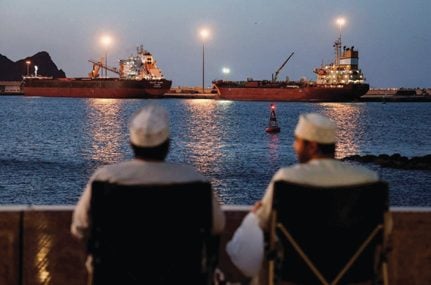
Fig. 1. The Galaxy Globe bulk carrier and the Luojiashan tanker anchored in Muscat, Oman, while shipping through the Strait of Hormuz remained severely restricted. Source: Benoit Tessier/Reuters.13
strategy is some sort of asymmetric normalize selective passage and fees against free transit.
Global Economic and Human Costs
The conflict has clearly led to increased oil prices, which has caused additional suffering, as the Strait of Hormuz transports approximately 20 million barrels of oil daily, accounting for about one-fifth of global petroleum consumption and one-fifth of traded liquefied natural gas.17 But apart from that, the human cost surpasses petrol prices. Hormuz also carries fertilizer, food, medicine, and aid. If the conflict persists, WFP projects up to 45 million additional acutely hungry people, including 9.1 million in ten Asian states.18 Again, it is also predicted that there is possible famine in Sudan, South Sudan, or Somalia. The IMO reports around 20,000 seafarers and workers affected; its evacuation plan covered over 11,000 sailors.19 Naval coercion punishes people who never chose war.
Asia having the greatest external risk, 84 percent of crude and 83 percent of LNG crossing Hormuz went there in 2024.20 China cannot simply celebrate the Iranian influence. Iran, China, and Russia oppose the Western-led order, but again, the coordination that took place among these three is a transactional alignment,21 not a reliable authoritarian alliance. China wants secure energy; neither partner conclusively rescued Tehran. Dependence on Chinese yuan, markets, or technology would replace Western pressure with another dependency.
‘
Gulf states require shared pipelines and electricity links as well as a non-aggression pact. Iran should
‘
accept nuclear verification and stop attacking the neighbors since it led to distrust; on the other side, Gulf states should behave by considering the cost-benefit analysis.
De-escalation and the Strategic Trap of Hormuz
attacks on Gulf states and shipping; enforcement should combine monitoring, defensive escort, investigation, and targeted penalties, not collective punishment.23
A settlement should establish a joint Iranian-Omani Centre, re-establish the 1968 IMO traffic scheme, divide ships into northern and southern lanes and set up a military hotline.24 International law would be challenged by tolls just for passing through. If service fees are inevitable, they should be uniform, transparent, subject to IMO audit, exempt from sanctions, deposited in dollar or multi-currency escrow25 and used for safety, mine clearance, compensation and reconstruction, not controlled by the IRGC.
On the other side, Washington should avoid practicing coercive diplomacy26 for regional stability. A permanent blockade or regime change would not bring any solution and, of course, not stability. Gulf states require shared pipelines and electricity links as well as a non-aggression pact. Iran should accept nuclear verification and stop attacking the neighbors since it led to distrust; on the other side, Gulf states should behave by considering the cost-benefit analysis. America also needs to accept that domination does not equal to stability. Peace must be designed, not merely declared.
No one won the race pragmatically. Iran attained tactical victory by denying the passage and forcing talks but also suffered in other ways. Over 90 percent of its maritime trade also uses Hormuz.27 The idea is simple, whoever closes a gate may lock himself inside. America damaged Iran but failed to reopen the strait or achieve maximal aims. In the future, the Gulf will be more militarized, diversified, and, to some extent, Asian-focused. Perpetual peace is possible if interdependence becomes a rule, not a hostage. Hormuz is Iran’s strongest weapon, only once. Repeated use makes it a weakness, teaches markets to escape, and turns geographical privilege into isolation.
Endnotes
importance may evolve, but geography remains a lasting influence on states and international relations.
3 Davit Khachatryan, “Operation Epic Fury, Regime Change, and the Collapse of Legal Constraint,” CIP, March 4, 2026, https://internationalpolicy.org/publications/epic-fury-international-law/.
4 International rules developed through the consistent practices of states that are accepted as legally binding
5 The ability to prevent another state from using a territory or route, even without fully occupying or controlling it.
6 Here, “offshore strike power” refers to the United States’ capacity to conduct attacks from sea-based platforms, including carrier-based aircraft and cruise-missile-equipped surface ships and submarines.
7 Imran Hosen, “Rise of Smart Warfare in the Modern World” (The Financial Express, June 27, 2026), https://thefinancialexpress.com.bd/views/rise-of-smartwarfare-in-the-modern-world.
8 Here, the “maritime version” refers to asymmetric warfare at sea, in which a weaker state uses geography, drones, missiles, naval mines, and small boats to challenge a conventionally stronger naval power.17 U.S. Energy Information Administration (EIA), “Amid Regional Conflict, the Strait of Hormuz Remains Critical Oil Chokepoint -” (U.S. Energy Information Administration (EIA), June 16, 2025), https://www.eia.gov/todayinenergy/detail.php?id=65504.
18 WFP, “WFP Projects Food Insecurity Could Reach Record Levels as a Result of Middle East Escalation” (World Food Programme, March 17, 2026), https://www.wfp.org/news/wfp-projects-food-insecuritycould-reach-record-levels-result-middle-east-escalation.
19 IMO, “Middle East – Information Related to Shipping and Seafarers – Strait of Hormuz and the Middle East” (International Maritime Organization, July 19, 2026), https://www.imo.org/en/mediacentre/hottopics/pages/middle-east-strait-of-hormuz.aspx.
20 U.S. Energy Information Administration (EIA), “Amid Regional Conflict, the Strait of Hormuz Remains Critical Oil Chokepoint -.”
21 Cooperation based mainly on immediate practical interests rather than permanent friendship, shared ideology, or a formal alliance.
22 Josh Waldman, “What Will Happen to Iran’s Sea Mines?,” Foreign Policy, July 21, 2026, https://foreignpolicy.com/2026/07/08/iran-hormuz-straitmines-trade-economy-china-us/.
Notes
- A protracted conflict is one that continues for an extended period without a decisive settlement and is often marked by recurring violence, failed ceasefires, and prolonged negotiations. For an application of this concept, see I. A. Jasmin and I. Hosen, “One Man’s Vision, One Protracted War: Vladimir Putin and the Russia–Ukraine Conflict,” BIISS Journal, vol. 47, no. 1, pp. 119–142, 2026, doi: 10.56888/biiss-journal.v47i1.a965. ↩
- This means that geographical conditions and their 45/1 New Eskaton (2nd Floor), Dhaka 1000, Bangladesh, Tel +880 2 58310217, +880 2 222223109, Website: www.cgs-bd.com ↩
- A strategy in which a weaker actor uses cheaper or unconventional weapons to make an attack too costly or dangerous for a stronger opponent. ↩
- Keith Johnson, “Iran Is Putting a ‘Toll Booth’ in the Strait of Hormuz,” Foreign Policy, July 21, 2026, https://foreignpolicy.com/2026/03/26/iran-strait-hormuz-war-tolls-shipping/. ↩
- Mariel Ferragamo, “The Strait of Hormuz: A U.S.-Iran Maritime Flash Point | Council on Foreign Relations” (Council on Foreign Relations, July 15, 2026), https://www.cfr.org/articles/strait-hormuz-us-iranmaritime-flash-point. ↩
- The June 17 Memorandum was a Pakistan-mediated U.S.–Iran agreement establishing a 60-day framework for toll-free passage through Hormuz and negotiations on sanctions and nuclear issues. ↩
- Ferragamo, “The Strait of Hormuz.” ↩
- A statement that does more than describe a situation; it attempts to create a political effect, shape public opinion, or justify action. ↩
- The process of presenting an issue as an urgent or existential security threat to justify extraordinary measures. ↩
- An actor that attempts to establish a new rule or practice that challenges an existing international norm. ↩
- UN, “Security Council Adopts Resolution 2817 (2026) Condemning Iran’s ‘Egregious Attacks’ against Neighbours as Middle East Violence Rapidly Escalates | UN Meetings Coverage and Press Releases” (United Nations Security Council, March 11, 2026), https://press.un.org/en/2026/sc16315.doc.htm. ↩
- Ellie Geranmayeh, “How the United States and Iran Can Solve Hormuz,” Foreign Policy, July 21, 2026, https://foreignpolicy.com/2026/07/15/hormuz-iran-united-states-trump-war-israel-shipping/. ↩
- An account in which money is held by a trusted third party and released only when previously agreed conditions are fulfilled. ↩
- The use of threats, sanctions, or limited military pressure to change another state’s behaviour without beginning a full-scale war. ↩
- Miad Maleki, “For Iran, Hormuz Is More a Weakness Than a Weapon,” Foreign Affairs, April 15, 2026, https://www.foreignaffairs.com/iran/iran-hormuz-moreweakness-weapon.Imran Hosen Research Intern, Centre for Genocide Studies Department of International Relations University of Dhaka ↩