
Research & Publications Web edition
The Malacca Strait Dilemma and the Kra Isthmus Bypass
Strategic Vulnerability and the Limits of an Overland Escape

When Iran’s naval command declared the Strait of Hormuz closed in early March 2026, the collapse that followed-a reported 95 percent fall in crude tanker traffic within weeks-did more than spike oil prices.1 It exposed, in real time, just how much of Asia’s trade still rests on a small number of narrow passages. The Strait of Malacca is the starkest case in point-more than 102,500 vessels transited it in 2025, up from roughly 94,300 the year before, according to Malaysia’s Marine Department figures reported by Reuters-a corridor carrying the bulk of the energy imports and container flows moving between the Indian Ocean and East Asia.2 Estimates place the total annual cargo value transiting the strait at roughly US$ 3.4-3.5 trillion, including about two-thirds of China’s seaborne trade.3 For China, this is not an abstract worry but a long-running strategic preoccupation. The majority of its imported crude still crosses waters it does not control, which Hu Jintao termed the “Malacca Dilemma”, noting it as a vulnerability in 2003. The Hormuz crisis has revived that preoccupation and the discussion on an old fix – a corridor across Thailand’s Kra Isthmus designed to let cargo skip the strait entirely. Thailand’s land bridge will not, on its own, resolve China’s dependence, nor anyone else’s; what it does is sharpen a broader question for the region-how far Asia’s trade geography can realistically be diversified away from a single chokepoint, and at what cost.
A Chokepoint by Design
Malacca’s vulnerability is structural, not incidental. The strait narrows from roughly 370 kilometres at its northwestern mouth to under three kilometres at the Phillips Channel near Singapore, forcing over 100,000 vessel transits a year through a corridor.4 In principle, a determined actor may obstruct the sea lanes of communication in the strait. In practice, outright closure is unlikely: Indonesia, Malaysia, and Singapore all depend on unimpeded transit and cooperate closely on its policing through frameworks such as the Malacca Strait Patrol. But unlikely is not impossible, and softer disruptions are already visible. Piracy and armed robbery in the Malacca-Singapore straits hit a nineteen-year high in 2025-108 incidents, a 74 percent jump from 2024-even if most were low-severity opportunistic theft rather than organized threats to shipping.5 For Beijing, the deeper worry has always been coercive interdiction rather than criminality: some 75 to 80 percent of China’s crude imports transit the strait.6
The concern has a military logic that outlasts any single crisis. The strait sits within reach of naval assets operating out of Singapore, and any future Taiwan or South China Sea contingency would put China-bound shipping squarely within an adversary’s interdiction range, a scenario Chinese strategists have discussed openly since Hu Jintao’s original warning.7 Washington’s deepening defence ties with Indonesia, formalized in a new bilateral partnership in April 2026, reinforce Beijing’s sense that the strait’s governance ultimately answers to interests it does not control, even as littoral states themselves insist on their own neutrality and management of the waterway.8 Geography tempers the starker readings of this exposure; however, unlike Hormuz, which has no practical detour, vessels can divert through Indonesia’s Sunda and Lombok straits-slower and costlier, but not easily sealed, which is why analysts
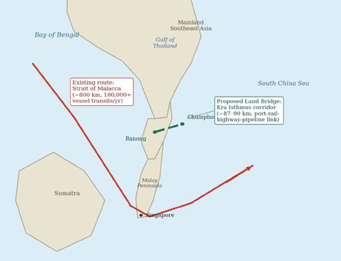
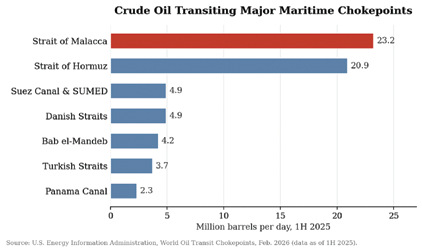
increasingly treat Malacca as more resilient than Hormuz even as concern about it grows.9
The Limits of China’s Existing Workarounds
China has spent two decades building redundancy. The Kyaukphyu pipelines carry Middle Eastern and African crude and gas from Myanmar’s Rakhine coast directly into Yunnan, but their roughly 440,000-barrel-per-day capacity is a small fraction of China’s eleven-millionbarrel daily import bill.10 That hedge is also increasingly fragile. The Kyaukphyu terminal has been delayed for over a decade, and Rakhine State is now a conflict zone where the Arakan Army controls most surrounding townships and has encircled the port-one reason Beijing likely treats any Thai corridor as a secondary hedge, not a primary route.11 The US$ 10 billion Pinglu Canal, due to open by the end of 2026, will give landlocked southwestern provinces a direct waterway to the sea, but it opens onto the Gulf of Tonkin, serving ASEAN-facing trade rather than bypassing Malacca for cargo arriving from the west.12 A narrower hedge runs through Pakistan’s China-Pakistan Economic Corridor and its Gwadar terminus, though chronic insecurity in Balochistan limits how much Beijing is prepared to depend on it.13 Analysts broadly agree that no existing combination of pipelines, ports, and rail can replace Malacca’s throughput.14 It is against this backdrop of unsatisfying alternatives that the Kra Isthmus keeps resurfacing in Thai, Chinese, and wider regional planning circles alike.
The Kra Isthmus, Again
The idea is old! French engineers surveyed the isthmus for King Narai in 1677, and Siam bound itself by an 1897 treaty not to grant a canal concession without British consent-a restriction aimed at protecting Singapore, only revoked in 1954.15 Thai governments have revived and shelved the project roughly once a decade since, pivoting most recently from a canal to an overland Land Bridge concept under Prayut Chan-o-cha in 2020.16 The current version, championed by Prime Minister Anutin Charnvirakul, would link a new deep-sea port at Ranong on the Andaman Sea to one at Chumphon on the Gulf of Thailand via an 87–90 pipeline-not a sea-level canal but a trans-shipment bridge. The headline price is roughly 997 billion baht, about US$31 billion, financed through a 50-year public-private concession, with government projections of a 1.5 percent GDP boost and 280,000 jobs.17 On 28 April 2026, Anutin’s cabinet ordered a fresh ninety-day review of the corridor, with a formal proposal expected by end-2026 and construction targeted for 2030.18
‘
China has spent two decades building redundancy. The Kyaukphyu pipelines carry Middle Eastern and African crude and gas from
‘
Myanmar’s Rakhine coast directly into Yunnan, but their roughly 440,000-barrel-per-day capacity is a small fraction of China’s eleven-million- barrel daily import bill.
Why the Bypass Struggles to Convince
The Land Bridge’s central weakness is one a canal would not share-cargo must be unloaded at one port, trucked or railed across the peninsula, and reloaded at the other-eroding much of the time saved by skipping Malacca.19 A former Bangkok deputy governor put the underlying problem bluntly, arguing that once real shipping economics are applied, “the numbers simply don’t add up.”20 Moreover, the feasibility studies were divided; a parliamentary committee endorsed the project in early 2024 on official transport-ministry figures, while a later joint study by Thailand’s National Economic and Social Development Council and Chulalongkorn University reached the opposite conclusion, finding that time lost to double-handling cargo at two ports largely
Figure 2. Malacca carries more daily oil volume than any other maritime chokepoint, including
kilometre corridor of highway, rail, and
Hormuz — underscoring why no single bypass can substitute for it.
cancels out any time saved at sea.21
Environmental assessments project roughly one billion baht a year in lost fisheries income and disruption near six UNESCO World Heritage sites, while security planners worry about further separating Thailand’s restive south from the rest of the country.22 Environmental groups further warn that the corridor would fragment the ecologically distinctive “Kra Ecotone,” where the biogeography of mainland Southeast Asia meets that of the Malay-Indonesian archipelago, and academic and opposition voices in Thailand have questioned both the project’s finances and the credibility of its impact assessments.23
As of mid-2026, no international investor has made a binding financial commitment, and Malaysia’s cheaper East Coast Rail Link-linking Kelantan to Port Klangoffers a more modest but more credible competitor for some of the same cargo.24 Internal Thai cost comparisons reportedly still price a full sea-level canal at roughly double the Land Bridge’s cost, an option officials describe as a “last resort” rather than an abandoned
‘
one.25
The real limitation is the volume of trade. the project becomes more financeable, and diplomatically safer for Bangkok, the more it is framed as a neutral, multi-stakeholder ASEAN and BIMSTEC asset rather than a China-only artery.28 The real limitation is the volume of trade. The Kra corridor has not yet become a true alternative to Malacca’s capacity. In reality, a land bypass may not completely solve the Malacca Dilemma. Even so, it could provide a small buffer that eases the issue slightly, but the strait and the ASEAN-based security system led by Indonesia, Malaysia, and Singapore will likely remain the main route for Indo-Pacific trade for the foreseeable future. For policymakers, the more important question may not be whether the Kra corridor will ever be built, but rather how both regional and external countries will continue to support the diplomatic and naval systems that ensure Malacca remains open.
Endnotes
1 House of Commons Library, “Israel/US-Iran Conflict 2026: Reopening the Strait of Hormuz,” UK Parliament, July 2026, https://researchbriefings.files.parliament.uk/documents/ CBP-10636/CBP-10636.pdf.
https://www.recaap.org/resources/ck/files/reports/annual/ ReCAAP%20ISC%20Annual%20Report%202025.pdf;
“80 Piracy and Robbery Cases Reported in Straits of Malacca and Singapore in First Half of 2025,” The Online Citizen, July 11, 2025, https://www.theonlinecitizen.com/2025/07/11/80-piracy-and-robbery-cases-reported-in-straits-of-malacca-and-singa pore-in-first-half-of-2025.
6 Gokcay Balci and Ebru Surucu-Balci, “Strait of Malacca Could Be Next Hormuz-like Flashpoint,” Asia Times, April 29, 2026, https://asiatimes.com/2026/04/strait-of-malacca-couldbe-next-hormuz-like-flashpoint/.
7 Balci and Surucu-Balci, “Strait of Malacca Could Be Next Hormuz-like Flashpoint” (see note 6).
8 Balci and Surucu-Balci, “Strait of Malacca Could Be Next Hormuz-like Flashpoint” (see note 6).
9 “Thailand’s Land Bridge and the Moving Map It Must Account For”, Maverick Consulting Group, June 2, 2026, https://www.mcg-asia.com/featured-insights/thailandland-bridge-chokepoints-geopolitics.
10 Balci and Surucu-Balci, “Strait of Malacca Could Be Next Hormuz-like Flashpoint” (see note 6).18 “Thailand to Accelerate Planning on ‘Land Bridge’ Project, Minister Says” (see note 17).
19 “Thailand to Accelerate Planning on ‘Land Bridge’ Project, Minister Says” (see note 17).
20 “Thailand to Accelerate Planning on ‘Land Bridge’ Project, Minister Says” (see note 17).
21 “Thailand’s Land Bridge: The Trillion-Baht Question Returns,” Maverick Consulting Group, May 7, 2026, https://www.mcg-asia.com/featured-insights/thailandland-bridge-trillion-baht-question.
22 “Thailand to Accelerate Planning on ‘Land Bridge’ Project, Minister Says” (see note 17).
23 “Thailand’s Kra Isthmus Land Bridge Megaproject Will Harm Nature,” Thailand Construction and Engineering News, December 31, 2025, https://thailand-construction.com/thailands-kra-isthmusland-bridge-megaproject-will-harm-nature/.
24 “Thailand Land Bridge: The $31 Billion Bet,” Strait of Malacca, May 2, 2026, https://straitmalacca.com/thailand-land-bridge/;
Murray Hunter, “Big Opportunity for ECRL Land-Bridge to Be a Competitive Transport Route,” Murray Hunter’s Substack, accessed July 22, 2026,
Notes
- Reuters, “Explainer: Hormuz Crisis Throws Spotlight on World’s Largest ‘Chokepoint’ — the Malacca Strait,” April 23, 2026, republished by U.S. News & World Report, https://www.usnews.com/news/world/articles/2026-04-23/explainer-hormuz-crisis-throws-spotlight-on-worlds-large st-chokepoint-the-malacca-strait; U.S. Energy Information Administration, “World Oil Transit Chokepoints,” March 3, 2026, https://www.eia.gov/international/content/analysis/special_topics/World_Oil_Transit_Chokepoints. ↩
- “The Strait of Malacca’s Global Supply Chain Implications,” Institute for Supply Management, Inside Supply Management, November 2023, https://www.ismworld.org/supply-management-news-andreports/news-publications/inside-supply-managementmagazine/blog/2023/2023-11/the-strait-of-malaccas-global -supply-chain-implications. ↩
- A. F. Mohamad Ayob, “The Malacca Strait Bottleneck: Vessel Traffic Density and Transit Patterns in the World’s Busiest Shipping Lane,” Internet Ship Database, March 10, 2026, https://shiptracker.seatospace.com/articles/malaccastrait-vessel-traffic-density-transit-patterns.html; “Malacca Strait Vessel Traffic at Record Levels in 2025,” Seatrade Maritime, April 20, 2026, https://www.seatrade-maritime.com/tankers/malacca-strait-vessel-traffic-at-record-levels-in-2025. ↩
- ReCAAP Information Sharing Centre, Annual Report: Piracy and Armed Robbery against Ships in Asia, 2025 (Singapore: ReCAAP ISC, 2026), ↩
- “Thailand’s Land Bridge and the Moving Map It Must Account For” (see note 9). ↩
- “Thailand’s Land Bridge and the Moving Map It Must Account For” (see note 9). ↩
- “How China is Attempting to Overcome Its Malacca Dilemma,” Utblick, May 17, 2026, https://www.utblick.org/2026/05/17/how-china-isattempting-to-overcome-its-malacca-dilemma/. ↩
- Center for Strategic and International Studies, “Kyaukpyu: Connecting China to the Indian Ocean,” accessed July 22, 2026, https://www.csis.org/analysis/kyaukpyu-connecting-chinaindian-ocean. ↩
- “Thailand’s Land Bridge: The Trillion-Baht Question Returns,” Maverick Consulting Group, May 7, 2026, https://www.mcg-asia.com/featured-insights/thailandland-bridge-trillion-baht-question. ↩
- “Thailand’s Land Bridge: The Trillion-Baht Question Returns” (see note 15). ↩
- “Thailand to Accelerate Planning on ‘Land Bridge’ Project, Minister Says,” The Diplomat, April 21, 2026, https://thediplomat.com/2026/04/thailand-to-accelerateplanning-on-land-bridge-project-minister-says/; “My Say: Thailand’s Kra Land Bridge a Reckoning for Malaysia,” The Edge Malaysia, September 22, 2025, https://theedgemalaysia.com/node/771005. 09 https://murrayhunter.substack.com/p/big-opportunity-forecrl-land-bridge. ↩
- “Thailand’s Land Bridge: The Trillion-Baht Question Returns” (see note 15). ↩
- Sohini Bose, “Operationalising the East: India’s Naval Engagement with Myanmar,” Observer Research Foundation, May 20, 2026, https://www.orfonline.org/expert-speak/operationalisingthe-east-india-s-naval-engagement-with-myanmar; “Ports and Geopolitics: The Case of Sino-Indian Rivalry in the Bay of Bengal,” Observer Research Foundation, event note, November 28, 2025, https://www.orfonline.org/research/ports-and-geopoliticsthe-case-of-sino-indian-rivalry-in-the-bay-of-bengal.
- Abhishek Kumar, “Why the Kra Isthmus Land Bridge Is Getting Strategic Attention Across Asia,” The Eastern Strategist, May 8, 2026, https://theeasternstrategist.com/kra-isthmus-land-bridgemalacca-strait/.
- “Thailand’s Land Bridge and the Moving Map It Must Account For” (see note 9).Niloy Ranjan Biswas, Ph.D.Professor, Department of International Relations University of Dhaka ↩