
Same Virus, Different Fates: What Uganda Got Right That DR Congo Could Not
Nuzhat Tabassum | 30 July 2026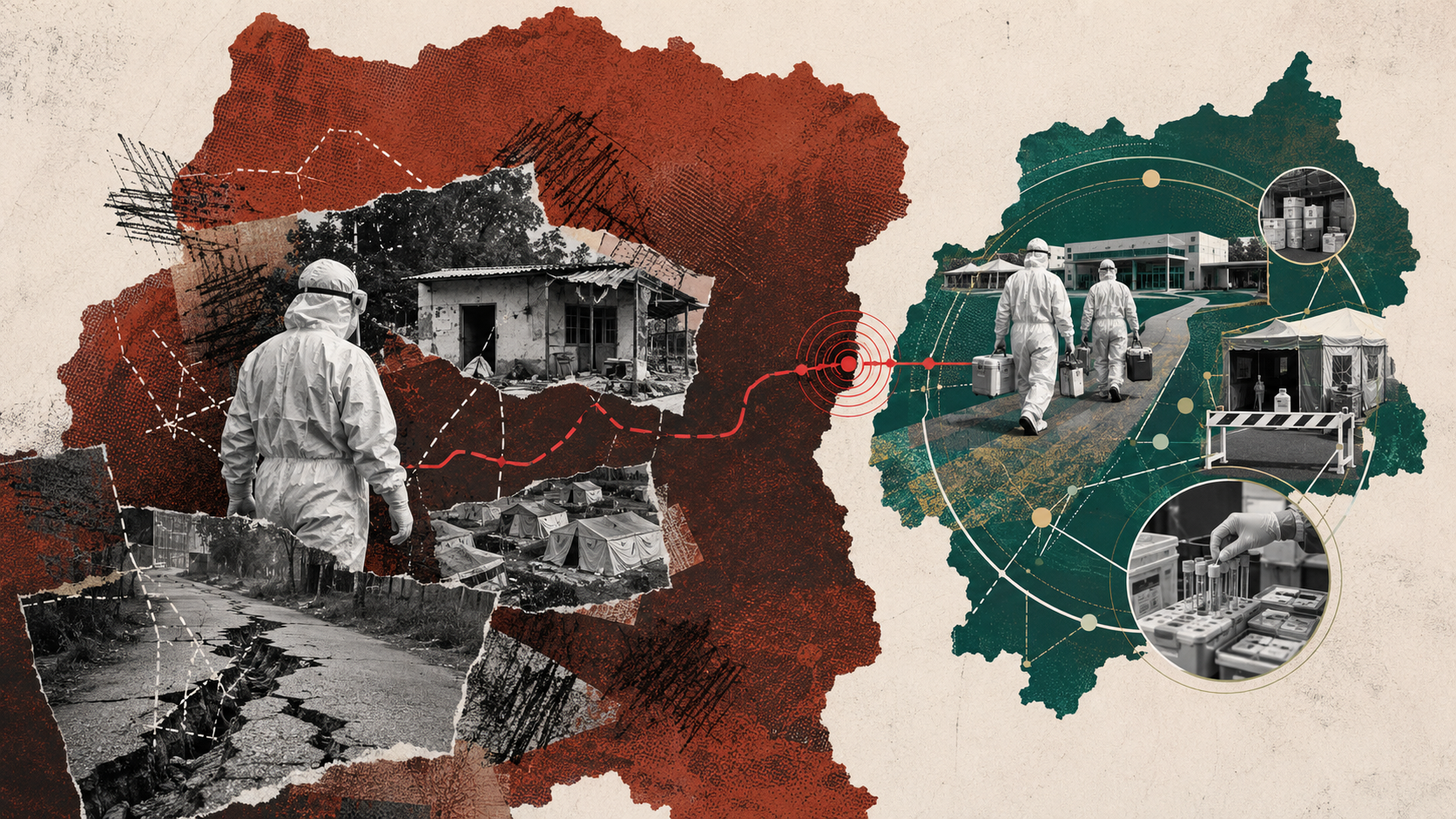
Just three months after the declaration of Ebola virus again in the Democratic Republic of Congo for the 17th time, more than 4,900 people have been affected and 2,300 people died, breaking their previous record of 2018 - 2020 outbreak. This year’s crisis has been the deadliest for the country[1]. With the conflict inside the country and spillover to other countries due to travel, Ebola is spreading fast. But what should concern the whole world is how a conflict has made tackling the outbreak much harder than it was supposed to be.
This year’s outbreak is caused by Bundibugyo virus, a very different type of Ebola virus than the previous one’s. So far, no vaccine has been established, the only solution is to take precaution and contain its spreading, including early detection, supportive care, and community engagement[2].
This new variant was first identified in Ituri province’s Mongbwalu health zone and traced back to transmission that was already under way before its official declaration on May 15. That delay allowed chains of infections to grow before response teams could deploy. But due to poor planning, logistical constraints, geographical problems, and local problems[3]. The virus is moving faster than any response could arrive. The conflict, on the other hand, is playing the part of an accelerant. In Ituri and neighboring North Kivu and South Kivu has been in conflict for years from multiple armed groups like the Allied Democratic Forces, CODECO militias, and the Rwanda-backed M23. Conflict disrupts the process of outbreak control such as passable roads, functioning hospitals, community trust, water and sanitation, and reliable communication[4].
Due to the prolonged conflict many people have been displaced, took shelter in refugee camps or migrated to neighboring countries. This has made disease control harder for the health workers. The refugee camps are overcrowded, lack hygienic environment or sanitation, and lack proper nutrients. As the area is already conflict ridden, it becomes harder for the healthcare team to reach the affected person or for the people that need treatment to come to the medical team[5]. Also, the conflict has made it difficult for the healthcare providers to do contact tracing as many people are hiding, migrating or fleeing the place. The affected people may at first think that it is a common flu or fever, but by the time they are identified it is already too late. A person exposed in one area may fall ill somewhere else entirely, breaking the chain investigators rely on to follow the virus[6].
For healthcare providers to do their task properly, the problem does not only end there but the bigger problem is to tackle the mistrust of the people. Community mistrust during DRC’s outbreaks is tied to years of conflict, political instability, and chronically under-resourced healthcare. People often doubt the healthcare workers mainly due to mistrust on safe burial practices as they consider it a sacred ritual. Communities often ask why aid money arrives when there is a disease and not when they are suffering. This has created anger and frustration among many people. There are several cases where people have attacked healthcare facilities and workers which has forced the aid workers to suspend their treatment in the area.
As recently, the United States president Donald Trump, has suspended USAID, there has been a shortage of funds. Aid in DRC has dropped sharply in 2025, just when the country needs funding to combat a deadly disease. It has been reported that health workers at one Ituri treatment center went unpaid for three months and went on strike, temporarily shutting it down[7]. Reduced aid support has put strain on clean water access, food and health care. Aid cuts have put a barrier to fighting Ebola.
On the contrary, Uganda, a neighboring country of DRC, has also become affected with the same variant of Ebola virus. But it has recorded only 20 cases and two deaths and declared itself Ebola-free after its last patient was released from hospital[8]. Even though they have declared Ebola in the same time period as DRC. Officials their credit preparedness built from experience with nine prior outbreaks since 2000: rapid isolation of suspected cases, active use of personal protective equipment, and swift activation of a specialist treatment center in Kampala that still held supplies from a previous outbreak[9]. Immediate action taken by the government has prevented spreading. They swiftly quarantined more than 6,000 contacts for the full 21-day incubation period[10]. Uganda invested in preparedness, which the DRC has failed to do. While it is DRC’s 17th Ebola outbreak, on the contrary, it’s the outbreak, citing lessons learned from previous outbreak to stop the disease from spreading. When a 12-year-old girl showed suspicious symptoms in 2011, health workers isolated her, used protective equipment, and safely handled her body after she died steps that stopped that outbreak from spreading further. That kind of institutional memory shaped the response this time too.
Once cases were confirmed, Uganda didn't have to build a response from scratch. A specialist Ebola treatment center at Mulago Hospital in Kampala, left over from a previous outbreak, was stocked with supplies and had an emergency medical team on standby. Getting it fully operational was easier for them. Also, early patients came directly to treatment units rather than passing through general hospitals first, which limited opportunities for the virus to spread through casual contact with other patients and staff before diagnosis. Uganda did not just stop their authorities closed the DRC border despite the economic cost to cross-border traders, cutting off one of the main routes the virus could have used to keep re-entering the country[11].
DRC is far behind Uganda, even though they are neighboring countries. One country successfully won; another failing miserably. But the point is, the conflict did not create Ebola; rather it is hampering the process to contain it. The way Uganda was able to prepare themselves, the DRC could not. The conflict stripped away passable roads, functioning clinics, trusted authorities, stable communities, the very things that disease control depends on[12]. Uganda's experience just across the border shows what becomes possible when preparedness, trust, and rapid isolation are in place; DRC's experience shows what happens when a virus arrives in a landscape already broken by war, displacement, and years of neglect[13]. Until the underlying conditions of conflict, displacement, and mistrust are addressed, eastern DRC will remain vulnerable not only to this outbreak, but to the next one.
Stopping this outbreak will take more than vaccines, treatment centers, and contact-tracing teams, though all of those remain urgently needed. It will require protecting humanitarian access, funding local health systems consistently rather than only in moments of crisis and treating affected communities as partners rather than obstacles. Until the underlying conditions of conflict, displacement, and mistrust are addressed, eastern DRC will remain vulnerable not only to this outbreak, but to the next one. As responders on the ground have made clear, in Ituri prevention cannot be separated from protection the two must move together, or neither will succeed.
Nuzhat Tabassumis a Program Assistantat Centre for Governance Studies (CGS)
References
[1] Ngorora, P. H. (2026, August 19). How Ebola became the deadliest outbreak in DR Congo’s history. Al Jazeera. https://www.aljazeera.com/news/2026/8/19/how-ebola-became-the-deadliest-outbreak-in-dr-congos-history
[2] Ngorora, P. H. (2026, August 19). How Ebola became the deadliest outbreak in DR Congo’s history. Al Jazeera. https://www.aljazeera.com/news/2026/8/19/how-ebola-became-the-deadliest-outbreak-in-dr-congos-history
[3] Soy, A., & Chibelushi, W. (2026, August 2). Why Uganda seems to be winning the battle against Ebola as virus spreads in DR Congo. BBC News. https://www.bbc.com/news/articles/clyemjn44qqo
[4] United Nations. (2026, May 27). Ebola outbreak in DR Congo collides with conflict and hunger, WHO warns. UN News. https://news.un.org/en/story/2026/05/1167592
[5] London School of Hygiene & Tropical Medicine. (2026, May 27). How conflict shapes Ebola outbreaks in eastern DRC. https://www.lshtm.ac.uk/newsevents/news/2026/how-conflict-shapes-ebola-outbreaks-eastern-drc
[6] London School of Hygiene & Tropical Medicine. (2026, May 27). How conflict shapes Ebola outbreaks in eastern DRC. https://www.lshtm.ac.uk/newsevents/news/2026/how-conflict-shapes-ebola-outbreaks-eastern-drc
[7] Campbell, D., & Savage, R. (2026, August 17). What is Ebola and why is the outbreak in DRC causing so much concern? The Guardian. https://www.theguardian.com/world/2026/aug/17/what-is-ebola-why-who-says-drc-uganda-outbreak-global-health-emergency
[8] Soy, A., & Chibelushi, W. (2026, August 2). Why Uganda seems to be winning the battle against Ebola as virus spreads in DR Congo. BBC News. https://www.bbc.com/news/articles/clyemjn44qqo
[9] Soy, A., & Chibelushi, W. (2026, August 2). Why Uganda seems to be winning the battle against Ebola as virus spreads in DR Congo. BBC News. https://www.bbc.com/news/articles/clyemjn44qqo
[10] Soy, A., & Chibelushi, W. (2026, August 2). Why Uganda seems to be winning the battle against Ebola as virus spreads in DR Congo. BBC News. https://www.bbc.com/news/articles/clyemjn44qqo
[11] Soy, A., & Chibelushi, W. (2026, August 2). Why Uganda seems to be winning the battle against Ebola as virus spreads in DR Congo. BBC News. https://www.bbc.com/news/articles/clyemjn44qqo
[12] London School of Hygiene & Tropical Medicine. (2026, May 27). How conflict shapes Ebola outbreaks in eastern DRC. https://www.lshtm.ac.uk/newsevents/news/2026/how-conflict-shapes-ebola-outbreaks-eastern-drc
[13] Soy, A., & Chibelushi, W. (2026, August 2). Why Uganda seems to be winning the battle against Ebola as virus spreads in DR Congo. BBC News. https://www.bbc.com/news/articles/clyemjn44qqo