
Houthi Escalation in Yemen: The Growing Threat to Shipping Through Bab el-Mandeb
Tohfatur Rabbi Piyal | 31 August 2026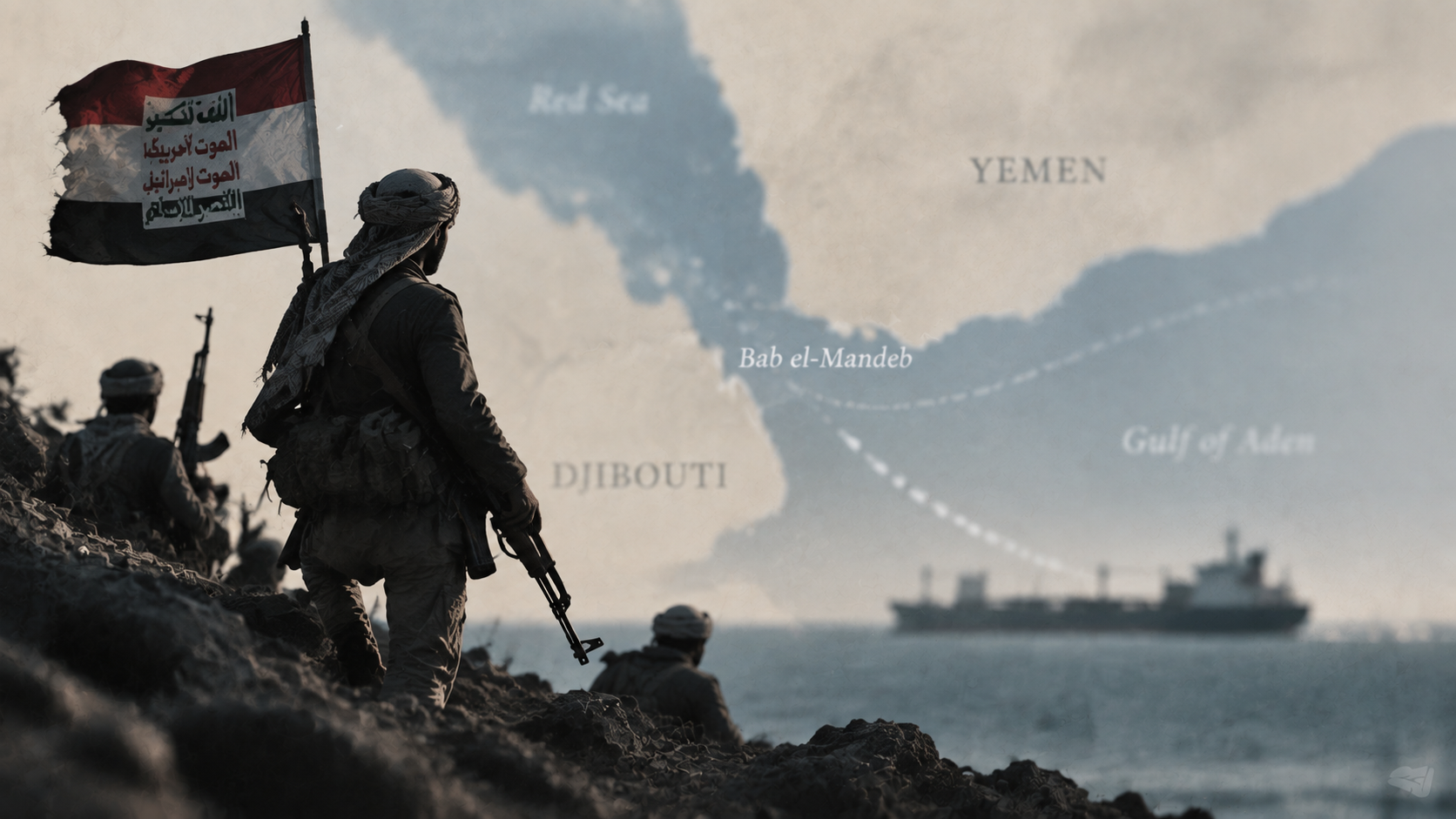
The world had already witnessed the Houthi forces demonstrating their ability to threaten international shipping after the Gaza catastrophe began in October 2023. Their series of attacks on commercial vessels in the Red Sea forced major shipping companies to divert vessels around the Cape of Good Hope, while the United States and the United Kingdom launched military strikes against Houthi positions within an “international maritime security operation”. Although Houthi maritime activity was seen as relatively limited earlier in 2026, the threat still remains visible. The situation transformed sharply in July, when the Houthis announced a maritime embargo against Saudi-linked shipping on July 20.Then claimed attacks on Saudi oil tankers two days later and subsequently expanded their threats to other Saudi-associated vessels. More significantly, Reuters reported on July 29 that the group was considering imposing fees on commercial vessels passing through the southern Red Sea. This suggests a shift from selective attacks towards an attempt to exercise coercive control over maritime traffic. Additionally, the reported involvement of Iran further connects the maritime crisis with the wider Iran–US confrontation.[1]
The latest escalation is particularly intimidating because both the objectives and the geographical landscapes of the threat have been broadened substantially. Earlier attacks were largely highlighted as responses to the Gaza destructionand directed at Israeli-linked vessels. In July 2026, however, Saudi-associated and energy-related shipping also came under threat, directly implicating the southern Red Sea and Bab el-Mandeb region.[2]While the consequences are already visible: shipping companies are redirecting vessels, and war-risk insurance costs have remarkably been risen. On August 12, an Egyptian-owned cargo vessel Tihamah was attacked near Bab el-Mandeb, killing four crew members and two rescuers and injuring ten others. Subsequently, traffic through the Bab el-Mandeb and Red Sea had already fallen by more than 50 percent from earlier levels and declined further after the July blockade. Where it’s firmly observed that A chokepoint does not have to be physically closed to become strategically dysfunctional. The perception of insecurity alone can push commercial operators to avoid the route, disrupting a huge chunk of global commerce.[3]
Bab el-Mandeb is a narrow maritime passage between Yemen and the Horn of Africa, connecting the Red Sea with the Gulf of Aden and the Arabian Sea/Indian Ocean. At its northern end, the Red Sea joins the Suez Canal, creating a continuous maritime corridor linking the Indian Ocean with the Mediterranean and Europe. This makes Bab el-Mandeb a classic maritime chokepoint: a relatively narrow passage through which substantial international shipping must pass, where insecurity can have consequences far beyond its immediate geography. Its importance is particularly visible in the flow of energy. According to the U.S. Energy Information Administration, 8.1 million barrels per day of crude oil and petroleum liquids passed through Bab el-Mandeb in the second quarter of 2026, compared with 4.1 million barrels per day in 2024. The crisis has therefore emphasized not the disappearance of its strategic importance, but how quickly vital flows can be displaced when the route becomes risky.[4]
Whereas the issue is that avoiding Bab el-Mandeb does not provide an equivalent alternative. Although ships can avail the scope to bypass Africa through the Cape of Good Hope, longer voyages will encounter higher fuel consumption, increased crew and operational costs, greater insurance expenses, and potentially higher freight rates. Moreover, Bab el-Mandeb and the Suez Canal form parts of the same maritime system,where insecurity at the southern entrance can undermine the expediency of the entire Red Sea and Suez route even if the canal itself remains operational. This threat is furthermore considered to be multidimensional. U.S. maritime authorities identify risks ranging from UAVs, unmanned surface andunderwater vehicles, andballistic and cruise missiles to small-arms fire, explosive boats, and illegal boardings or seizures. Thus, the challenge doesn’t turn out to be simply physical closure; it is the consequence of sustained insecurity that makes a strategically important commercial passage increasingly difficult and costly to navigate.[5]
The first economic consequence of this maritime insecurity is the route diversion of ships. When ships even avoid Bab el-Mandeb and the Red Sea channel, they have the option to sail around the Cape of Good Hope, but this alternative is considerably longer and more expensive. During the previous Red Sea crisis, a tanker voyage from the Persian Gulf to the Amsterdam-Rotterdam-Antwerp hub took about 19 days through Suez, compared with nearly 35 days via the Cape. Longer voyages increase fuel consumption, crew and operating costsalongside insurance expenses and delivery times, whichsubstantially reduces the vessel utilisation. The 2026 experience already demonstrates how rapidly commercial behaviour changes: after the Houthis’ July maritime blockade against Saudi Arabia, Bab el-Mandeb traffic dropped by around 24%, while mainstream tanker traffic particularly declined with far-reachingeffects. By mid-August, overall traffic remained around 15% below the pre-blockade average, with tanker traffic approximately 38–40% lower. The market accordingly does not wait for a complete blockade,where it is widelyperceived that this range of risks alone can alter regular shipping patterns.[6]
These consequences spread beyond shipping into energy security and consumer prices. Bab el-Mandeb is considered to be a keycorridor for crude oil, petroleum products, and LNG. Record shows, in the second quarter of 2026, around 8.1 million barrels per day of crude oil and petroleum liquids passed through the strait, partly because Saudi Arabia rerouted more oil towards its Red Sea port of Yanbu during disruption elsewhere.[7] This creates a strategic paradox: the more precarious the Strait of Hormuz becomes, the more important Bab el-Mandeb turns out to be as an alternative. Redirection cannot entirely replace these corridors because alternatives are longer, costlier along with having the capacity-constraints. Higher maritime risk can therefore translate into higher amounts of losses, insurance, and import costs, eventually affecting businesses and consumers. As a result, Import-dependent developing economies are particularly vulnerable because they have fewer substitutes to absorb such shocks.[8]
Bab el-Mandeb has evolved from a maritime security concern into an instrument of regional power politics. Although the Houthis are well-aligned with Iran, they hold their own political and military objectives in Yemen. Their maritime campaign therefore has both a local dimension involving Yemen and Saudi Arabia and a wider strategic aspect engaging Iran, the United States and Israel. The July 2026 blockade of Saudi-linked shipping made this especiallyclear, as the Houthis exercised their position near the Red Sea to apply pressure while the United States and Iran were already in proxy confrontation.[9] While Iran does not directly control Bab el-Mandeb, its relationship with the Houthis provides Tehran a form of indirect strategic leverage over this significant maritime corridor. The likelihood of simultaneous disturbance at Bab el-Mandeb and the Strait of Hormuz makes the threat even more severe, potentially transforming a regional conflict into a global strategic challenge.[10] At its fundamental point, this also raises a question of freedom of navigation: whether a non-state armed group can really determine which ships, companies, or national affiliations will safely be able to use an important international waterway.[11]
Protecting navigation hence requires something more than military retaliation. Multinational maritime surveillance, intelligence-sharing, early warning, naval coordination and appropriate protection for commercial vessels can reinforce existing security efforts. But military deterrence alone can produce a cycle of attack, retaliation and further escalation. A strong response must also address the political incentives behind the crisis through a broader regional framework involving Yemen, Saudi Arabia, Iran, Egypt and other Red Sea states. The central principle should be clear: commercial shipping should not become a bargaining chip or objective of warfare in any regional conflicts.
Tohfatur Rabbi Piyal is a research assistant at CGS
Views in this article are author’s own and do not necessarily reflect CGS policy.
Endnote:
[1]Ghobari, M., Saul, J., & Abdallah, N. (2026, August 11). Three killed in attacks on ships in Red Sea, Gulf, sources say. https://www.reuters.com/world/china/three-killed-attacks-ships-red-sea-gulf-sources-say-2026-08-11/
[2]Ghobari, M., Saul, J., & Abdallah, N. (2026, August 11). Three killed in attacks on ships in Red Sea, Gulf, sources say.https://www.reuters.com/world/china/three-killed-attacks-ships-red-sea-gulf-sources-say-2026-08-11/
[3]U.S. Energy Information Administration. (2024, February 1). Red Sea attacks increase shipping times and freight rates. U.S. Department of Energy.https://www.eia.gov/todayinenergy/detail.php?id=61363
[4]Security Council Report. (2026, July 1). The Red Sea: July 2026 monthly forecast. Security Council Report. https://www.securitycouncilreport.org/monthly-forecast/2026-07/the-red-sea.php
[5]U.S. Maritime Administration. (2026, March 26). 2026-006-Red Sea, Bab el-Mandeb Strait, Gulf of Aden, Arabian Sea, and Somali Basin: Houthi attacks on commercial vessels. U.S. Department of Transportation. https://www.maritime.dot.gov/msci/2026-006-red-sea-bab-el-mandeb-strait-gulf-aden-arabian-sea-and-somali-basin-houthi-attacks
[6]Tan, F. (2026, July 27). Red Sea shipping slows after Houthi attack on Saudi Arabia, data shows. Reuters. https://www.reuters.com/world/middle-east/red-sea-shipping-slow-after-houthi-attack-saudi-arabia-data-shows-2026-07-27/
[7]Saul, J. (2026, July 22). More ships change course in Red Sea after Houthi threats, shipping data shows. Reuters. https://www.reuters.com/world/middle-east/more-ships-change-course-red-sea-after-houthi-threats-shipping-data-shows-2026-07-22/
[8]U.S. Energy Information Administration. (2024, February 1). Red Sea attacks increase shipping times and freight rates. U.S. Department of Energy. https://www.eia.gov/todayinenergy/detail.php?id=61363
[9]Council on Foreign Relations. (2026, July). Another Hormuz? What to know about the Houthi threat to the Red Sea. Council on Foreign Relations. https://www.cfr.org/articles/another-hormuz-the-red-seas-threat-to-the-global-economy
[10]Sarı, İ. (2024, January 18). Iran’s strategy in the Bab el-Mandeb Strait and Houthi attacks. ORSAM. https://orsam.org.tr/en/yayinlar/irans-strategy-in-the-bab-el-mandeb-strait-and-houthi-attacks/
[11]U.S. Maritime Administration. (2026, March 26). 2026-006-Red Sea, Bab el-Mandeb Strait, Gulf of Aden, Arabian Sea, and Somali Basin: Houthi attacks on commercial vessels. U.S. Department of Transportation. https://www.maritime.dot.gov/msci/2026-006-red-sea-bab-el-mandeb-strait-gulf-aden-arabian-sea-and-somali-basin-houthi-attacks