
The United States at 250: Between Founding Ideals and Global Power
Fawzia Afrin | 30 July 2026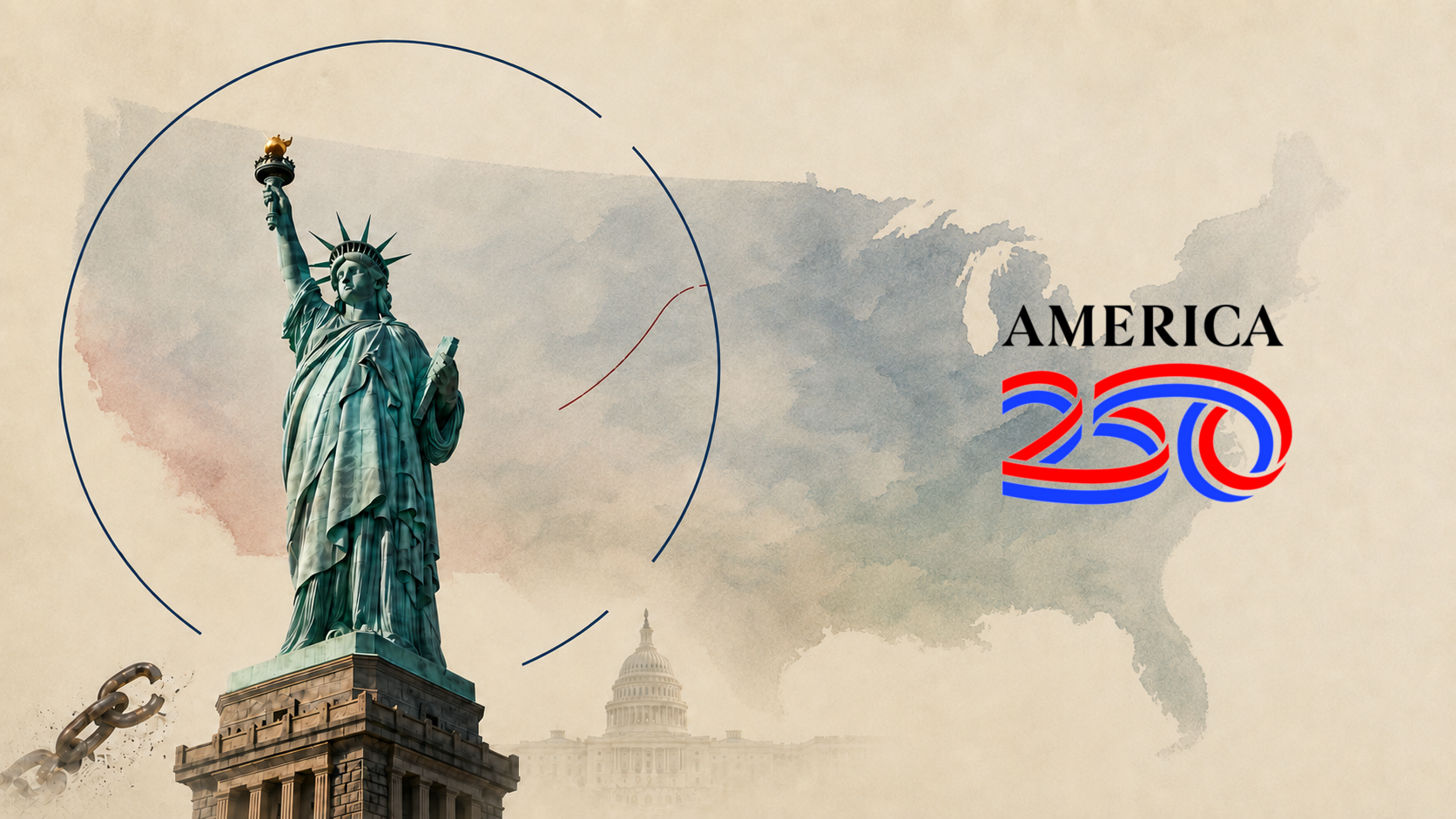
This year, the United States marked 250 years since the Continental Congress adopted the Declaration of Independence. The Semiquincentennial has been commemorated through the congressionally established U.S. Semiquincentennial Commission and its supporting America250 organization, alongside the Trump administration's Freedom 250 initiative.[1]Yet America's 250th birthday invites more than celebration. It raises a difficult question: How closely has the United States lived by the principles it announced in 1776?
The Declaration’s revolutionary significance rested not only on separation from Britain but also on its claims about political legitimacy. It asserted that “all men are created equal,” that human beings possess rights including life, liberty, and the pursuit of happiness, and that governments derive their legitimate authority from the “consent of the governed.” [2]Those principles gave the new country a powerful vocabulary of liberty and self-government.
But there was a profound contradiction at the country’s birth. The same generation that declared all men created equal built an economy substantially dependent on slavery.[3] It took a civil war, a constitutional amendment, and another century of struggle before Black Americans could claim even formal citizenship rights. NativeAmericans were also excluded from the expanding political community. The Indian Removal Act of 1830 facilitated the forced relocation of Indigenous nations from ancestral lands. [4]
These were not footnotes to America's history. They demonstrate why 1776 should be understood not as the completion of American liberty, but as the beginning of a continuing argument over who was entitled to it.
By the 19th century, the republic was already asserting itself beyond its borders. The abolition of slavery, constitutional amendments after the Civil War, women's suffrage and the civil-rights movement progressively broadened political and legal rights. The Monroe Doctrine of 1823 declared the Western Hemisphere off-limits to further European colonization, an early statement of the idea that American security required influence beyond American soil.
Over the following century, wars, economic expansion, and the Cold War transformed the United States from a fragile former colony into a global superpower. CFR describes the recurring dilemma of American foreign policy as how to balance national interests, professed values, and the responsibilities created by growing power.[5]
Donald Trump’s second administration has sought to redefine American power through an explicit “America First” framework. On his first day back in office, Trump ordered U.S. foreign policy to put American interests first and issued an America First Trade Policy directing a broad review of trade deficits, economic security, and foreign trade practices. Trade quickly became one of the most visible elements of the strategy. On February 1, 2025, the administration announced additional tariffs of 25 percent on most imports from Canada and Mexico and 10 percent on imports from China, linking the action to border security, illegal migration, and fentanyl trafficking. Supporters argue that tariffs can protect strategic industries, encourage domestic manufacturing, reduce dependence on competitors, and strengthen Washington's negotiating leverage. Critics contend that tariffs can raise costs, disrupt supply chains, and strain relationships with allies. CFR says Trump's second term has produced a fundamental shift toward an America First approach across trade, security, and immigration.
That strategy also encountered institutional limits. On February 20, 2026, the Supreme Court struck down Trump's sweeping emergency-power tariffs. Trump nevertheless pledged to pursue tariffs through other statutes, meaning protectionism remained an important feature of his economic agenda.[6]
Immigration presents an equally sharp debate over sovereignty. Trump's second administration intensified immigration enforcement and removals. Supporters view stricter enforcement as necessary to restore border control and uphold immigration law. Critics point to humanitarian, due-process, and economic consequences. Brookings estimates that sharply reduced migration in 2025 and 2026 is dampening labor-force growth, consumer spending, and GDP growth. [7]
The broader question is therefore not whether Trump seeks to reduce American power abroad, but how he wants that power used: more transactionally, with greater reliance on economic leverage, and with greater emphasis on sovereignty and direct national advantage.
The anniversary celebrations have themselves reflected competing interpretations of American identity. America 250 began the Semiquincentennial year with a special Times Square ceremony after midnight on January 1, featuring an America250-themed ball, red-white-and-blue illumination, and 2,000 pounds of matching confetti. [8]
The White House's Freedom 250 program began on Memorial Day 2025 and is scheduled to continue through the end of 2026. It has included the Great American State Fair, July 4 celebrations on the National Mall, and events at historic locations nationwide. But Americans enter the next quarter-century with considerable uncertainty. A Pew Research Center survey conducted in April 2026 found that 66 percent expect the country to become more politically divided by 2050, 58 percent expect the United States to become less important internationally, and 51 percent described themselves as pessimistic about the country's future. Yet 48 percent were optimistic. [9]
Perhaps that mixture of pride and unease is appropriate for America's 250th anniversary.The United States has expanded democracy and individual rights while also bearing the legacies of slavery, Indigenous displacement, exclusion, and controversial uses of international power. Its founding ideals have repeatedly been violated but they have also supplied the language through which generations demanded reform.
Fawzia Afrin is a Research Intern at Centre for Governance Studies (CGS)
References
[1] The White House. (n.d.). Freedom 250. https://www.whitehouse.gov/freedom250/ (The White House)
[2] National Archives. (n.d.). Declaration of Independence: A transcription. https://www.archives.gov/founding-docs/declaration-transcript (National Archives)
[3] Smithsonian National Museum of American History. (n.d.). Slavery at Jefferson’s Monticello: Paradox of liberty. https://americanhistory.si.edu/explore/exhibitions/slavery-at-monticello
[4] Library of Congress. (n.d.). Indian Removal Act: Primary documents in American history. https://guides.loc.gov/indian-removal-act
[5] Council on Foreign Relations. (2026, March 9). 250 years of American foreign policy. https://www.cfr.org/articles/history-us-foreign-policy (Council on Foreign Relations
[6] Fong, C., & Venkat, S. (2026, February 23). Trump’s 2026 State of the Union: Foreign policy issue guide. Council on Foreign Relations. https://www.cfr.org/articles/trumps-2026-state-of-the-union-foreign-policy-issue-guide (Council on Foreign Relations)
[7]Edelberg, W., Veuger, S., & Watson, T. (2026, January 13). Macroeconomic implications of immigration flows in 2025 and 2026: January 2026 update. Brookings Institution. https://www.brookings.edu/articles/macroeconomic-implications-of-immigration-flows-in-2025-and-2026-january-2026-update/ (Brookings)
[8] America250. (n.d.). America250. https://america250.org/
[9] The White House. (2026, July 3). 250th anniversary of the adoption of the Declaration of Independence: A proclamation. https://www.whitehouse.gov/presidential-actions/2026/07/250th-anniversary-of-the-adoption-of-the-declaration-of-independence/ (The White House)