
The Makkah Pact: A New Strategic Triangle in the Middle East
Roman Uddin | 31 August 2026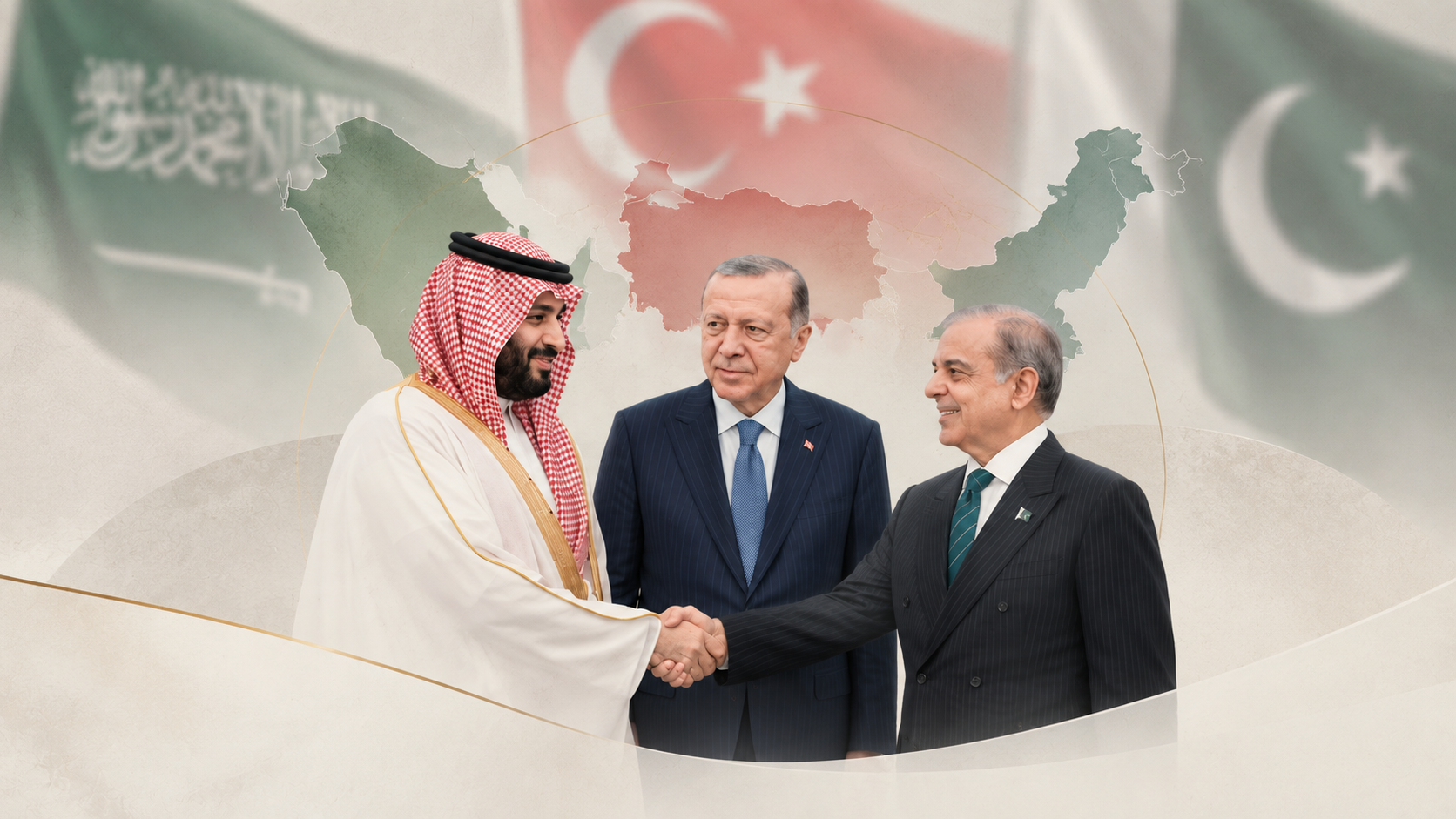
On 7 August 2026, at Al-Safa Palace in Mecca, Saudi Crown Prince and Prime Minister Mohammed bin Salman, Turkish President Recep Tayyip Erdogan and Pakistani Prime Minister Shehbaz Sharif signed the Makkah Joint Defense Agreement.[1] The joint statement issued that day committed the three states to collective deterrence and declared that any armed attack against one of them shall be regarded as an attack against them all.[2] The declaration is consequential, yet its weight rests less on the language agreed in Mecca than on institutions and procedures that remain largely unbuilt.
The agreement was concluded at the Makkah Al-Mukarramah Summit for Joint Defense, and on 31 August Turkish Foreign Minister HakanFidan announced that the grouping would be known as the Makkah Defense Alliance.[3] The treaty text has not been released, leaving duration, ratification, withdrawal, geographic scope and accession procedures outside public knowledge.[4] Descriptions such as “Islamic NATO” are journalistic shorthand rather than official terminology. Fidan has called the clause technically equivalent to NATO’s Article 5 while noting that the degree, form and format of any response would be settled through consultation.[5] Saudi Deputy Minister for Public Diplomacy Rayed Krimly has said the pact establishes neither a military axis nor a sectarian bloc.[6]
The agreement emerged from several overlapping pressures rather than one single event. Since 2023, wars in Gaza and Lebanon, Israeli operations in Syria and Iran, Iranian attacks on Gulf states and disruption to energy routes have sharpened fears of escalation, while the conflict that began on 28 February 2026 raised serious questions about the dependability of the United States security umbrella.[7] Riyadh has consequently sought broader strategic options without abandoning Washington. Turkey has expanded its regional military role and defense industry, while Pakistan has decades of training and security ties with Saudi Arabia and close defense cooperation with Ankara.[8] The pact also builds on the Saudi-Pakistani Strategic Mutual Defense Agreement of September 2025, which declared aggression against either country to be aggression against both.[9]
The members bring complementary assets. Together they field roughly 1.4 million active personnel, 3,400 aircraft, 6,000 tanks and more than 340 naval assets, according to the 2026 Global Firepower Index.[10] Saudi Arabia contributes financial capacity, diplomatic influence, a central Gulf and Red Sea position, and substantial defense resources. Turkey contributes large conventional forces, NATO experience, an expanding defense industry, drones and naval capability. Pakistan adds a large professional military, long-standing Gulf defense relationships, strategic access between South Asia and the Middle East, and nuclear-weapon status.[11] That capability should not be treated as a nuclear guarantee to the other members. Krimly has said the pact is not linked to nuclear ambitions or an arms race,[12] and specialists note that Pakistani doctrine remains oriented toward India rather than extended to allies.[13]
Operationally, the August statement was broad. It established collective deterrence and defense but did not publicly specify activation thresholds, force commitments, command authority or rules for intervention.[14] Institutionalization has nevertheless moved quickly. On 31 August, foreign and defense ministers and military chiefs met in Istanbul through a new Strategic Political and Defense Committee, agreeing to establish a secretariat in Saudi Arabia, led initially for three years by a Pakistani secretary-general, and to deepen defense-industry cooperation, joint technology development and production.[15] Pakistan’s Foreign Office acknowledged that the alliance remains in its formative stage, with considerable work still required to finalize its structure and procedures.[16] Intelligence sharing, missile defense and combined commands may follow, but none is confirmed in public documents.
Existing arrangements show both the pact’s importance and its limits. The 2025 Saudi-Pakistani agreement was bilateral, whereas the Makkah framework adds Turkey and creates a wider strategic triangle. The Gulf Cooperation Council also has an attack-on-one principle, supported by a Peninsula Shield Force, a Unified Military Command and joint planning, yet these have not displaced reliance on outside guarantors.[17] NATO offers only a limited analogy, since Article 5 leaves each ally to take the action it deems necessary while resting on mature political and military institutions.[18] The Makkah pact shares that declaratory logic but has far less developed machinery.
It is also fundamentally different from the Organization of Islamic Cooperation (OIC), a 57-member body with a broad diplomatic, political, economic, humanitarian and cultural agenda whose charter emphasizes sovereignty, peaceful settlement and cooperation rather than an automatic military guarantee among all members.[19] The Makkah pact, by contrast, is a three-state defense arrangement with an explicit mutual-defense clause. It could complement OIC diplomacy as a narrower mechanism among willing states, but it is neither institutionally nor politically a replacement for it.
Geopolitically, the pact is best understood as strategic hedging and regional security autonomy rather than a break with the United States. Saudi Arabia retains its defense relationship with Washington, Turkey remains in NATO, and Pakistan continues its security dialogue with the United States.[20] All three gain options when American priorities appear uncertain, which may increase bargaining leverage and shift responsibility toward regional powers. President Donald Trump publicly welcomed the agreement on 16 August, suggesting that regional autonomy and partnership with Washington can coexist.[21]
The agreement should not automatically be read as directed against Iran or Israel. Members describe it as defensive, and Tehran has so far responded without alarm.[22] Israel’s formal position remains unclear, since the prime minister’s office declined to comment.[23] Israeli planners may view closer coordination among three significant states with concern, yet the members differ in their relations with Iran, Israel, Syria and the Gulf, which constrains assumptions of a unified front.
Collective defense can raise the cost of aggression, but it also carries escalation and entrapment risks while activation rules remain ambiguous. Recently, after Houthi attacks injured more than seventy people in southern Saudi Arabia, Defense Minister Khawaja Asif said aggression against one member was aggression against all, and that the agreement would become operational if the Yemen conflict spilled over.[24] Two days later, Pakistan’s Foreign Office described the pact as defensive and said no military response was under discussion.[25] The distance between the two suggests consultation and political judgement may weigh as much as treaty language.
Expansion presents a similar trade-off. Additional Muslim-majority members could add capability and legitimacy, but also divergent threat perceptions and rivalries. Islamic solidarity, military alliance, collective security and defense cooperation are not interchangeable, and the Muslim-majority world is not a single strategic bloc. Islamabad has said expansion is not currently under discussion and that the three states must first consolidate.[26]
While the Makkah Joint Defense Agreement may be important, it is not yet a fully developed regional alliance. Its mutual-defense clause, political and defense committee and planned secretariat give it institutional substance. Credibility will depend on defining armed attack, allocating responsibilities, planning operations and managing disagreements. Its lasting significance will rest less on the symbolism of Mecca than on whether the three states convert a shared promise into interoperable capabilities and predictable decision-making without turning deterrence into escalation.
Roman Uddin is a Senior Research Associate and Youth Outreach Program Coordinator
Views in this article are author’s own and do not necessarily reflect CGS policy.
Endnote:
[1]Saudi Press Agency. (2026, August 7). Saudi Arabia, Türkiye, and Pakistan issue joint statement of the Makkah Al-Mukarramah Summit for Joint Defence. https://spa.gov.sa/en/w2649227
[2]Ministry of Foreign Affairs of Pakistan. (2026, August 7). Makkah Al-Mukarramah Summit for Joint Defence [Press release]. Government of Pakistan. https://mofa.gov.pk/press-releases/makkah-al-mukarramah-summit-for-joint-defence
[3]Dawn. (2026, August 31). Makkah Defence Alliance to be institutionalised, Pakistan to head secretariat for 3 years: FO. https://www.dawn.com/news/2026391
[4]Middle East Council on Global Affairs. (2026, September 2). The Mecca Joint Defense Agreement: The makings of a new security architecture [Situation assessment]. https://mecouncil.org/publication/the-mecca-joint-defense-agreement-the-makings-of-a-new-security-architecture/
[5]Reuters. (2026, August 8). Turkey, Pakistan, Saudi Arabia defence pact technically same as NATO's Article 5, Turkish minister says. https://www.reuters.com/world/asia-pacific/turkey-pakistan-saudi-arabia-defence-pact-technically-same-natos-article-5-2026-08-08/
[6]Saudi Gazette. (2026, August 7). Makkah Joint Defense Agreement not a military axis or sectarian bloc, Saudi official says. https://saudigazette.com.sa/article/663557/saudi-arabia/makkah-defense-pact-not-a-military-axis-or-sectarian-bloc-saudi-official-says
[7]Stepansky, J. (2026, August 8). Will Pakistan-Saudi-Turkiye defence pact change US strategy? Al Jazeera. https://www.aljazeera.com/news/2026/8/8/will-pakistan-saudi-turkiye-defence-pact-change-us-strategy
[8]Shankar, P. (2026, August 7). Turkiye, Saudi Arabia, Pakistan sign joint defence agreement: What's in it? Al Jazeera. https://www.aljazeera.com/news/2026/8/7/turkiye-saudi-arabi-pakistan-sign-joint-defence-agreement-whats-in-it
[9]Akhtar, R. (2025, September 18). Beyond the hype: Pakistan-Saudi defense pact is not a Saudi nuclear umbrella. Belfer Center for Science and International Affairs, Harvard Kennedy School. https://www.belfercenter.org/research-analysis/beyond-hype-pakistan-saudi-defense-pact-not-saudi-nuclear-umbrella-0
[10]Al Jazeera. (2026, August 11). What are Saudi Arabia, Turkiye and Pakistan's joint military capabilities? https://www.aljazeera.com/news/2026/8/11/what-are-saudi-arabia-turkiye-and-pakistans-joint-military-capabilities
[11]Al Jazeera. (2026, August 11). What are Saudi Arabia, Turkiye and Pakistan's joint military capabilities? https://www.aljazeera.com/news/2026/8/11/what-are-saudi-arabia-turkiye-and-pakistans-joint-military-capabilities
[12]Saudi Gazette. (2026, August 7). Makkah Joint Defense Agreement not a military axis or sectarian bloc, Saudi official says. https://saudigazette.com.sa/article/663557/saudi-arabia/makkah-defense-pact-not-a-military-axis-or-sectarian-bloc-saudi-official-says
[13]Türkiye Today. (2026, August 7). Defense pact with Türkiye, Pakistan not about nuclear arms: Saudi official. https://www.turkiyetoday.com/region/defense-pact-with-turkiye-pakistan-not-about-nuclear-arms-saudi-official-3225605
[14]Middle East Council on Global Affairs. (2026, September 2). The Mecca Joint Defense Agreement: The makings of a new security architecture [Situation assessment]. https://mecouncil.org/publication/the-mecca-joint-defense-agreement-the-makings-of-a-new-security-architecture/
[15]Ministry of Foreign Affairs of the Republic of Türkiye. (2026, August 31). Strategic Political and Defence Committee of the Makkah Agreement for Joint Defence, joint statement, 31 August 2026 [Press release]. https://www.mfa.gov.tr/strategic-political-and-defence-committee-of-the-makkah-agreement-for-joint-defence--joint-statement--31-august-2026.en.mfa
[16]Arab News. (2026, September 10). Pakistan says will act upon Makkah defense pact, military action not yet under discussion. https://www.arabnews.com/middle-east/pakistan-says-will-act-upon-makkah-defense-pact-military-action-not-yet-under-discussion-3001183
[17]Al Jazeera. (2025, November 11). The GCC and collective security. https://www.aljazeera.com/features/2025/11/11/the-gcc-and-collective-security
[18]North Atlantic Treaty Organization. (n.d.). Collective defence and Article 5. Retrieved September 12, 2026, from https://www.nato.int/en/what-we-do/introduction-to-nato/collective-defence-and-article-5
[19]Organisation of Islamic Cooperation. (n.d.). History. Retrieved September 12, 2026, from https://www.oic-oci.org/en/page/1
[20]Stepansky, J. (2026, August 8). Will Pakistan-Saudi-Turkiye defence pact change US strategy? Al Jazeera. https://www.aljazeera.com/news/2026/8/8/will-pakistan-saudi-turkiye-defence-pact-change-us-strategy
[21]Hussain, A. (2026, August 17). Trump hails Mecca pact: Can it replace the region's US security umbrella? Al Jazeera. https://www.aljazeera.com/news/2026/8/17/trump-hails-mecca-pact-can-it-replace-the-regions-us-security-umbrella
[22]Reuters. (2026, August 10). Iran says no reason to fear Pakistan, Turkey, Saudi security pact. https://www.reuters.com/world/asia-pacific/iran-says-no-reason-fear-pakistan-turkey-saudi-security-pact-2026-08-10/
[23]The New Arab. (2026, August 7). Mecca defence pact: A new 'Sunni NATO' in the Middle East? https://www.newarab.com/news/mecca-defence-pact-new-sunni-nato-middle-east
[24]Arab News. (2026, September 9). Pakistan warns Makkah defense pact could become operational after Houthi attacks on Saudi Arabia. https://www.arabnews.com/middle-east/pakistan-warns-makkah-defense-pact-could-become-operational-after-houthi-attacks-on-saudi-arabia-3001112
[25]Arab News. (2026, September 10). Pakistan says will act upon Makkah defense pact, military action not yet under discussion. https://www.arabnews.com/middle-east/pakistan-says-will-act-upon-makkah-defense-pact-military-action-not-yet-under-discussion-3001183
[26]Arab News. (2026, September 10). Pakistan says will act upon Makkah defense pact, military action not yet under discussion. https://www.arabnews.com/middle-east/pakistan-says-will-act-upon-makkah-defense-pact-military-action-not-yet-under-discussion-3001183